Independent intelligence for the global insect industryISSUE 01 · 2026
Mealworm Production: How Commercial Farming and Processing Work
By IIR Editorial DeskSeptember 24, 2026
Commercial mealworm production connects breeding and larval rearing with harvesting, stabilisation, drying and downstream processing. This analysis explains how the production chain works and where scale, consistency and processing decisions matter most.
This analysis explains how commercial mealworm production moves from breeding and egg production through larval rearing, harvesting and processing, and where operational decisions affect capacity, consistency and final product quality.
By IIR Editorial Desk · September 24, 2026 · Market Intelligence
How Commercial Mealworm Production Works
Commercial mealworm production is a connected biological and industrial process rather than simply the rearing of Tenebrio molitor larvae. A production facility needs to maintain a breeding population, generate eggs, rear larvae efficiently, separate insects at different life stages, harvest marketable larvae, and convert that biomass into stable commercial products.
Research into industrial insect farming describes mealworm production through several interconnected subsystems, including oviposition, larval growth, separation of larvae for production, and separation of pupae for reproduction. At commercial scale, these biological stages must operate alongside feed preparation, environmental control, material handling and downstream processing.
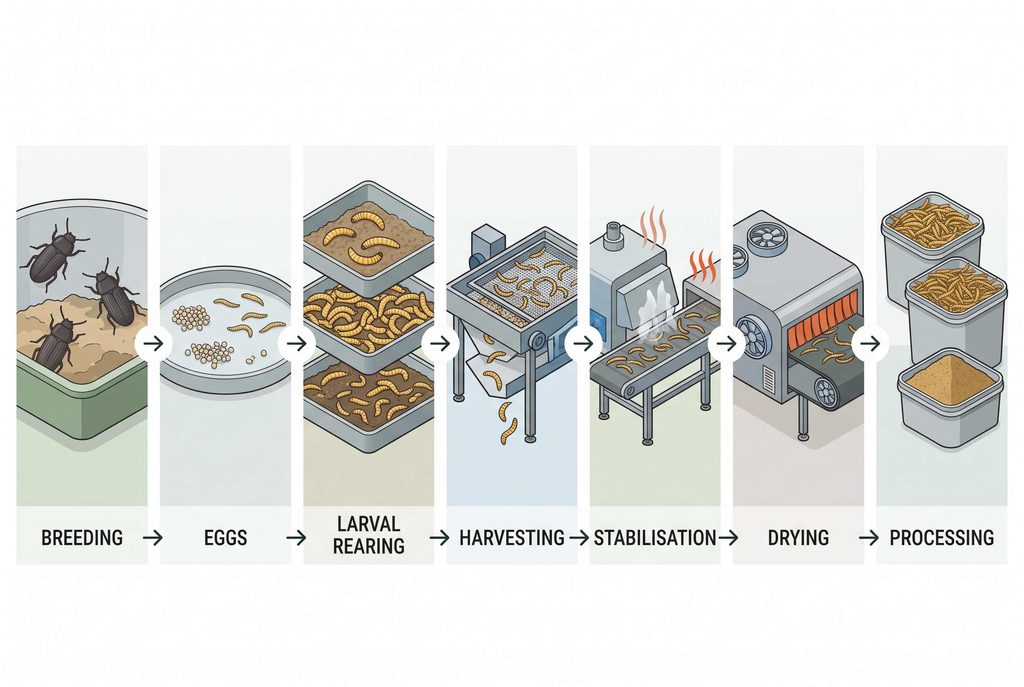
The production chain can therefore be simplified as:
Performance at one stage can influence the rest of the system. High larval output, for example, provides limited commercial value if harvesting or drying capacity cannot process the biomass efficiently.
1. Breeding Establishes the Production Cycle
Commercial production starts with adult darkling beetles rather than marketable larvae. Selected insects are allowed to progress through pupation to adulthood, after which breeding beetles mate and females lay eggs that begin the next production cycle.
A commercial facility therefore cannot direct its entire larval population toward sale. Part of the population must remain within the reproductive system to maintain future output, creating a continuous relationship between current harvest volume and future breeding capacity.
Managing this breeding population becomes increasingly important as production scales. Egg output, reproductive performance, and the timing of different cohorts influence how evenly larvae enter the rearing system, which in turn affects facility utilisation and harvesting schedules.
2. Egg Management Connects Breeding With Larval Production
Mealworm eggs are small and need to be managed separately from larger larvae and adult beetles. Production systems therefore require methods for collecting or separating eggs and transferring them into appropriate conditions for hatching and early larval development.
At small scale, these operations can rely heavily on manual handling. Industrial systems increasingly benefit from standardised trays, sieving systems and controlled movement between production stages because labour requirements rise rapidly when thousands of individual rearing units must be managed.
Consistency at this stage helps create more predictable production cohorts. If egg collection and hatching become irregular, variation can move downstream into larval size, harvesting schedules, and overall facility throughput.
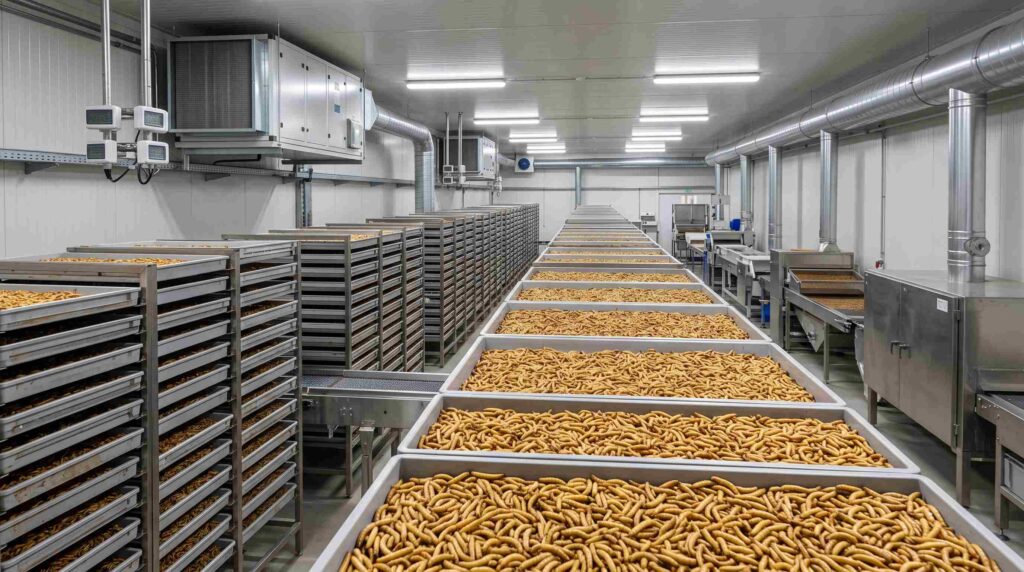
3. Larval Rearing Is the Core Biomass-Production Stage
The larval stage is where most commercially valuable biomass is created. Larvae consume feed, grow through successive developmental stages, and are eventually harvested before completing the transition to pupae and adult beetles.
Commercial rearing typically takes place within controlled environments where producers manage temperature, humidity, feed availability, stocking conditions, and production timing. Research on mass rearing shows that these environmental and dietary variables can materially affect growth, survival, and production performance.
For industrial producers, the objective is not simply maximum biological growth. The more relevant goal is repeatable production that delivers sufficiently uniform larvae on a predictable schedule while controlling labour, feed, space and energy requirements.
4. Feed Management Affects More Than Growth
Feed is one of the central inputs in commercial mealworm farming. Cereal-based materials and other permitted feed ingredients are commonly used, while moisture may be supplied through appropriate supplementary materials depending on the production system.
Substrate composition can influence growth performance, biomass yield, and aspects of larval composition. A 2026 review of alternative substrates likewise found substantial interest in how feed choice affects survival, growth and nutritional characteristics of T. molitor.
This makes feed management both a biological and commercial decision. Producers need to consider cost, availability, consistency, and regulatory suitability alongside growth performance, particularly when the resulting larvae are destined for regulated food or feed markets.
5. Environmental Control Supports Production Consistency
Temperature and humidity affect mealworm development, which makes environmental management an important component of industrial production. Commercial facilities may use controlled production rooms, ventilation, and monitoring systems to maintain conditions appropriate for different life stages.
Greater environmental control can improve production predictability, but it also introduces energy and infrastructure requirements. A production system therefore needs to balance biological performance with the cost of maintaining controlled conditions across a large rearing area.
This becomes especially relevant when facilities expand vertically through stacked trays or other high-density systems. More biological production per square metre can improve space utilisation, but it also increases the importance of airflow, heat management, monitoring and reliable material handling.
6. Production Systems Need to Separate Different Life Stages
A mealworm farm contains several biological populations simultaneously: eggs, larvae of different ages, pupae and adult beetles. These groups perform different functions and cannot simply be managed as one continuous mass.
Commercial operations therefore use separation and sorting steps to direct insects toward either reproduction or harvest. The 2024 review of industrial insect-rearing methods describes larval separation for production and pupal separation for reproduction as distinct components of the basic mealworm-rearing system.
As production volume increases, separation can become an important automation opportunity. Sieving, mechanical handling and standardised production units can reduce repetitive manual work while helping maintain more consistent movement through the production cycle.
7. Harvesting Marks the Transition From Farming to Processing
Larvae intended for commercial products are harvested at an appropriate stage before they continue into pupation. At this point, the production process begins to shift from biological farming toward food or feed processing.
Harvesting generally requires separating larvae from remaining feed material, frass, and other residues. The required level of cleaning and sorting depends partly on the final product because whole dried larvae place greater emphasis on visible cleanliness and physical appearance than products destined for subsequent milling.
Harvest timing also affects production flow. If large quantities of larvae reach harvest simultaneously without sufficient downstream capacity, the bottleneck can move from the farm into stabilisation, drying or storage.
8. Stabilisation Is a Critical Post-Harvest Step
Freshly harvested larvae contain substantial moisture and remain biologically and microbiologically unstable. Commercial production therefore requires a controlled transition from live biomass into a stable material suitable for further processing.
Common approaches described in the scientific literature include heat treatment, blanching, freezing or related stabilisation methods. Processing reviews emphasise that these stages can influence microbial control, enzyme activity and subsequent product characteristics.
The appropriate method depends on the intended product and production system. A producer selling dried whole larvae may prioritise appearance and physical integrity differently from a manufacturer preparing mealworms for milling, defatting or ingredient extraction.
9. Drying Converts Perishable Biomass Into a Stable Product
Drying is one of the most important processing stages because fresh larvae have high moisture content and are susceptible to microbial and biochemical deterioration. Removing sufficient water improves storage stability and makes transportation and further processing more practical.
Several technologies can be used, including hot-air or oven drying, freeze-drying, microwave processing, and other industrial methods. These approaches differ in equipment requirements, energy consumption, processing time, and their effects on final product characteristics. Reviews of insect processing therefore treat drying as both a preservation step and a product-quality decision.
There is no universally superior method for every market. Freeze-drying may preserve some desirable characteristics but carries different economics from conventional thermal drying, while newer research continues to show that processing choice can alter oxidative and nutritional outcomes in mealworm-derived products.
10. Processing Determines the Final Commercial Product
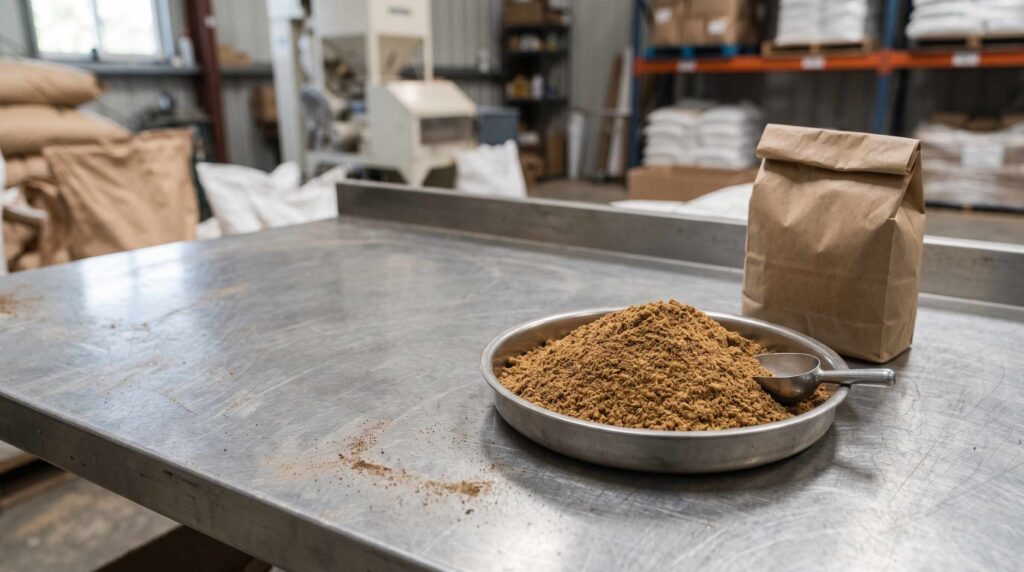
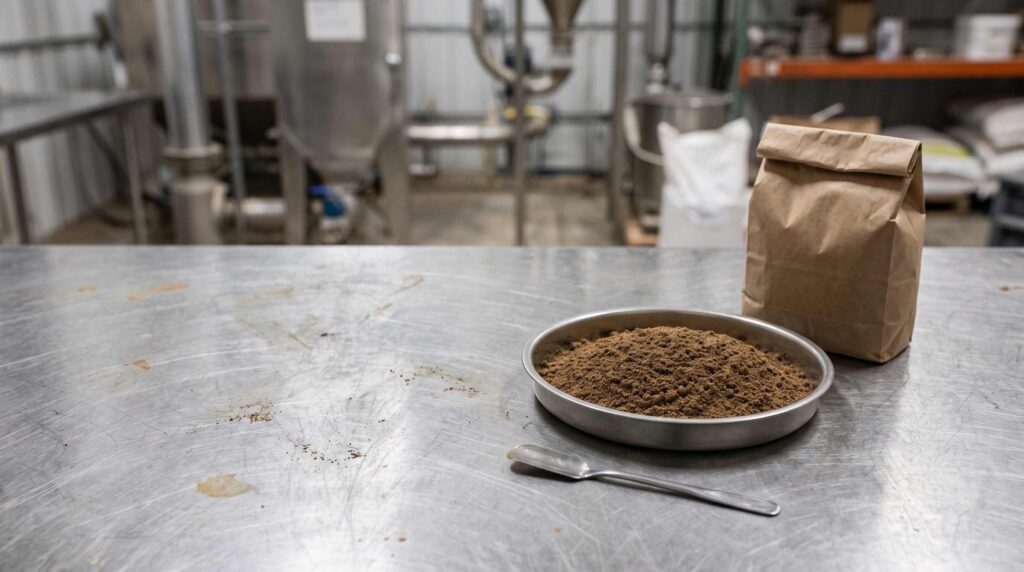
After stabilisation and drying, mealworms can enter different product streams. Whole dried larvae may be sorted and packaged directly, while other material can be ground into full-fat meal or undergo additional fractionation.
Further processing can include milling, pressing, defatting, and protein or lipid separation. Reviews of T. molitor processing describe both conventional thermal and mechanical methods and more advanced extraction technologies, reflecting the industry’s movement from simple insect farming toward ingredient manufacturing.
The resulting production pathways can be represented as:
Processing strategy therefore determines which customers a facility can serve as much as its farming capacity does.
11. Quality Control Runs Through the Entire Production Chain
Quality control cannot be added only after processing. Feed inputs, rearing conditions, hygiene, harvesting, thermal treatment, drying and storage can all influence the characteristics of the final product.
Microbiological control is particularly important because untreated insects can carry substantial microbial loads. A 2025 systematic review of 64 studies on farmed and processed T. molitor identified microbiological safety as a significant consideration for food and feed applications, confirming the importance of appropriate hygienic and processing controls.
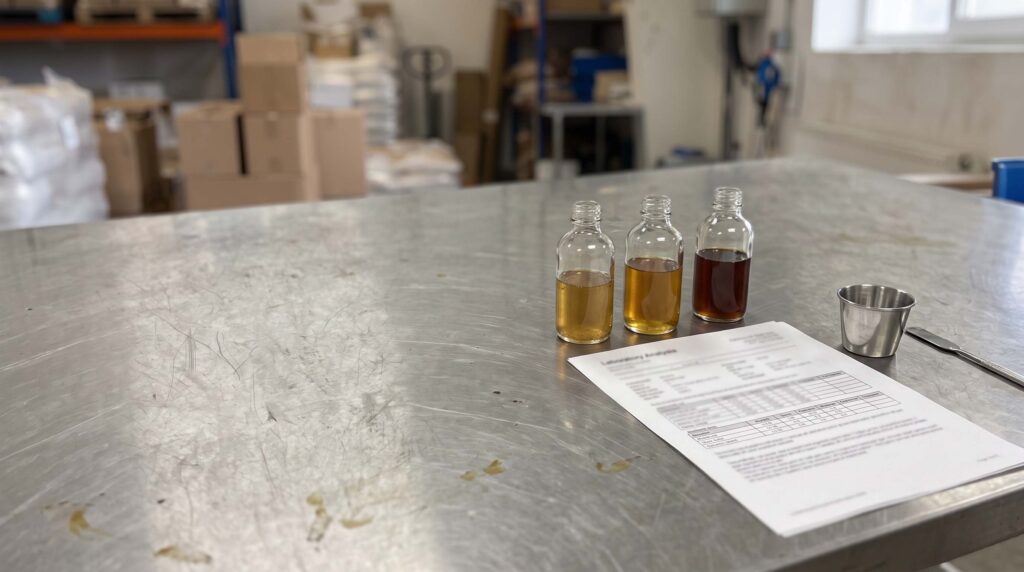
Commercial buyers may also require information on moisture, protein, fat, microbiological parameters, or other specifications depending on product and market. Production consistency therefore means not only producing similar quantities from one cycle to another, but also delivering batches that remain within acceptable commercial specifications.
12. Automation Becomes More Important as Production Scales
Small mealworm farms can rely heavily on manual tray movement, feeding, separation and harvesting. That model becomes progressively harder to maintain as production volume increases because repetitive handling creates substantial labour requirements.
Industrialisation can therefore involve automated feeding, environmental monitoring, mechanical sieving, tray transport and other material-handling systems. Automation does not eliminate the biological variability in insect production, but it can improve throughput and reduce the labour required for repetitive production tasks.
The commercial value of automation depends on scale. Highly automated equipment adds to capital costs, so producers need sufficient utilisation and output to justify the investment, rather than assuming that more automation automatically yields better economics.
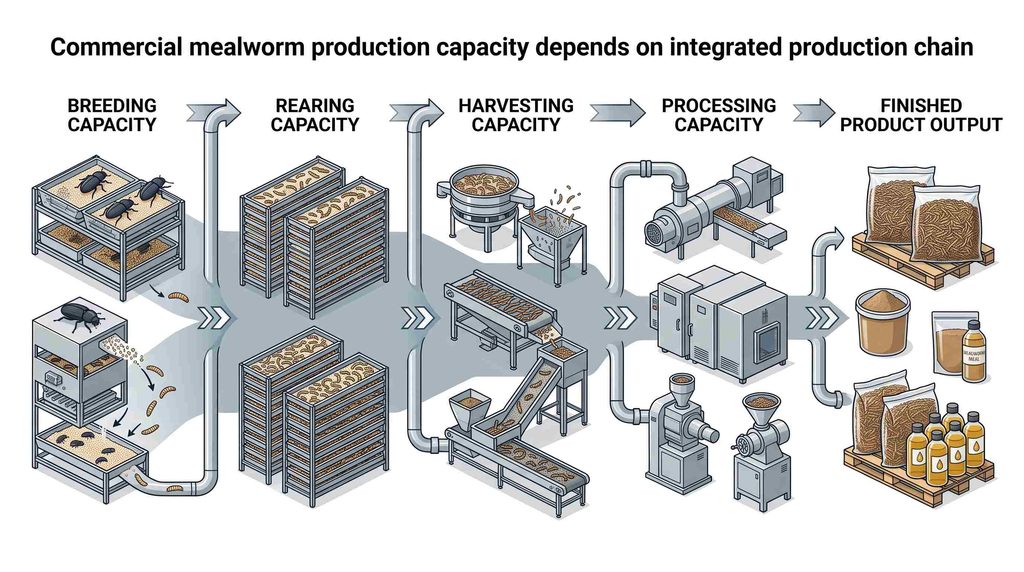
13. Production Capacity Depends on the Entire System
A mealworm facility’s output cannot be understood from rearing space alone. Breeding capacity, egg production, larval performance, harvesting, drying, processing, storage and labour all contribute to the amount of finished product that can actually reach customers.
This creates an important distinction between theoretical production capacity and operational output. Increasing the number of rearing trays will not proportionally increase saleable production if drying or processing equipment is already operating at its limit.
For IIR, commercial capacity is therefore better viewed as a chain:
The effective capacity of the facility is ultimately constrained by the weakest stage in that chain.
14. Scaling Mealworm Production Requires Process Integration
Scaling from a small farm into an industrial operation involves more than replicating additional trays. Biological production needs to be integrated with environmental systems, feed logistics, labour, automation, harvesting and downstream processing.
This integration also changes how producers manage risk. A disruption in breeding can affect future cohorts, while problems in environmental control can influence large quantities of larvae simultaneously. Processing interruptions can create another bottleneck when harvested biomass cannot be stabilised or dried quickly enough.
Industrial mealworm production is therefore best understood as a coordinated manufacturing system built around a biological organism. Scale becomes commercially meaningful only when each production stage can support the throughput of the stages around it.
IIR Analysis
Commercial mealworm farming appears relatively straightforward when reduced to its biological cycle, but industrial production is more complex. Breeding beetles, eggs, larvae, harvesting and processing operate on different timelines, and each stage needs sufficient capacity to prevent disruption elsewhere in the system.
The transition from farming to processing is particularly important. Once larvae are harvested, stabilisation, drying and downstream processing determine whether the biomass becomes a whole dried product, full-fat meal or a more specialised ingredient. Recent processing research also reinforces that these decisions can affect nutritional and oxidative characteristics rather than functioning merely as preservation steps.
For industry analysis, the most useful measure of production capability is therefore not simply the number of trays, the size of a facility or announced annual capacity. The stronger indicator is whether the complete system can repeatedly convert breeding output into commercially acceptable finished products.
That distinction will become increasingly important as the mealworm sector moves from relatively fragmented specialty production toward more automated and industrialised supply.
Disclaimer: This article is for informational purposes only and does not constitute business, legal or investment advice. Always consult primary sources and qualified professionals.