Independent intelligence for the global insect industryISSUE 01 · 2026
Mealworm Industry: Market, Production and Commercial Applications
By IIR Editorial DeskSeptember 24, 2026
This analysis examines the commercial mealworm industry, from Tenebrio molitor farming and processing to market demand, major applications and the constraints shaping industrial-scale production. By IIR Editorial Desk · September…
This analysis examines the commercial mealworm industry, from Tenebrio molitor farming and processing to market demand, major applications and the constraints shaping industrial-scale production.
By IIR Editorial Desk · September 24, 2026 · Market Intelligence
The Mealworm Industry Is Moving Beyond a Single Market
The mealworm industry has developed around one of the most established insects in commercial farming: the yellow mealworm, Tenebrio molitor. Mealworms have long been sold into bird, reptile, pet and specialty animal markets, while industrial producers and researchers have increasingly explored animal feed, aquaculture, pet food and human food applications.
This gives the sector a different commercial profile from insect industries built primarily around a single feed ingredient. Mealworms can be sold as whole larvae, dried products, full-fat meal, defatted protein ingredients or other processed fractions, allowing the same species to participate in markets with very different volumes, specifications and pricing structures.
Recent research reflects this breadth. T. molitor is widely studied for food and feed applications, while commercial production increasingly involves controlled farming and post-harvest processing designed to deliver consistent products. For industry analysis, the key question is therefore no longer simply whether mealworms can be farmed commercially, but whether producers can scale production and processing while matching each output with a viable market.
1. Tenebrio molitor Is the Industry’s Core Commercial Species
“Mealworm” can be used broadly, but Tenebrio molitor is the species at the centre of the commercial yellow mealworm industry discussed here. Its larval stage is the principal commercial product and can be harvested for sale as a whole insect or processed into different ingredient forms.
The species has attracted extensive research because its protein and lipid content creates opportunities across both food and feed markets. This places the industry in two overlapping commercial models: one in which the mealworm remains a recognisable finished product, and another in which the insect becomes industrial biomass for further processing.
Those models require different production and sales strategies. Whole dried mealworms may compete on appearance, cleanliness, size and physical integrity, while processed ingredients are more likely to be evaluated through nutritional specifications, functionality, consistency and price
2. Commercial Mealworm Production Is Becoming More Industrialised
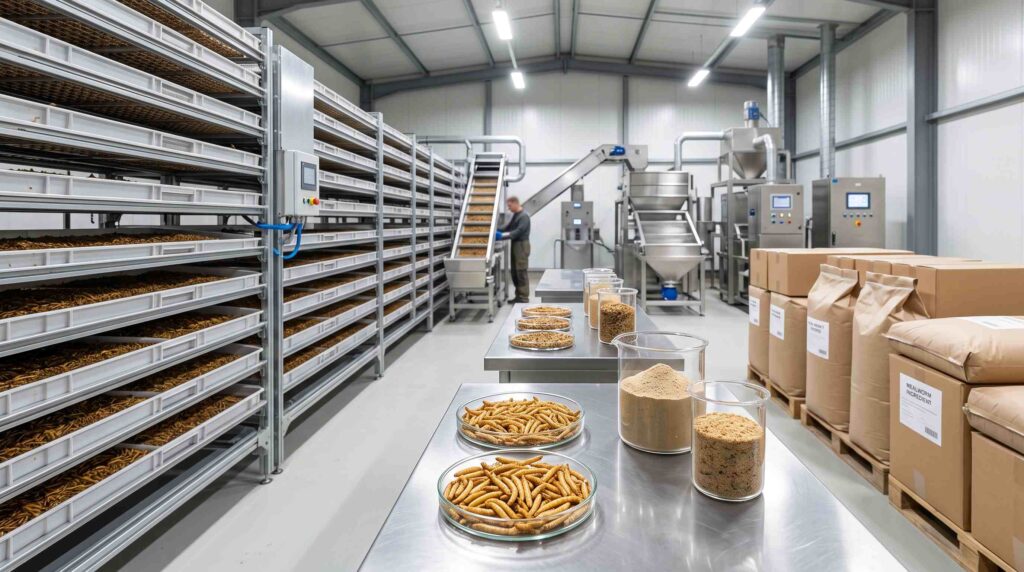
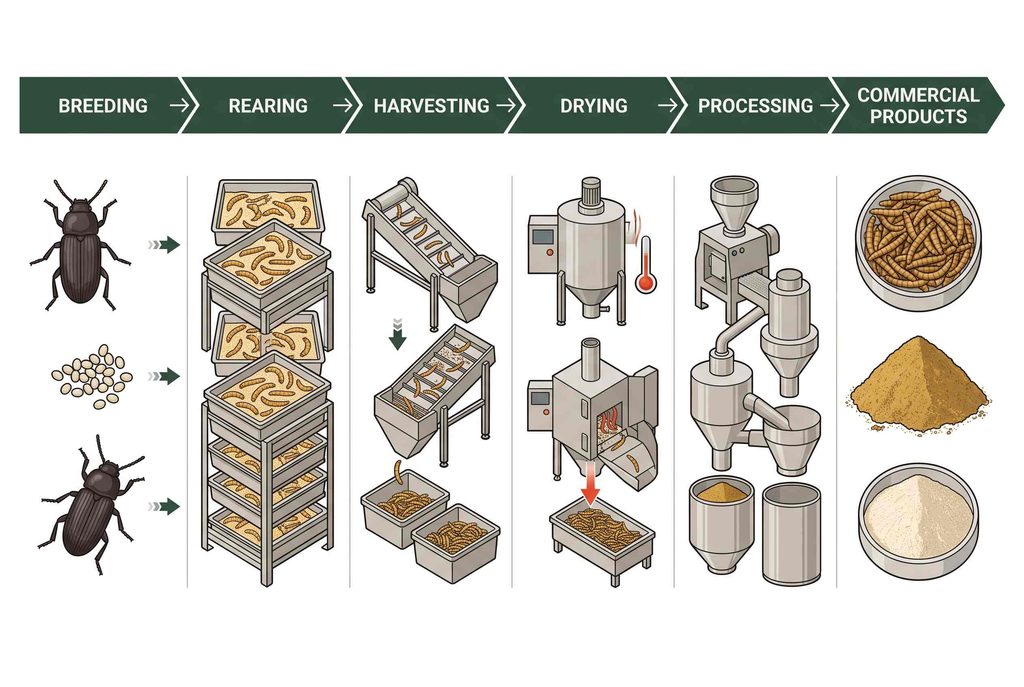
Commercial production begins with maintaining breeding beetles and a reliable reproductive population. Eggs develop into larvae that are typically reared in controlled environments, with producers managing temperature, humidity, stocking density, feed availability and harvesting schedules.
The underlying biological cycle is well understood, but industrial scale introduces a different set of challenges. Large operations must coordinate breeding, larval growth, material handling, environmental control, harvesting and processing across repeated production cycles, while automation becomes increasingly important as manual handling creates labour and throughput constraints.
Commercial performance therefore depends less on whether mealworms can grow and more on whether the production system can repeatedly generate predictable quantities of suitable biomass. That distinction becomes especially important when comparing a facility’s theoretical or announced capacity with its actual commercial output.
3. Feed Inputs Influence Both Production and Product Characteristics
Mealworm production depends on the relationship between the insect and its feed. T. molitor can be reared on a range of suitable materials, but substrate composition and rearing conditions can influence growth performance as well as nutritional characteristics.
Research on yellow mealworms as animal-feed ingredients has found that nutritional composition can vary with feed supply, environmental conditions and post-harvest processing. Commercial operators therefore need to consider both biological performance and the consistency of the resulting product rather than treating feed simply as an input cost.
There is also a regulatory dimension. Feed materials need to comply with the rules associated with the intended market, particularly when mealworm farming is presented as part of a circular-economy model. A material capable of biologically supporting larvae is not automatically an authorised commercial feed input in every jurisdiction.
Feed strategy consequently affects production performance, cost, product composition and market access at the same time.
4. Processing Determines What the Producer Can Sell
Harvested mealworms can follow several commercial processing routes. Whole larvae may be killed, stabilised and dried for bird, reptile, pet and specialty-feed markets, while other producers may grind dried larvae into meal or introduce additional processing such as defatting, protein separation or ingredient formulation.
Processing affects more than product appearance. Killing, drying and downstream processing can influence microbial condition, protein and lipid characteristics, storage stability and the specifications available to commercial buyers. As processing becomes more sophisticated, the producer increasingly moves from insect farming toward ingredient manufacturing.
The resulting product chain can be simplified as:
Whole Larvae → Dried Whole Product
Larvae → Drying → Full-Fat Meal
Larvae → Further Processing → Protein-Rich Fraction + Lipid Fraction
Each route serves different buyers. Processing technology therefore determines not only what leaves the factory, but also which commercial markets the producer can realistically enter.
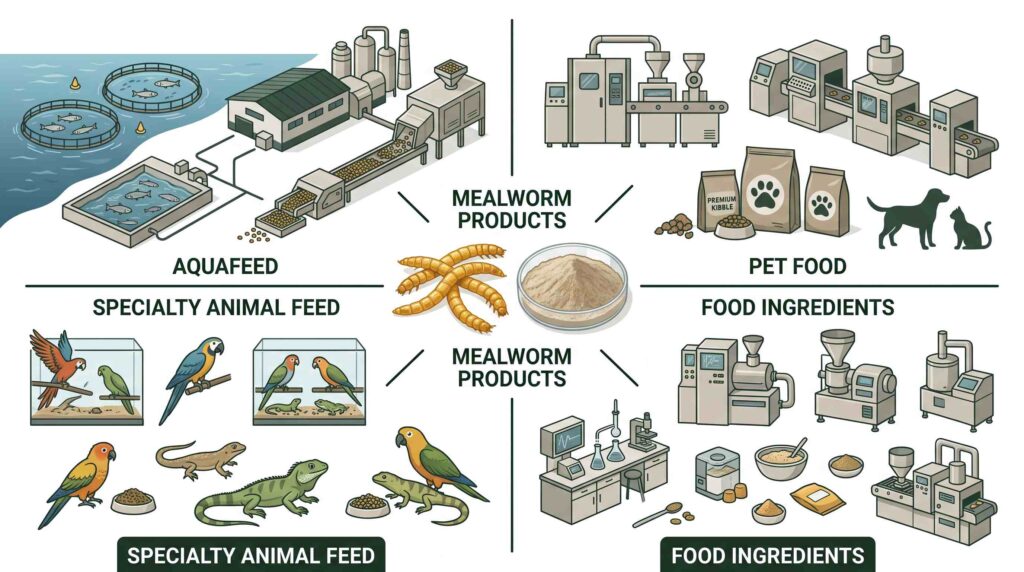
Whole mealworms have an established role in specialty animal nutrition, including bird, reptile, ornamental fish and other pet-related applications. These markets differ substantially from industrial feed manufacturing because the insect often remains visible in the finished product.
As a result, buyers may place greater emphasis on physical characteristics such as whole-product integrity, size, colour, cleanliness and moisture condition. Distribution is also more fragmented, with products potentially moving through importers, wholesalers, specialty-feed businesses, pet brands and retailers rather than directly from a large insect producer to a feed mill.
Although specialty animal markets may be smaller than mainstream livestock feed, they remain commercially relevant because whole mealworms can function as a finished product rather than merely as a commodity protein input. That can create a different value structure from bulk feed ingredients.
6. Aquafeed Creates a Larger Ingredient Opportunity
Aquaculture represents one of the most researched feed applications for T. molitor. Mealworm meal has been evaluated in formulations for multiple fish and aquatic species as researchers investigate alternatives or supplements to conventional protein ingredients such as fishmeal.
The potential market is considerably larger than the traditional whole-insect specialty segment, but commercial requirements are also more demanding. Aquafeed manufacturers evaluate nutritional performance, digestibility, specification consistency, regulatory status, available volume and price relative to established ingredients.
This distinction is important. Evidence that mealworm meal can work nutritionally does not automatically mean it is commercially competitive at industrial scale. Demand ultimately depends on whether the ingredient can deliver an acceptable combination of performance, specification, availability and price.
7. Poultry and Other Feed Markets Expand the Demand Base
Mealworm ingredients have also been investigated for poultry and other production animals. Their protein, lipid and amino-acid characteristics make them relevant to research into alternative feed ingredients, potentially expanding the addressable market beyond aquaculture.
These sectors offer substantial potential volume, but they also create stronger price pressure. A specialty pet product may support a higher ingredient cost because the insect contributes to product differentiation, whereas mainstream livestock feed operates under much tighter formulation economics.
For mealworm producers, nutritional suitability is therefore only the starting point. Accessing high-volume feed markets also requires reliable production, consistent specifications and unit economics that can be justified against established protein sources.
8. Pet Food Offers a Different Value Proposition
Pet food sits between specialty whole-insect markets and industrial feed. Mealworm protein can function as an animal-derived ingredient while supporting product differentiation around novel proteins, alternative nutrition and sustainability positioning.
This creates a commercial model in which value is not determined solely by crude protein content or commodity pricing. Pet-food manufacturers may evaluate ingredient functionality, consumer positioning, formulation requirements and supply consistency together, potentially creating opportunities for producers that cannot compete directly with conventional feed proteins on price.
Claims still require caution. The use of mealworm protein does not automatically establish that a finished product is hypoallergenic or provides a particular health benefit. Those conclusions depend on the formulation, supporting evidence and the regulatory requirements governing the final product.
9. Human Food Creates a Distinct Market Path
One feature differentiating the mealworm industry from several other insect sectors is its development as a human-food ingredient. In Europe, Tenebrio molitor has been assessed and authorised in specified forms under the EU Novel Food framework, creating a regulated pathway distinct from animal-feed applications.
Mealworm-derived ingredients have been investigated for snacks, bakery products, pasta and other formulated foods, while processing can also create protein- and lipid-rich fractions. This expands the industry’s theoretical customer base beyond animal nutrition.
Technical approval, however, does not guarantee consumer demand. Sensory characteristics, allergen considerations, labelling, cultural acceptance and price can all affect commercial adoption. Human food should therefore be analysed as a separate market segment rather than treated as an automatic extension of feed demand.
10. Food and Feed Safety Remain Central to Scale
Industrial growth requires repeatable safety controls throughout production and processing. Research into farmed and processed T. molitor has identified microbiological hazards as an important consideration, while appropriate thermal treatment and hygienic processing can play a role in controlling microbial risk.
At commercial scale, safety therefore extends across the production chain:
The exact control system depends on product form and destination market. A whole dried product, feed ingredient and human-food ingredient do not necessarily face identical specifications or regulatory requirements.
For buyers, supplier capability is consequently determined by more than protein content or production volume. Traceability, process control, documentation and batch consistency become increasingly important as mealworms move into regulated ingredient markets.
11. Production Capacity Is Not the Same as Market Supply
Industrial insect projects are often described through facility size or planned production capacity, but those numbers require careful interpretation. A facility may have substantial installed or nameplate capacity while operating below that level during commissioning or commercial ramp-up.
Biological performance, labour, automation, harvesting efficiency and processing throughput can all influence realised output. Mealworm production also needs to remain aligned with downstream operations; increasing larval biomass without sufficient drying, processing or storage capacity can simply move the bottleneck to another stage.
IIR therefore distinguishes between:
Announced Capacity → Operational Capacity → Actual Production → Commercially Delivered Volume
For market analysis, actual production and commercially delivered volume are generally more informative than factory design capacity alone because they better reflect the amount of product available to customers.
12. Market Structure Varies by Product Form
There is no single commercial market for mealworms. Whole dried larvae serve a different customer base from protein meal, while feed ingredients compete under different economics from human-food products. Premium pet applications also differ substantially from aquaculture or livestock feed.
The mealworm industry is therefore better understood as several connected product markets built around the same insect species:
Whole Mealworms → Bird / Reptile / Specialty Feed
Mealworm Meal → Aquafeed / Livestock Feed / Pet Food
The ability to serve multiple markets can diversify demand, but it also increases processing, regulatory and sales complexity. Producers need to decide which product forms best match their production economics and customer base rather than assuming that every output can serve every market.
13. Economics Will Determine How Far the Industry Can Scale
Technical feasibility alone will not determine the industry’s trajectory. Commercial producers need to balance feed cost, labour, energy, facility utilisation, processing expenditure and logistics against the value of the products they sell.
The challenge becomes more pronounced when targeting high-volume feed markets because conventional ingredients benefit from mature global supply chains and enormous production scale. Mealworm protein therefore needs either to become more cost competitive or deliver additional value that justifies a premium.
Higher-value pet, specialty-feed and food applications provide another route. Producers may choose to scale toward larger commodity-like ingredient markets, concentrate on smaller markets capable of supporting higher product value, or use different product streams to participate in both.
14. Regulation Shapes the Addressable Market
Regulatory approval determines which theoretical applications can become commercial markets. Requirements vary by geography, product form and intended use, while food, aquaculture feed, livestock feed and pet food do not necessarily follow the same regulatory pathway.
This is particularly important for internationally traded mealworm ingredients. A product manufactured legally in one country is not automatically authorised for the same use in another market. Commercial producers therefore need to align:
Species → Feed Input → Processing → Product Form → Application → Destination Market
Regulatory capability is consequently part of market strategy rather than an administrative step after production. For producers seeking international customers, understanding the destination market can be just as important as developing the ingredient itself.
What Could Drive the Next Stage of the Mealworm Industry?
Several factors will influence the industry’s next phase. Automation could reduce labour intensity and improve throughput, while better control of breeding and rearing could increase biological consistency. Processing improvements could also create more standardised protein and lipid ingredients.
Demand development will matter just as much. Aquafeed and livestock markets offer potential volume, while pet food, specialty animal nutrition and human food can support different value propositions. Greater production does not guarantee commercial success if producers cannot secure customers at sustainable prices.
The next stage of industry development will therefore depend on how effectively companies connect production scale with product-market fit. Expansion is more likely to be commercially meaningful when additional capacity is supported by repeat customers, appropriate processing capability and regulatory access.
IIR Analysis
The mealworm industry has an unusual advantage within the broader insect sector: Tenebrio molitor can participate in both recognisable whole-insect markets and more industrialised ingredient markets. That provides diversification, but it also makes the commercial structure more complex.
Production and processing strategy need to match the intended end market. Whole dried mealworms, feed meal, protein fractions and human-food ingredients cannot be evaluated as if they were interchangeable products because buyers assess different specifications, prices and regulatory requirements.
For IIR, the most useful indicators of industry development are therefore not simply the number of mealworm farms or announced factory capacity. More meaningful signals include actual production, processing capability, regulatory market access, repeat commercial demand and the ability to deliver consistent products at viable economics.
As the sector matures, companies that connect these elements successfully will provide a clearer indication of the industry’s commercial development than capacity announcements alone.
Disclaimer: This article is for informational purposes only and does not constitute business, legal or investment advice. Always consult primary sources and qualified professionals.