Evaluating North American insect leaders. How EnviroFlight and Beta Hatch pioneer commercial BSFL and mealworm production across the United States.
Evaluating North American insect leaders. How EnviroFlight and Beta Hatch pioneer commercial BSFL and mealworm production across the United States.
Published: September 2026 | Fact-checked by: IIR Research Team | Industry Analysis: IIR Company Watch
While the European bioconversion sector captured global financial headlines in the early 2020s through massive sovereign subsidies and record venture capital rounds, the North American market quietly charted a divergent, engineering-driven course. Confronted with a decentralized feed regulatory architecture governed jointly by the United States Food and Drug Administration (FDA) Center for Veterinary Medicine and individual state feed control officials, commercial pioneers in the US built operations around regional agricultural pragmatism. Today, a comparative operational analysis of premier North American insect companies—most prominently EnviroFlight and Beta Hatch—provides international buyers with vital market intelligence on domestic manufacturing capabilities, feedstock sourcing strategies, and ongoing commercial supply constraints.
For corporate procurement directors, animal feed formulators, and pet food brand managers worldwide, studying the evolution of these ventures offers valuable strategic insights. While US production guarantees unmatched domestic regulatory compliance and supply chain transparency, total domestic manufacturing volume remains heavily constrained. Understanding why these flagship producers cannot meet surging domestic demand is essential for procurement teams designing resilient global sourcing networks.
1. Facility Architecture and Engineering Approaches of North American Insect Companies
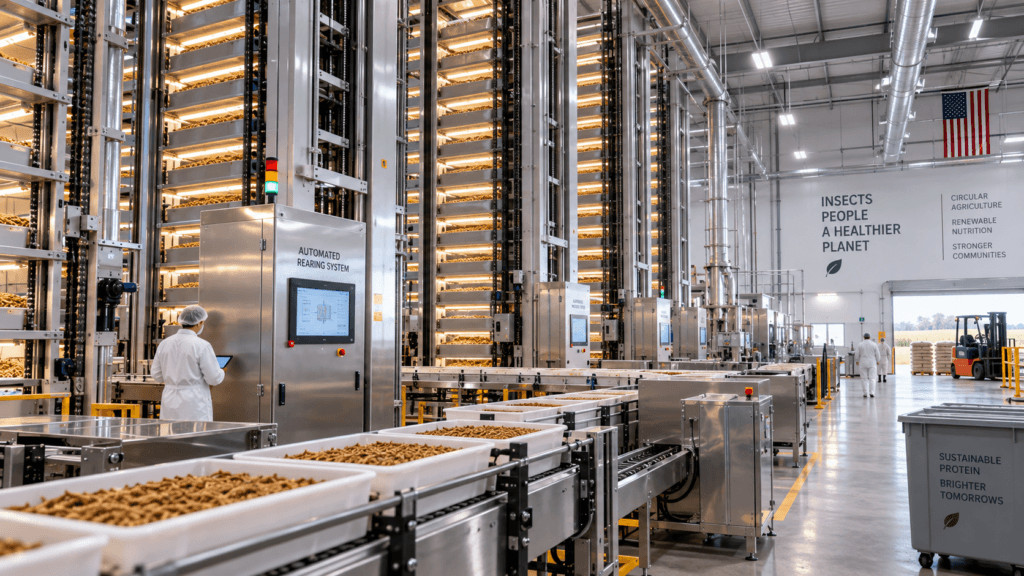
The physical engineering of bioconversion plants in North America reflects a deliberate departure from the towering vertical megasites often constructed in Western Europe. Instead of committing hundreds of millions of dollars to unproven ultra-dense vertical silos, top North American insect companies prioritized modular, horizontal, and climate-integrated facility designs:
EnviroFlight, established in 2007 and later integrated into Darling Ingredients, situated its primary commercial facility in Maysville, Kentucky. The selection of this specific location was guided by logistical synergy rather than urban land optimization. By positioning its industrial facility in the heart of the Ohio River Valley, EnviroFlight gained direct physical access to major midwestern grain processing corridors, commercial distilleries, and established animal feed distribution channels.
From an engineering perspective, EnviroFlight standardized its processing lines around the Black Soldier Fly Larva (Hermetia illucens). The Maysville plant relies on modular horizontal rearing bays designed to optimize airflow, metabolic heat dissipation, and automated larval feeding. Rather than utilizing experimental robotics, the facility implements rugged, proven industrial conveyor belts, mechanical dewatering units, and continuous thermal drying systems. This pragmatic engineering stance minimized unbudgeted equipment downtime and accelerated the plant’s timeline to consistent commercial-scale manufacturing.
In contrast, Beta Hatch, based in Cashmere, Washington, adopted an alternative technological architecture focused entirely on the Yellow Mealworm (Tenebrio molitor). Rearing mealworms presents distinctly different thermodynamic and mechanical challenges compared to rearing fly larvae. Mealworms require dry granular substrates, longer life cycles, and careful management of environmental moisture.
To overcome the elevated operational expenditures (OpEx) associated with long rearing periods, Beta Hatch engineered a specialized vertical microclimate facility. Crucially, the company integrated its thermodynamic infrastructure with neighboring industrial operations. By capturing waste industrial heat directly from adjacent data centers and regional fruit cold-storage facilities, Beta Hatch significantly offset the electrical heating demands required to maintain optimal mealworm developmental chambers throughout the Pacific Northwest winter. This industrial colocation philosophy allowed the facility to produce high-protein mealworm meal, whole dried larvae, and organic frass fertilizer while keeping thermal energy expenditures under tight operational control.
2. Regulatory Groundwork: Leading the AAFCO Feed Ingredient Approvals
Beyond physical engineering, the most defining contribution made by these flagship North American insect companies has been paving the federal and state regulatory pathways for the broader agricultural sector. In the United States, commercial animal feed ingredients do not operate under a blanket classification system. Every insect species, downstream processing technique, and target livestock category requires rigorous toxicological evaluation and explicit ingredient definitions vetted through the Association of American Feed Control Officials (AAFCO) and the FDA:
EnviroFlight spearheaded this decade-long regulatory campaign, serving as the lead petitioner on numerous landmark safety dossiers. Through controlled feeding trials evaluating animal performance, pathology, and heavy metal tissue bioaccumulation, EnviroFlight systematically secured historic AAFCO ingredient definitions for Black Soldier Fly ingredients:
- Aquaculture: Formal authorization of defatted and whole BSFL meal across commercial salmonid rations and all marine finfish diets.
- Poultry Production: Securing legal inclusion thresholds for dried BSFL biomass across commercial broiler chicken operations and laying hen feed lines.
- Swine Nutrition: Approval for mechanical BSFL ingredients in nursery and starter pig diets to support early-stage gut development.
- Companion Animals: Gaining recognized definitions for adult canine complete formulations and functional pet treats.
Concurrently, Beta Hatch advanced independent scientific reviews to validate the safety and nutritional efficacy of yellow mealworm biomass within North American companion animal diets. Because commercial pet food brands cannot distribute products across interstate retail channels without formal AAFCO feed definitions, the regulatory investments made by these US pioneers transformed insect bioconversion from an unverified novelty into a legally validated, mainstream feed ingredient category.
3. Feedstock Sourcing Models and Regional Supply Chain Dynamics
A core determinant of long-term viability for North American insect companies is their approach to substrate procurement. While theoretical models frequently suggest rearing insects on post-consumer food scrap slops or municipal organic waste, US federal feed safety regulations impose strict guardrails on allowable substrates:
Under the Food Safety Modernization Act (FSMA) Preventive Controls for Animal Food regulations, commercial facilities must ensure that insect rearing substrates are fully traceable, pathogen-free, and devoid of unapproved chemical residues. Both EnviroFlight and Beta Hatch built their procurement protocols around standardized agro-industrial co-products:
- Distillery Grains and Bakery Co-Products: EnviroFlight sources standardized spent brewer’s grains, distillers dried grains with solubles (DDGS), and surplus commercial bakery residuals. Because these streams are derived from food-grade cereal processing, they exhibit highly consistent protein, carbohydrate, and moisture levels. This consistency prevents nutritional fluctuations across finished meal batches while eliminating heavy metal contamination risks.
- Cereal Brans and Fruit Co-Products: Beta Hatch leverages regional agricultural streams across Washington State, combining clean wheat bran with verified fruit processing by-products. This high-fiber, low-moisture diet aligns with the natural digestive physiology of mealworms, ensuring rapid larval growth without introducing excess humidity that could trigger mold or bacterial issues.
4. The Commercial Reality: Persistent Supply Deficits and Import Demand
Despite the technical milestones achieved by these domestic pioneers, global ingredient buyers and corporate formulators frequently encounter severe availability challenges when sourcing within North America:
First, available production volumes from established domestic plants are overwhelmingly locked up. Major multinational pet food conglomerates, recognizing the marketing appeal and clinical hypoallergenic benefits of novel insect proteins, have secured multi-year exclusive offtake contracts covering the vast majority of current US output. Spot-market availability is virtually non-existent, leaving mid-tier pet food brands and commercial aquafeed millers without domestic supply.
Second, the capital requirements and zoning timelines necessary to construct new bioconversion plants in North America remain steep. Securing industrial permits, installing specialized air filtration systems, and commissioning automated processing machinery require multi-year lead times. Domestic capacity expansions simply cannot keep pace with the exponential growth in commercial demand for insect-based pet kibble and specialized aquafeeds.
Finally, the unit economics of North American production remain positioned at the high end of the global spectrum. High regional labor costs, specialized construction CapEx, and ongoing regulatory compliance overhead mean that domestic defatted insect meals regularly command prices ranging between $4,000 and $6,000 per metric ton. While fully viable for high-margin veterinary pet treats and niche aquaculture starters, these price points make domestic insect meal difficult to justify in mainstream commercial livestock rations.
As alternative protein adoption accelerates toward 2027, international procurement directors must establish balanced, risk-mitigated supply chains that look beyond single geographic territories:
First, verify that your finished formulations align with domestic legal standards. Formulators targeting North American distribution should review our detailed analysis of global insect feed regulations to verify that their chosen ingredient species and target animal categories match current AAFCO and FDA-cleared definitions.
Second, bridge the domestic supply deficit through audited international partnerships. While domestic North American insect companies have successfully validated the nutritional science and regulatory legality of insect protein, securing scalable volume at competitive landed prices requires developing audited supplier relationships across specialized Asian manufacturing corridors. When qualifying overseas bioconversion platforms, procurement directors should deploy our structured framework for evaluating an insect ingredient supplier to audit physical facility hygiene, HACCP systems, and Certificate of Analysis (COA) reliability.
Finally, track ongoing structural shifts across the broader animal feed ingredient sector to anticipate seasonal price fluctuations. By pairing the regulatory validation established by North American pioneers with the cost-effective volume delivered by audited overseas processors, feed manufacturers can secure high-grade insect protein at the commercial scale needed to protect product quality and profit margins.