Independent intelligence for the global insect industryISSUE 01 · 2026
How to Evaluate an Insect Ingredient Supplier: A Buyer’s Checklist
By IIR Editorial DeskSeptember 13, 2026
Looking for a reliable insect ingredient supplier? Use this B2B checklist to verify true production capacity, COAs, and global regulatory compliance.
As the commercial use of insect-based proteins scales up in animal feed and pet food globally, buyers face the complex challenge of distinguishing commercial-ready manufacturers from early-stage, heavily marketed startups. Evaluating an insect ingredient supplier requires a systematic, evidence-based approach focusing on baseline documentation, verifiable capacity, and batch consistency, rather than relying solely on promotional material or pilot-scale samples.
For procurement managers, formulators, and livestock producers, switching to a novel protein like Black Soldier Fly Larvae (BSFL) or Yellow Mealworms involves significant operational and financial risk. This checklist provides commercial buyers with a practical, step-by-step framework for assessing insect ingredient suppliers, ensuring that the supply chain is resilient, legal, and nutritionally consistent.
1. Verify Certifications and Baseline Documentation First The foundation of a reliable supply chain is verifiable quality and feed safety documentation. Before discussing pricing or initiating sample testing, buyers must audit the supplier’s baseline compliance.
Essential Feed Safety Certificates: A commercial-scale insect ingredient supplier should operate under internationally recognized quality management systems tailored for animal feed. The gold standard in this sector is GMP+ FSA (Feed Safety Assurance). Managed by GMP+ International, this certification integrates ISO quality management criteria with Hazard Analysis and Critical Control Point (HACCP) principles specifically for the feed industry. A GMP+ or ISO 22000 certification indicates that the facility has established strict hygiene, safety, and operational protocols, significantly reducing the risk of product recall due to contamination.
Navigating the Regulatory Shift (US & EU): Insect feed regulations are highly regional and constantly evolving. In the European Union, buyers must verify that the supplier is registered on the Trade Control and Expert System (TRACES) for importing animal by-products. In the United States, a major regulatory shift occurred recently. Historically, ingredients relied on the AAFCO (Association of American Feed Control Officials) ingredient definition process. However, as of late 2024, the MOU between the FDA and AAFCO expired. Now, new insect ingredients must navigate the FDA’s Animal Food Ingredient Consultation (AFIC) pathway, or rely on Generally Recognized as Safe (GRAS) notices and Food Additive Petitions (FAP). Buyers importing into the US must explicitly ask suppliers for their FDA facility registration and their current GRAS/AFIC status for the specific target animal.
2. Assess True Production Capacity and Feedstock Traceability A frequent bottleneck in insect ingredient procurement is the discrepancy between a company’s stated capacity in press releases and its actual output capability.
Planned Capacity vs. Actual Operational Output: The insect agriculture sector frequently announces large-scale funding for future facilities. However, buyers must strictly differentiate between “planned capacity” (future projections based on blueprint blueprints) and “operational capacity” (current monthly tonnage available for dispatch). When auditing a supplier, requesting historical shipment volumes or current monthly production metrics is essential to ensure the facility can reliably meet commercial Minimum Order Quantities (MOQs) without supply chain disruptions.
Feedstock Traceability (The Substrate Rule): The nutritional profile and safety of an insect are directly influenced by its diet (feedstock). Suppliers must be able to provide clear traceability records of their rearing substrate. The European Union strictly regulates feedstock, enforcing the rule that insects intended for animal feed can only be reared on substrates of vegetal origin or specific limited materials of animal origin (such as milk or eggs). It is strictly prohibited to feed commercial insects with catering waste, municipal solid waste, or meat and bone meal. The IPIFF (International Platform of Insects for Food and Feed) Guide on Good Hygiene Practices is the leading framework for ensuring substrate safety in the EU.
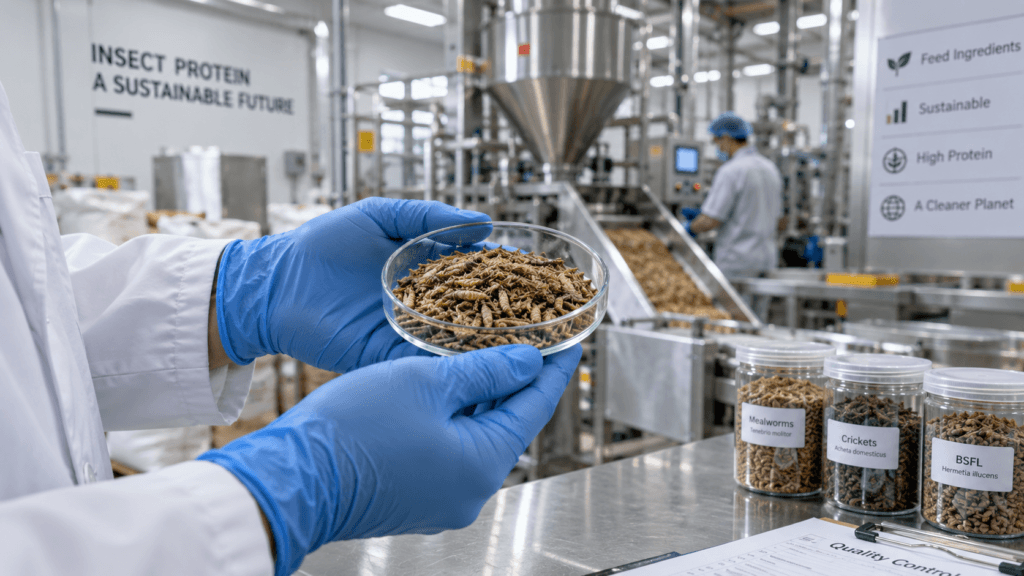
3. Evaluate Product Quality by Form and Reading the COA Insect ingredients are typically sold in three main forms: whole dried insects, insect meal (defatted or full-fat), and insect oil. Each requires a different evaluation matrix.
Form-Specific Metrics: When evaluating insect meal, the primary focus is on crude protein levels, crude fat, moisture, and ash content. For insect oil, the fatty acid profile—specifically the concentration of lauric acid (C12:0)—and Free Fatty Acid (FFA) levels indicate quality and shelf life. Whole dried insects are often evaluated on physical integrity, moisture content, and the absence of foreign matter.
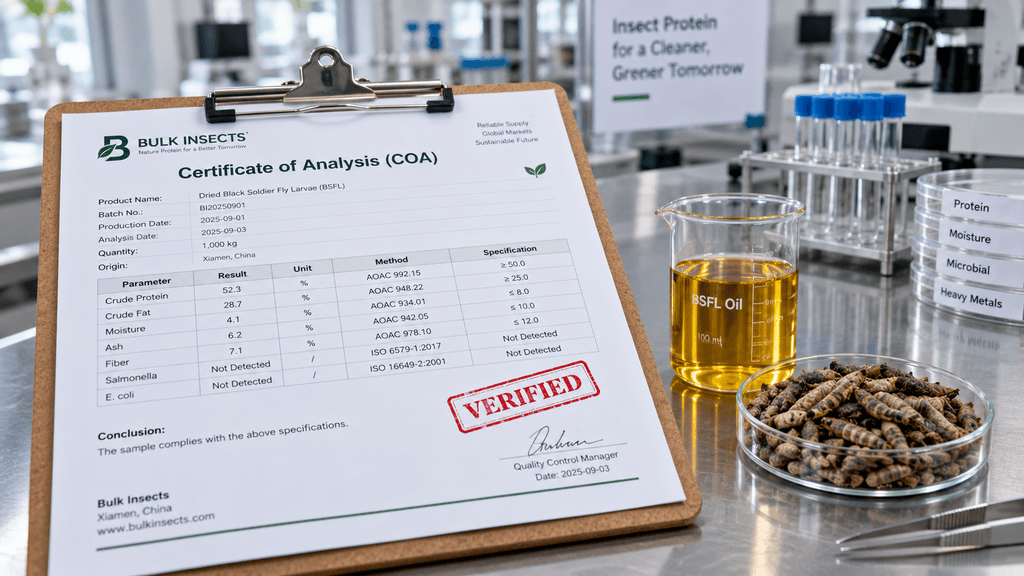
Reading the Certificate of Analysis (COA): A reliable supplier will provide a batch-specific COA for every commercial delivery. Buyers should routinely cross-reference the supplier’s internal COAs with accredited third-party laboratory results.
Microbiological Limits: Ensure tests for Salmonella (must be absent in 25g) and Enterobacteriaceae / E. coli comply with destination country limits.
Heavy Metals: Insects can bioaccumulate heavy metals from their substrate. The COA must show that Cadmium, Lead, Arsenic, and Mercury fall within the legal thresholds of the target market.
Mycotoxins: Tests for Aflatoxin B1 and Deoxynivalenol (DON) should be standard practice.
4. The Sampling and Commercial Order Process The transition from lab-scale testing to commercial purchasing requires a disciplined procurement protocol.
Requesting Representative Samples: Initial marketing samples do not always reflect commercial reality. Buyers should explicitly request “representative samples” drawn directly from a standard, large-scale production batch. It is highly advisable to conduct independent laboratory testing on these samples to verify the supplier’s COA claims before signing any long-term off-take agreements.
Consistency and Logistics Constraints: Evaluate the supplier’s packaging options (e.g., standard 1-ton FIBC bulk bags with moisture barriers, or vacuum-sealed cartons) to ensure they protect the product from moisture and oxidation during oceanic transit. For insect oil, which may solidify at room temperature due to its high lauric acid content, buyers must confirm whether the supplier ships in IBC totes equipped with heating pads for easy discharge upon arrival. Finally, align the supplier’s lead times and MOQs with your own feed milling schedule to prevent costly downtime.
By systematically applying this checklist, buyers can filter out speculative startups and partner with mature insect ingredient manufacturers capable of delivering compliant, high-quality proteins at commercial scale.
Disclaimer: This article is for informational purposes only and does not constitute business, legal or investment advice. Always consult primary sources and qualified professionals.