Independent intelligence for the global insect industryISSUE 01 · 2026
Black Soldier Fly Industry: Market, Production, and Commercial Applications
By IIR Editorial DeskSeptember 20, 2026
The black soldier fly industry is developing around insect protein, feed ingredients, organic side-stream utilization and commercial-scale production. This IIR analysis examines the industry's production model, demand drivers, applications, regional development and key constraints.
This analysis examines black soldier fly production systems, market demand, regional development and commercial applications, as well as the key constraints shaping the industry’s next stage of growth.
By IIR Editorial Desk · September 20, 2026 · Market Intelligence
The black soldier fly industry has become one of the most commercially developed segments of the broader insect-protein sector. Black soldier fly (Hermetia illucens) larvae can convert permitted organic feedstocks into insect biomass that can subsequently be processed into protein meal, oil, and other products. At the same time, frass can provide an additional output stream.
Commercial interest is particularly concentrated in animal nutrition. FAO identifies soldier fly larvae among the insect groups considered promising for industrial feed production. In contrast, black soldier fly applications have been investigated in aquaculture, poultry, and other animal feed systems.
However, the industry’s development cannot be measured simply by announced factories or projected market values. Commercial performance depends on feedstock availability and regulation, biological conversion efficiency, production scale, processing economics, product consistency, permitted end uses, and the ability of insect-derived ingredients to compete with established feed materials.
For buyers, producers, and investors, the central question is therefore shifting from whether black soldier fly production is technically feasible to where it can operate competitively and which applications can sustain commercial demand.
Executive Summary
The black soldier fly value chain connects several markets that are normally treated separately: organic resource management, insect farming, feed ingredients, pet nutrition, and agricultural inputs. This gives the sector multiple potential revenue streams, but also creates operational complexity.
Three factors are particularly important for the industry’s next phase:
Production economics: Scaling larvae production does not automatically guarantee competitive ingredient costs.
Demand quality: Announced capacity differs from operational production, and theoretical demand differs from contracted or repeat commercial demand.
IIR therefore treats the black soldier fly industry as an emerging industrial supply chain rather than simply an alternative-protein category.
Three、Market Context: Why Black Soldier Fly Has Attracted Commercial Attention
Black soldier fly larvae have several characteristics that make them relevant to industrial insect production.
The larvae can consume a range of organic materials, although the substrates legally permitted for commercial feed production vary substantially by jurisdiction. They produce harvestable biomass that can be processed into different product forms, creating a potential link between biological conversion and downstream feed markets.
FAO has highlighted black soldier fly as an alternative protein source for poultry and aquaculture, including through pilot and development programs. In one Caribbean initiative, black soldier fly production was introduced to reduce dependence on conventionally imported feed proteins.
This is one reason BSF differs from a conventional single-output commodity.
Both the input and output sides influence the economy. Feedstock sourcing, transport, energy, labor, automation, and processing determine production costs, while protein meal, oil, whole larvae, and frass may address different customers and price points.
That makes BSF fundamentally a multi-output biological manufacturing system.
Four、How the Black Soldier Fly Production System Works
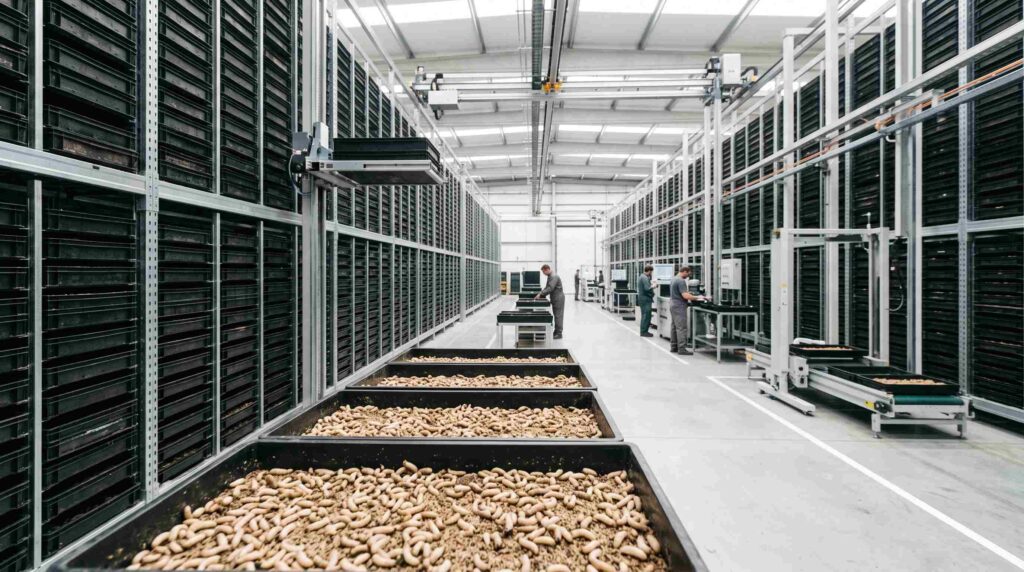
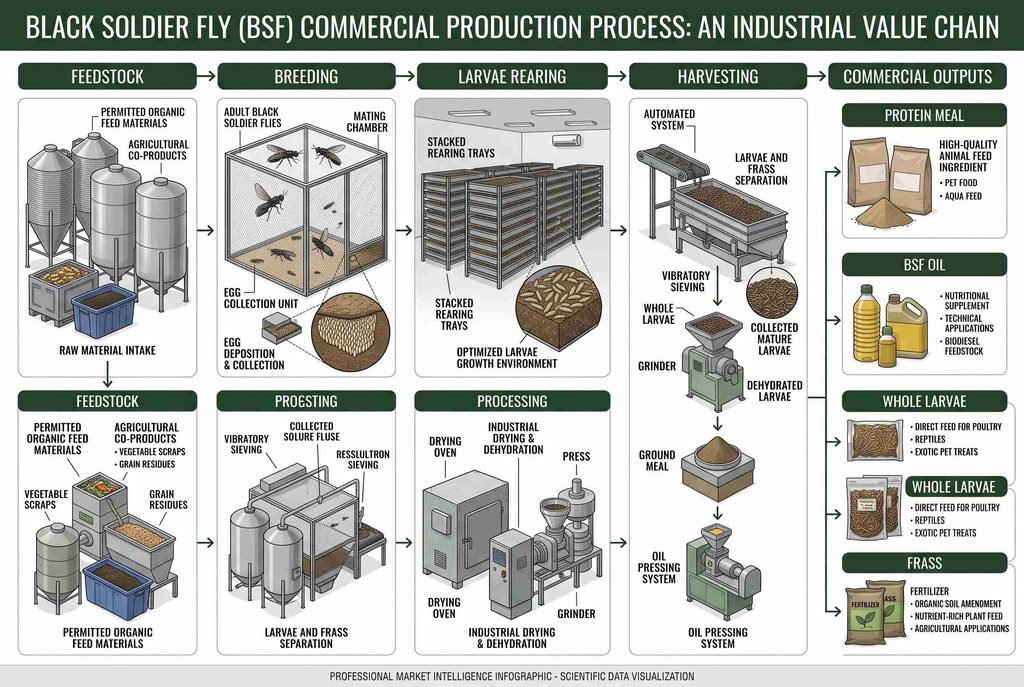
Industrial BSF production typically begins with breeding and egg production, then proceeds through larval rearing, harvesting, and downstream processing.
Breeding and Egg Production
A stable breeding population is required to provide eggs for continuous production.
At a commercial scale, breeding consistency matters because an irregular egg supply can reduce the utilization of downstream rearing infrastructure. Environmental parameters such as temperature, humidity, lighting, and adult reproductive conditions, therefore, become part of production management.
Larval Rearing
After hatching, larvae are introduced to suitable feed substrates.
This stage is central to BSF economics because substrate composition can influence growth, conversion performance, and the characteristics of the harvested larvae.
Not every organic material that BSF larvae can biologically consume can legally be used in a commercial feed-production system.
That distinction is critical.
Biological suitability ≠ regulatory permission.
For example, Singapore can impose specific requirements covering insect species, substrates, processing establishments, and downstream users. Singapore’s insect regulatory framework similarly covers businesses that import, farm, or process insects for food or animal feed and emphasizes species, contaminants, and final-product safety.
Harvesting and Processing
Larvae are harvested once they reach the targeted production stage.
Depending on the intended market, subsequent processing can produce:
Product
Typical commercial direction
BSF protein meal
Aquafeed, poultry and other permitted feed applications
Defatted insect meal
Higher-protein ingredient applications
BSF oil
Feed formulation and specialty applications
Whole dried larvae
Pet, bird, poultry,y and specialty-feed markets
Live larvae
Selected local feed/pet applications
Frass
Agricultural and soil-input applications
The existence of several outputs provides commercial flexibility, but it a “so means that “the BSF market” is not one homogeneous market.
Protein meal, whole larvae, oil, and frass have different buyers, specifications, regulatory requirements, and competitive benchmarks.
Five、Where Market Demand Is Developing
The demand side of the black soldier fly industry is concentrated in applications where insect-derived materials offer a specific functional, nutritional, or commercial value.
Aquaculture
Aquaculture has been one of the most-researched applications of BSF protein.
Scientific literature has examined BSF larval meal as a partial or alternative protein ingredient compared with conventional sources such as fishmeal and soybean meal. Results depend on species, inclusion level, formulation, substrate, and processing method; BSF should therefore not be treated as a universal one-for-one substitute.
Commercially, aquafeed is important because feed manufacturers consume protein ingredients in significant quantities.
But that also creates a challenge: industrial feed buyers are highly sensitive to nutrition, consistency, availability, and price.
Poultry and Pig Feed
Regulatory expansion has increased the addressable market in some jurisdictions.
In the European Union, insect-derived animal protein was authorized for use in aquaculture feed under Regulation (EU) 2017/893. Regulation (EU) 2021/1372 subsequently authorized the use of processed animal protein derived from farmed insects for poultry and porcine animals under specified conditions.
This illustrates why regulation is a structural market variable rather than a secondary compliance issue.
A regulatory change can materially alter the set of customers a BSF producer is legally able to serve.
Pet Food and Specialty Feed
Pet food represents a different commercial environment.
Compared with commodity livestock feed, purchasing pet food can place greater emphasis on product differentiation, ingredient narratives, and specialized formulations. Whole dried larvae can also address birds, reptiles, fish, and other specialty-feed markets.
Producers do not necessarily compete in both using the same product specification or commercial strategy.
Frass and Agricultural Inputs
Frass creates a second value chain around insect production.
Rather than treating residual material solely as waste, producers may develop it as an agricultural input where regulations permit.
This can improve resource utilization, but commercial value should not be assumed automatically. Local fertilizer regulations, nutrient composition, consistency, transportation cost,s and buyer acceptance determine whether frass becomes a meaningful revenue stream.
Six、Regional Development of the BSF Industry
The industry is not developing uniformly.
Europe
Europe has played an important role in establishing regulatory pathways for insect-derived feed proteins.
Consequently, European market development is closely linked to regulatory compliance, feed safety, processing infrastructure, and integration with established feed manufacturers.
Southeast Asia
Southeast Asia presents a different production proposition.
Warm climatic conditions, large agricultural and food-processing sectors, expanding aquaculture production, and proximity to potential organic feedstocks can support BSF production models.
However, it would be misleading to treat Southeast Asia as a single regulatory market. Substrate rules, feed approvals, import requirements, and product classifications differ by country.
Africa and Other Emerging Production Regions
BSF also has potential in markets where conventional protein ingredients are expensive or imported.
FAO-supported projects in Kenya and the Caribbean have examined BSF as a locally produced feed input for poultry, fish, and other livestock systems.
These models can differ substantially from highly automated European or Asian industrial plants.
The global industry,y therefore, includes both:
centralized industrial production
and
smaller decentralized production systems.
Seven、Production Capacity Is Not the Same as Production.
This distinction is particularly important for IIR.
Industry announcements frequently refer to factory capacity, expansion plans, or projected annual output. These figures can be useful indicators of investment and strategic direction, but they should not automatically be interpreted as actual production.
IIR distinguishes between:
Term
Meaning
Announced capacity
Capacity stated in a company announcement or plan
Nameplate capacity
Theoretically designed output of a facility
Operational capacity
Output a functioning plant is currently capable of producing
Actual production
The product is actually produced over a defined period
A 10,000-tonne facility announcement, therefore, does not establish that 10,000 tonnes are being produced or sold annually.
This distinction becomes increasingly important as the industry moves from pilot projects toward industrial facilities.
The next phase of BSF market analysis should therefore focus less on cumulative announcements and more on operational utilization, realized production, and recurring demand.
这也完全符合你 IIR 技术文档对 Company Data 的要求:必须区分 announced capacity、nameplate capacity、operational capacity 和 actual production;没有公开生产数据就明确说明 unavailable。
Eight、The Economics of Black Soldier Fly Production
Scaling BSF production requires more than biological efficiency.
The relative importance of each cost changes by geography and production model.
For example, warm climates may reduce some environmental control requirements, while highly automated facilities may reduce certain labor inputs but require greater capital investment.
Drying can also be economically important because removing moisture improves product stability, but requires energy.
For a protein meal, the competitive benchmark is ultimately not simply another insect producer.
Buyers can compare BSF ingredients with:
fishmeal,
soybean meal,
other animal proteins,
plant proteins,
and increasingly other alternative proteins.
Therefore, the commercial question is not:
Can the BSF protein be produced?
It is:
Can BSF-derived ingredients deliver sufficient nutritional, functional, or commercial value at a cost buyers are prepared to pay?
Nine、Key Constraints Facing the Industry
The black soldier fly sector still faces several structural constraints.
Production consistency is one. Biological systems require control over breeding, feedstock, larval growth, harvesting, and processing.
Feedstock regulation is another. The economic appeal of low-cost organic inputs can be constrained by what regulators permit insects intended for feed to consume.
Processing costs matter because commercial buyers typically require stable, safe, and transportable ingredients rather than wet larvae.
Market pricing remains important because conventional feed proteins benefit from established global supply chains, liquid commodity markets, and decades of formulation experience.
Finally, capacity utilization will increasingly matter. Building facilities demonstrates capital commitment; operating them efficiently and selling recurring output demonstrates commercial viability.
Ten、Outlook: What to Watch in the Black Soldier Fly Industry
The next stage of industry development is likely to be defined less by proof-of-concept farming and more by commercial execution.
IIR will track five indicators in particular:
1. Operational production versus announced capacity
Large capacity announcements should increasingly be tested against actual operating output.
2. Long-term offtake and repeat demand
Recurring contracts and repeat purchasing provide stronger evidence of market development than isolated trials.
3. Feedstock economics and regulation
Changes to permitted substrates can materially affect both costs and scalability.
4. Product mix
The balance between protein meal, oil, whole larvae, and frass will help indicate where producers are finding commercially viable demand.
5. Regional competitiveness
Climate, energy, feedstock, labor, regulation, logistics, and downstream demand will determine where BSF production ultimately concentrates.
Eleven、IIR Analysis
The black soldier fly industry has moved beyond being primarily a research topic, but it has not yet become a standardized global commodity industry.
Its strongest commercial proposition comes from the interaction of three systems:
biological conversion + ingredient production + downstream feed demand.
That combination creates substantial opportunity but also makes simplistic market-size narratives unreliable.
For IIR, the most useful indicators will therefore be measurable operating data: actual production, capacity utilization, feedstock costs, product pricing, regulatory access, contracted demand, and facility economics.
As those datasets improve, BSF can increasingly be analyzed no” simply as an “alter” ative protein,” but as a distinct industrial supply chain.
Disclaimer: This article is for informational purposes only and does not constitute business, legal or investment advice. Always consult primary sources and qualified professionals.