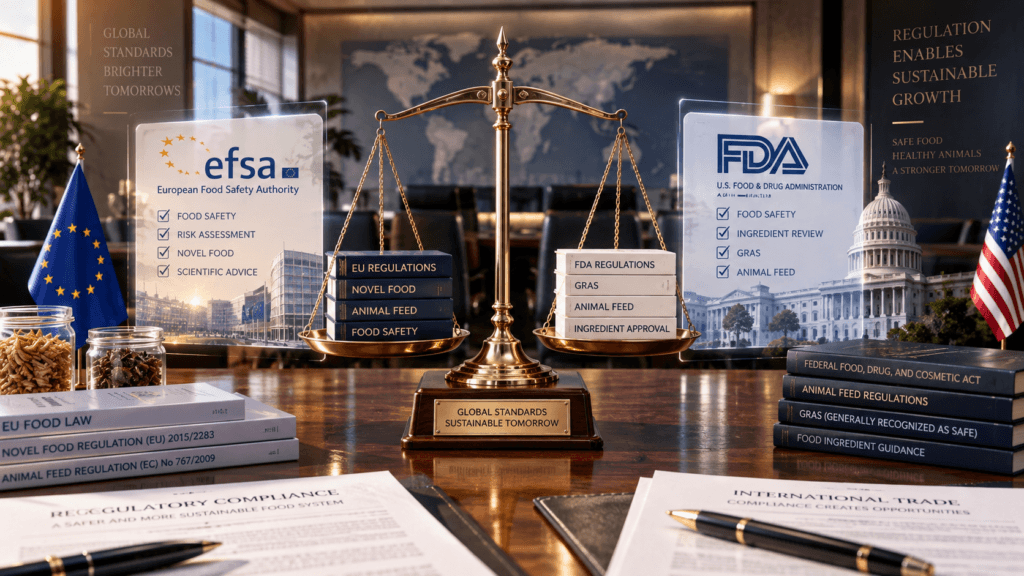
Navigate transatlantic standards. Detailed comparison of FDA and EFSA insect feed approvals across aquaculture, poultry, and swine applications.
Navigate transatlantic standards. Detailed comparison of FDA and EFSA insect feed approvals across aquaculture, poultry, and swine applications.
Published: September 2026 | Fact-checked by: IIR Research Team | Regulatory Analysis: IIR Regulation
Navigating cross-border trade in insect-derived agricultural commodities requires a thorough understanding of international regulatory jurisdictions. For feed millers, pet food manufacturers, and ingredient importers, compliance is not merely an administrative checkbox; it directly determines import clearance, formulation legality, and downstream brand liability. Globally, two regulatory authorities set the benchmark for feed safety: the United States Food and Drug Administration (FDA), working closely with the Association of American Feed Control Officials (AAFCO), and the European Food Safety Authority (EFSA), which enforces policies under the European Commission.
While both jurisdictions acknowledge the safety of bioconversion technologies, they govern commercial insect feed approvals through fundamentally divergent administrative methodologies. European regulators employ a unified positive list approach under the Novel Food and Animal By-Product (ABP) regulations, while US authorities rely on ingredient-by-ingredient and species-by-species definitions.
1. Regulatory Philosophies: AAFCO Definitions vs. EU Animal By-Product Framework
To understand commercial availability in North America, buyers must examine the institutional interaction between the FDA Center for Veterinary Medicine (CVM) and AAFCO. In the United States, animal feed ingredients do not follow the European Union’s blanket classification system. Instead, each insect species, physical processing method, and target livestock category requires an explicit AAFCO definition review:
The FDA evaluates formal scientific dossiers submitted by ingredient manufacturers, assessing continuous toxicological data, digestibility metrics, and heavy metal accumulation. Once the FDA issues a letter of concurrence, AAFCO votes to adopt a formal tentative definition into the AAFCO Official Publication (OP). Crucially, an approval granted for one insect species in one livestock sector does not automatically authorize other species or uses.
In contrast, the European Union governs commercial insect biomass primarily under Regulation (EC) No 1069/2009 and Regulation (EU) No 142/2011, collectively known as the Animal By-Product (ABP) regulations. In the EU, farmed insects are legally classified as “farmed animals.” Consequently, all general rules governing livestock production apply to insects. EFSA provides comprehensive scientific opinions on biological hazards, chemical contaminants, and substrate safety, which are subsequently enacted as binding European Commission regulations applicable across all 27 member states.
2. Species-Specific Insect Feed Approvals Across US and European Markets
The most direct practical impact of these divergent frameworks appears in the authorization of specific insect species for commercial formulations:
European Union Authorizations (EFSA Jurisdiction)
Under Regulation (EU) 2021/1372, the European Union achieved a major milestone by amending the longstanding “TSE feed ban” regulations. Today, the EU maintains a clear positive list authorizing eight distinct insect species for commercial feeding across aquaculture, poultry, and swine:
- Black Soldier Fly (Hermetia illucens)
- Yellow Mealworm (Tenebrio molitor)
- Lesser Mealworm (Alphitobius diaperinus)
- House Cricket (Acheta domesticus)
- Band-legged Cricket (Gryllodes sigillatus)
- Field Cricket (Gryllus bimaculatus)
- Silkworm (Bombyx mori)
- Common Housefly (Musca domestica)
EU law authorizes the utilization of Processed Animal Proteins (PAPs) derived from these eight species in commercial aquafeeds, poultry rations, and swine feeds, subject to strict species cross-feeding prohibitions to prevent intraspecies recycling (cannibalism).
United States Authorizations (FDA/AAFCO Jurisdiction)
In North America, progress on commercial insect feed approvals has been driven largely by species-specific petitions for the Black Soldier Fly Larva (BSFL):
- Salmonids and Finfish: BSFL meal is broadly authorized in salmonid and all marine finfish commercial rations.
- Poultry: Dried BSFL biomass and defatted meal are formally recognized for inclusion in broiler chicken diets and commercial laying hen operations.
- Swine: Mechanically processed BSFL ingredients are approved for use in nursery and growing pig rations.
- Adult Dogs: Both dried BSFL and whole dried yellow mealworms have obtained official definitions for adult canine complete feeds and treats.
However, other key commercial species, including crickets and grasshoppers, are still progressing through formal petition pathways for general livestock use in the US, while enjoying established utility within boutique pet treats and avian specialty sectors.
3. Substrate Authorization and Traceability Protocols
A fundamental point of alignment between both jurisdictions centers on substrate control. Regulators recognize that insects bioaccumulate substances from their rearing feed:
EFSA strictly enforces Annex III of Regulation (EC) No 767/2009. Farmed insects destined for European animal feeds must be reared exclusively on substrates authorized for conventional farm animals. This restricts feedstuffs to vegetal materials, traceable brewery by-products, and select non-animal agro-industrial residues. Substrates derived from municipal catering waste, catering slops, or any mammalian-derived products remain prohibited.
The FDA applies similar oversight under the Food Safety Modernization Act (FSMA) Preventive Controls for Animal Food regulations. Producers must verify that feedstocks are free from industrial chemical contaminants, pesticides, and unapproved veterinary drug residues.
Given these regulatory complexities, international procurement teams must institute clear internal compliance steps:
First, audit supplier processing protocols to confirm that heating and desiccation standards satisfy sanitary import criteria. In European trade, insect meal must undergo thermal processing that meets specific microbiological destruction metrics (free from Salmonella in five 25g samples and Enterobacteriaceae not exceeding 300 CFU/g).
Second, align your supplier qualification with established baseline parameters. Feed millers preparing cross-border import workflows should review our foundational guide to global insect feed regulations to verify that physical import permits and veterinary health declarations reflect current legal thresholds.
Finally, stay informed on evolving international standards by reviewing broader food-safety compliance benchmarks across global logistics. Actively tracking both FDA and EFSA regulatory cycles ensures procurement teams can pivot formulations smoothly as new approvals unlock expanded commercial volumes.