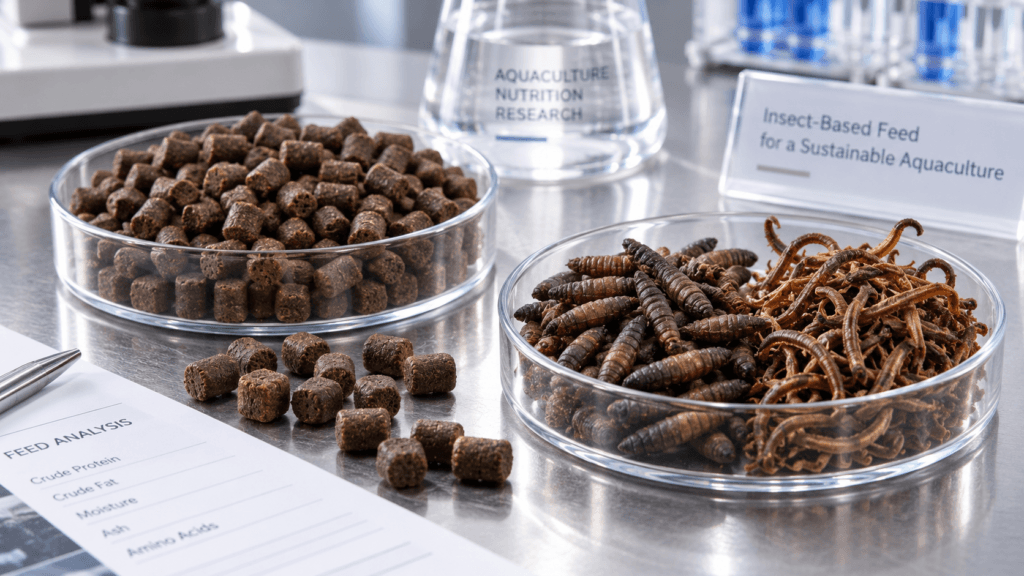
Combat marine ingredient volatility. Learn how utilizing bsfl in aquaculture and dried earthworms delivers functional benefits and boosts ROI.
Published: September 2026 | Fact-checked by: IIR Research Team | Industry Analysis: IIR Market Intelligence
Combat marine ingredient volatility. Learn how utilizing BSFL in aquaculture and dried earthworms delivers functional benefits and boosts ROI.
The global aquaculture sector faces sustained volatility in marine ingredient supply chains. Fluctuating catch quotas in South American reduction fisheries, combined with climate anomalies affecting wild pelagic fish populations, have driven fishmeal and marine oil prices to historic highs. Commercial aquafeed millers who rely heavily on ocean-caught marine inputs face severe margin vulnerability.
While plant-based proteins such as soybean meal and wheat gluten have long served as partial substitutes, their high inclusion rates introduce well-documented anti-nutritional factors. Saponins, phytates, and antigenic soy proteins frequently induce distal enteritis in carnivorous finfish, impairing nutrient absorption and degrading the Feed Conversion Ratio (FCR). In this demanding operational environment, the strategic incorporation of whole dried earthworms and defatted BSFL in aquaculture diets offers an effective path to decouple feed production from ocean fishmeal while boosting farming profitability.
1. Nutritional and Physiological Advantages of BSFL in Aquaculture
The Black Soldier Fly Larva (Hermetia illucens) represents one of the most biologically efficient bio-converters known to agricultural science. When processed through commercial mechanical expellers, defatted BSFL meal yields a robust crude protein concentration of 55% and 62% on a dry matter basis.
Crucially, the essential amino acid profile of defatted BSFL meal closely aligns with that of super-prime fishmeal. Its concentrations of lysine, methionine, threonine, and arginine fulfill the biological maintenance and lean tissue synthesis requirements of carnivorous species, including Atlantic salmon (Salmo salar), rainbow trout (Oncorhynchus mykiss), and Asian seabass (Lates calcarifer). Digestibility studies consistently report apparent protein digestibility coefficients exceeding 85% in juvenile marine fish, confirming that BSFL delivers bioavailable nutrition without triggering gastrointestinal inflammation.
Beyond basic macronutrient delivery, utilizing BSFL in aquaculture feeds brings significant functional benefits through its native lipid fraction. BSFL fat is naturally rich in lauric acid (C12:0), a medium-chain fatty acid renowned for disrupting the cellular membranes of pathogenic Gram-positive bacteria. Including unrefined or partially defatted BSFL products in starter feeds provides natural gut-protective antimicrobial action, helping to stabilize intestinal microflora during early life stages when fry and fingerlings are most vulnerable to infectious outbreaks.
2. Earthworms: The Premier Chemo-Attractant for High-Value Species
While BSFL meal provides the foundational protein and lipid matrix for volume diets, whole dried earthworms (Eisenia fetida and Lumbricus rubellus) represent a high-potency functional additive for ultra-premium aquaculture categories. Commercial producers cultivating finicky or high-margin aquatic species—such as Japanese eel (Anguilla japonica), Chinese softshell turtle (Pelodiscus sinensis), and juvenile tiger prawns—regularly battle feed refusal when transitioning stock from live feeds to manufactured compound pellets.
Dried earthworms resolve this bottleneck through their complex profile of natural chemical attractants. Earthworm biomass contains exceptionally high concentrations of free amino acids (specifically glycine, alanine, and glutamic acid), alongside betaine and nucleotide metabolites. These compounds act as potent gustatory stimulants in aquatic animals, triggering vigorous feeding behavior via chemosensory pathways.
Field formulation trials demonstrate that incorporating modest amounts of whole dried earthworm meal (typically 2% to 5% of total formula weight) dramatically shortens pellet ingestion time. By accelerating feed consumption, earthworm inclusions minimize the leaching of water-soluble vitamins into the surrounding pond environment, reduce nitrogenous waste accumulation, and maximize nutrient retention across high-density recirculation aquaculture systems (RAS).
3. Calculating the Farm-Gate ROI: Beyond Ingredient Unit Cost
When evaluating alternative proteins, feed formulators must move beyond simple raw material price comparisons and assess the holistic Return on Investment (ROI) realized at harvest. While raw insect meal may trade at a slight initial premium over conventional soybean meal, its true financial return manifests through three measurable biological performance indicators:
- FCR Optimization: Because defatted BSFL protein delivers superior biological value compared to plant concentrates, commercial trials routinely document FCR improvements between 6% and 12% in salmonids and marine whitefish. Even a fractional reduction in FCR translates into tens of thousands of dollars in feed savings over a single commercial production cycle.
- Mortality Mitigation: The combined antimicrobial properties of BSFL lauric acid and the immune-stimulating effects of insect chitin help suppress common bacterial pathogens. Improving juvenile fingerling survival rates by just 3% to 5% dramatically enhances end-of-cycle net harvest tonnage.
- Shortened Production Cycles: Faster feeding response and optimized metabolic absorption driven by earthworm attractants accelerate daily weight gain, enabling operators to achieve target market sizes weeks ahead of standard production schedules.
To capture these commercial gains without encountering manufacturing setbacks, procurement and extrusion teams should adhere to clear technical guidelines:
- Strict Lipid Management: Aquafeed extruders require tight control over raw material lipid levels to achieve targeted pellet expansion, sink rates, and structural water stability. Formulators should explicitly demand mechanically defatted meal with uniform residual oil parameters. To master the operational differences between raw forms, review our detailed guide on Whole Dried Insects vs Insect Meal vs Insect Oil.
- Chitin Auditing: While insect chitin acts as a valuable prebiotic immunostimulant at moderate inclusion rates (under 1.5% total dietary chitin), excessive fiber levels can reduce overall nutrient transit time. Formulators must verify ash and fiber contents on every incoming supplier Certificate of Analysis.
- Global Sector Alignment: Monitoring worldwide expansion across commercial aquaculture networks demonstrates that integrating sustainable, farm-reared insect proteins is becoming an essential regulatory and commercial prerequisite for accessing premium seafood retail markets worldwide.