A new study published in Scientific Reports finds that different tomato leaf handling methods can support desert locust growth while influencing mineral and fatty acid composition, highlighting a possible use for greenhouse agricultural residues.
A study published in Scientific Reports finds that tomato leaf waste can support desert locust growth under controlled conditions, with storage and handling methods influencing insect nutrient composition without significantly reducing survival or protein content.
By IIR Editorial Desk · October 25, 2026 · Latest Coverage
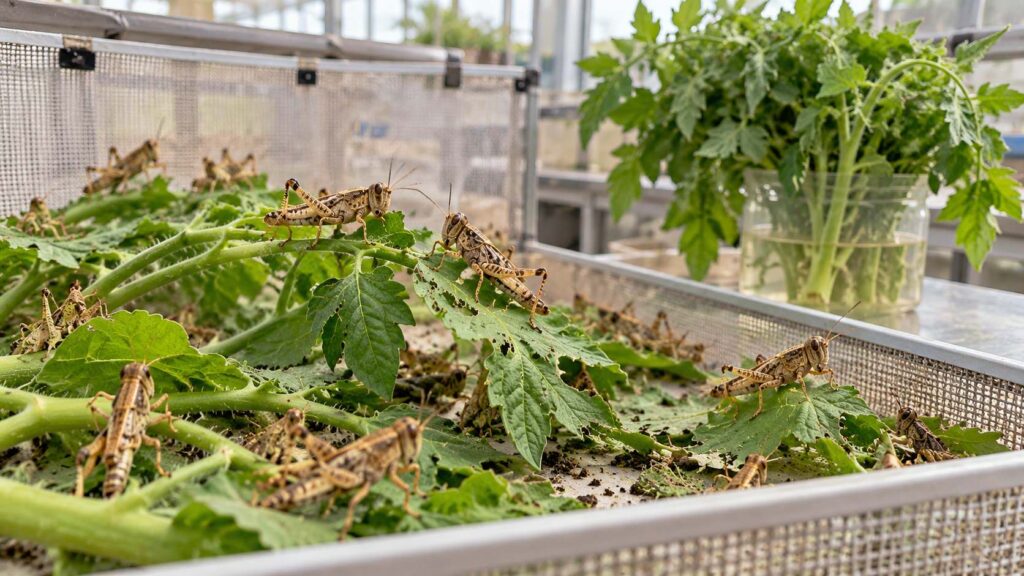
Tomato leaf waste has shown potential as a feed resource for farmed desert locusts in a new study examining how different leaf handling methods influence insect growth, survival, and chemical composition. Researchers found that storing tomato leaves or maintaining cut leaves in water did not significantly reduce locust performance compared with feeding freshly harvested leaves.
The findings, published on October 24, 2026, in Scientific Reports, address a practical challenge in insect farming: how to use agricultural plant residues without requiring constant harvesting and daily delivery of fresh material.
According to the study published in Scientific Reports, the researchers evaluated four tomato leaf handling methods during a 21-day feeding experiment involving desert locusts (Schistocerca gregaria). The experiment measured growth, survival, feed utilization, glycoalkaloids, minerals, and fatty acid composition.
The results suggest that suitable handling methods could make tomato leaf residues easier to incorporate into controlled locust production. However, the research does not establish that the approach is commercially profitable or applicable to all farmed insect species.
Tomato Leaf Waste Handling Methods Compared
The researchers investigated how changes in tomato leaf storage and water availability affected the performance of desert locusts.
The four treatments included freshly harvested leaves supplied daily, leaves stored at 8°C for three days, leaves stored at 8°C for up to six days and supplied over the feeding period, and cut tomato leaves maintained in water to preserve freshness.
The water-based leaf-cutting method was designed to reduce moisture loss and preserve leaf condition without requiring daily harvesting. This approach is relevant to greenhouse operations where tomato leaves are periodically removed during plant maintenance.
Across the four feeding treatments, the researchers found no statistically significant differences in final locust body weight, survival, or estimated feed conversion ratio.
The insects increased from approximately 0.08–0.09 grams at the beginning of the experiment to 1.04–1.14 grams by the end of the 21-day period. Average survival rates ranged from 82% to 89%.
These findings suggest that carefully managed tomato leaf storage may provide operational flexibility without reducing the measured growth performance of desert locusts under the conditions tested.
However, the study was conducted under controlled experimental conditions. Further investigation would be required to determine whether the same results can be reproduced reliably in larger commercial production systems.
Protein, Minerals, and Fatty Acid Composition
The different handling methods had little effect on the crude protein content of the harvested insects.
Crude protein levels ranged from 59.37% to 60.51% on a dry-matter basis, with no significant differences among the four treatment groups.
The researchers also examined fatty acid composition. Alpha-linolenic acid, an omega-3 fatty acid, represented approximately 40.63% to 43.12% of the measured fatty acids across treatments.
Although the overall fatty acid profile remained relatively consistent, the researchers identified differences in certain minerals.
Locusts fed tomato leaves maintained using the water-based method showed increased accumulation of copper and zinc compared with insects in the fresh-leaf treatment. These changes indicate that feed handling can influence aspects of insect composition even when overall growth remains similar.
The findings may be relevant to producers seeking insect ingredients with consistent nutritional characteristics. However, nutrient composition is only one component of commercial ingredient quality, and further assessment is required before drawing conclusions about finished products intended for food or feed markets.
Tomato Leaf Glycoalkaloids Remain an Important Consideration
Tomato leaves contain natural defensive compounds, including alpha-tomatine and dehydrotomatine. These substances can affect insects differently depending on species and feeding conditions.
The study found that the water-based leaf-cutting treatment produced higher alpha-tomatine levels in the leaves themselves. However, the researchers did not observe a corresponding increase in alpha-tomatine accumulation in the locusts under that treatment.
The authors suggested that detoxification mechanisms could help explain this result, although the experiment did not directly establish the underlying biological mechanism.
This distinction is important because the ability of one insect species to tolerate a plant material does not mean that the same material is suitable for all commercially farmed insects.
Previous research cited in the paper identified negative effects of tomato leaves on black soldier fly larvae and mealworms. The current findings should therefore be interpreted specifically in relation to desert locust production.
Additional work is also needed to evaluate food and feed safety, possible agricultural chemical residues, and compliance with the regulations applicable to the intended market.
IIR Analysis: Can Greenhouse Waste Reduce Locust Feed Costs?
The commercial significance of the study extends beyond proving that desert locusts can consume tomato leaves. It raises the question of whether greenhouse plant residues can be integrated into insect farming without creating excessive labor, storage, and handling costs.
In commercial grasshopper production, feed management influences biological performance and daily operating efficiency. A feed material may be inexpensive or readily available, but its commercial value depends on how consistently it can be delivered and how much labor is required to prepare it.
Tomato leaf waste offers a potential advantage when insect farms operate near greenhouse production facilities. Such proximity could reduce collection distances and create opportunities to reuse plant material generated during routine pruning.
However, the two handling approaches examined in this study involve different operating requirements. Refrigerated storage requires equipment and energy, while maintaining cut leaves in water requires appropriate containers, space, and handling practices.
These costs must be evaluated against potential savings from less frequent harvesting, reduced feed preparation, and the replacement of conventional feed materials.
The results also suggest that nutrient quality should not be assessed from crude protein alone. Changes in copper, zinc, and plant-derived compounds may affect how producers evaluate feed inputs and finished insect ingredients.
From IIR’s perspective, the most promising application is not indiscriminate use of agricultural waste. It is a controlled relationship between greenhouse crop production and insect farming, supported by species-specific research, suitable substrates, and consistent quality management.
The study provides useful biological evidence for this approach, but commercial economic performance remains unproven.
What to Watch Next
The next research priority will be evaluating tomato leaf feeding systems under larger and more commercially representative production conditions.
Useful measurements would include feed collection costs, refrigerated storage requirements, labor savings, growth consistency across production cycles, and the nutritional quality of harvested locusts.
Further investigation into glycoalkaloid metabolism and agricultural chemical residues would also help establish appropriate safety controls for different end uses.
Researchers and producers should avoid extending the conclusions automatically to black soldier fly larvae, mealworms, or other species with different nutritional requirements and tolerances.
For the wider insect industry, the study illustrates how species-specific feed research may unlock new uses for agricultural residues.
Its longer-term significance will depend on whether the biological results can be translated into reliable production methods, acceptable product quality, and economically practical greenhouse-to-insect farming systems.