Independent intelligence for the global insect industryISSUE 01 · 2026
Grasshopper Production: How Commercial Farming and Processing Work
By IIR Editorial DeskSeptember 29, 2026
Commercial grasshopper production connects species selection, breeding and controlled rearing with harvesting, stabilization, drying and downstream processing. This analysis examines how the production chain works and where consistency and scale matter most.
This analysis explains how commercial grasshopper production moves from species selection and breeding through nymph rearing, harvesting and processing, and where nutrition, environmental control and post-harvest decisions affect commercial output.
By IIR Editorial Desk · September 29, 2026 · Market Intelligence
How Commercial Grasshopper Production Works
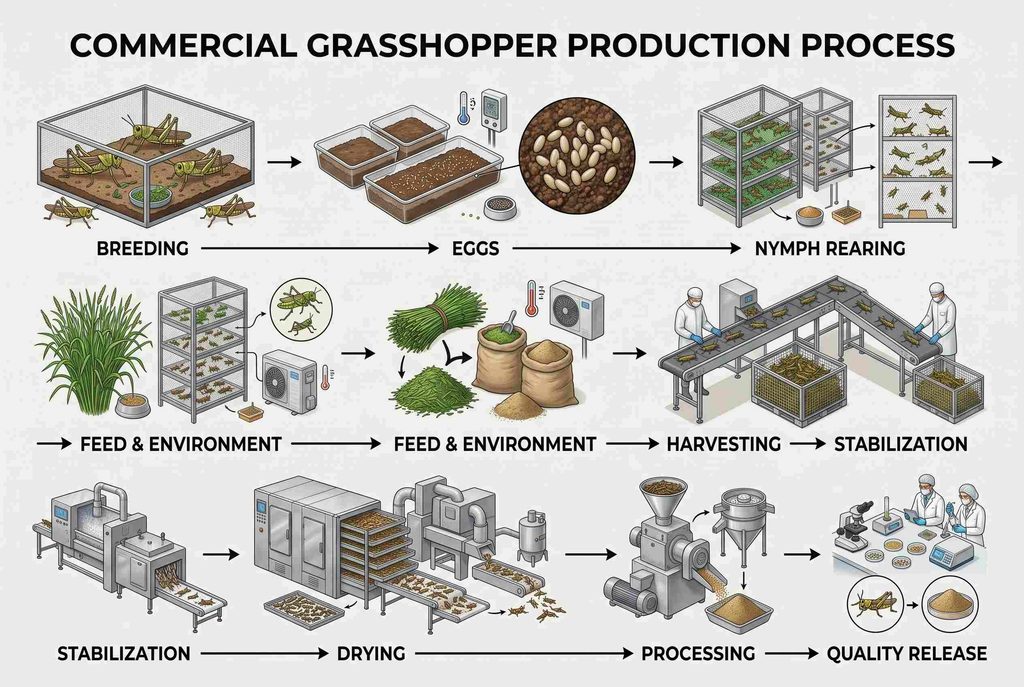
Commercial grasshopper production requires more than keeping insects alive until harvest. A repeatable production system must connect species selection, breeding, egg management, juvenile development, feeding, and environmental control with harvesting and downstream processing.
The production model also depends heavily on the species being farmed. Research relevant to commercial production frequently focuses on locust species such as Locusta migratoria and Schistocerca gregaria, while other edible grasshoppers can have different biological characteristics and production histories.
This makes species-specific management especially important. Production methods developed for one grasshopper or locust should not automatically be treated as a universal protocol for the entire commercial category.
1. Species Selection Defines the Production System
Species selection is one of the earliest production decisions because it influences nearly every stage that follows. Development rate, reproductive behavior, feed requirements, environmental conditions and final product characteristics can vary among species.
The migratory locust, Locusta migratoria, and desert locust, Schistocerca gregaria, have attracted research attention for food and feed farming. Both have been described as having potential for larger-scale production, although their nutritional requirements and production optimization still require further study.
Other edible grasshopper species can require different production systems. A commercial operator therefore needs to begin with a clearly identified species rather than treating “grasshopper” as a standardized biological input.
2. Breeding Establishes the Production Cycle
A controlled production system needs a reliable breeding population. Adult insects must reproduce consistently enough to generate the eggs required for subsequent production cohorts.
Breeding performance determines how effectively a farm can maintain its own production cycle. Weak reproductive output can create shortages further downstream even when rearing capacity is available.
Commercial scaling makes this relationship more important. A farm needs enough breeding capacity to support planned harvest volumes without allowing breeder requirements to become disconnected from the capacity of the rearing system.
3. Egg Management Connects Breeding With Rearing
Egg production does not immediately create harvestable biomass. Eggs need to be collected or managed under conditions that support successful development and predictable hatching.
For locust species, oviposition behavior affects how this stage is organized. Production systems need suitable egg-laying substrates and a practical method for moving new generations into the rearing cycle.
The objective is not simply high egg numbers. Commercial production benefits from predictable hatch timing because synchronized cohorts are easier to feed, manage, and eventually harvest.
4. Nymph Rearing Produces Most of the Commercial Biomass
After hatching, juvenile insects enter the main biomass-production stage. During successive developmental stages, feed and environmental resources are converted into growing insect biomass.
The rearing system needs enough space and infrastructure to accommodate changing body size and population requirements. Management practices that work immediately after hatching may not remain suitable as insects develop.
Mortality during this period directly affects final output. Feed, labor, and facility capacity are already being consumed, so losses before harvest reduce the amount of saleable biomass produced from those inputs.
5. Feed Management Is a Core Production Variable
Grasshoppers and locusts are herbivorous insects, making plant-based nutrition central to production. Commercial systems need feed that supports development while remaining practical to source, prepare, and distribute.
Recent research on nutritional requirements of migratory and desert locusts emphasizes the importance of balanced diets. Unbalanced nutrition can increase feed consumption while reducing fitness, meaning that low-cost feed is not automatically economically efficient.
Feed management becomes more complex at scale. Nutritional quality, consistency, storage, and delivery all need to support large populations without creating excessive variation between production cohorts.
6. Feed Source Can Affect More Than Growth
A production diet is not merely a source of calories. Its composition can influence growth performance and may also affect the nutritional characteristics of the harvested insects.
Research has explored whether Locusta migratoria and other farmed insects can utilize organic side streams, reflecting broader interest in lowering feed costs and reducing competition with conventional food or feed resources. The suitability of any feed source still depends on nutritional adequacy, safety, and the applicable regulatory framework.
Commercial producers therefore need to evaluate feed inputs as part of a controlled production system. Availability alone is not enough if the feed creates inconsistent performance or introduces unwanted contaminants.
7. Temperature Influences Development and Throughput
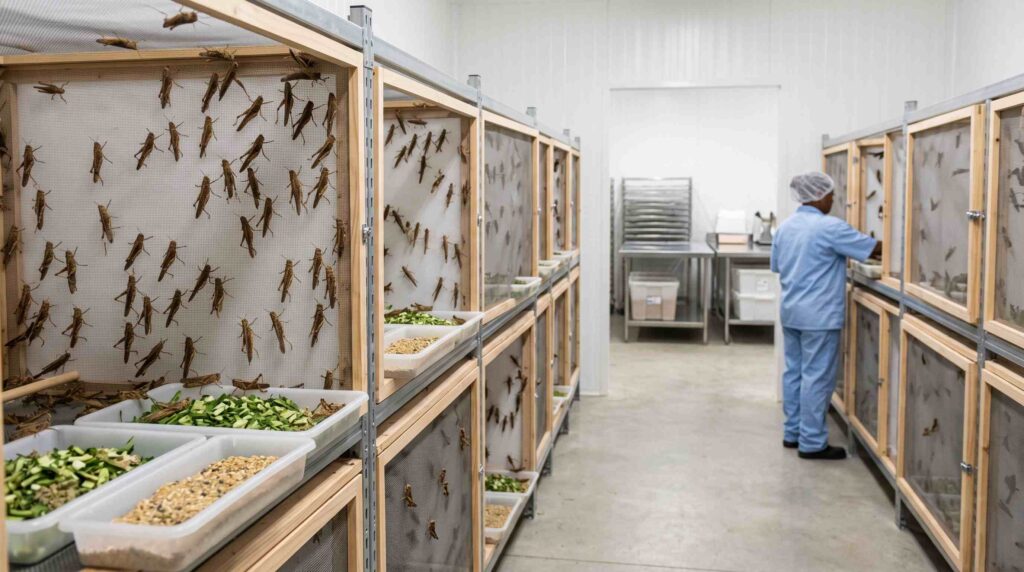
Grasshoppers are ectothermic, so environmental temperature influences biological activity and development. Commercial facilities need conditions that support predictable growth rather than relying entirely on uncontrolled ambient variation.
Temperature management also affects production throughput. If development slows, insects occupy rearing space for longer periods before harvest, reducing the number of production cycles that a facility can complete.
The appropriate conditions are species- and system-specific. Commercial production needs enough environmental control to support consistency without assuming that a single temperature profile applies to every grasshopper species.
8. Humidity and Ventilation Need to Be Managed Together
Temperature is only one part of the rearing environment. Humidity and airflow also influence conditions within densely populated production areas.
Ventilation can help manage heat, moisture, and air quality, while inappropriate humidity can create production problems. The interaction becomes more important as population density and facility size increase.
Environmental management should therefore be treated as an integrated system. Temperature, humidity, airflow, and stocking conditions collectively shape the environment experienced by the insects.
9. Population Density Can Affect Production Performance
Commercial farming creates an incentive to produce more biomass from a limited amount of physical space. Higher density can improve space utilization, but it can also change insect behavior and the rearing environment.
This issue is especially relevant to locust biology because population density can influence behavior and physiology. Commercial operators need to distinguish productive density from simply maximizing the number of insects placed into an enclosure.
The useful production metric is consistent harvestable output from the available space. Density that increases stress, mortality, or management difficulty can reduce rather than improve overall system performance.
10. Facility Design Shapes Daily Production Work
The physical organization of a farm affects how efficiently workers or automated systems can manage production populations.
Feed delivery, cleaning, movement between production stages, environmental monitoring, and harvesting all require access to the insects. A poorly organized facility can turn simple biological tasks into repeated labor-intensive operations.
As production expands, layout becomes part of process engineering. The objective is to move feed, insects, information, and eventually harvested biomass through the facility with as little unnecessary handling as possible.
11. Biosecurity Supports Production Continuity
Controlled farming concentrates insects into managed populations, which creates advantages for production but also increases the importance of hygiene and biosecurity.
New breeding material, feed, equipment, and personnel can all create pathways through which biological hazards enter or move within a facility. Separating production groups and maintaining cleaning procedures can reduce the chance that one problem spreads across the entire operation.
Biosecurity does not directly increase biomass, but it helps protect expected output. Its value becomes more significant as farms invest more capital and operating resources into each production cycle.
12. Harvest Timing Influences Final Product Consistency
Commercial harvesting needs a defined target rather than simply collecting insects whenever convenient.
Developmental stage can influence body size, composition, and physical characteristics. Buyers purchasing whole dried products can also expect relatively consistent appearance across a batch.
Predictable harvest timing helps connect biological production with processing schedules. When production cohorts reach harvest within a manageable window, facilities can use stabilization and drying equipment more efficiently.
13. Harvesting Marks the Transition to Processing
Once grasshoppers reach the intended harvest stage, the production chain moves from farming into post-harvest handling.
Insects need to be collected and separated from feed residues, fecal material, and other production debris. The level of care required depends partly on the intended final product.
Whole dried grasshoppers place greater emphasis on physical integrity and cleanliness. Products intended for milling can tolerate more physical damage, although contamination and handling control remain important.
14. Stabilization Begins Immediately After Harvest
Fresh insect biomass is biologically and microbiologically perishable. Post-harvest stabilization is needed before the product can enter longer-term storage or distribution.
Heat treatment is one possible approach. Research involving edible Orthoptera, including Locusta migratoria and Schistocerca gregaria, has examined blanching followed by oven drying as a practical processing route.
The appropriate process depends on the intended product and food- or feed-safety requirements. Commercial systems need a defined transition from harvesting to stabilization rather than allowing fresh biomass to remain uncontrolled.
15. Drying Converts Biomass Into a More Stable Commercial Product
Drying removes moisture and can make grasshopper products easier to store, package, and transport. For whole dried products, the process also strongly influences appearance and physical integrity.
Different drying technologies can create different outcomes. Hot-air, freeze-drying and other approaches vary in equipment requirements, processing time, energy demand and their effects on the final product.
Drying should therefore be evaluated as part of product design. The objective is not simply to remove as much water as possible, but to achieve a stable product with characteristics appropriate for the intended customer.
16. Whole Products and Powders Require Different Process Control
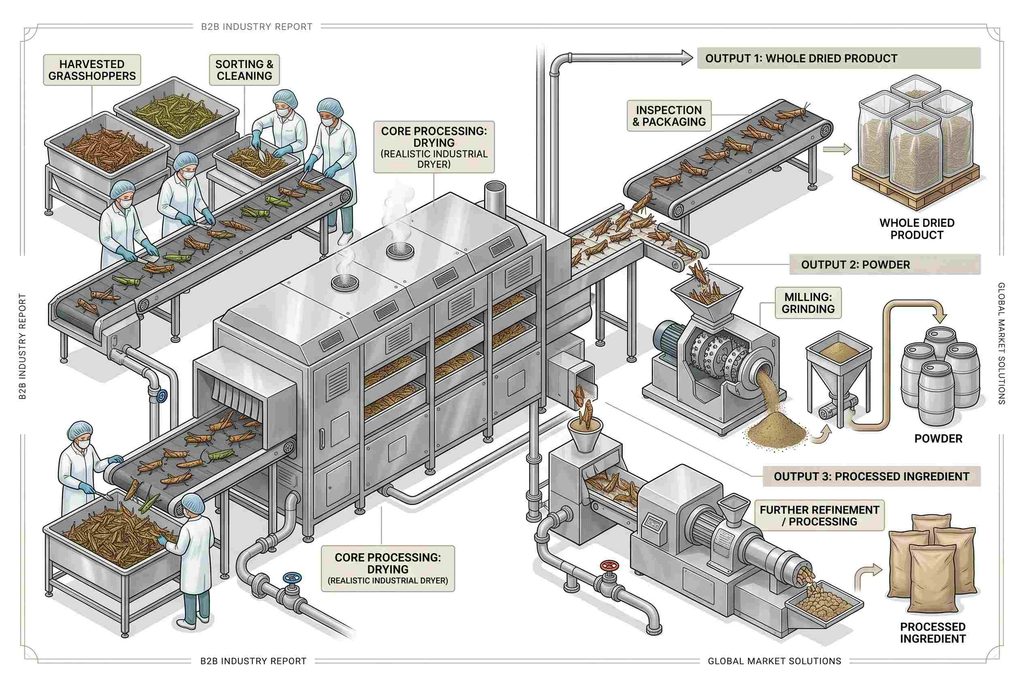
A whole dried grasshopper and a grasshopper powder originate from the same biological material but require different production priorities.
Whole products retain visible characteristics. Body integrity, color, cleanliness, size, and breakage can therefore affect commercial quality. Sorting and careful packaging can become important after drying.
Powder production introduces milling and particle-size control. Appearance of individual insects becomes less important, while consistency of the processed ingredient becomes more relevant.
17. Processing Can Create Multiple Commercial Outputs
Processing decisions determine which markets a production facility can serve.
A simple pathway may end with whole dried insects. Additional milling can create powder or meal, while more advanced processing could produce ingredients with more specific technical characteristics.
Every additional stage increases process complexity. Equipment, labor, quality control, and product losses need to be considered alongside the value of the resulting product.
18. Quality Control Runs Through the Production Chain
Quality control should not begin only after the product has been packaged. Important variables originate much earlier.
Species identity, feed inputs, environmental conditions, harvesting, hygiene, stabilization, and drying can all influence the final product. Batch records can help connect these production stages with testing results and finished inventory.
This becomes especially important when products enter formal food or feed markets. Buyers need confidence that specifications are supported by controlled production rather than being treated as isolated laboratory measurements.
19. Farmed Production Offers Greater Control Than Wild Harvesting
One of the most important distinctions in the grasshopper sector is the difference between controlled production and insects collected from wild populations.
Wild harvesting can provide substantial seasonal volumes in some regions, but producers have less control over diet, environmental exposure, age, and possible contact with pesticides. Controlled farming creates the opportunity to manage these variables more systematically.
This does not make farming automatically safer or more efficient. It does, however, create a production environment in which inputs and processes can be documented more consistently—an important characteristic for formal B2B supply.
20. Automation Becomes More Relevant as Production Scales
Small-scale grasshopper farming can rely heavily on manual work. Feeding, monitoring, cleaning, moving production groups, and harvesting can all be managed by workers when the number of units remains limited.
At a larger scale, repeated manual tasks can become a constraint. Automation or semi-automation can improve consistency and reduce the amount of labor required per unit of output.
The challenge is economic as well as technical. Equipment adds capital and maintenance costs, so automation needs enough production throughput to justify the investment.
21. Production Capacity Depends on the Entire System
Theoretical rearing capacity is not the same as commercial production capacity.
A facility may have enough space for a large insect population but lack sufficient breeding output, feed-delivery capacity, environmental control, harvesting labor, or drying equipment to process the resulting biomass.
Effective capacity is determined by the interaction of all these stages:
The slowest or least reliable stage can limit the output of the entire operation.
22. Scaling Requires Better Production Standardization
Grasshopper and locust farming remains less standardized than some established commercial insect-production systems. A 2025 review of migratory and desert locust farming specifically identifies remaining knowledge gaps in nutrition despite the species’ potential for large-scale production.
Other species illustrate the same challenge from a different angle. A 2026 review of Ruspolia differens, an important edible grasshopper in Eastern and Central Africa, describes seasonal wild availability and limited domestication evidence as constraints despite progress toward optimizing mass-production conditions.
Scaling the sector therefore requires more than building larger rearing facilities. Producers need repeatable breeding, nutrition, environmental control, harvesting, and processing protocols that can generate consistent output across production cycles.
IIR Analysis
Commercial grasshopper production is not yet defined by one standardized farming model. Species biology, regional production practices, and the continuing role of wild harvesting make the sector more heterogeneous than several other commercial insect categories.
Controlled farming nevertheless changes what producers can offer B2B buyers. Defined species, managed feed, documented production conditions and planned harvest cycles provide a stronger basis for traceability and repeatable specifications than uncontrolled collection.
Nutrition is likely to remain one of the most important technical variables. Recent research supports the production potential of migratory and desert locusts but also shows that optimizing their diets still requires further work.
For IIR, progress in grasshopper production should therefore be measured less by the maximum number of insects that can be housed in a facility and more by whether producers can achieve repeatable biological performance, predictable harvests, and consistent processed output across successive commercial batches.
Disclaimer: This article is for informational purposes only and does not constitute business, legal or investment advice. Always consult primary sources and qualified professionals.