Independent intelligence for the global insect industryISSUE 01 · 2026
Mealworm Production Cost: Key Drivers of Commercial Economics
By IIR Editorial DeskSeptember 25, 2026
Mealworm production economics depend on more than feed prices. Labour, energy, processing, biological performance, facility utilisation and product yield can all influence the cost of commercial output.
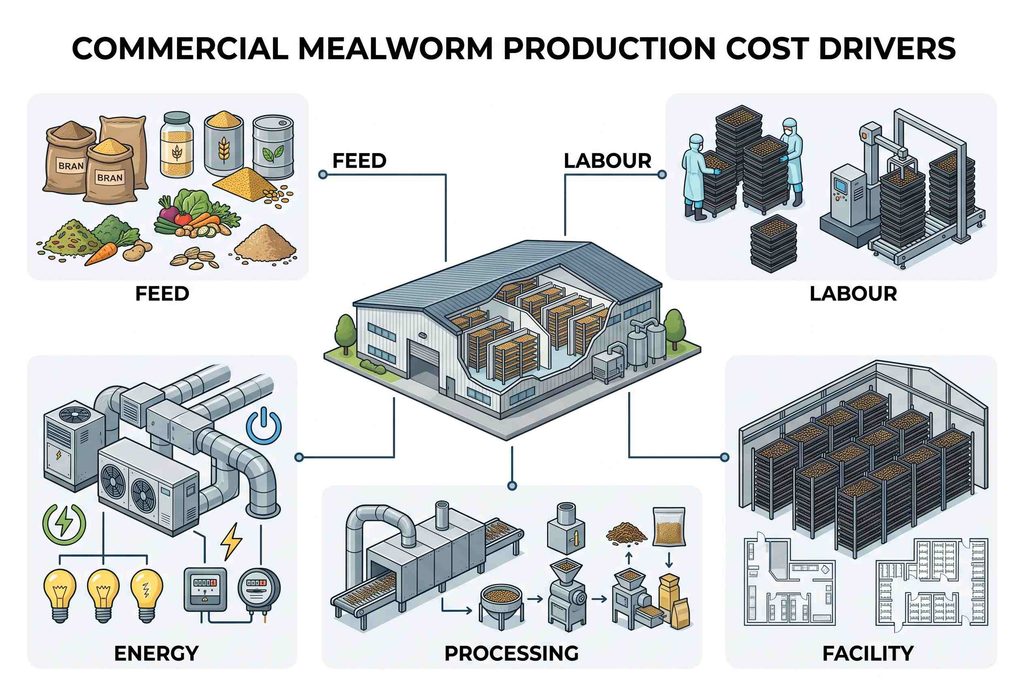
This analysis examines the main drivers of commercial mealworm production cost, including feed, labour, energy, processing, facility utilisation and biological performance.
By IIR Editorial Desk · September 25, 2026 · Market Intelligence
Understanding the Economics Behind Commercial Mealworm Production
Commercial mealworm production cost cannot be reduced to the price of feed or the cost of maintaining rearing trays. Industrial Tenebrio molitor production combines biological farming with controlled-environment infrastructure, repetitive material handling and post-harvest processing, meaning that several cost centres interact before a finished product reaches the buyer.
Published economic data remain relatively limited, and reported figures vary substantially between production systems and markets. A Wageningen University & Research review of insect-farm profitability found that feed and labour were major operational costs for T. molitor, while sales prices varied according to geography, market type and quantity sold.
This makes a universal cost-per-kilogram figure potentially misleading. A more useful commercial framework is to examine the variables that determine how efficiently a producer converts feed, labour, energy and capital into saleable mealworm products.
1. Feed Is a Major Operating Cost
Feed is one of the most direct variable inputs in mealworm farming. Commercial systems need a reliable supply of suitable dry feed materials, together with an appropriate moisture source or feeding strategy, throughout the larval growth cycle.
The economic effect depends on more than the purchase price of the substrate. Feed conversion, larval survival, development time, and final biomass yield determine how much saleable output is generated from the feed entering the facility. Wageningen’s profitability review identified feed as one of the major operating-cost components across commercial insect production systems.
A lower-cost feed material is therefore not automatically the lowest-cost production strategy. If it reduces growth performance, increases development time or produces inconsistent output, the apparent saving at the input stage can be offset elsewhere in the system.
2. Feed Conversion Changes the Economics of Biomass Production
Feed conversion provides an important link between biological performance and commercial economics. A facility that needs less feed to produce a given amount of harvestable biomass has a different cost structure from one operating with poorer conversion efficiency.
One frequently cited commercial mealworm LCA reported a concentrate feed conversion ratio of approximately 2.2 kg per kilogram of live-weight production under the system studied. The figure should not be treated as a universal industry benchmark, but it demonstrates how strongly feed requirements can influence resource use at production scale.
Commercial operators therefore need to evaluate feed cost together with conversion efficiency rather than independently. Changes in diet that appear inexpensive on a per-tonne basis may have limited economic value if they reduce the amount of usable biomass produced.
3. Labour Can Become a Major Scaling Constraint
Mealworm farming involves numerous repetitive operations, including feeding, tray movement, separation, harvesting, cleaning, and production monitoring. Small farms can perform many of these tasks manually, but labour requirements become increasingly significant as the number of production units grows.
The profitability literature identifies feed and labour as major operational costs for T. molitor. This is particularly relevant because simply adding more trays can increase handling requirements unless production systems are redesigned or partially automated.
Labour economics consequently depend on productivity rather than wages alone. The relevant question is how many kilograms of saleable product a facility can produce per unit of labour while maintaining biological performance and product consistency.
4. Automation Can Reduce Labour but Adds Capital Cost
Automation is often presented as a solution to high labour requirements. Mechanical feeding, sieving, tray movement, environmental monitoring and harvesting can reduce repetitive manual work and potentially increase throughput.
The trade-off is capital expenditure. Automated systems require equipment, integration, maintenance and sufficient utilisation to justify the investment. A highly automated facility operating well below its intended capacity may carry a larger fixed-cost burden per kilogram than a simpler system operating close to its practical limit.
The economics of automation therefore depend on scale and utilisation. The relevant comparison is not simply manual versus automated, but the total cost of achieving the required throughput and consistency under each production model.
5. Heating and Environmental Control Can Be Material Costs
Mealworms are commonly produced in controlled environments, making temperature management an important component of production economics. The cost varies substantially with climate, facility design, insulation, energy prices, and the biological conditions maintained inside the production area.
Earlier commercial-scale research in the Netherlands found that heating and electricity made substantial contributions to the energy requirements of fresh mealworm production. A more recent review of insect-farming LCAs likewise identifies heating as an important energy requirement for T. molitor, particularly in colder production environments.
This creates a geographic dimension to production economics. Two facilities using similar biological systems may face different energy requirements because ambient climate, building efficiency, and local energy prices change the cost of maintaining suitable rearing conditions.
6. Production Density Changes Facility Economics
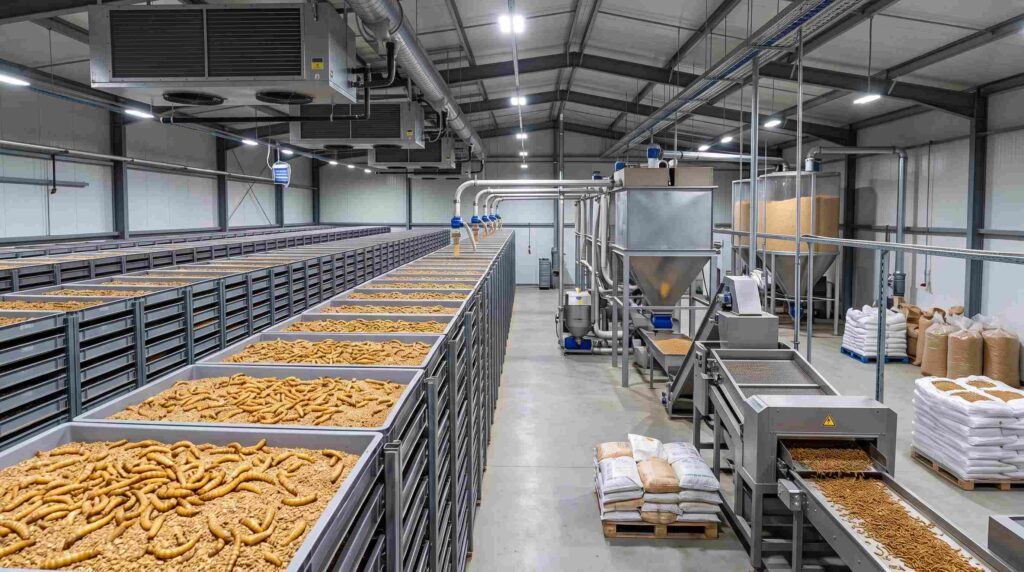
Commercial insect farming can use vertical or stacked rearing systems to generate substantial biomass within a relatively limited floor area. This can improve the utilisation of expensive production space compared with systems requiring larger horizontal areas.
Higher density, however, does not eliminate infrastructure costs. Greater biomass concentration can increase requirements for ventilation, environmental monitoring, material handling and heat management, while poorly balanced production density can affect biological performance.
The economic objective is therefore not maximum density in isolation. It is the level of production density that allows the facility to generate high and repeatable output without creating disproportionate environmental-control or handling costs.
7. Biological Performance Determines How Productive the Facility Really Is
A facility’s economics depend heavily on what happens inside the rearing system. Growth rate, survival, development time, reproductive performance and harvestable biomass all influence the amount of product generated from the same physical infrastructure.
Longer production cycles reduce the number of potential production turns over a given period. Poor survival reduces output after feed, labour and environmental resources have already been committed. Variability in larval size can also complicate harvesting and downstream processing.
This means that biological optimisation can have an economic effect even when input prices remain unchanged. Improving repeatability and yield can spread labour, energy and facility costs across a larger quantity of saleable production.
8. Drying Can Be an Important Post-Harvest Cost
Fresh larvae are not equivalent to finished dried mealworms. Water must be removed, and the processing step requires equipment, energy and time while reducing the physical mass of the product being sold.
Different drying technologies also create different cost structures. Hot-air, microwave, vacuum and freeze-drying systems differ in capital requirements, processing time, energy consumption and final product characteristics, so the cheapest process cannot be identified without considering the intended product and market.
For producers selling dried larvae or meal, economics should therefore be measured against finished saleable output, not simply kilograms of fresh larvae harvested. This distinction becomes especially important when comparing farms that sell fresh biomass with businesses that manufacture shelf-stable ingredients.
9. Further Processing Adds Cost but Can Create More Valuable Outputs
A producer can stop after drying and sell whole mealworms, or continue into milling, pressing, defatting and fractionation. Each additional processing stage adds equipment, energy, labour and yield considerations.
Research assessing mealworm meal at the mill gate identified farm electricity, processing electricity, feed intake, and meal and oil yields as important variables affecting environmental performance. Although environmental LCA is not the same as financial cost accounting, these variables highlight the resource-intensive stages that also matter when examining industrial production economics.
Additional processing can nevertheless change the commercial value of the output. The relevant economic question is whether the additional revenue generated by a processed ingredient is sufficient to compensate for the extra processing cost and any material losses involved.
10. Yield Matters as Much as Input Cost
Production economics ultimately depend on the amount of saleable material recovered from the resources entering the system. This applies both to biological production and to downstream processing.
Meal and oil yields have been identified as particularly influential variables in assessments of processed mealworm production. Lower recovery means that feed, labour, energy and facility costs are distributed across fewer kilograms of finished product.
This is why cost analysis based only on fresh-larvae output can be misleading for processed products. A more commercially useful calculation follows the production chain through to the specific product actually sold.
11. Facility Utilisation Changes Unit Economics
Industrial insect facilities carry fixed or semi-fixed costs regardless of whether every production area is operating at full throughput. Buildings, environmental systems, processing equipment and management capacity all need to be supported by commercial output.
A facility designed for large production volumes can therefore have poor unit economics during ramp-up if actual output remains well below its intended capacity. Conversely, higher utilisation can spread fixed costs across more saleable product, provided that biological performance and downstream processing remain stable.
This is one reason why announced production capacity should not be treated as equivalent to low production cost. What matters economically is how consistently the installed system is used and how much saleable output it produces.
12. Scale Can Reduce Some Costs but Increase Operational Complexity
Larger production systems can create economies of scale through automation, purchasing, labour productivity and better utilisation of specialised equipment. Evidence from an Austrian small-scale system also illustrates the importance of scale: the study concluded that its production system could not compete environmentally with larger mealworm facilities in France and the Netherlands because of differences including production scale and feed-conversion efficiency.
Scale is not automatically beneficial, however. Larger facilities require greater biological throughput, stronger process control, more reliable downstream processing and sufficient customers to absorb the resulting production.
The economically relevant question is therefore not simply how large a facility can become, but whether output, utilisation and sales can increase together.
13. Product Form Determines the Cost Base
The phrase mealworm production cost can refer to very different products. One kilogram of fresh larvae, dried whole mealworms and processed protein meal do not carry the same resource requirements or represent equivalent commercial outputs.
A producer selling fresh larvae may avoid some drying and processing costs but operate within a different logistics and customer model. Whole dried mealworms require stabilisation and drying, while protein ingredients can add milling, defatting, or fractionation.
Cost comparisons therefore need a clearly defined production boundary:
Without that distinction, apparently comparable cost-per-kilogram figures can describe fundamentally different products.
14. Market Position Determines What Cost Is Commercially Viable
Production cost cannot be analysed independently from the market in which the product is sold. Whole dried mealworms for specialty animal nutrition, mealworm meal for aquafeed and processed ingredients for pet food or human food operate under different price structures and buyer requirements.
Wageningen’s profitability review found substantial variation in insect sales prices according to geographical market, market type, and sales quantity. That means the same production cost can be commercially viable in one customer segment and uncompetitive in another.
This relationship is particularly important when producers consider moving from relatively high-value specialty markets into larger feed markets. Higher potential volume does not necessarily compensate for the lower price tolerance of commodity-oriented buyers.
15. The Cost Equation Is a System, Not a Single Input
Commercial mealworm economics can be represented as a connected system:
Feed + Labour + Energy + Facility + Processing + Logistics
This is deliberately a conceptual framework rather than a universal cost formula. Actual accounting also needs to incorporate depreciation, financing, maintenance, packaging, quality control, overhead, and other company-specific expenses.
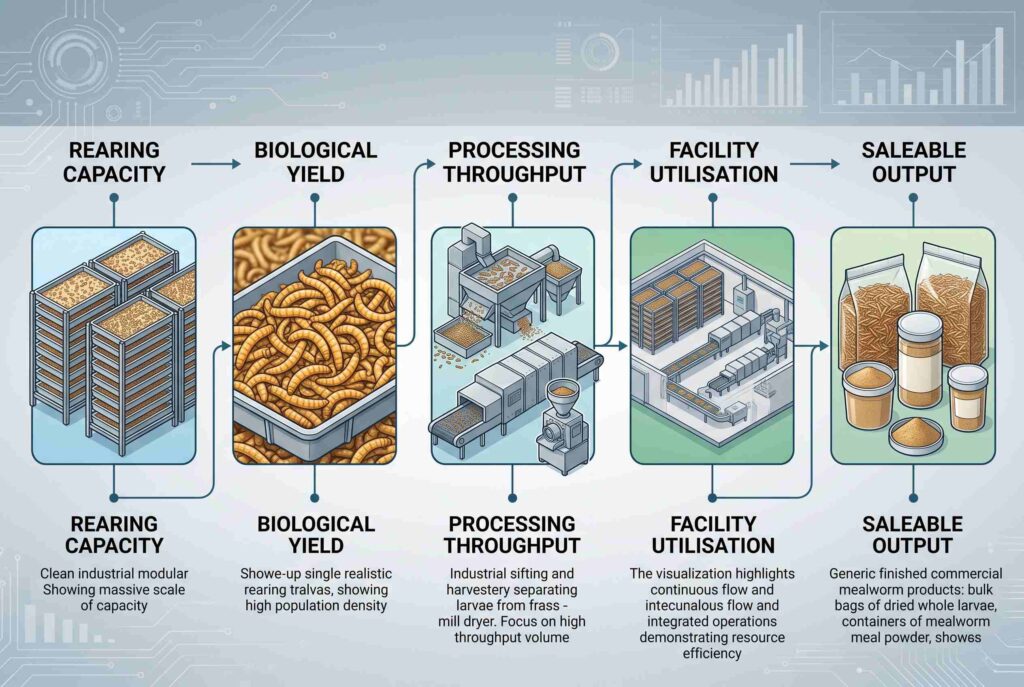
Its value is in showing why reducing one input does not necessarily produce the lowest overall mealworm production cost. Commercial performance depends on how efficiently the entire production system converts resources and installed capacity into products that customers will actually buy.
IIR Analysis
The economics of mealworm production are sometimes simplified around cheap feed, efficient land use or the potential for automation. Published research suggests a more complicated picture in which feed, labour and energy interact with biological performance, processing yield and production scale.
The distinction between fresh biomass and finished commercial product is particularly important. Drying and further processing require additional resources while reducing or redistributing product mass, meaning that farm-level output alone cannot explain the economics of dried mealworms or processed ingredients.
Facility utilisation may become equally important as the sector industrialises. Large automated facilities can theoretically improve labour productivity and throughput, but their fixed-cost advantages depend on maintaining sufficient biological output and commercial demand.
For IIR, the strongest indicator of improving industry economics is therefore not simply lower feed prices or larger announced capacity. It is the ability to produce more consistent saleable output from the same combination of feed, labour, energy and installed infrastructure, while maintaining a product value sufficient to support the production model.
Disclaimer: This article is for informational purposes only and does not constitute business, legal or investment advice. Always consult primary sources and qualified professionals.