Independent intelligence for the global insect industryISSUE 01 · 2026
Mealworm Market Demand: Feed, Pet Food and Emerging Applications
By IIR Editorial DeskSeptember 25, 2026
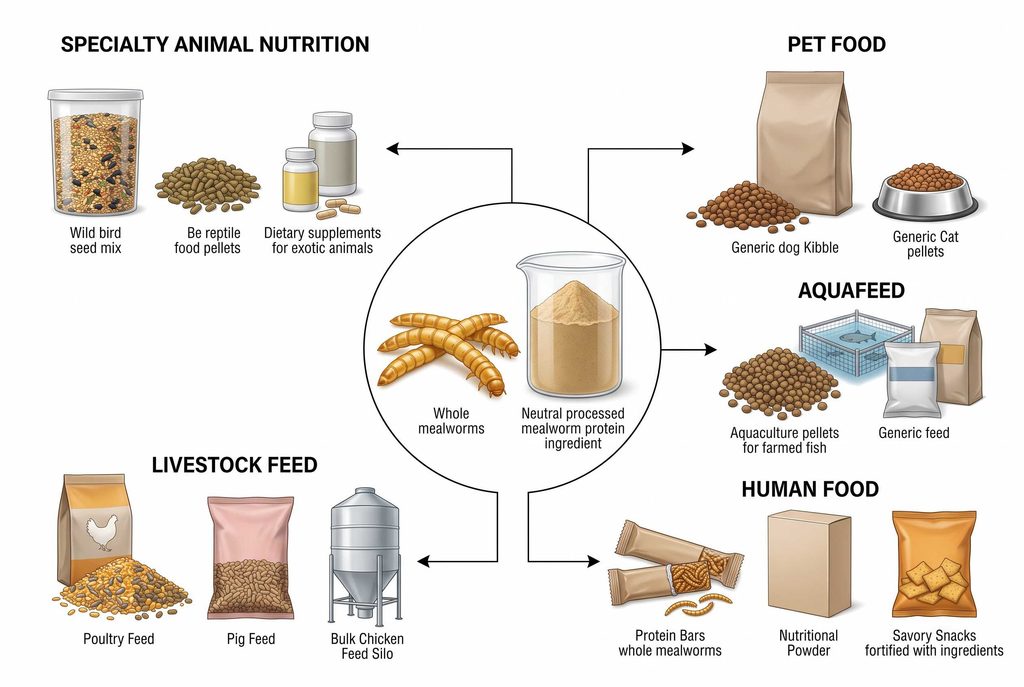
Mealworm demand spans specialty animal nutrition, pet food, aquafeed and livestock feed, while food and processed ingredients create additional commercial opportunities. This analysis examines where demand is established, developing and emerging.
This analysis examines where commercial demand for mealworm products is developing, from specialty animal nutrition and pet food to aquafeed, livestock feed, human food and emerging higher-value applications.
By IIR Editorial Desk · September 25, 2026 · Market Intelligence
Where Is Commercial Demand for Mealworm Products Developing?
Commercial mealworm market demand is not concentrated in a single application. Tenebrio molitor can be sold as whole larvae, dried whole products, full-fat meal, or more processed ingredients, allowing producers to serve markets ranging from bird and reptile nutrition to aquafeed, pet food, and human food.
These markets should not be treated as equally mature. Whole mealworms already have an established role in specialty animal nutrition, while mealworm meal has been extensively investigated for aquaculture and livestock feed. Human-food applications have obtained regulatory pathways in markets including the European Union, but regulatory authorisation does not by itself demonstrate equivalent levels of consumer demand.
The commercial question is therefore not simply how many potential applications exist. What matters is which markets can combine technical suitability, regulatory access, buyer acceptance, available supply and commercially workable pricing.
1. Specialty Animal Nutrition Provides an Established Demand Base
Whole mealworms have long been associated with birds, reptiles, ornamental fish and other specialty animal markets. In these applications, the insect can remain recognisable rather than being processed into an anonymous protein ingredient.
That changes how buyers evaluate the product. Whole dried mealworms may be purchased according to size, colour, cleanliness, physical integrity and moisture condition in addition to nutritional characteristics. Importers, wholesalers, pet businesses and specialty-feed companies can therefore form an important part of the customer base.
This market is also structurally different from industrial feed. Volumes can be smaller and distribution more fragmented, but the insect itself contributes to the identity of the finished product. Producers are not necessarily competing only on crude protein content against commodity feed ingredients.
2. Pet Food Creates a Higher-Value Ingredient Opportunity
Pet food expands demand beyond traditional whole-insect products. Mealworm-derived ingredients can be incorporated into formulated foods where the insect functions as an alternative animal protein rather than as a visible finished product.
The commercial proposition is different from mainstream livestock feed. Pet-food brands can evaluate ingredient functionality alongside product differentiation, formulation strategy, sourcing requirements, and consumer positioning. That potentially allows ingredient value to depend on more than the lowest available protein price.
Claims nevertheless require restraint. Mealworm protein should not automatically be described as hypoallergenic or as providing specific health benefits simply because it is a novel protein source. Commercial demand may benefit from novel-protein positioning, but individual product claims require appropriate evidence and must comply with the relevant market rules.
3. Aquafeed Represents a Larger Potential Volume Market
Aquaculture is one of the most extensively researched applications for T. molitor meal. Studies have evaluated its use in species including rainbow trout, European sea bass, gilthead sea bream, Atlantic salmon, Nile tilapia and several other fish and shellfish species.
This research base makes mealworm meal commercially relevant to discussions around alternative aquafeed proteins. Reviews have examined partial and, in some experimental settings, more extensive substitution of conventional protein ingredients such as fishmeal, while also showing that outcomes depend on species, formulation, inclusion level and ingredient characteristics.
The potential addressable volume is considerably larger than traditional specialty-animal markets, but so is the economic challenge. Feed manufacturers need nutritional performance, consistent specifications, reliable volumes and a price structure that works within commercial formulations. Technical suitability therefore represents only one component of actual demand.
4. Poultry Feed Expands the Addressable Market
Yellow mealworm meal has also been extensively investigated in poultry nutrition. Research includes evaluation of T. molitor meal and oil in broiler diets, with systematic reviews examining effects on performance, gut health and other nutritional parameters.
Poultry represents a potentially large feed market, but high theoretical volume should not be confused with immediately accessible commercial demand. Large feed sectors operate under strong formulation and cost constraints, meaning alternative ingredients need to compete against established protein and energy sources.
For mealworm producers, entering these markets therefore requires more than demonstrating nutritional value. Production scale, regulatory approval, consistent composition, and cost per unit of usable nutrition all influence whether research interest develops into sustained procurement.
5. Other Livestock Applications Broaden the Research Base
Research into mealworm ingredients extends beyond aquaculture and poultry. Reviews of T. molitor as an alternative protein source have considered its potential in monogastric animal nutrition more broadly, reflecting interest in insect meal as part of future feed formulations.
The distinction between research potential and commercial demand remains important. A feeding trial demonstrating that an ingredient can be used successfully does not establish that feed manufacturers will purchase it at scale. Commercial adoption also depends on regulatory status, ingredient availability, formulation economics, and confidence in long-term supply.
This means the addressable feed market can be substantially larger than current procurement volumes. For market analysis, IIR therefore distinguishes between technical application potential and observable commercial demand.
6. Product Form Changes the Customer Base
One reason the mealworm sector can serve multiple markets is that the same insect can leave the processing chain in different forms. Each form creates a different group of potential customers and a different commercial value proposition.
A producer’s addressable market therefore depends partly on processing capability. Increasing larval production without developing the product forms required by target buyers does not necessarily expand commercial demand.
7. Human Food Creates a Distinct Demand Path
Mealworms are unusual among commercially farmed insects because they also have a formal pathway into human food in the European Union. The EU Union list includes authorisations covering dried T. molitor larvae as well as frozen, dried and powder forms; in January 2025, the Commission also authorised UV-treated powder of whole T. molitor larvae under specified conditions of use.
These authorisations create regulatory access for specified food uses rather than evidence of mass-market demand. Food applications still need to overcome issues including consumer acceptance, sensory characteristics, allergen management, formulation, labelling and price.
This distinction is particularly important for market intelligence. Regulatory approval expands the addressable market, but actual market demand needs to be demonstrated through commercial products, repeat purchasing and consumer adoption.
8. Food Formulation Can Extend Demand Beyond Whole Insects
Human-food demand does not need to depend entirely on consumers purchasing recognisable whole mealworms. Powdered and processed forms can be incorporated into formulated products, potentially changing how the insect is presented to the consumer.
EU authorisations illustrate this distinction. Specified T. molitor forms have been authorised for defined conditions of use, while the Union list records the applicable specifications and labelling requirements.
For producers, this creates a different commercial model from selling whole dried larvae. Food manufacturers require ingredient consistency, regulatory compliance and functionality within the finished formulation, moving demand towards a more conventional B2B ingredient relationship.
9. Further Processing Could Create Higher-Value Applications
As processing technology develops, mealworms can potentially be separated into more specialised protein- and lipid-rich fractions. This creates opportunities beyond basic whole insects or full-fat meal.
The commercial attraction is clear: fractionation can allow producers to target applications that value particular ingredient characteristics rather than simply purchasing insect biomass. The challenge is that additional processing adds capital, energy, technical requirements, and yield losses.
These applications should therefore be treated as developing or emerging opportunities, not automatically as established high-volume markets. Their importance will depend on whether the additional value of the processed ingredient can justify the additional manufacturing cost.
10. Market Demand Depends on Product Specifications
Potential customers do not purchase the abstract concept of “mealworm protein”. They purchase products with defined physical, nutritional, microbiological and commercial characteristics.
A whole dried mealworm buyer may care about integrity, colour and cleanliness, while an aquafeed manufacturer is more likely to focus on nutritional composition, digestibility, consistency and formulation economics. Food and pet-food manufacturers can introduce additional requirements around processing, documentation and ingredient functionality.
The mealworm market demand visible to an individual producer is therefore partly determined by its ability to manufacture the specifications buyers actually require. Two producers farming the same species can have very different addressable markets because their processing and quality capabilities differ.
11. Price Determines How Much Potential Demand Becomes Real Demand
Mealworm ingredients compete within markets that already have established protein sources. Nutritional suitability can create potential demand, but price influences whether buyers can incorporate the ingredient economically.
This pressure is particularly strong in large-volume animal-feed markets. Aquafeed and livestock-feed manufacturers operate within formulation economics where ingredient cost needs to be justified by nutritional performance, functionality or another measurable source of value.
Specialty animal nutrition and pet food can operate differently because the insect may contribute to product differentiation as well as nutrition. The same production cost can therefore support commercial demand in one segment while remaining too high for another.
12. Reliable Supply Is Part of Market Demand Development
A buyer’s willingness to formulate around an ingredient depends partly on confidence that the ingredient will remain available. Sporadic production can support occasional sales but is less suitable for manufacturers that require repeatable procurement.
This creates a relationship between production capacity and demand development. Buyers may hesitate to adopt a new ingredient if f,uture volumes, specifications or delivery schedules remain uncertain, while producers can hesitate to expand capacity before long-term customers are established.
Commercialisation therefore develops through both sides of the market. Producers need customers to justify scale, while customers need credible supply before they can commit significant demand.
13. Regulation Defines the Commercial Market Boundary
An application can be technically feasible but commercially inaccessible if the relevant product is not authorised for the intended use in the destination market. Food and feed regulations therefore define which parts of theoretical demand are actually addressable.
The EU provides a clear example on the food side. Novel foods require authorisation before being placed on the Union market, and authorisations can specify product forms, conditions of use, specifications and additional labelling requirements.
Regulatory status should therefore be incorporated into market-demand analysis rather than treated as a separate administrative issue. The commercially relevant market is the intersection of technical application, regulatory permission, buyer acceptance, supply availability and viable economics.
14. Emerging Demand Should Be Separated From Established Demand
One of the easiest ways to overstate the mealworm market is to combine every experimental application into a single demand narrative. Research activity, regulatory approval, product launches, and repeat industrial procurement represent different stages of commercial development.
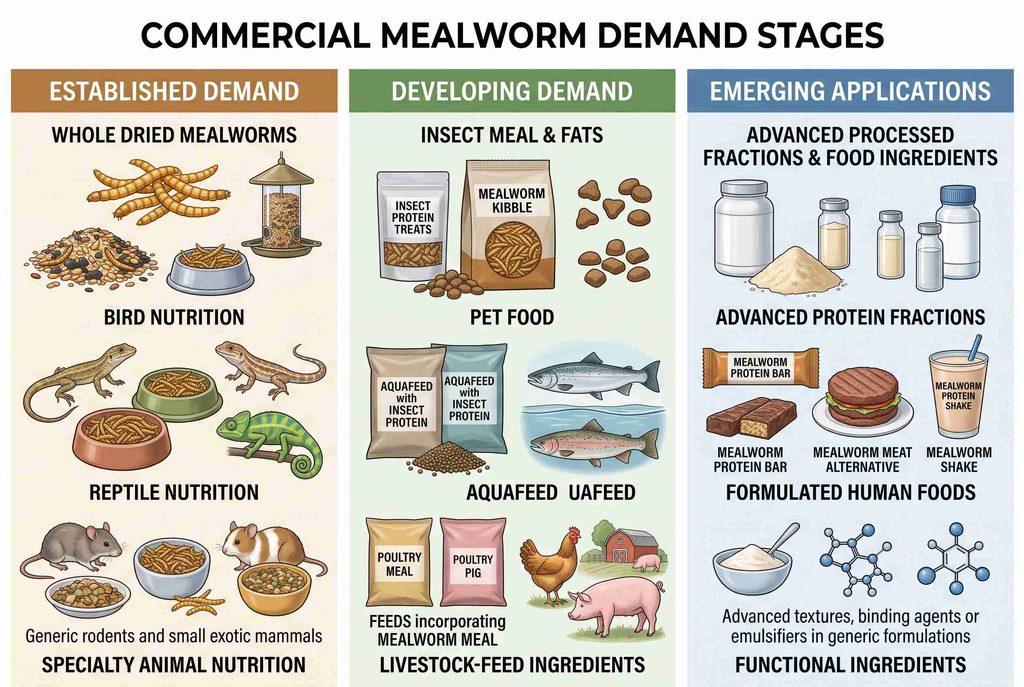
For IIR analysis, the market is more usefully viewed through three levels:
Established Demand Whole mealworms for bird, reptile and specialty animal nutrition.
Developing Demand Pet food and selected feed applications where commercialisation exists but economics, supply and adoption continue to develop.
Emerging / Application Potential More specialised fractions, new formulated-food uses and other applications where technical development may be ahead of broad commercial adoption.
These categories are analytical rather than fixed market classifications. Applications can move between them as regulation, production economics, customer adoption and supply capacity change.
What Could Drive the Next Stage of Mealworm Demand?
The next stage of demand development will depend partly on whether producers can reduce the gap between technical potential and commercial reality. Lower production costs, improved automation and greater facility utilisation could make mealworm ingredients accessible to applications with tighter formulation economics.
Processing will also matter. Producers able to offer different product forms can address a broader range of customers, but only if those products solve a genuine procurement or formulation requirement. More processing does not automatically create more demand.
Regulatory expansion can open additional markets, while reliable supply can make existing applications easier for manufacturers to adopt. The strongest demand growth is therefore likely to occur where regulatory access, product performance, consistent supply and workable economics develop together.
IIR Analysis
The mealworm market demand is structurally more diverse than a single “alternative protein” narrative suggests. Whole dried insects, meal, processed ingredients and human-food products serve different customers and compete under different commercial conditions.
Specialty animal nutrition provides an established commercial base, while aquafeed and livestock nutrition offer substantially larger theoretical volumes but stronger price pressure. Pet food can support a different value proposition, while human food has achieved important regulatory milestones without those approvals necessarily demonstrating mass-market consumer adoption.
For IIR, the most important distinction is therefore between addressable market and realised demand. Scientific research can establish technical suitability, and regulation can establish legal market access, but realised demand requires repeat purchasing at commercially sustainable prices.
As the sector develops, repeat procurement, product-specific sales, utilisation of actual production capacity and expansion into economically sustainable customer segments will provide stronger evidence of market development than the number of potential applications alone.
Disclaimer: This article is for informational purposes only and does not constitute business, legal or investment advice. Always consult primary sources and qualified professionals.