Canadian black soldier fly producer Entosystem is exploring aquafeed expansion, but its existing Drummondville facility is largely committed to the backyard poultry market, making a second factory central to its growth strategy.
Canadian black soldier fly producer Entosystem is exploring a move into aquaculture feed, but strong demand from its existing backyard poultry customers means significant expansion will require a second industrial facility.
By IIR Editorial Desk · November 3, 2026 · Company Watch
Entosystem aquafeed ambitions are taking shape as the Canadian insect producer considers how to expand beyond its established market for whole dried black soldier fly larvae. The company operates an industrial facility in Drummondville, Quebec, where food-industry residues are converted into insect ingredients and organic fertilizer. However, most of its existing output is already committed to buyers in the backyard poultry market, making additional production capacity central to its aquaculture strategy.
Founded in 2016, Entosystem has pursued a gradual commercialization model rather than moving immediately into large-volume aquafeed supply. Its approach combines food waste recovery, industrial insect farming, and sales to customers willing to pay for specialized animal nutrition products.
In The Fish Site’s November 2 interview, president and co-founder Cédric Provost explained how the company has developed its manufacturing operations, established existing markets, and begun evaluating opportunities for a second production facility.
Entosystem’s Industrial Production Model
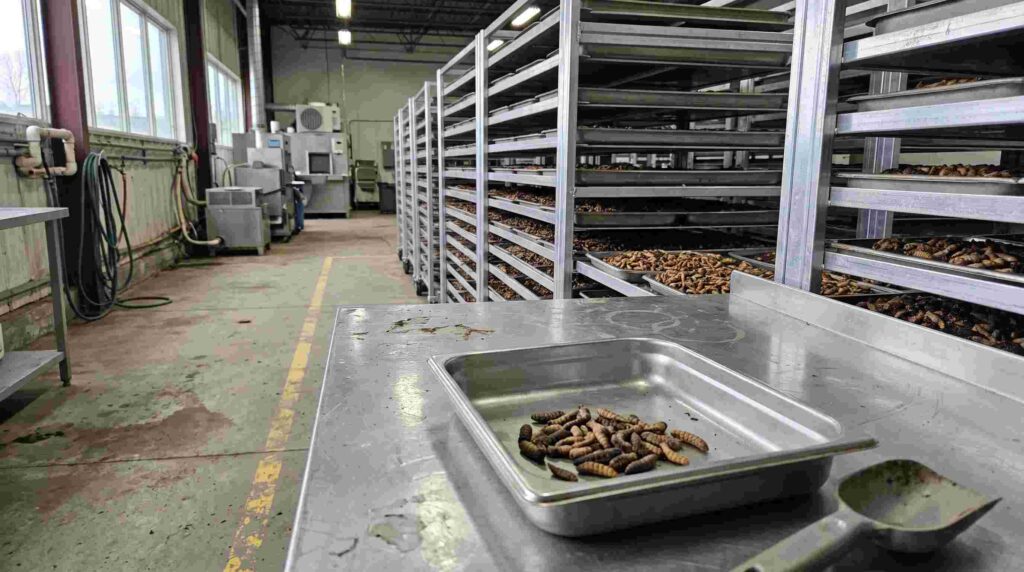
Entosystem opened its Drummondville industrial facility in 2023. The approximately 9,300-square-meter plant was designed to process up to 90,000 metric tons of organic material annually, producing approximately 5,000 metric tons of dried black soldier fly larvae and 15,000 metric tons of frass-based fertilizer.
These figures represent the facility’s designed annual capacity rather than confirmed production volumes. According to the recent interview, the first production phase reached full operating capacity in January 2026, while equipment installed during the summer was intended to bring the second phase toward maximum output.
The company has received more than C$60 million in public and private investment associated with its Drummondville operations. A separate C$58 million investment package announced in October 2024 involved Idealist Capital, Sanimax, and Fondaction and was intended to support growth and further expansion.
These investments are part of the company’s existing development history, not newly announced financing in November 2026.
Entosystem uses black soldier fly larvae (Hermetia illucens) to convert suitable organic materials into valuable products. Its system combines feedstock preparation, controlled insect rearing, harvesting, processing, and product quality management.
Food Waste Recovery and Feedstock Logistics
An important feature of Entosystem’s business model is its relationship with Sanimax, a company specializing in the recovery and processing of organic by-products.
Sanimax provides investment support and helps coordinate feedstock sourcing and transportation. This relationship allows Entosystem to access non-meat organic materials from supermarkets and food-processing businesses, including fruit and vegetable residues, bakery leftovers, and other suitable materials.
The Drummondville location provides logistical access to the Montreal and Quebec City regions. By using existing transportation routes and available return capacity, the company aims to limit additional transportation requirements.
Feedstock consistency remains a technical challenge. Unlike standardized industrial feed ingredients, recovered food materials can vary in composition, moisture content, and nutritional characteristics.
Entosystem addresses this variability through feedstock preparation and adjustments to larval diets. According to the company, its nutrition team modifies feeding formulations to maintain consistent production performance and finished-product characteristics.
This capability matters commercially because low-cost raw materials do not necessarily produce low-cost ingredients. Handling, sorting, nutritional balancing, contamination control, and transportation can all influence the economics of insect production.
Why Backyard Poultry Remains the Main Market
Entosystem currently focuses much of its commercial output on whole dried black soldier fly larvae sold primarily to backyard chicken owners in the United States.
This market differs substantially from industrial aquaculture feed manufacturing.
Backyard poultry products are sold as specialized feed supplements or treats, allowing producers to serve consumers purchasing relatively small quantities. Aquafeed manufacturers, by contrast, generally require substantial ingredient volumes, consistent specifications, competitive delivered prices, and dependable long-term supply.
The company’s existing commercial strategy reflects these differences.
Rather than pursuing large aquafeed contracts before establishing reliable manufacturing capacity, Entosystem initially concentrated on customers whose purchasing requirements could develop alongside its production capabilities.
A smaller share of its output is already supplied to pet food applications.
The company reports that almost all production from the Drummondville facility is already committed to its existing backyard poultry market. This limits how much additional volume it can allocate to aquaculture without expanding capacity.
Why Entosystem Aquafeed Expansion Requires Another Factory
Entosystem’s interest in aquaculture became more visible during 2026, when company representatives attended the Global Shrimp Forum in Utrecht to evaluate potential industry opportunities.
The company sees aquafeed as a possible next market for black soldier fly ingredients, but recognizes that commercial aquaculture customers have different requirements from its existing buyers.
One challenge is pricing. Industrial aquafeed ingredients compete within cost-sensitive formulations, where manufacturers consider nutritional performance, ingredient availability, processing characteristics, and delivered cost.
Another challenge is production volume. Large feed manufacturers need suppliers capable of delivering consistent quantities without significant interruptions.
Entosystem believes a second facility could allow it to develop production specifically for aquaculture rather than diverting output from existing customers.
The company has discussed potential locations in North and Latin America, considering feedstock availability, climate conditions, transportation distances, and proximity to aquaculture markets.
However, no final location, confirmed construction schedule, or completed second-factory commissioning has been established in the November interview.
The company also sees insect-derived ingredients as potential functional components in aquafeed, rather than necessarily positioning them as direct replacements for all fishmeal.
Environmental performance is another important part of Entosystem’s commercial positioning.
On September 1, 2026, the company announced that greenhouse gas emission reductions associated with its ENVOL project had received independent third-party verification in accordance with ISO 14064-3 requirements.
The project was registered with the CSA Group’s EcoProjects greenhouse gas registry, providing a framework for generating and commercializing eligible carbon credits.
Entosystem estimates that, at full operating capacity, its food waste recovery project could avoid more than 23,000 metric tons of carbon dioxide equivalent emissions annually.
This is a projected annual avoidance figure linked to the project, not an independently established total of emissions already avoided during 2026.
The distinction is important because verification of emission reductions under a defined project methodology does not automatically establish that every insect ingredient produced by the company has a negative product-level carbon footprint.
The company has also developed methods to recover heat generated during larval growth, potentially reducing the external energy required for parts of the production environment.
These measures provide useful evidence of environmental management, but buyers evaluating individual feed ingredients still need appropriate product-level environmental data.
IIR Analysis: Market Selection Before Production Expansion
Entosystem illustrates a commercially relevant distinction within the insect protein industry: production capacity, product format, and target market must be developed together.
Many industrial insect companies have focused on producing large quantities of insect meal for commercial feed manufacturers. Entosystem has instead developed a substantial market for whole dried larvae before pursuing a larger position in aquaculture ingredients.
This approach may provide an opportunity to match production growth with existing demand while limiting exposure to the lower pricing typically associated with bulk industrial feed markets.
However, it also creates a strategic constraint. Capacity allocated to established customers cannot automatically be redirected toward aquafeed without affecting existing commercial commitments.
The challenge becomes more complex when moving from whole dried larvae into processed aquaculture ingredients.
As outlined in IIR’s analysis of BSFL aquafeed applications, commercial feed formulations may use full-fat or defatted insect meals with defined nutritional specifications. These products differ from whole dried larvae in processing requirements, composition, and procurement expectations.
From IIR’s perspective, a second Entosystem facility should therefore be evaluated on more than its planned processing capacity. The important questions include what ingredient format it will produce, its expected operating cost, the availability of suitable feedstocks, and whether customers will commit to commercially meaningful purchasing volumes.
The company’s existing logistics arrangements offer another potential advantage. Its relationship with Sanimax helps connect organic material recovery with industrial production, although similar partnerships may need to be developed or adapted in new regions.
Entosystem’s environmental verification also deserves careful interpretation. Credible project-level emission reductions can support its circular economy strategy, but commercial feed buyers may require separate life-cycle assessments and product-specific environmental information.
The broader lesson is that scaling insect production does not necessarily require every company to enter the largest available market first. Matching production capabilities with customer economics can be just as important as expanding manufacturing capacity.
What to Watch Next
The next major development will be whether Entosystem announces a confirmed location and financing structure for its second industrial facility.
Its intended product format, annual capacity, customer commitments, and projected production economics will be particularly important for evaluating the proposed aquafeed expansion.
Further disclosures on actual output from Drummondville would also help distinguish installed production capacity from sustained commercial performance.
In environmental reporting, future project-level emission reduction data and product-specific life-cycle assessments could provide additional clarity for buyers evaluating the sustainability of insect-derived ingredients.
For the wider insect industry, Entosystem represents a model built around recovered food materials, established customer demand, and gradual production expansion.
Its next commercial test will be whether that approach can support a competitive move into aquaculture feed without compromising the operational reliability and customer relationships developed during its first decade.