Scottish foodtech startup The Insect Café has secured £160,000 in revenue-based financing to develop local cricket protein production, with a new consumer protein powder planned for early 2027.
Edinburgh-based foodtech startup The Insect Café has secured £160,000 in revenue-based financing to bring cricket protein production in-house and prepare its Nahla’s Insect Nutrition product line for a planned early 2027 launch.
By IIR Editorial Desk · November 4, 2026 · Company Watch
Cricket protein startup The Insect Café has secured £160,000 in funding to expand local insect-based food production in Edinburgh, Scotland. The investment will support the company’s transition toward in-house cricket farming and processing as it prepares to launch a new single-ingredient protein powder under the Nahla’s Insect Nutrition brand in early 2027.
The financing comes from the Catalyst Fund, managed by Scottish social investor Firstport, through a revenue-based financing arrangement. Unlike conventional equity investment, this model links repayments to business revenue, offering a potentially more flexible financing structure for a growing food enterprise.
According to The Edinburgh Reporter’s November 3 coverage, the funding follows support from The Ventures Lab, which helped the startup develop its business plan, growth strategy, and investment proposition.
£160K Funding Supports Cricket Protein Production
The new investment is intended to help The Insect Café move key stages of its operations in-house, including cricket farming, processing, and product distribution.
The company aims to develop a more integrated production model in Scotland rather than relying entirely on external suppliers for insect ingredients. The proposed change could provide greater control over production schedules, ingredient consistency, and traceability as its business expands.
The funding was arranged through the Ventures Catalyst partnership, with Firstport providing the financial support. The Ventures Lab, established by the Challenges Group, assisted the business in preparing for investment.
The Catalyst Fund uses a revenue-based financing model under which repayments are linked to trading income. This differs from a conventional bank loan with fixed monthly repayments and from equity financing involving the sale of ownership shares.
For an emerging food business, the arrangement may provide flexibility during the transition from product development to commercial manufacturing. However, the financing still creates repayment obligations, and its commercial benefits will depend on future sales and operating performance.
From Insect-Based Baking to Consumer Nutrition
The Insect Café was founded by ecologist and baker Nahla Mahmoud in 2023. The business initially developed insect-based baked goods, including products made with cricket flour, and introduced them to consumers through local markets and events in Edinburgh.
These early activities helped the company engage directly with customers and understand responses to insect-derived foods. Rather than presenting insects exclusively as an unfamiliar alternative protein source, the business incorporated them into recognizable products such as brownies, cakes, and snacks.
The company’s next product, Nahla’s Insect Nutrition, is intended to extend this approach into everyday protein supplementation.
The planned powder contains a single insect-derived ingredient and is designed for use in food and drink applications. Unlike conventional protein supplements containing multiple formulated ingredients, the product is being positioned around simplicity and ingredient transparency.
The company already sells cricket flour and other insect-containing products. The planned 2027 launch therefore represents an expansion into a new branded nutrition product and production model, not its first experience selling edible insect ingredients.
The challenge will be converting initial consumer curiosity into consistent purchasing demand beyond occasional food experiences and specialty market events.
Local Manufacturing and Commercial Expansion
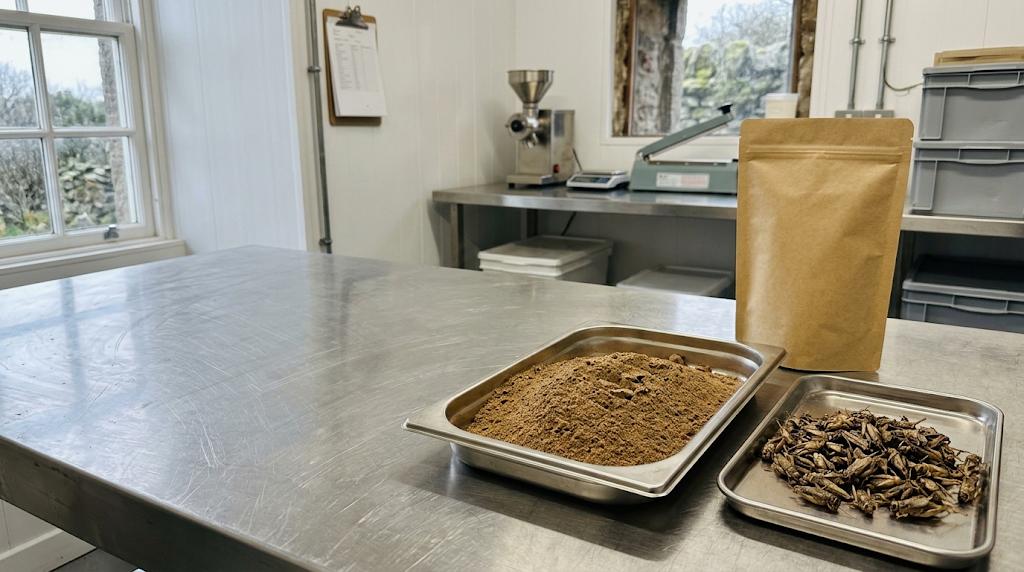
The Insect Café aims to establish local production capacity by bringing cricket farming, harvesting, and processing into its own operations.
An integrated production system could allow the business to exercise greater control over ingredient sourcing and manufacturing. However, it would also require investment in suitable rearing facilities, biological production management, food safety controls, and processing infrastructure.
Cricket farming presents operational challenges involving temperature management, feed consistency, harvesting, and biomass processing. Finished powders must also meet relevant moisture, microbiological, compositional, and traceability specifications.
Local manufacturing may shorten certain supply routes, but it does not automatically guarantee lower production costs or environmental impacts. Energy consumption, facility utilization, processing yields, and packaging requirements will influence the outcome.
The company’s early 2027 launch target will therefore depend on more than obtaining financing. It must demonstrate that its production system can consistently deliver a suitable consumer ingredient at a commercially acceptable cost.
UK Novel Food Rules Remain Important
Regulatory compliance represents another important consideration for cricket protein products intended for human consumption in Scotland.
Under the Great Britain novel food framework, edible insects are subject to specific market authorization and transitional arrangements. Food Standards Scotland identifies house crickets (Acheta domesticus) and banded crickets (Gryllodes sigillatus) among the species covered by qualifying applications submitted before the end of 2023.
However, these transitional arrangements are conditional. The inclusion of a species within the eligible categories does not automatically establish that every cricket powder, processing method, or supplier arrangement is authorized.
The specific species, ingredient form, supply chain, and relevant authorization conditions must be considered when assessing compliance.
Commercial producers must also address general food safety responsibilities, appropriate labeling, and potential allergen risks associated with insect-derived ingredients.
The publicly available funding announcement does not provide enough information to independently confirm the regulatory status of the planned Nahla’s Insect Nutrition product.
Its commercial launch should therefore be monitored alongside any relevant food safety, product specification, and regulatory disclosures.
IIR Analysis: Can Cricket Protein Move Beyond Niche Foods?
The commercial significance of The Insect Café’s funding lies in its attempt to move cricket protein from specialty food experiences toward a repeatable consumer nutrition business.
The company has already used insect-based bakery products to engage customers and introduce unfamiliar ingredients through recognizable food formats. A single-ingredient protein powder represents a different purchasing proposition, where customers may compare nutritional value, convenience, taste, safety, and price against established supplements.
This creates an important distinction between consumer food markets and industrial insect ingredient markets.
As discussed in IIR’s overview of cricket meal production, ingredient specifications and processing methods can vary substantially across cricket-derived products. Food-grade products intended for human consumption also face distinct regulatory, safety, labeling, and quality requirements.
From IIR’s perspective, bringing production in-house could provide greater operational control, but it will also expose the company more directly to farming and processing costs.
Revenue-based financing is particularly relevant in this context. By linking repayments to sales, the Catalyst Fund may provide more flexibility than fixed repayment structures, although the business must still generate sufficient revenue to cover production expenses and financing obligations.
The decision to focus on a minimally formulated protein powder also presents a market positioning challenge. Consumers already have access to widely available whey, soy, pea, and other protein products supported by established manufacturing and distribution networks.
For cricket protein to establish a recurring customer base, its differentiated characteristics must justify any price premium and overcome concerns about insect consumption.
The company’s local production strategy may provide an additional selling point, particularly for customers interested in ingredient traceability and regional supply chains. However, environmental and economic advantages should be supported by measured production data rather than assumed from the use of insects alone.
The broader lesson is that successful food innovation requires more than an unusual ingredient. Consumer acceptance, regulatory eligibility, repeat purchasing, manufacturing efficiency, and reliable distribution must develop together.
What to Watch Next
The first milestone will be the planned early 2027 introduction of Nahla’s Insect Nutrition.
Commercial details such as product pricing, nutritional specifications, cricket species, manufacturing arrangements, and distribution channels will provide a clearer picture of the company’s position in the consumer protein market.
Another important development will be the completion of its transition toward in-house cricket farming and processing. Actual production capacity, operating costs, and quality assurance systems will be more informative than the initial financing announcement alone.
Customer retention and repeat purchasing will also be important indicators of commercial progress.
For the wider edible insect industry, The Insect Café offers an example of a small food business seeking to expand from locally tested specialty products into a more standardized nutrition category.
Whether that strategy succeeds will depend on the company’s ability to combine consumer acceptance, compliant manufacturing, reliable supply, and commercially sustainable product economics.