Independent intelligence for the global insect industryISSUE 01 · 2026
Black Soldier Fly Market Demand: Feed, Pet Food and Emerging Applications
By IIR Editorial DeskSeptember 23, 2026
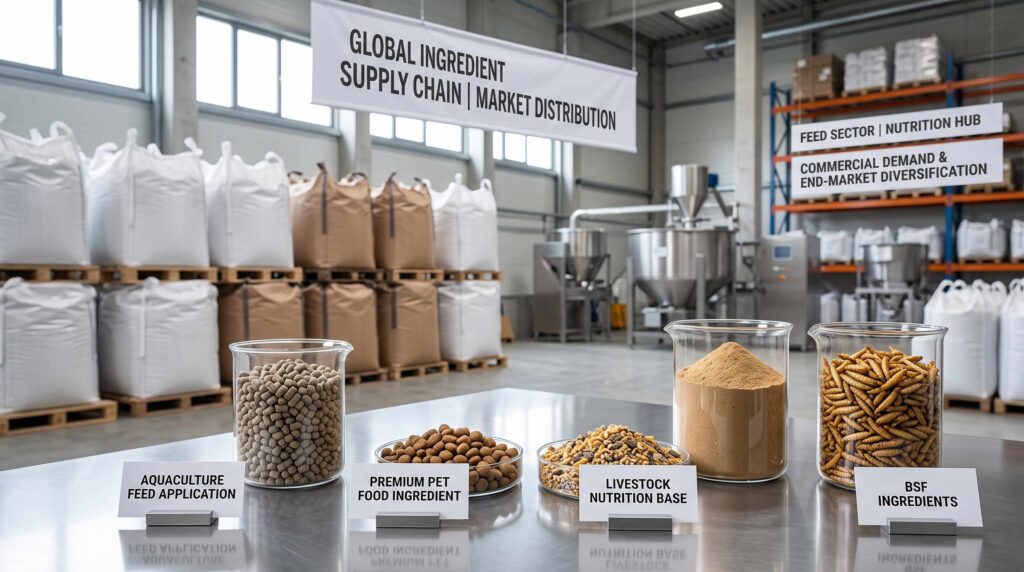
Black soldier fly demand is developing across aquafeed, pet food and livestock nutrition, while BSF oil, frass and higher-value applications create additional commercial opportunities.
This analysis examines where commercial demand for black soldier fly ingredients is developing, from aquafeed and pet food to livestock nutrition and emerging higher-value applications.
By IIR Editorial Desk · September 23, 2026 · Market Intelligence
Where Is Commercial Demand for Black Soldier Fly Products Developing?
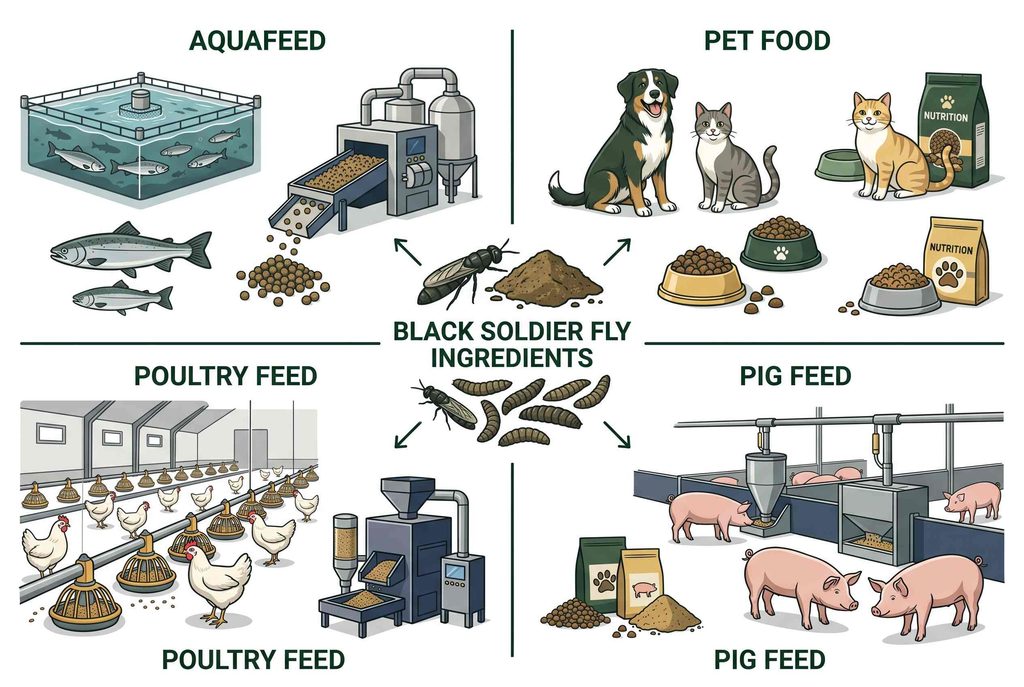
Commercial black soldier fly market demand is developing across several distinct markets rather than a single end-use sector.
Aquaculture has attracted attention because BSF meal can be incorporated into formulations traditionally dependent on fishmeal and other protein ingredients. Pet food offers a different commercial proposition, with insect protein and oil positioned around nutrition, novel proteins and product differentiation. Poultry and pig feed create another potentially large-volume market where regulations permit insect-derived ingredients.
Beyond animal nutrition, BSF production also creates oil, frass and other materials that can serve separate commercial applications.
These markets should not, however, be treated as equally mature.
Regulatory access, ingredient specifications, pricing, available production volumes and customer requirements vary significantly between applications. In the EU, for example, processed insect proteins from authorised insect species, including Hermetia illucens, are permitted in aquaculture, poultry and pig feed, while insect-derived products also have established routes into pet-food applications.
Understanding demand therefore requires looking beyond the total theoretical market for animal protein.
The more useful question is:
Where can BSF ingredients solve a specific commercial problem at a price and specification buyers are prepared to accept?
1. Aquafeed Is a Major Target Market
Aquaculture has been one of the most extensively studied applications for BSF protein.
Feed manufacturers need protein sources capable of supporting fish and shrimp nutrition while managing cost, ingredient availability, and formulation requirements. Fishmeal remains nutritionally important in many aquaculture feeds, but supply constraints and sustainability considerations have encouraged research into alternative proteins.
BSF meal fits into this discussion because its protein and amino-acid characteristics allow it to replace a portion of conventional protein ingredients in some formulations.
A substantial body of feeding research has evaluated BSFL meal across fish and shrimp species, although effective inclusion levels and nutritional outcomes depend on processing, formulation, and the species being fed.
Commercial demand therefore does not simply arise from the idea that insect protein is “sustainable.”
BSF ingredients must compete within that framework.
This distinction matters because aquaculture represents a potentially large-volume market, but large-volume feed markets can also be highly sensitive to ingredient economics.
2. Pet Food Creates a Different Demand Profile
Pet food represents a different commercial opportunity.
Rather than competing exclusively as a commodity protein source, BSF ingredients can be positioned around novel protein, digestibility, sustainability and specialised formulations.
Black soldier fly protein and fat have already been studied for use in companion-animal diets. Reviews report the use of insects in dry and wet foods and treats, while research has examined digestibility and acceptance in dogs.
This creates a potentially different value proposition from mainstream livestock feed.
A pet-food manufacturer may be able to justify an ingredient based not only on its protein content but also on product differentiation or formulation objectives.
That distinction can make pet food particularly relevant for producers whose BSF ingredients cannot compete solely on cost with conventional bulk proteins.
However, market positioning still requires caution.
Terms such as “hypoallergenic” or other health-related claims depend on formulation, evidence, and the regulatory environment. The presence of BSF protein alone should not automatically be treated as proof of a particular health outcome.
3. Poultry and Pig Feed Expand the Addressable Market
Poultry and pig feed can substantially broaden the potential demand base for insect protein.
In the European Union, processed animal protein from authorised farmed insects can be used in feed for poultry and pigs under the applicable regulatory framework. This followed earlier authorisation for aquaculture and expanded the range of livestock markets accessible to insect producers.
From a market perspective, these sectors are attractive because of their scale.
But a large addressable market does not automatically translate into immediate commercial demand.
Mainstream livestock-feed formulations operate under strong cost constraints. Ingredient buyers typically evaluate nutritional value relative to established alternatives, supply reliability, and the ability to procure consistent volumes.
This creates a different commercial challenge from premium pet food.
For BSF producers, the question is not simply whether poultry or pigs can consume insect protein. It is whether insect ingredients can reach the combination of price, volume, consistency, and performance required by industrial feed manufacturers.
4. Whole Larvae Serve More Specialised Markets
Not all BSF demand is based on processed protein meal.
Whole dried or live larvae can serve markets including birds, reptiles, ornamental fish and other specialty animal applications.
These markets are typically smaller than industrial feed sectors, but the commercial structure can be attractive because the insect itself is the product rather than merely an input into a feed formulation.
Whole-insect markets may therefore place greater value on physical characteristics such as size, appearance, cleanliness, moisture and product integrity.
They also involve different distribution channels.
Instead of selling bulk protein meal directly to a large feed manufacturer, suppliers may work with pet-food businesses, specialty-feed brands, distributors, wholesalers and retailers.
This illustrates an important characteristic of BSF demand:
Volume is not the only measure of market attractiveness.
Smaller specialised applications can sometimes support different margins and product specifications from industrial feed markets.
5. BSF Oil Creates a Separate Commercial Market
Protein is only one commercial output from BSF processing.
When larvae are processed and partially defatted, the separated lipid fraction creates another ingredient stream.
BSF oil has potential applications in animal nutrition, including pet food and livestock feed. Research has examined its fatty-acid composition and possible role in canine and feline formulations, although the evidence base and commercial adoption remain less developed than for BSF protein.
This matters economically because producers do not necessarily need to recover the value of the larval biomass from protein meal alone.
A processing model that generates both protein and oil can serve multiple customer groups.
Demand for the two products, however, may develop differently.
A producer with strong demand for protein meal still needs an economically viable outlet for its lipid fraction if defatting is part of the processing strategy.
Product-market balance therefore becomes important when evaluating commercial demand.
6. Frass Adds an Agricultural Demand Stream
BSF production also generates residual material commonly marketed as frass or related soil inputs, depending on processing and regulatory classification.
This creates an agricultural market distinct from animal feed.
Potential customers can include growers, horticultural businesses, fertilizer companies, and distributors of soil products.
From a commercial perspective, frass is important because it can create value from material that exists alongside insect biomass production.
But its economic contribution should not be assumed.
Regulatory definitions, nutrient characteristics, product consistency, transportation economics, and local fertilizer markets influence whether frass becomes a meaningful revenue stream.
For large BSF facilities, the question is therefore not simply whether frass can be produced.
It is whether sufficient local or regional demand exists to absorb the volume generated by insect production.
7. Emerging Applications Could Increase the Value of BSF Biomass
BSF research increasingly extends beyond conventional feed ingredients.
Potential higher-value applications include biomaterials and compounds derived from insect biomass, including chitin and chitosan-related products. Industry research in Asia has also explored materials such as chitosan and melanin from BSF production.
These applications are strategically interesting because they could allow producers to extract additional value from insect biomass.
However, they should be separated from established feed demand.
An application demonstrated in research or pilot production is not automatically a mature commercial market.
Scaling higher-value products may require additional extraction technology, quality standards, regulatory approvals and specialised customers.
For market analysis, IIR therefore distinguishes between:
Established commercial applications → Developing applications → Research-stage opportunities
This avoids overstating demand simply because a technically possible use has been identified.
8. Market Demand Depends on Product Form
“BSF demand” is not a single market because buyers purchase different products.
A feed manufacturer looking for defatted protein meal has different requirements from a pet-food brand sourcing whole dried larvae.
A buyer of BSF oil evaluates another specification set, while a fertilizer distributor operates in a separate market entirely.
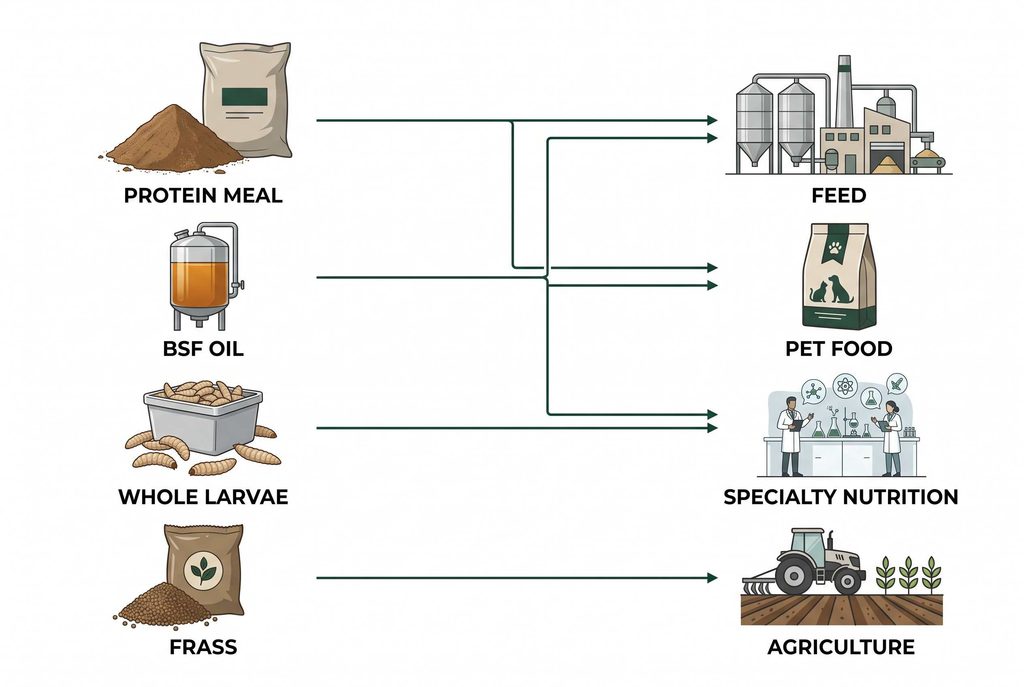
Demand therefore needs to be mapped against product form:
Whole larvae → Specialty animal and pet markets
Protein meal → Aquaculture, poultry, pig and pet-food formulations
This product-level view is more useful than treating all BSF output as interchangeable.
It also explains why processing strategy affects market access.
A producer’s equipment determines which products it can manufacture, while those products determine which customers it can realistically serve.
9. Price Determines How Much Potential Demand Becomes Real Demand
A market may be technically accessible without being commercially accessible.
This distinction is particularly important for insect protein.
Large feed sectors can theoretically absorb significant quantities of alternative protein, but buyers still compare BSF ingredients with fishmeal, soybean meal and other established inputs.
If the price premium is too high relative to the nutritional or functional value delivered, the addressable market can shrink considerably.
Premium markets operate differently.
Pet food, specialty animal nutrition and certain differentiated products may tolerate a higher ingredient cost when the ingredient supports positioning or formulation objectives.
As a result, the same BSF product may face very different demand conditions depending on the customer segment.
Commercial market demand is therefore shaped by the interaction of:
Performance + Price + Availability + Regulation + Customer Value
rather than market size alone.
10. Reliable Supply Is Part of Demand Development
Demand cannot develop independently from supply.
Large customers are unlikely to redesign formulations around an ingredient that is available only intermittently or in insufficient volume.
Buyers may require predictable specifications, batch consistency, documentation, and delivery schedules before moving beyond trials into routine purchasing.
This creates a feedback loop.
More reliable production can encourage larger commercial commitments, while stronger demand can support investment in additional production capacity.
Conversely, uncertain demand can make producers cautious about expansion, while limited production capacity can prevent buyers from adopting the ingredient at scale.
The development of the BSF market therefore depends on supply and demand maturing together.
11. Regulation Defines the Commercial Market Boundary
Regulation does more than determine whether a product is legally permitted.
It effectively defines which parts of theoretical demand are commercially accessible.
A BSF ingredient may be technically suitable for several applications while being authorised for only some of them in a particular jurisdiction.
Rules can also differ between protein meal, fat, whole insects and other derivatives.
This means market-demand analysis must always be geographically specific.
A commercial opportunity in the European Union may not have the same regulatory status in the United States, Asia, or another destination market.
For international producers, regulatory access therefore becomes part of market selection rather than a compliance issue considered only after a customer has been identified.
What Could Drive the Next Stage of Demand?
Several factors could determine whether BSF demand moves from specialised applications toward broader commercial adoption.
Greater production scale could improve ingredient availability. More consistent specifications could reduce procurement risk. Additional feeding data could increase buyer confidence. Regulatory expansion could open new applications.
Price competitiveness will remain important, particularly in high-volume feed markets.
At the same time, growth does not necessarily need to come from a single dominant application.
BSF producers can potentially serve a portfolio of markets with different value structures: larger feed applications for protein volume, premium pet-food applications, oil markets, agricultural demand for frass, and emerging higher-value products.
The commercial challenge is matching each output with a market capable of valuing it.
IIR Analysis
The development of the black soldier fly industry should not be measured solely by the theoretical size of the global animal-feed market.
The more important indicator is the amount of demand that BSF producers can realistically access at commercially viable prices and specifications.
Aquafeed provides an established route for insect protein research and commercial adoption. Poultry and pig feed expand the potential volume base where regulations permit their use. Pet food offers a different proposition built around specialised formulations and product differentiation, while oil, frass and emerging derivatives create additional demand channels.
These markets will not develop at the same pace.
For BSF producers, the strongest commercial strategy may therefore be less about finding one enormous market and more about aligning each production output with the customer segment that values it most.
Disclaimer: This article is for informational purposes only and does not constitute business, legal or investment advice. Always consult primary sources and qualified professionals.