Zimbabwe's FISH4ACP aquaculture program has reported estimated annual economic benefits of $3.6 million. The assessment highlights stronger tilapia production and local feed innovation, including black soldier fly-based ingredients.
Zimbabwe’s FISH4ACP program has reported estimated annual economic benefits of $3.6 million, highlighting improvements in tilapia production and the potential for locally produced black soldier fly feed to reduce costs for fish farmers.
By IIR Editorial Desk · November 9, 2026 · Latest Coverage
Zimbabwe aquaculture development is generating renewed attention after officials associated with the FISH4ACP program reported estimated annual economic benefits of approximately US$3.6 million. The assessment attributes the gains to increased fish production, improved farming practices, and savings from locally developed feed innovations. Black soldier fly larvae have played a role in the program’s efforts to identify lower-cost alternatives to conventional fish feed ingredients.
According to The Herald’s November 9 report, the program has invested approximately US$2 million in Zimbabwe and reached more than 4,200 aquaculture farmers. The latest figures, attributed to Food and Agriculture Organization (FAO) officials, suggest that the program has created measurable economic opportunities across the tilapia value chain. However, the reported benefits are estimates covering several interventions, rather than verified revenue generated exclusively by insect-based feed.
Zimbabwe Aquaculture Program Reports $3.6M in Annual Benefits
FISH4ACP is an initiative of the Organisation of African, Caribbean and Pacific States, implemented by FAO with financial support from the European Union and Germany’s Federal Ministry for Economic Cooperation and Development. In Zimbabwe, the program has focused on strengthening the tilapia industry through improved farming practices, access to quality fingerlings, affordable feed, and stronger market connections. The latest assessment presented during a program legacy event in Harare estimates that these activities contribute approximately 1,909 additional metric tons of fish production annually, representing about US$3.53 million in additional fish sales.
When estimated feed cost savings are included, the reported annual economic benefits rise to approximately US$3.6 million. Officials also cited a modeled benefit-cost ratio of 2.92 to 1, suggesting that the project’s economic assessment identifies a positive return from its interventions. This ratio is a separate evaluation result and should not be calculated by simply dividing the reported annual benefits by the approximately US$2 million invested. The published summary does not provide all the assumptions, time horizons, or discounting methods needed to independently reproduce that calculation.
Improved Farming Practices Support Higher Production
The program has supported fish farmers through training, technical assistance, equipment, and improved access to agricultural services. FAO’s November 5 update reported that more than 1,500 small-scale farmers had adopted improved management practices, including better pond maintenance, water quality monitoring, fish health management, and business planning. The initiative has also contributed to stronger producer organizations and market connections, helping farmers address constraints that extend beyond the availability of feed ingredients.
Access to quality fingerlings has been another priority. Government research facilities and local distribution hubs have received support intended to improve the availability of suitable young fish, while producer groups have gained opportunities to coordinate purchasing and marketing. These measures are important because fish growth, survival, and profitability depend on several interacting factors. Affordable feed can improve farm economics, but successful aquaculture production also requires suitable stocking practices, reliable water management, disease prevention, and access to buyers.
Black Soldier Fly Feed Offers Potential Cost Savings
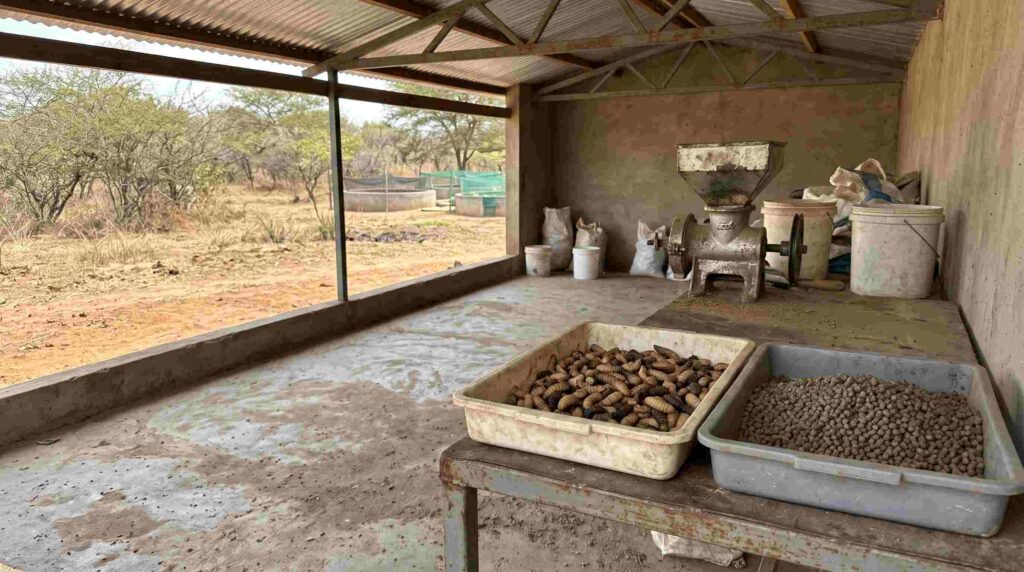
One of the program’s notable innovations has been the development and testing of fish feed containing black soldier fly larvae (Hermetia illucens). Research conducted with Chinhoyi University of Technology has investigated whether insect-derived ingredients can substitute for conventional protein sources while maintaining acceptable fish growth performance. The November 9 report highlights potential feed cost reductions of approximately 40%, consistent with earlier FAO findings that estimated savings could range from 15% to 40% under different production conditions.
These figures describe potential savings in the cost of formulated feed, not a guaranteed reduction in total fish farming expenses. Actual results depend on insect production costs, raw material availability, feed formulation, nutrient balance, processing efficiency, and transportation. FAO has previously described how locally sourced black soldier fly ingredients can be incorporated into tilapia diets, potentially reducing reliance on more expensive conventional protein sources. However, successful experimental performance does not automatically establish that every farm can obtain equivalent savings or that insect-based ingredients are commercially competitive in every market.
Local Feed Enterprises Show Early Commercial Progress
The FISH4ACP initiative has also supported local entrepreneurs seeking to make alternative feed production more accessible to farmers. One example is Aquadelicacy, a feed business operated by Fortune Garapo in Zimbabwe’s Honde Valley. According to FAO, the company supplies feed to more than 300 farmers and has received technical and equipment support through the program. Garapo previously estimated that incorporating black soldier fly ingredients could reduce his production cost from approximately US$1 per kilogram of conventional feed to US$0.60–0.75 per kilogram, depending on the formulation.
This example illustrates the potential importance of regional feed businesses in connecting insect production with commercial aquaculture demand. Rather than requiring every fish farmer to breed insects and manufacture feed independently, specialized producers could provide formulated products to a wider customer network. Nevertheless, expanding such operations will require dependable supplies of suitable rearing substrates, consistent insect biomass, controlled processing, feed quality assurance, and distribution networks. FAO has also identified technical and administrative requirements that must be addressed before black soldier fly-based feed can become more widely commercialized.
Economic Estimates Require Careful Interpretation
The economic figures reported in November should be considered alongside earlier FISH4ACP assessments. In an October 1 update, FAO estimated that supported interventions contributed slightly more than 1,000 additional metric tons of fish production annually, valued at approximately US$3.03 million in sales, with around US$57,000 in annual savings attributed to black soldier fly feed innovations. The November 9 newspaper report subsequently cited 1,909 additional metric tons and approximately US$3.53 million in extra annual fish sales. The publicly available summaries do not explain whether the difference reflects revised modeling assumptions, a broader group of beneficiaries, updated production estimates, or another change in methodology.
These figures should therefore not be interpreted as evidence that fish production increased by nearly 900 metric tons in a single month. Similarly, the overall US$3.6 million annual benefit estimate should not be presented as the revenue of the black soldier fly feed sector. The figure covers multiple aspects of the wider aquaculture development program, while insect-based feed represents one contributing innovation. Additional information on evaluation methodology, actual feed adoption, and the separation of production gains from cost savings would help establish a clearer picture of the industry’s economic performance.
IIR Analysis: Can Insect Feed Benefits Continue Beyond Project Support?
The FISH4ACP experience highlights an important distinction between successful development projects and sustainable commercial supply chains. Publicly supported training, equipment, and research can help establish new production capabilities, but long-term viability depends on whether farmers and feed manufacturers can continue operating profitably without ongoing subsidies. For black soldier fly-based feed, the critical questions include the cost of collecting suitable substrates, maintaining insect colonies, processing harvested larvae, manufacturing finished feed, and delivering consistent products to fish farms.
As discussed in IIR’s earlier overview of BSFL aquafeed applications, the commercial value of insect-derived ingredients depends on digestible nutrients, formulation compatibility, quality consistency, and delivered cost. A lower ingredient price is beneficial only if the finished diet continues to support satisfactory fish growth, feed conversion, and health. In Zimbabwe, the potential advantages of black soldier fly production must therefore be evaluated as part of complete feed manufacturing economics rather than through insect biomass costs alone.
From IIR’s perspective, the most meaningful development would be evidence that locally produced insect-based feed can attract repeat purchases at commercially sustainable prices. Businesses such as Aquadelicacy provide early examples of how local feed manufacturing may connect research with farmer demand, but reliable financial and operational data are still needed. The broader economic assessment is encouraging, yet the next stage should be measured through sustained production volumes, independently verifiable cost savings, product quality, and market performance after donor-supported activities decline.
What to Watch Next
The next priority for Zimbabwe’s aquaculture sector will be converting project-supported innovations into stable businesses and institutions. Future updates should clarify how many farms are regularly purchasing black soldier fly-based feed, the volumes being manufactured, and whether cost savings remain consistent as production expands. More detailed disclosure of the FISH4ACP economic assessment would also help explain differences between previously published estimates and the latest reported figures.
Access to financing, reliable fingerling supply, feed manufacturing capacity, and cold-chain infrastructure will remain important as the industry develops. For the wider insect sector, Zimbabwe offers a useful example of how black soldier fly feed may contribute to aquaculture growth, while also demonstrating that biological performance and potential cost savings must ultimately be supported by commercially repeatable results.