A Danish Refugee Council black soldier fly initiative in Kenya's Dadaab Refugee Complex has expanded beyond its initial 40 participants, bringing approximately 50 additional farmers into a community-based production model supporting poultry feed, vegetable growing, and local livelihoods.
A black soldier fly farming initiative in Kenya’s Dadaab Refugee Complex is expanding participation among refugee and host-community farmers, connecting insect production with poultry feeding, vegetable cultivation, and local livelihood opportunities.
By IIR Editorial Desk · November 5, 2026 · Latest Coverage
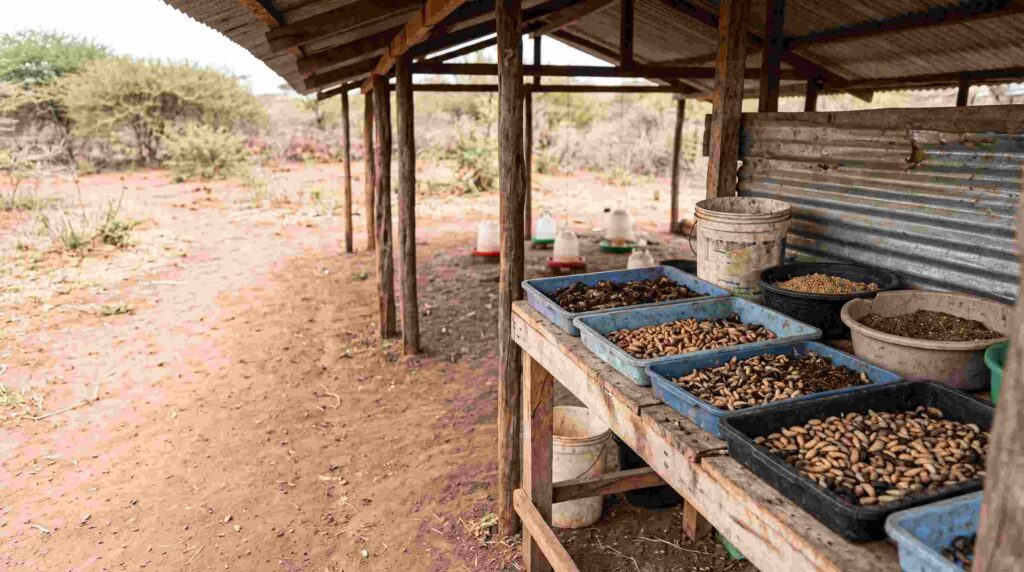
Black soldier fly farming in Kenya is gaining a new community-based example as the Danish Refugee Council (DRC) expands its Model Hub initiative in Dadaab. The project uses black soldier fly larvae (Hermetia illucens) to convert suitable organic materials into locally produced poultry feed inputs and soil amendments, creating opportunities for participating households to improve agricultural production while developing supplementary income sources.
Launched in 2024 with support from UNHCR, the project initially involved 40 refugee participants. Subsequent support from the European Union through the Area-Based Livelihood Initiative Garissa (ABLI-G II) has enabled approximately 50 additional farmers from refugee and host communities to join. According to the Danish Refugee Council’s November 3 project update, the initiative is developing a decentralized production network built around a central larvae supply facility, household rearing activities, and emerging local market connections. The participation figures represent phased program expansion, not 90 independently established commercial insect farms.
How Black Soldier Fly Farming in Kenya Works
The Dadaab initiative uses a central Model Hub to provide early-stage black soldier fly larvae and technical support to participating farmers. Instead of requiring each household to maintain a complete breeding operation, farmers can purchase larvae approximately five days after hatching and continue raising them using locally available suitable organic materials. This approach separates early-stage biological production from household grow-out activities, potentially reducing the equipment, space, and technical expertise required for individual farmers to begin insect rearing.
The model also creates a coordinated relationship between a specialized larvae supplier and a network of small producers. Farmers can concentrate on feeding, managing, and harvesting larvae while receiving support from the central facility. However, reliable biological inputs remain essential: larvae quality, transport conditions, feedstock suitability, and production management can influence the performance of the entire network. As participation increases, the Model Hub must maintain consistent input supply and practical training arrangements to support farms operating under different household conditions.
Connecting Insect Production With Poultry and Vegetable Farming
The project integrates insect rearing with existing agricultural activities, particularly poultry keeping and vegetable cultivation. Harvested larvae can serve as locally produced poultry feed inputs, while appropriately handled residual material from insect production may be used to improve soil conditions. DRC has also established connections with poultry supplier Uzima Chicks, helping farmers obtain birds at approximately two months of age. This combination offers households potential benefits from both feed production and the sale or consumption of agricultural products.
The project report describes one participant, Maimuna, who collected 120 eggs from six hens over 20 days and reported that a tray of 30 eggs could sell for up to KES 900, depending on local conditions. This illustrates a possible household income opportunity, although the example cannot be treated as the average financial outcome of the project. Other participants sell vegetables through shops and markets in Dadaab, Ifo, and Hagadera. Together, these activities demonstrate how small-scale insect farming can form part of a wider agricultural livelihood system rather than functioning as an isolated protein production enterprise.
Expansion Brings New Distribution and Market Challenges
As the production network grows, the project is exploring ways to connect individual producers with more organized markets. DRC is working with ZeHunger Solutions to support technical assistance, input distribution, and potential purchasing relationships. One proposal involves establishing an aggregation center where black soldier fly products and poultry eggs could be collected from participating farmers before reaching larger buyers. Such an arrangement could help overcome the difficulty of marketing relatively small production volumes from geographically dispersed households.
However, aggregation also introduces requirements for transportation, grading, weighing, storage, and consistent product handling. Farmers located farther from the central hub already face challenges when collecting young larvae, making shared transport arrangements an important potential improvement. The proposed aggregation center has not yet been confirmed as an operational commercial facility, and public project information does not establish long-term purchasing contracts or verified average farm profitability. Its success will depend on whether the network can develop reliable distribution channels while keeping participation affordable for small producers.
IIR Analysis: Can Decentralized Insect Farming Scale?
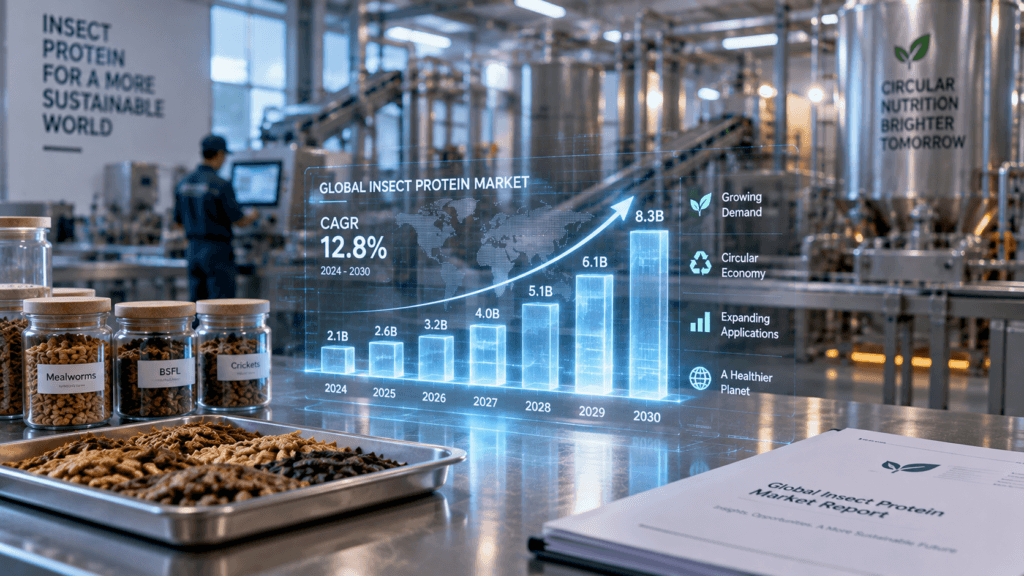
The Dadaab initiative offers a different commercial development model from the large industrial black soldier fly factories that dominate much of the insect protein investment discussion. Centralized facilities generally integrate breeding, rearing, harvesting, processing, and distribution within a single industrial system, where production efficiency and equipment utilization strongly influence operating costs. Dadaab instead distributes part of the production process among individual households, potentially reducing the initial investment required from each participant while creating opportunities for local agricultural activity.
This approach has similarities to the regional black soldier fly demonstration facilities previously covered by IIR in India, where technical training and local production infrastructure are used to encourage wider adoption. However, decentralized production presents additional challenges involving feedstock variation, temperature management, harvesting schedules, hygiene, and finished-product consistency. A central larvae supply facility may simplify early-stage production, but it does not automatically guarantee that material harvested by different farmers will meet common quality standards.
From IIR’s perspective, the project’s long-term commercial value will depend on whether farmer participation can develop into a reliable supply network. Useful indicators include household output, larvae input costs, poultry feed savings, transport expenses, product sales, and the share of income retained by farmers. The proposed aggregation center could eventually improve market access, but its economic viability must be demonstrated through actual operations. Growth in participation is an encouraging development indicator, not proof that the model has already achieved sustainable profitability at scale.
What to Watch Next
The most important next milestone is the development of reliable collection and distribution arrangements for participating farmers. Establishing a functioning aggregation center, improving access to young larvae, and securing predictable buyers could strengthen the project’s transition from training and initial production toward a more coordinated local supply chain. Future reporting on production volumes, household costs, feed savings, and sales would help determine whether the model delivers measurable and sustainable financial benefits.
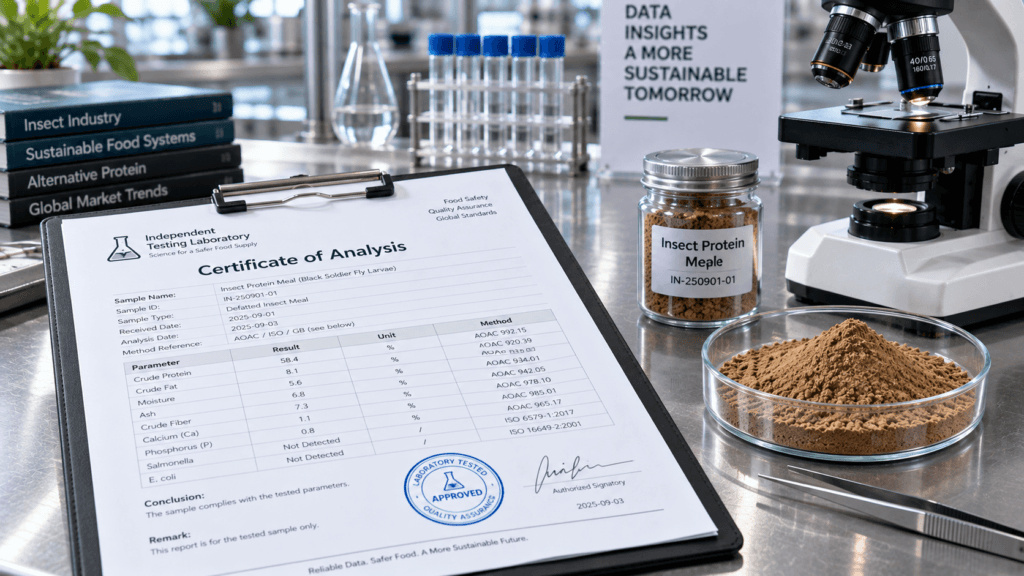
Quality management will become increasingly important as the network expands. Practical standards for substrate selection, insect handling, harvesting, storage, and product grading could help maintain consistency across multiple small producers. For the wider insect industry, Dadaab provides an example of how coordinated community-level black soldier fly production might support local agricultural livelihoods without relying entirely on capital-intensive industrial facilities. Its broader significance will depend on whether the model can achieve reliable supply, manageable costs, and lasting benefits for participating communities.