AIDA and Germany-based Eclose GmbH have promoted black soldier fly technology in India’s Nagaland state, highlighting its potential for organic waste recovery and decentralized waste management. By IIR Editorial Desk…
AIDA and Germany-based Eclose GmbH have promoted black soldier fly technology in India’s Nagaland state, highlighting its potential for organic waste recovery and decentralized waste management.
By IIR Editorial Desk · October 18, 2026 · Latest Coverage
The ANMA Integrated Development Association (AIDA), in collaboration with Germany-based Eclose GmbH, held a workshop in Dimapur, Nagaland, in mid-October 2026 to explore the use of black soldier fly technology for organic waste management and agricultural resource recovery.
The event, organized under the Waste Insect Nexus for Growth & Sustainability (WINGS) initiative, brought together government officials and representatives from social and educational institutions to discuss practical applications of insect-based waste processing.
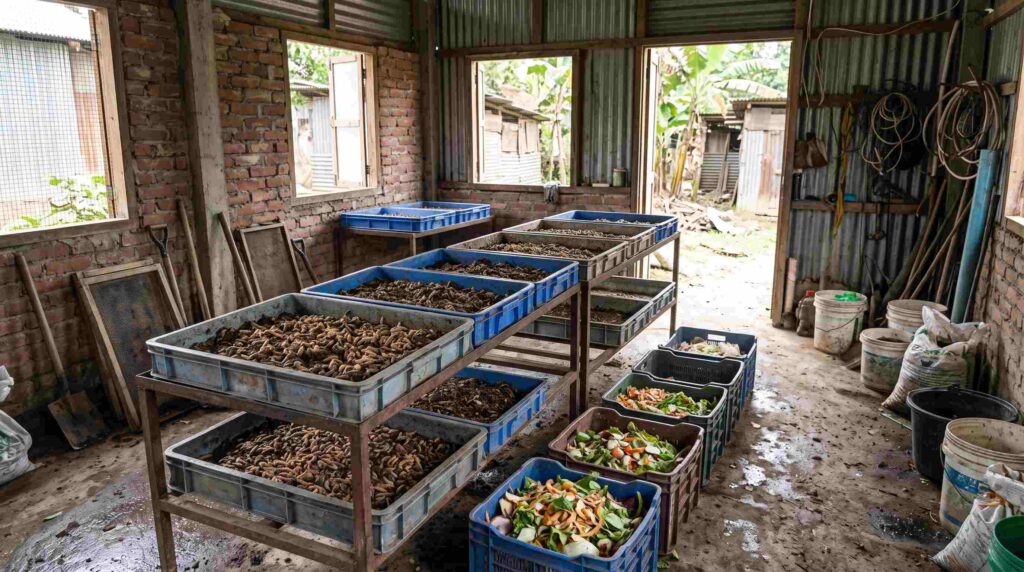
According to The Morung Express, participants examined the potential of black soldier fly larvae to process suitable organic waste streams. The program also included a visit to an existing WINGS demonstration facility.
The workshop focused on technology awareness, practical learning, and stakeholder cooperation. It was not announced as the commissioning of a new commercial-scale insect production facility.
Black Soldier Fly Technology and Organic Waste Recovery
Black soldier fly larvae can convert suitable organic materials into insect biomass through a biological process that reduces the amount of material remaining after larval feeding.
Depending on feedstock quality and applicable regulations, harvested larvae may be processed into ingredients for animal feed. Residual material from the process may also have agricultural applications following appropriate treatment and quality assessment.
For communities facing increasing volumes of organic waste, insect-based bioconversion represents one potential approach to recovering useful resources rather than relying entirely on disposal.
However, successful waste processing requires more than introducing larvae into organic materials. Waste must be properly separated, unsuitable substances must be excluded, and production conditions must be managed to support reliable biological performance.
Substrate handling, moisture control, temperature, hygiene, and downstream product management all affect the practicality of insect-based systems.
These requirements are particularly important in decentralized waste management, where facilities may operate with smaller budgets, different feedstock streams, and more limited technical resources than centralized industrial plants.
Six Demonstration Facilities Support Regional Adoption
AIDA representatives reported that the organization has established six black soldier fly demonstration facilities across Arunachal Pradesh, Nagaland, Manipur, and Assam.
The centers are intended to demonstrate the technology, support practical training, and encourage adoption among interested communities, agricultural producers, institutions, and other stakeholders.
The regional approach may allow smaller facilities to investigate how insect-based waste processing fits local collection systems and agricultural practices.
Demonstration operations can also help identify practical challenges involving feedstock preparation, insect rearing, harvesting, residue management, and the handling of finished products.
Nevertheless, the existence of demonstration facilities does not establish that the technology is commercially competitive.
Publicly available information from the workshop does not provide comparable figures for processing capacity, production costs, insect yields, revenue, or operating profitability across the six locations.
Such information would be necessary to assess whether the approach could be expanded into a reliable commercial system.
Government and Institutional Participation
Dimapur Deputy Commissioner Dr. Tinojongshi Chang attended the event and emphasized the potential contribution of black soldier fly technology to waste reduction and local economic activity.
The workshop also highlighted the importance of cooperation among public departments, local institutions, and organizations involved in agricultural and environmental development.
This coordination matters because organic waste recovery involves several connected activities: collection, segregation, transportation, processing, product quality management, and downstream sales.
A black soldier fly facility cannot resolve the entire waste management process independently. Its performance depends partly on whether suitable organic materials can be supplied consistently and whether the resulting products have practical destinations.
Government and institutional engagement may help address infrastructure and coordination challenges, although sustainable operations still require technical competence and reliable financing.
IIR Analysis: The Economics of Decentralized BSF Systems
The AIDA–Eclose initiative raises a practical question for decentralized insect production: can small regional facilities achieve sufficient operating efficiency without the scale advantages of centralized industrial plants?
Smaller systems may benefit from access to nearby organic waste streams and shorter collection routes. However, they may also face higher unit costs for equipment, technical supervision, quality control, and downstream product processing.
The commercial opportunity therefore depends on more than demonstrating that black soldier fly larvae can process organic waste. Future assessments should examine waste treatment capacity, operating costs, product consistency, and whether the resulting materials can be sold into reliable local markets.
This distinction is especially important for communities considering small-scale insect farming as part of municipal waste management. A facility that successfully processes organic material may still struggle financially if the cost of collecting, preparing, and handling waste exceeds the value of its outputs.
Conversely, decentralized operations may prove useful where local conditions support consistent feedstock collection, low transport requirements, and demand for suitable agricultural products.
The important question is not whether small or large facilities are universally better. It is which operating model delivers reliable waste processing and commercially viable products under local conditions.
Without comparable financial and production data, the existing facilities should be viewed primarily as demonstrations of technical potential rather than evidence of an economically proven waste management model.
What to Watch Next
The next important developments will involve measurable operating results from the demonstration facilities and evidence of wider local adoption.
Useful indicators would include the quantity of organic waste processed, the consistency of larvae production, operating costs, technical staffing requirements, and the quality of resulting agricultural products.
Additional partnerships with municipal waste collectors, agricultural businesses, or feed manufacturers could also provide evidence of progress beyond technical demonstration.
For the wider insect industry, the AIDA–Eclose collaboration illustrates continued interest in decentralized black soldier fly applications, particularly where waste management and agricultural development are closely connected.
Its long-term significance will depend on whether local facilities can demonstrate reliable operations, sustainable economics, and practical integration with existing waste and agricultural systems.