Independent intelligence for the global insect industryISSUE 01 · 2026
Whole Dried Insects Specifications: What Commercial Buyers Should Compare
By IIR Editorial DeskOctober 26, 2026
Whole dried insects specifications help commercial buyers compare product identity, moisture, physical integrity, nutritional composition, safety testing and packaging requirements. This guide explains how to establish practical acceptance criteria and evaluate supplier offers on an equivalent basis.
Whole dried insect products are not interchangeable across species, processing methods or physical grades. This guide explains how commercial buyers compare moisture, integrity, size distribution, nutritional composition, laboratory evidence and delivered procurement costs.
By IIR Editorial Desk · October 26, 2026 · Buyer Guides
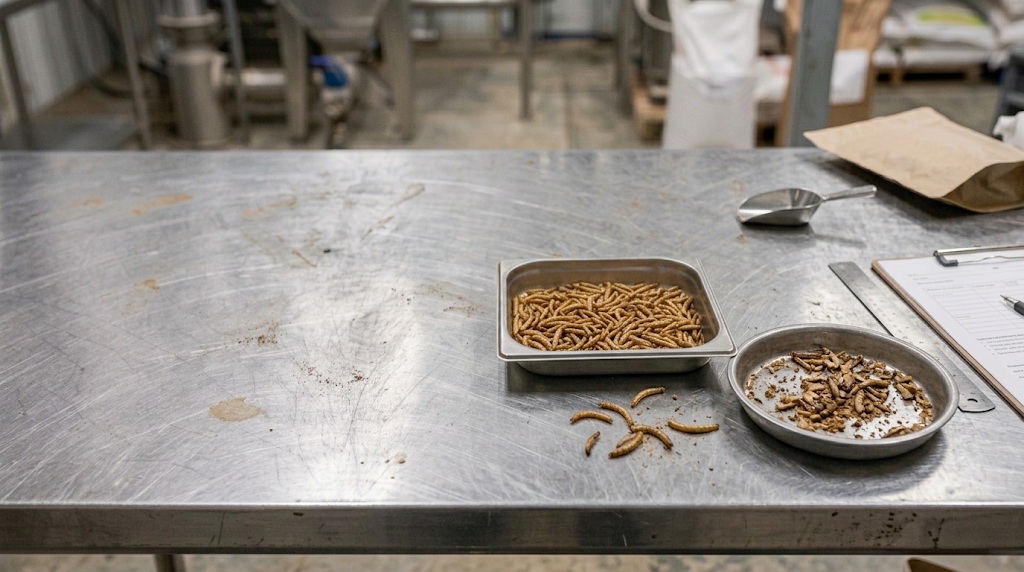
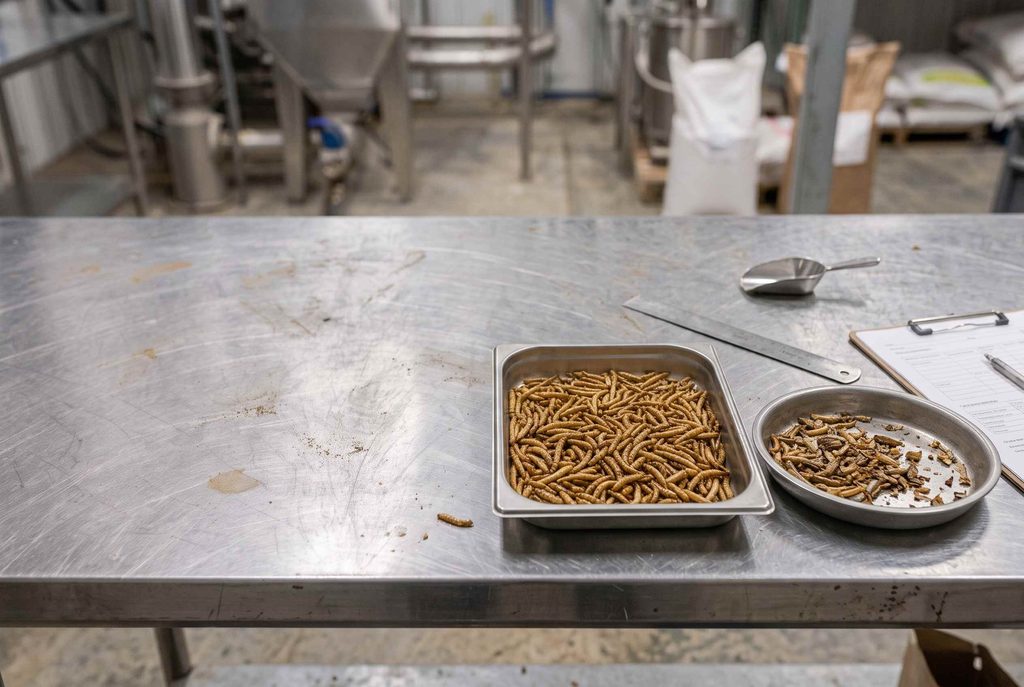
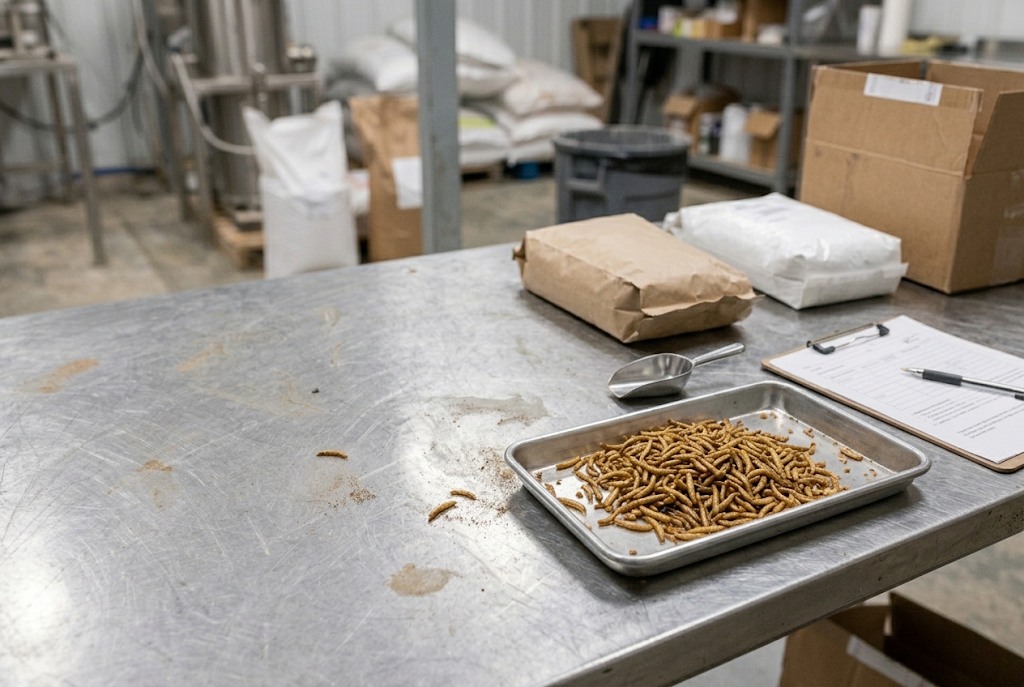
Whole dried insects specifications are essential for commercial buyers sourcing intact dried insect products for bird food, reptile diets, specialty pet products, aquaculture, and other potentially permitted animal feed applications. Unlike insect meal or extracted insect oil, whole dried insects retain their recognizable body form. Consequently, purchasing requirements must address physical integrity, size distribution, cleanliness, and packaging performance alongside nutritional composition and safety.
However, whole dried insect products are not interchangeable across species or processing methods. Dried mealworms, black soldier fly larvae, crickets, grasshoppers, and other insects may differ substantially in body structure, moisture behavior, nutrient composition, and handling characteristics. For importers, distributors, and feed manufacturers, comparing supplier quotations requires a defined product specification and reliable evidence that the material supplied will meet the intended requirements.
1. Why Whole Dried Insects Specifications Matter
A commercial specification establishes the measurable characteristics a supplier must deliver. For whole dried insects, this includes more than a protein percentage or a general statement that the product is dry and clean. Buyers may need to define the species, processing grade, size distribution, acceptable breakage, moisture limits, foreign-material controls, and packaging requirements.
These factors affect both product usability and purchasing economics. For example, a bird food distributor may require visually intact dried mealworms, while a buyer using dried insects as an ingredient in a further-processing operation may tolerate more broken pieces. Although the two products could have similar nutritional composition, they would not necessarily represent equivalent commercial grades.
Specifications also provide a basis for shipment inspection and dispute resolution. Without agreed acceptance criteria, terms such as premium, high protein, low moisture, and export quality may have little practical meaning.
Therefore, buyers should establish a product-specific specification before approving samples or comparing prices. This approach reduces misunderstandings and helps ensure that subsequent commercial deliveries match the agreed product.
2. Confirm Species Identity and Product Form
Species identity is the starting point for any whole dried insect procurement decision. Common names may refer to different insects, and products with similar appearances can have different nutritional, physical, or regulatory characteristics.
Commercial buyers should request the scientific name where possible, along with confirmation of the product’s life stage and processing form. Dried larvae and dried adult insects have different body structures, while immature and mature larvae of the same species may also differ in appearance and composition.
The term whole should be defined in the purchasing agreement. Some level of fragmentation can occur during drying, grading, packing, and transportation. Consequently, whole dried insects should not automatically be interpreted as a guarantee that every individual insect remains undamaged.
Buyers should also distinguish intact dried insects from crushed insects, insect meal, protein concentrates, and extracted oils. These products may originate from the same species, but they require different technical specifications and serve different commercial purposes.
A clear product description should identify the species, life stage, drying method where relevant, intended application, and physical grade. Without this information, comparisons between suppliers may be unreliable.
3. Compare Size Distribution, Integrity, and Breakage
Physical specifications are particularly important for whole dried insects because the recognizable insect form may be central to the intended application.
Size distribution can influence feeding suitability, packaging efficiency, and visual consistency. Commercial suppliers may offer different size grades, but grading systems are not necessarily standardized across manufacturers. Buyers should therefore request measurable size ranges and an explanation of the sampling or grading method.
Integrity is another important consideration. Dried crickets and grasshoppers may lose legs or other fragile body parts during handling, while dried larvae may break into shorter segments. As a result, a single definition of acceptable breakage may not be suitable for every species.
Physical parameter
Buyer consideration
Possible acceptance approach
Average body size
Compatibility with intended application
Defined length or size grade
Size distribution
Uniformity within a batch
Agreed grading tolerance
Whole-body integrity
Proportion of recognizable intact insects
Defined inspection method
Broken pieces
Material damaged during processing or handling
Maximum permitted fraction
Fines and fragments
Small particles generated during handling
Separate limit where relevant
Color consistency
Appearance and processing variation
Approved reference sample
Foreign material
Cleanliness and contamination control
Defined inspection criteria
Buyers should clarify whether breakage is measured by weight, count, or another agreed method. The difference matters because a small number of heavily fragmented insects may produce a different result depending on how the material is assessed.
In addition, suppliers should explain whether grading occurs before or after final packaging. A product that meets its integrity requirement immediately after processing may experience further breakage during shipment.
4. Evaluate Dried Insect Moisture Content and Water Activity
Dried insect moisture content is one of the most important specifications for commercial storage and transportation. Excessive residual moisture can contribute to deterioration and may indicate inconsistent drying or unsuitable handling.
However, total moisture and water activity are not the same parameter. Moisture content measures the amount of water in the product, while water activity describes the availability of water for microbial growth and certain chemical reactions.
Two dried insect products with similar moisture percentages may have different water activity values because of differences in composition and how water is associated with the material. Consequently, a moisture result alone may not fully describe storage behavior.
Buyers should request a defined moisture limit appropriate to the species, processing method, packaging, and intended shelf life. Where water activity is relevant to the hazard assessment or storage requirements, it should be evaluated separately.
Testing methods and reporting bases also matter. Moisture should be measured using an appropriate method, and results should be linked to the production batch being supplied.
For international shipments, packaging and storage conditions are especially important. Even material that meets its moisture specification at dispatch may deteriorate if exposed to unsuitable humidity or damaged packaging during transportation.
5. Compare Crude Protein, Fat, and Ash
Nutritional composition remains relevant when whole dried insects are purchased for animal nutrition applications. However, different insect species can have substantially different protein, fat, ash, and other compositional characteristics.
Crude protein is commonly estimated from measured nitrogen using a conversion factor. This introduces a particular consideration for insect-derived materials because not all measured nitrogen necessarily represents nutritionally available protein. Therefore, buyers should confirm the analytical method and conversion factor where relevant.
Fat content influences the energy contribution of the product and may also affect storage stability. Insects with higher residual lipid content may require greater attention to oxidation during storage and transportation.
Ash represents the mineral residue remaining after analytical combustion. However, a high ash result should not automatically be interpreted as contamination. Its significance depends on the insect species, cleaning procedures, and intended nutritional use.
For example, dried earthworms may require particular attention to cleaning and residual soil-related material, while other species may present different ash or mineral characteristics.
Nutritional parameter
Commercial relevance
Key comparison issue
Crude protein
Protein contribution
Analytical basis and conversion factor
Crude fat
Energy and storage considerations
Species and processing variation
Ash
Mineral residue
Species-specific interpretation
Amino acid profile
Nutritional suitability
Target animal requirements
Calcium and phosphorus
Mineral balance
Application-specific requirements
Chitin-associated material
Structural component of insects
Digestibility and analytical interpretation
Buyers should also confirm whether results are reported on an as-fed or dry-matter basis. Comparing values expressed on different bases can create misleading conclusions about nutritional quality.
6. Review Drying Methods and Processing Consistency
Drying technology influences the physical and chemical characteristics of whole dried insects. Commercial products may be processed using hot-air drying, microwave-assisted drying, freeze-drying, or other controlled methods.
However, the processing method alone does not establish product quality. A well-controlled hot-air process may produce suitable commercial material, while an inadequately managed premium-priced process may still result in unacceptable moisture variation or physical damage.
Buyers should therefore evaluate processing outcomes rather than rely on general claims about a particular technology.
Important considerations include drying uniformity, residual moisture, physical integrity, color variation, and any validated microbial reduction controls. In addition, the supplier should maintain procedures for managing process deviations and identifying unsuitable material.
A drying process should not automatically be assumed to eliminate all relevant pathogens. Where microbial safety depends on specific treatment conditions, the manufacturer should have appropriate supporting evidence.
For recurring procurement, buyers may benefit from comparing multiple production lots. Consistency across batches can provide a more useful indication of supplier capability than the appearance of one carefully selected sample.
7. Physical Cleanliness and Foreign-Material Controls
Whole dried insects require appropriate separation, cleaning, inspection, and handling controls. The nature of these controls depends on the insect species, rearing system, and processing method.
Foreign material may include unwanted residues from rearing or processing environments, packaging fragments, or other materials that do not belong in the finished product. However, naturally detached insect body parts should be distinguished from unrelated foreign materials.
For some species, cleaning requirements are particularly important. Dried earthworms, for example, may require attention to soil-related residue and ash content, while larval products may require suitable separation from their rearing substrate.
Buyers should establish how foreign materials are identified and measured. A vague statement such as clean and free from impurities may not provide a sufficiently clear acceptance criterion.
Where appropriate, suppliers may use visual inspection, screening, sieving, or other controls. The effectiveness of these measures should be evaluated according to the actual product and risk profile.
Commercial buyers should also verify that the supplier has procedures for preventing contamination after drying, particularly during grading, packing, and storage.
8. Whole Dried Insect Quality Standards and Safety Testing
Whole dried insect quality standards should be based on the product’s intended use, applicable regulations, and relevant hazards. There is no universal testing program that can be applied without modification to every insect species and destination market.
Microbiological testing may include relevant pathogens or hygiene indicators identified through the production process and regulatory requirements. However, a negative result from a limited sample cannot establish that every unit in a large shipment is free of contamination.
Chemical safety considerations may include relevant heavy metals, pesticide residues, or other contaminants associated with rearing inputs and processing conditions. The appropriate testing program should reflect a documented risk assessment rather than an arbitrary collection of laboratory tests.
Testing category
Potential purpose
Buyer verification
Microbiological testing
Assess relevant biological hazards
Organisms, methods, limits, sampling
Heavy metals
Evaluate relevant chemical hazards
Substances tested and reporting limits
Pesticide residues
Assess exposure from applicable inputs
Relevant analytes and methods
Moisture and water activity
Evaluate drying and storage characteristics
Batch results and acceptance criteria
Physical inspection
Assess integrity and cleanliness
Defined grading and sampling methods
Nutritional analysis
Confirm composition
Reporting basis and laboratory method
Buyers should also distinguish general product safety from regulatory eligibility. A product that passes laboratory testing is not automatically authorized for every animal species or importing country.
For international procurement, the applicable legal requirements should be verified before commercial shipment. This may include ingredient eligibility, animal health documentation, import conditions, and relevant labeling requirements.
9. Evaluate Packaging, Shelf Life, and Shipment Stability
Packaging affects both physical integrity and storage stability. Whole dried insects may be relatively fragile, and unsuitable packing or excessive compression can increase breakage during transportation.
Commercial packaging may include cartons, bags, or other formats appropriate to the product and destination. However, the packaging material should protect against contamination, moisture exposure, and avoidable physical damage.
Buyers should confirm the net weight per package, dimensions, sealing method, and any required internal liners. In addition, palletization and stacking arrangements may influence the condition of the material after long-distance shipment.
Shelf-life statements should be supported by appropriate evidence and defined storage conditions. A generic claim of extended shelf life is insufficient if the supplier does not specify how the product should be stored.
For recurring orders, buyers may also establish inspection procedures at delivery. These can help identify packaging damage, unexpected moisture exposure, excessive fragments, or other conditions requiring investigation.
10. How to Review a Dried Insect Certificate of Analysis
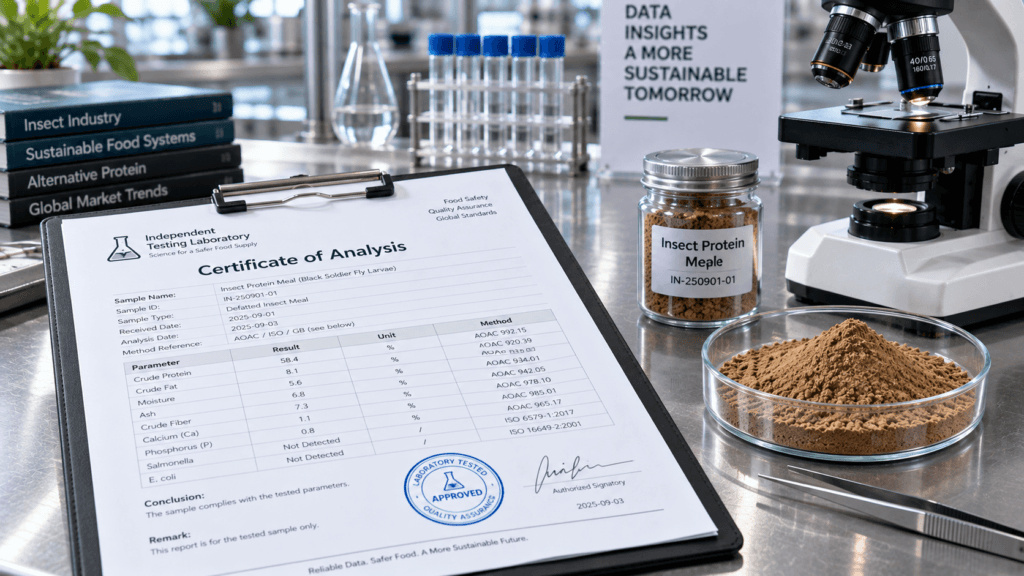
A dried insect certificate of analysis should connect laboratory results to an identifiable production batch. It should not be confused with a general product brochure or an unrelated historical testing report.
A useful COA should identify the species, product form, lot number, sample or testing date, measured parameters, analytical methods, units, and results. Depending on the purchasing agreement, it may also include applicable acceptance criteria and laboratory details.
COA field
What buyers should check
Product identity
Correct species and product grade
Batch or lot number
Connection to the shipment
Sample and test dates
Relevance to supplied material
Moisture
Actual result and agreed limit
Crude protein and fat
Measured values and reporting basis
Ash
Species-specific interpretation
Microbiological results
Relevant tests, methods, and limits
Chemical contaminants
Applicable analytes and reporting limits
Laboratory information
Testing responsibility and traceability
Acceptance criteria
Clear basis for shipment approval
A report without batch identification may provide useful background information, but it does not independently establish the quality of the material being shipped.
In addition, a COA may not include every physical grading requirement. Size distribution, integrity, breakage, and packaging condition may need separate inspection records or agreed sampling procedures.
For new suppliers or disputed batches, independent testing may provide additional assurance. Nevertheless, testing should support rather than replace the supplier’s manufacturing controls and traceability system.
11. Compare Bulk Dried Insects Packaging and Delivered Cost
Bulk dried insects packaging is a major factor in commercial procurement because whole dried products can be volume-intensive and sensitive to physical damage.
A supplier offering a lower price per kilogram may not provide the best delivered value if the product has a higher breakage rate, unsuitable packaging, or inefficient container utilization.
For meaningful comparison, buyers should evaluate quotations using the same product grade, packaging requirements, delivery terms, and quality obligations.
Consider the following hypothetical example. These figures are illustrative only and do not represent verified market quotations.
Comparison item
Supplier A
Supplier B
Product
Whole dried mealworms
Whole dried mealworms
Quoted price
$4.20/kg
$4.40/kg
Moisture requirement
Same agreed limit
Same agreed limit
Breakage limit
Higher allowance
Lower allowance
Packaging
Standard cartons
Reinforced cartons
Delivery basis
FOB
FOB
Batch COA
Included
Included
Pallet configuration
To be confirmed
Confirmed
Supplier A has the lower nominal price. However, Supplier B may offer better commercial value if the stricter integrity requirement and packaging configuration reduce unusable material or handling losses. The actual result depends on the buyer’s application and verified shipment performance.
Buyers should also compare carton dimensions, net weight, pallet utilization, and realistic container-loading assumptions. In some shipments, volume rather than gross weight determines the practical loading limit.
The relevant purchasing measure is therefore the total delivered cost of usable, specification-compliant product.
12. Commercial Buyer Specification Checklist
Before approving a whole dried insect supplier, procurement teams should verify the following requirements:
Evaluation area
Buyer question
Species identity
Is the scientific species confirmed?
Product form
Is the material intact whole dried insects rather than meal?
Processing
Are stabilization and drying methods documented?
Size grading
Are measurable size requirements established?
Integrity
Is the acceptable breakage level defined?
Moisture
Is the batch within the agreed limit?
Water activity
Is testing included where relevant?
Nutritional composition
Are the required parameters reported consistently?
Cleanliness
Are foreign-material criteria defined?
Safety testing
Are relevant hazards and limits addressed?
COA
Does the report identify the supplied production lot?
Packaging
Is the material protected against moisture and damage?
Shelf life
Are storage conditions and supporting evidence available?
Regulatory status
Is the product permitted for the intended use and market?
Commercial terms
Are quantity, delivery basis, and testing responsibilities clear?
A buyer should resolve material gaps before approving a commercial shipment. Furthermore, repeated purchases should be monitored against the agreed specification so that changes in product quality can be identified early.
IIR Analysis
The principal challenge in comparing whole dried insect specifications is that commercial value depends on physical form as well as nutritional composition. Unlike milled insect ingredients, whole dried products may be purchased specifically for their recognizable appearance, size, and integrity.
For buyers, the strongest evaluation framework combines species verification, moisture control, size grading, breakage limits, safety testing, and batch documentation. These factors establish whether two supplier offers are technically comparable before price is considered.
Packaging and transportation deserve particular attention. A product may meet its specification at the factory but experience unacceptable fragmentation or moisture exposure during shipment. Consequently, acceptance criteria should account for the agreed point of inspection and the practical requirements of international logistics.
As the market develops, clearer grading systems and more consistent documentation may improve procurement efficiency. Nevertheless, buyers should avoid applying a single universal specification to different insect species or commercial applications.
Ultimately, the most suitable supplier is the one capable of delivering consistent, traceable, application-appropriate whole dried insects at a competitive total cost.
Disclaimer: This article is for informational purposes only and does not constitute business, legal or investment advice. Always consult primary sources and qualified professionals.