Independent intelligence for the global insect industryISSUE 01 · 2026
Mealworm Supply Chain: From Rearing to Ingredient Distribution
By IIR Editorial DeskSeptember 25, 2026
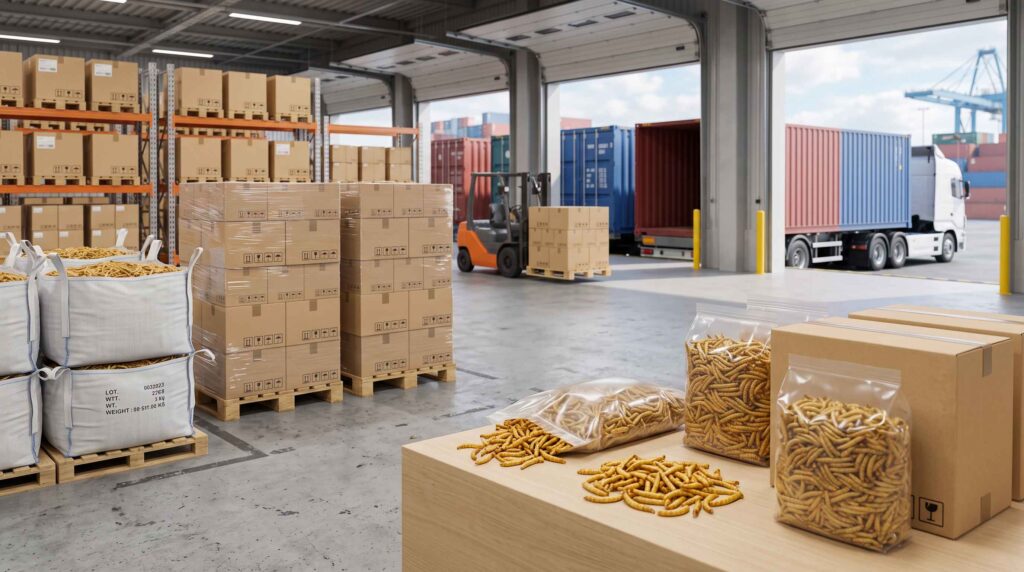
The mealworm supply chain connects commercial rearing and processing with quality control, packaging, storage, international logistics and ingredient distribution. This analysis examines how mealworm products move from producers to commercial buyers.
This analysis examines how commercial mealworm products move through the supply chain, from rearing and processing to quality release, storage, international logistics and B2B distribution.
By IIR Editorial Desk · September 25, 2026 · Market Intelligence
The Mealworm Supply Chain Extends Beyond the Farm
The mealworm supply chain begins with commercial Tenebrio molitor production, but farming represents only the first part of the commercial system. Once larvae are harvested, they still need to be stabilised, processed into the required product form, evaluated against commercial specifications, packaged, stored and delivered to customers.
The structure becomes more complex when products cross borders or move through distributors. A whole dried mealworm sold to a specialty-feed wholesaler follows a different commercial route from mealworm meal supplied to an industrial feed manufacturer, while food-grade products can face additional regulatory and documentation requirements.
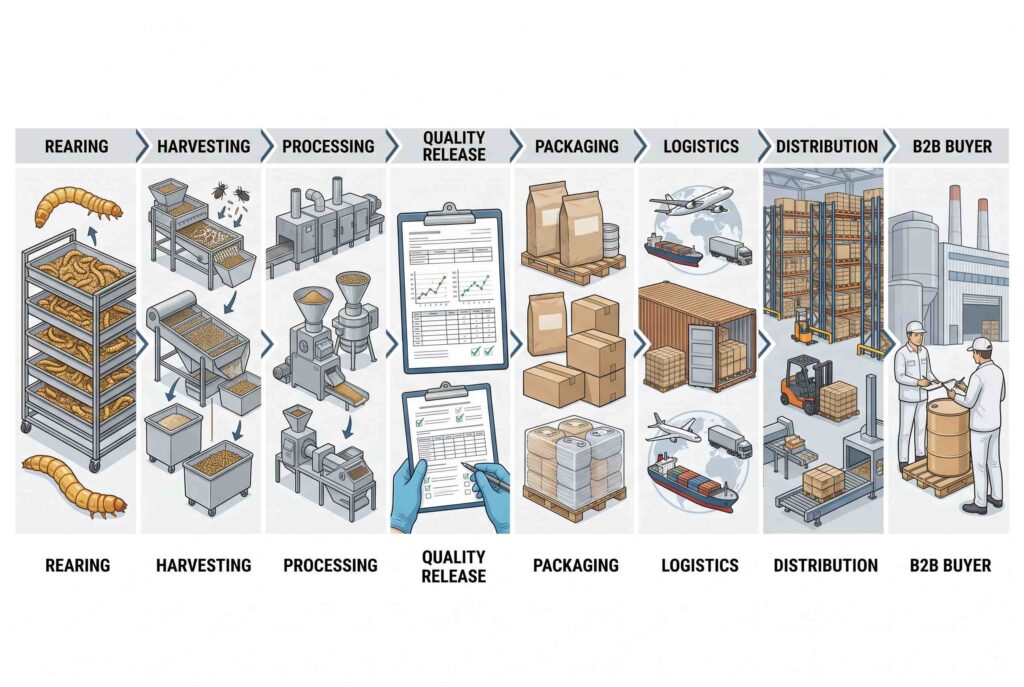
A simplified commercial chain can therefore be represented as:
Supply-chain performance depends on how effectively these stages remain connected. High production capacity provides limited commercial advantage if processing, documentation, logistics, or distribution cannot move the resulting products reliably to customers.
1. Rearing Creates the Biological Supply Base
Commercial supply begins with breeding and larval rearing. Producers need sufficiently predictable biological output to support customer requirements, processing schedules and inventory planning.
Variability at the farm level can move through the entire chain. Changes in growth rate, survival, harvesting schedules or biomass availability can influence processing utilisation and the volume of finished product available for delivery.
For supply-chain analysis, production should therefore be viewed as the source of commercial inventory rather than as an isolated farming activity. A reliable supplier needs not only the biological ability to produce mealworms but also the operational ability to convert that production into repeatable supply.
2. Harvesting Connects Farming With Industrial Processing
Harvesting marks the point where biological production begins to enter an industrial product chain. Larvae intended for sale are separated from residual feed, frass and other materials before being transferred into post-harvest treatment.
The level of separation and cleaning required depends partly on the intended product. Whole dried mealworms retain visible physical characteristics, so cleanliness, integrity and appearance can remain commercially important. Material intended for milling or further fractionation may follow a different downstream specification.
Harvesting schedules also need to align with processing capacity. If large volumes of larvae become available without sufficient stabilisation or drying throughput, supply can accumulate at one of the most perishable stages of the chain.
3. Processing Creates Different Commercial Product Streams
After harvesting, mealworms can be stabilised and processed into several commercial forms. Whole dried larvae represent one route, while milling can create full-fat meal and additional processing can produce defatted or fractionated ingredients.
This means that the supply chain begins to divide after production:
Larvae → Further Processing → Protein-Rich Fraction + Lipid Fraction
These products do not necessarily move through the same buyers or distribution channels. Processing therefore acts as a commercial branching point that determines which downstream markets a producer can realistically supply.
4. Product Specifications Become the Commercial Language of the Chain
Once mealworms move from farm output into a commercial ingredient, buyers increasingly evaluate them through specifications rather than through the production process itself. Product form, moisture, protein, fat, microbiological parameters, and physical characteristics can all become relevant depending on the intended use.
Specifications also allow companies at different points in the chain to communicate more consistently. A distributor receiving material from a producer and reselling it to multiple customers needs a clearer basis for describing the product than simply stating how the insects were reared.
The exact specification requirements vary by application and destination market. Supply-chain reliability therefore depends partly on whether the producer can repeatedly deliver batches that remain within the commercial parameters agreed with downstream buyers.
5. Quality Release Is a Commercial Gateway
Finished production does not necessarily mean that a batch is ready for commercial distribution. Depending on the product and market, businesses may conduct physical inspection, moisture measurement, microbiological testing, or other batch-specific checks before release.
This creates an important distinction between produced inventory and released inventory. Material may physically exist in a warehouse while still awaiting test results, documentation or internal approval before it can be supplied to customers.
For B2B buyers, quality release also supports traceability between the physical batch and its documentation. Certificates of Analysis and related records can help communicate batch-specific characteristics, although the exact testing programme depends on product, market and contractual requirements.
6. Packaging Protects Product During Commercial Distribution
Packaging needs to protect mealworm products from moisture, contamination, physical damage and other conditions that could affect quality during storage and transportation. The appropriate format depends on whether the product is sold as whole dried insects, meal, or another processed ingredient.
Whole dried mealworms can be particularly sensitive to breakage during handling, making packaging and transport conditions relevant to visible product integrity. Milled ingredients face different handling requirements, including containment of fine material and protection against moisture uptake.
Commercial packaging also performs a traceability function. Batch identification, product information, and associated documentation help connect the physical goods with the production and quality records used elsewhere in the supply chain.
Dried products are substantially more stable than fresh larvae, but drying alone does not remove the need for controlled storage. Moisture exposure, temperature, oxygen, and storage duration can affect product quality, while lipid-rich insect products may also be susceptible to oxidative changes.
Research on dried insects has shown that processing and storage conditions can influence microbiological and physicochemical stability. The implications vary according to drying technology, packaging and product composition, so storage requirements should be aligned with the specific product rather than treated as universal across all mealworm ingredients.
From a supply-chain perspective, this means warehouse conditions form part of product management. A correctly processed batch can still lose commercial value if it is stored or handled poorly before reaching the customer.
8. Inventory Management Connects Production With Customer Demand
Mealworm farming operates through biological production cycles, while customers purchase according to commercial schedules. Those timelines do not always match.
Inventory can help bridge the difference. Producers or distributors may hold finished dried products so that customer orders do not depend directly on the timing of a particular larval harvest.
Holding inventory, however, creates its own costs and risks. Warehouse space, packaging, working capital, and shelf-life management need to be considered, while excessive inventory can become problematic if specifications change or customer demand develops more slowly than expected.
The commercial objective is therefore not maximum stock. It is sufficient available inventory to support reliable supply without creating unnecessary storage exposure.
9. Logistics Can Change the Economics of Mealworm Products
Transport economics depend on product form, shipment size, origin, destination, and required handling conditions. Dried mealworm products have an important logistical advantage over fresh biomass because removing water improves stability and reduces the need to transport unnecessary moisture.
Freight still matters, particularly for internationally traded products. Small shipments can carry substantially higher logistics costs per kilogram than palletised or container-scale orders, while delays and repeated handling can create additional risks for packaging and product condition.
Supply-chain design therefore influences the final delivered cost. A product that appears competitive at the producer’s warehouse may become less attractive after freight, import procedures, local warehousing and distributor margins are included.
10. International Trade Adds Regulatory Complexity
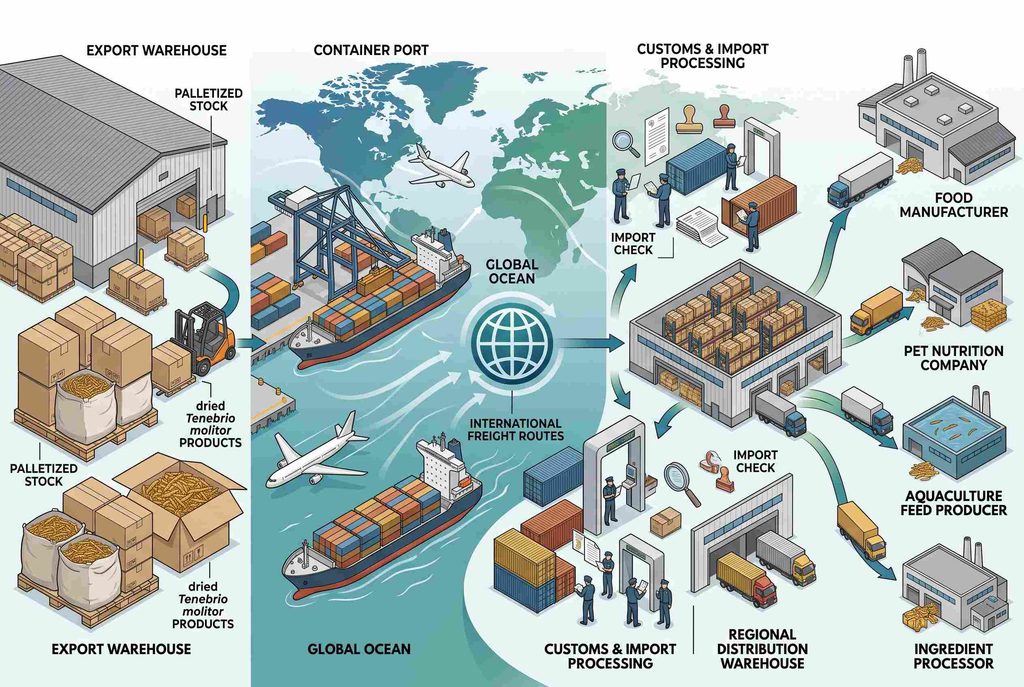
International movement introduces another layer to the mealworm supply chain. Exporters and importers need to consider how the destination jurisdiction classifies the product, which applications are permitted and what documentation or border procedures apply.
These requirements can vary substantially between food, animal feed, pet food and specialty animal products. Regulatory treatment can also depend on species, processing method and intended use, meaning that a product legally manufactured in one jurisdiction is not automatically marketable for the same application elsewhere.
International supply therefore requires coordination between commercial and regulatory functions. Before shipment, suppliers and buyers need to establish not only product specifications and quantity but also whether the proposed product can enter and be used in the destination market.
11. Importers and Distributors Connect Producers With Fragmented Demand
Not every commercial buyer purchases directly from an insect farm. Importers, wholesalers and ingredient distributors can aggregate supply, manage local inventory and serve customers that are too small or geographically dispersed to purchase efficiently from the original producer.
This role can be particularly relevant for whole dried mealworms and specialty animal-feed markets, where demand may be distributed across pet businesses, bird-food companies, reptile suppliers and regional wholesalers. Distributors can reduce transaction complexity by dividing larger imported quantities into smaller commercial orders.
The distribution layer adds cost, but it can also create market access. Producers gain access to a broader customer base, while buyers can obtain local stock, smaller quantities, and commercial support without managing every aspect of international sourcing themselves.
12. Traceability Becomes More Important as the Chain Expands
A direct transaction between producer and buyer creates a relatively short information chain. Once processors, exporters, freight providers, importers, warehouses and distributors become involved, maintaining product identity becomes more complicated.
Batch numbers and commercial documentation help preserve traceability through these stages. The objective is to maintain a credible connection between the finished product, its production or processing history, and the quality information supplied to the customer.
Traceability is therefore not simply a regulatory concept. It also supports recalls, complaint investigation, inventory control and supplier evaluation, making it an operational component of a mature B2B supply chain.
13. Supply Reliability Matters More Than Theoretical Capacity
Buyers ultimately purchase available products rather than factory capacity. A producer may announce substantial annual output, but commercial reliability depends on how much conforming product can actually be released and delivered according to customer schedules.
Production interruptions, inconsistent specifications, testing delays, processing bottlenecks, and logistics disruptions can all reduce the amount of material commercially available even when biological production remains high.
For supply-chain analysis, the progression is therefore better represented as:
Announced Capacity → Actual Production → Quality-Released Inventory → Available Stock → Delivered Volume
The further the analysis moves towards delivered volume, the more accurately it reflects what customers can actually purchase.
14. Supply Chain Bottlenecks Can Appear at Multiple Stages
A mealworm business does not need to experience a farming failure for supply to become constrained. Bottlenecks can occur during harvesting, drying, laboratory release, packaging, storage, freight, customs clearance, or local distribution.
The effect depends on where the constraint occurs. Insufficient drying capacity can delay conversion of fresh biomass into stable product, while laboratory delays can prevent finished inventory from being released. International logistics disruptions can leave compliant products unavailable in the destination market despite sufficient production at origin.
This is why supply-chain resilience depends on more than production redundancy. Companies also need workable alternatives for processing, inventory, transportation, and distribution where commercial scale justifies them.
15. Product Form Determines the Distribution Model
Different mealworm products create different supply chains. Whole dried insects can move through specialty-feed and wholesale networks, while processed meal or protein ingredients are more likely to enter industrial ingredient procurement systems.
Human-food applications can require a different combination of regulatory approval, food-safety controls, and downstream manufacturing relationships. Fresh or live products create yet another logistics model because their stability and handling requirements differ fundamentally from dried ingredients.
There is therefore no universal mealworm distribution system. The appropriate chain depends on product form, intended application, customer scale and destination market.
IIR Analysis
The commercial mealworm supply chain should be understood as a conversion process: biological production is progressively transformed into quality-released inventory, tradable goods and ultimately delivered commercial products.
This distinction matters because industry capacity figures usually describe only part of that process. A farm can produce substantial biomass without generating equivalent quantities of commercially available product if processing, quality release, storage or distribution cannot keep pace.
Internationalisation adds another layer. As mealworm products move across borders, product specifications, documentation, regulatory market access and importer capability become as important as farming performance. Distribution networks can also determine whether production reaches smaller B2B customers efficiently.
For IIR, one of the strongest indicators of supply-chain maturity is therefore the gap between announced capacity and reliably delivered volume. As that gap narrows, production capacity becomes more meaningful to buyers and to the wider commercial market.
Disclaimer: This article is for informational purposes only and does not constitute business, legal or investment advice. Always consult primary sources and qualified professionals.