Independent intelligence for the global insect industryISSUE 01 · 2026
Black Soldier Fly Production: How Commercial Farming and Processing Work
By IIR Editorial DeskSeptember 21, 2026
Commercial black soldier fly production connects breeding, feedstock management and larval rearing with harvesting, processing and quality control. This analysis explains how the production chain works and where scale, consistency and processing decisions matter most.
This analysis explains how commercial black soldier fly production moves from breeding and feedstock preparation through larval rearing, harvesting and processing, and where operational decisions affect capacity, consistency and final product quality.
By IIR Editorial Desk · September 21, 2026 · Market Intelligence
How Commercial Black Soldier Fly Production Works
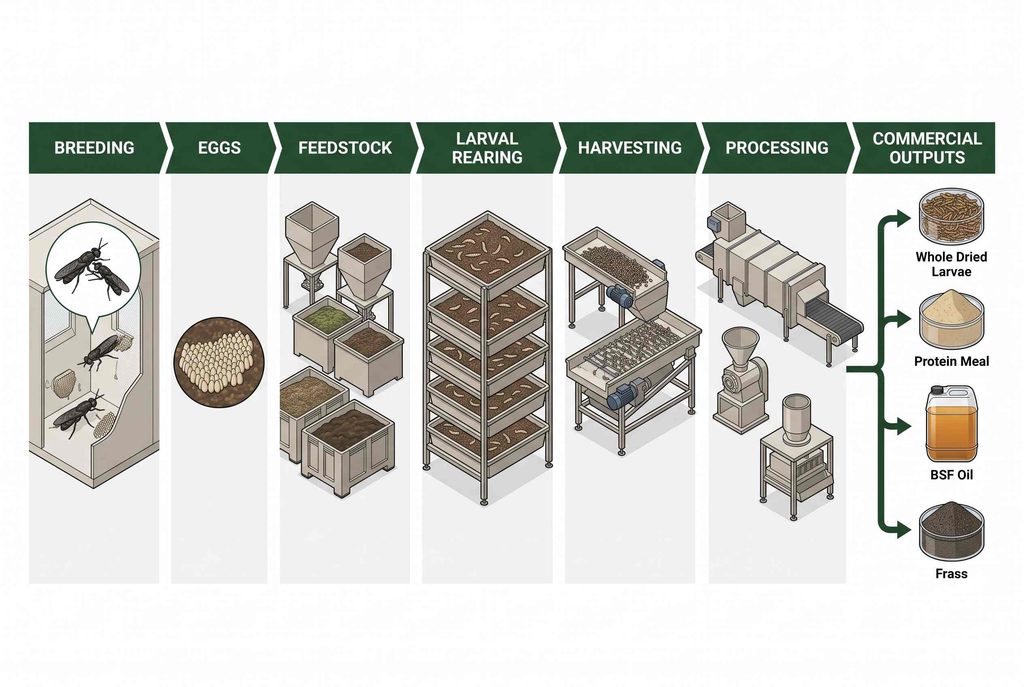
Commercial black soldier fly production is not a single farming process. It is an integrated biological and industrial system connecting insect breeding, feedstock management, larval growth, harvesting, processing, and quality control.
At the biological level, the production cycle begins with adult black soldier flies (Hermetia illucens) mating and laying eggs. Those eggs develop into larvae, which consume suitable organic feedstocks and convert them into insect biomass. After harvesting, the larvae can be processed into products such as whole dried larvae, protein meal, and insect oil, while frass represents another potential output stream. Recent reviews describe protein, lipids and frass among the principal outputs of BSF bioconversion systems.
At commercial scale, however, the challenge is not simply whether larvae can grow. Producers must operate each stage consistently enough to maintain biological performance, product specifications, throughput, and food or feed safety.
That makes production-system design central to the industry’s economics.
Stage 1: Breeding and Egg Production
A commercial BSF production chain starts with a breeding colony.
Adult flies must mate and produce sufficient eggs to support downstream larval capacity. Environmental conditions, including light, temperature, and humidity, can affect breeding performance, while egg collection and handling influence the number of viable larvae entering production.
Research on commercialization commonly identifies egg production, larval rearing, and final product processing as three major production stages where consistency and efficiency affect output and nutritional quality.
For large facilities, this creates an important capacity relationship: downstream rearing infrastructure cannot operate at its intended utilization if breeding and egg supply are inconsistent.
Some production models integrate breeding and larval rearing at the same site, while specialized suppliers can also provide eggs or young larvae to external growers. The production model therefore influences both biological control and facility design.
Stage 2: Feedstock Preparation
After hatching, larvae require an appropriate feed substrate.
Feedstock management is one of the most important parts of commercial black soldier fly production because the material entering the rearing system can influence larval growth, operational consistency, and the characteristics of the harvested biomass.
Commercial facilities may need to receive, inspect, store, size-reduce, mix, or otherwise prepare feed materials before they enter larval rearing.
However, biological suitability does not automatically mean regulatory suitability. The feedstocks permitted for insects intended for food or animal feed depend on the applicable regulatory framework and target market.
This distinction becomes particularly important for companies using circular-economy narratives. A material that larvae can biologically consume is not necessarily one that can legally be used in every commercial production system.
Stage 3: Larval Rearing and Bioconversion
Larval rearing is the core biomass-production stage.
Young larvae are introduced to prepared feedstock and maintained under controlled conditions while they consume the material and gain biomass.
Commercial operators must manage variables such as stocking density, feed availability, moisture, temperature, rearing duration, and environmental conditions. At industrial scale, the objective is not merely maximum individual larval growth; producers need predictable output across repeated production batches.
This is where automation becomes increasingly relevant.
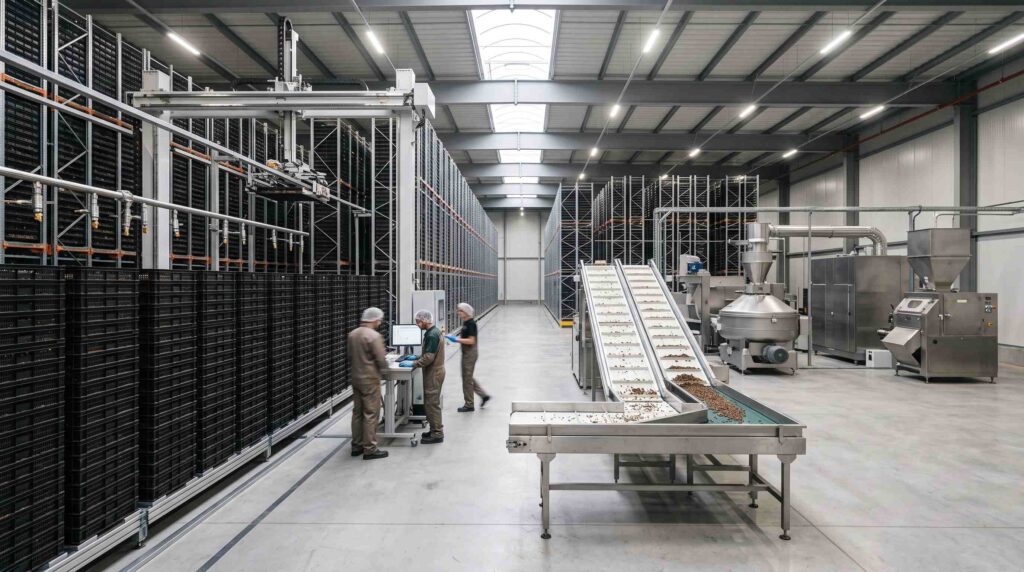
Large production systems may use controlled rearing units, environmental monitoring, material-handling equipment and data systems to manage large numbers of larvae. Recent research into BSF scale-up has also examined decision-support and machine-learning systems designed to optimize biomass yield and nutritional quality under real-world farming conditions.
The key production metric is therefore not simply the number of trays or rearing units installed. What matters commercially is how consistently those assets can convert feedstock into harvestable biomass.
Stage 4: Harvesting and Separation
Once larvae reach the targeted production stage, they must be separated from the remaining rearing material.
Harvesting connects the biological part of the operation with industrial processing.
Depending on the production system, separation may involve mechanical screening or other material-handling processes designed to recover larvae while separating residual substrate and frass.
The timing of harvest also matters because larval development changes over time. Producers therefore need to coordinate biological maturity with processing schedules and product requirements.
At this stage, the production stream begins to divide into different commercial outputs.
Larvae move toward further processing or sale, while separated residual material may enter a frass or soil-input production stream where regulations and product specifications allow.
Stage 5: Stabilisation and Drying
Freshly harvested larvae are biologically active and contain substantial moisture, so commercial processing generally requires a stabilization step before long-term storage or further ingredient production.
Processing methods vary according to the intended product.
Drying is particularly important because reducing moisture and water activity improves storage stability. Commercial processing can use active drying technologies rather than relying solely on passive methods. Research describes dried meal as a common processed form of BSFL and identifies drying as an important step before milling or further ingredient production.
The choice of drying technology can also affect processing time and final-product characteristics. Recent research comparing microwave, hot-air, infrared, and freeze-drying found differences in drying performance, nutrient composition, and physical structure.
For commercial buyers, this means that “dried BSFL” is not necessarily a uniform product category. Processing history can matter when evaluating specifications and applications.
Stage 6: Processing Into Commercial Products
After stabilization, BSF biomass can follow several processing routes.
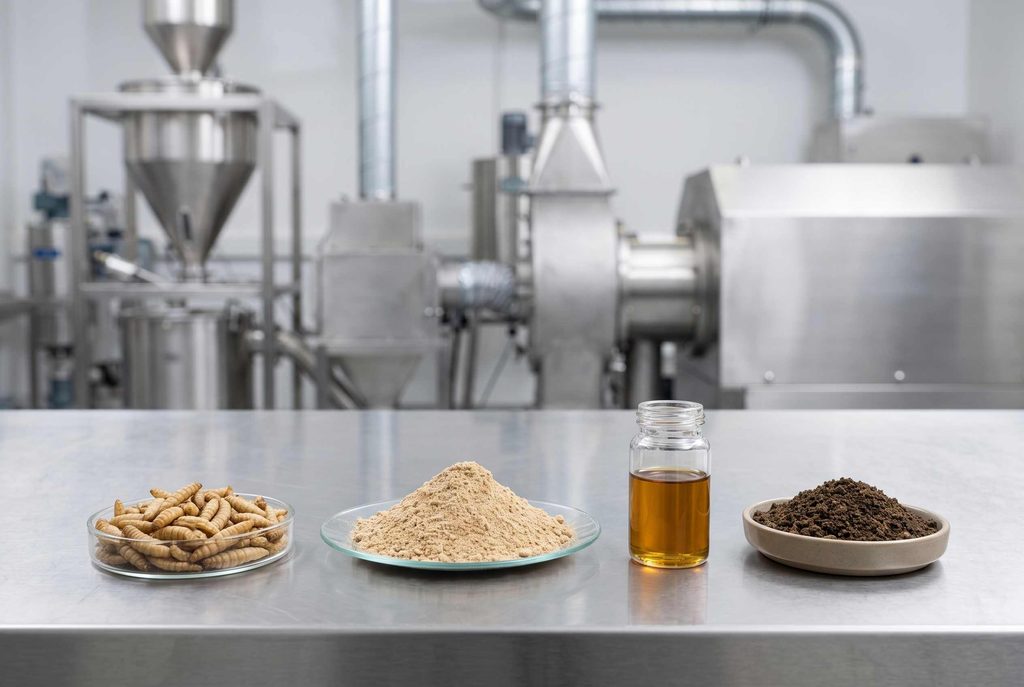
One route is the production of whole dried larvae, which preserves the recognizable insect form.
Another is milling dried larvae into a full-fat meal.
Additional processing can separate a portion of the lipid fraction, producing a higher-protein, defatted or partially defatted meal alongside BSF oil. Mechanical pressing or centrifugation are among the approaches described for lipid separation in BSFL processing.
The resulting commercial output structure can therefore include:
Frass forms a separate co-product stream rather than a downstream product made from processed larvae.
This distinction matters because different processing routes require different equipment, energy inputs, quality controls, and target markets.
Processing Technology Can Change Product Characteristics
Processing is not simply a final packaging step.
Drying, grinding, defatting and other operations can influence moisture, storage stability, nutrient composition, physical characteristics and suitability for downstream feed manufacturing.
A 2025 review of insect-feed processing identified operations such as blanching, grinding, drying, mixing, and extrusion, while emphasizing the relationship among processing, microbiological safety, and final ingredient quality.
For BSF producers, the commercial question is therefore not only how much larval biomass a farm can generate.
It is also:
How efficiently can that biomass be converted into a consistent, saleable ingredient?
That is where farming capacity and processing capacity begin to interact.
A BSF facility’s capacity cannot be assessed from rearing space alone.
The practical output of a plant can be constrained by breeding capacity, egg availability, feedstock preparation, larval performance, harvesting equipment, drying throughput, processing lines, labor, storage, or market demand.
A bottleneck in any one stage can reduce actual production below the facility’s theoretical or announced capacity.
This is why IIR distinguishes between announced capacity, operational capacity, and actual production when analyzing industrial insect facilities.
For buyers and investors, the more useful question is not simply:
How large is the facility?
It is:
How much consistent commercial product can the complete production system deliver?
Quality Control Runs Through the Production Chain
Quality control should not be treated as a single test performed after processing.
Commercial insect production requires controls across feedstock reception, breeding and rearing, harvesting, processing, storage and dispatch. IPIFF’s good-hygiene guidance similarly covers the production chain from insect feeding and breeding through killing, processing, storage, transport and final delivery.
Relevant controls depend on the product and market but may include feedstock traceability, hygiene procedures, moisture management, microbiological testing, chemical contaminant testing, storage conditions, and batch documentation.
For B2B buyers, this means that a Certificate of Analysis is only one part of a broader production and quality management system.
Scaling Black Soldier Fly Production
Moving from pilot production to industrial output introduces challenges that are less visible at small scale.
Biological variability must be managed across much larger populations. Feedstock supply needs to remain sufficiently predictable. Automated equipment must work with biological materials that are inherently less uniform than conventional industrial inputs.
Processing capacity must also expand alongside farming capacity.
These constraints help explain why nameplate production capacity should not be taken as actual commercial output—a distinction that has become increasingly important as insect companies move from pilot projects to larger facilities.
In July 2026, IPIFF also highlighted the financing gap between pilot projects and industrial-scale insect production in Europe, describing the sector as capital-intensive and calling for additional support for scale-up.
IIR Analysis
The commercialization of black soldier fly farming depends on the integration of biology and industrial engineering.
Breeding determines the biological input. Feedstock preparation and larval rearing determine biomass conversion. Harvesting and processing determine how efficiently that biomass is converted into a commercial product. Quality systems determine whether the resulting ingredient can reliably reach its intended market.
The strongest production systems, therefore, should not be evaluated solely by farm size, number of rearing units, or announced capacity.
A more useful assessment examines the entire chain:
As the BSF industry matures, operational consistency across this chain is likely to become a more meaningful indicator of production performance than facility size alone.
Disclaimer: This article is for informational purposes only and does not constitute business, legal or investment advice. Always consult primary sources and qualified professionals.