Independent intelligence for the global insect industryISSUE 01 · 2026
Entosystem Gains Carbon Verification as It Eyes Aquaculture Feed Growth
By IIR Editorial DeskSeptember 19, 2026
By IIR Editorial Desk · September 19, 2026 · Latest Coverage Entosystem insect protein production is moving into a new phase as the Canadian black soldier fly producer gains independent…
By IIR Editorial Desk · September 19, 2026 · Latest Coverage
Entosystem insect protein production is moving into a new phase as the Canadian black soldier fly producer gains independent recognition for greenhouse gas reductions and evaluates new opportunities in aquaculture feed.
The Quebec-based company uses black soldier fly larvae to convert pre-consumer food residues into protein and oil ingredients for animal nutrition, as well as frass for agricultural applications.
Entosystem’s recent carbon verification adds another commercial dimension to a business model built around two challenges: managing organic residues and producing alternative feed ingredients at an industrial scale.
Entosystem Moves From Production Scale-Up to Market Expansion
Entosystem was founded in Quebec in 2016 and has spent much of the past decade developing and scaling its black soldier fly production system.
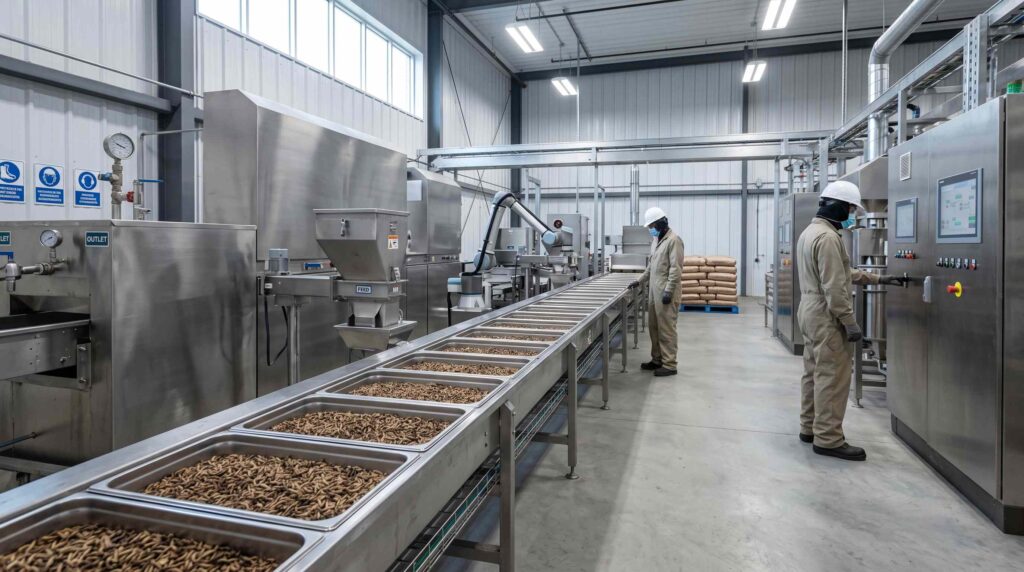
Its current facility in Drummondville, Quebec, has the capacity to process up to 90,000 metric tons of food residues annually, according to the company.
Rather than relying primarily on standardized feed inputs for its insects, Entosystem has developed systems for handling variable pre-consumer food residues. This includes separating unwanted materials, preparing substrates for bioconversion, rearing black soldier flies, and processing the resulting biomass into finished products.
This capability is important because feedstock economics remain one of the central questions facing commercial insect farming.
For insect protein producers, scaling production is only part of the challenge. The cost and consistency of substrates, energy requirements, processing efficiency, and access to end markets can all influence whether a facility can compete with conventional feed ingredients.
Entosystem’s approach is therefore notable not simply because it produces black soldier fly protein, but because food-residue management is integrated into the economics of its production model.
Carbon Verification Adds a New Revenue Dimension
Entosystem announced in September that its ENVOL project had obtained independent verification of its greenhouse gas emission reductions.
The project was verified in accordance with ISO 14064-3 requirements and registered with the CSA Group’s EcoProjects GHG Registry, making verified reductions eligible for the generation and commercialization of carbon credits.
At full capacity, Entosystem estimates that its Drummondville operation could avoid more than 23,000 metric tons of CO₂-equivalent emissions annually.
The avoided emissions are linked primarily to diverting organic materials from landfill and processing them through the company’s bioconversion system.
For the insect industry, this development is significant beyond Entosystem itself.
Sustainability has long been one of the main arguments supporting insect-based feed ingredients. However, commercial buyers, investors, and large food and feed companies increasingly require measurable environmental data rather than broad sustainability claims.
Independent verification can therefore become part of the commercial infrastructure surrounding insect ingredients.
Instead of sustainability functioning only as a marketing benefit, verified emissions reductions may create an additional measurable — and potentially monetizable — component of the production model.
Aquaculture Could Become a Larger Market
Entosystem has already developed markets for its black soldier fly products, including the backyard poultry sector in the United States.
Aquaculture, however, could represent a different scale of opportunity.
Company president and co-founder Cédric Provost told SeafoodSource that Entosystem is examining opportunities in aquaculture as the economics of feed ingredients evolve and demand for alternative protein sources increases.
This reflects a broader issue across the aquaculture supply chain.
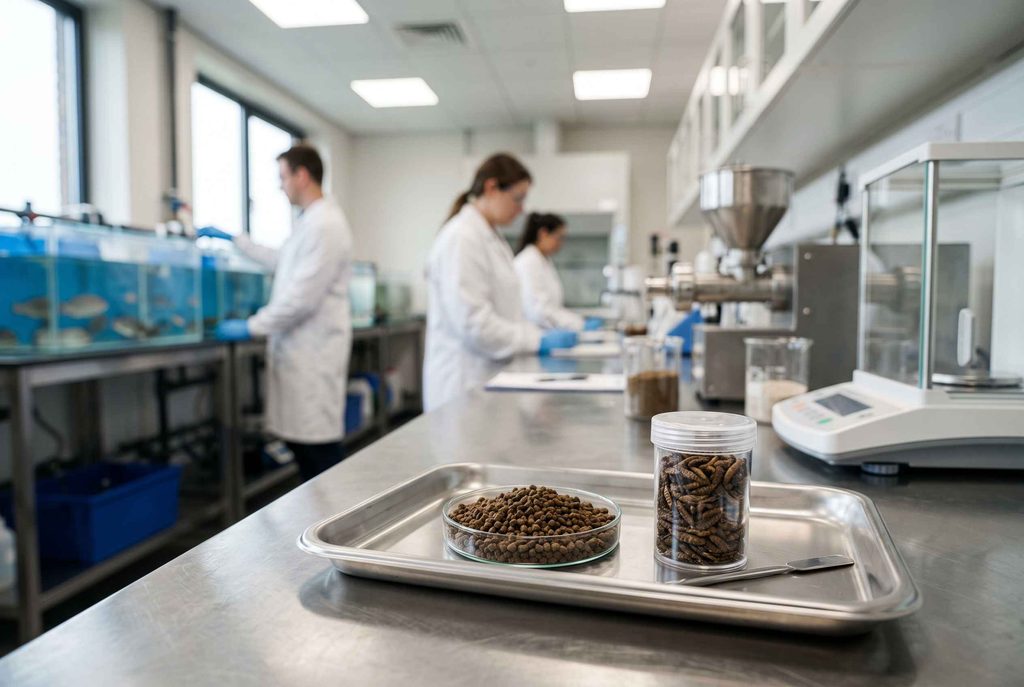
Fishmeal remains an important protein ingredient in many aquaculture feeds, while producers continue to evaluate alternative ingredients that can provide suitable nutrition, consistent supply, and commercially acceptable pricing.
For insect producers, aquaculture offers potentially large volumes, but it also imposes different requirements than those of premium pet food or specialty animal-feed markets.
Production economics becomes especially important.
A producer targeting aquaculture must be able to deliver consistent specifications and significant volumes while competing in a feed industry highly sensitive to ingredient costs.
Different Markets Require Different Insect Products
One important point emerging from Entosystem’s strategy is that insect protein is not a single standardized market.
Processing requirements can vary significantly depending on the customer.
Products intended for backyard poultry, pet food, and aquaculture may require different drying methods, physical characteristics, specifications, and production economics.
That means insect producers increasingly need to decide which markets they are designing their facilities around, rather than simply maximizing production capacity.
A facility optimized for a high-margin specialty product may not have the same cost structure as one designed to supply large aquafeed manufacturers.
This distinction is likely to become more important as the insect industry matures.
The first phase of the sector focused heavily on whether insects could be produced at an industrial scale. The next phase is increasingly about whether individual production systems can match specific end markets at competitive economics.
Why This Matters for the Insect Industry
Entosystem’s development illustrates three trends worth watching.
First, waste sourcing is becoming part of an insect-production strategy. Access to suitable, consistent, and economically attractive substrates can materially affect production costs.
Second, environmental claims are becoming more measurable. Independent carbon verification provides a clearer framework for buyers and investors evaluating the sustainability of insect production.
Third, market specialization is becoming increasingly important. Aquaculture, pet food, and poultry may all use insect-derived ingredients, but their product requirements, pricing structures, and purchasing volumes are different.
For producers, this means the question is shifting from “Can insect protein be produced at scale?” toward “Can it be produced at the right cost and specification for a specific market?”
Entosystem’s next steps in aquaculture will therefore be worth watching.
If the company can combine low-cost food-residue inputs, verified environmental benefits, and production tailored to large feed markets, its model could provide another indication of how the commercial insect protein industry is evolving from capacity expansion toward market-specific economics.
Disclaimer: This article is for informational purposes only and does not constitute business, legal or investment advice. Always consult primary sources and qualified professionals.