Meet the hidden champions of the insect industry. Discover how scaled Asian manufacturers dominate global supply volume through localized substrates, pragmatic engineering, and reliable unit economics.
Meet the hidden champions of the insect industry. Discover how scaled Asian manufacturers dominate global supply volume through localized substrates, pragmatic engineering, and reliable unit economics.
Published: September 2026 | Fact-checked by: IIR Research Team | Industry Analysis: IIR Company Watch
Much of the public discourse and media coverage of global insect bioconversion has historically focused on multi-million-dollar venture capital funding rounds and towering automated megasites in Europe and North America. However, away from the Western media headlines, the actual commercial supply volume powering global cross-border trade is quietly anchored in East and Southeast Asia. A highly organized cluster of scaled, mid-tier asian insect protein manufacturers has steadily emerged as the true backbone of the international alternative protein supply chain.
These specialized production platforms operate with a fundamentally different business philosophy. They function without the crippling capital depreciation, excessive corporate overhead, or exorbitant climate-control utility bills that continuously burden Western gigafactories. By leveraging optimal native climates, abundant agricultural co-products, and streamlined, pragmatic processing hardware, these facilities offer international buyers commercial reliability and unit-economics advantages that Western facilities cannot match. For global feed millers and pet food formulators, understanding the operational DNA of these manufacturers is the key to unlocking scalable, profitable insect inclusion.
1. The Climatic and Geographic Advantage of Asian Insect Protein Manufacturers
To understand how mid-tier asian insect protein manufacturers achieve such competitive ex-works pricing without sacrificing finished-meal quality, procurement managers must first examine their geographic foundation.
Operating across subtropical and tropical agricultural zones enables these facilities to rear Black Soldier Fly Larvae (BSFL), yellow mealworms (Tenebrio molitor), and field crickets in their native ambient conditions. A European vertical farm located in France or the Netherlands must spend hundreds of thousands of dollars annually on industrial natural gas and electricity to maintain constant space heating and humidity control during harsh winter months. In stark contrast, Asian facilities utilize natural thermodynamic balances.
This single geographical advantage eliminates a massive portion of baseline Operational Expenditure (OpEx). Factories can utilize simple, high-volume horizontal rearing sheds equipped with automated ventilation fans rather than complex, energy-draining climate chambers. This natural energy efficiency translates directly into a lower baseline cost per kilogram of harvested larval biomass, ensuring that the final defatted meal remains cost-competitive against traditional marine ingredients like Peruvian fishmeal.
2. Localized Substrate Integration and Circular Economics
Beyond climate, the second major pillar supporting asian insect protein manufacturers is their deep integration into established, localized agricultural supply chains. The success of any commercial insect farming operation depends on the cost, consistency, and safety of its rearing substrate (the feed given to the insects).
Successful Asian processing hubs locate bioconversion sites directly adjacent to major regional agricultural processing centers. This includes strategic proximity to cassava starch extraction plants, commercial beer breweries, tofu and soy manufacturing facilities, and palm oil processing mills. By sourcing standardized, wet vegetal co-products (such as spent brewer’s grains, soy okara, and palm kernel expeller) directly at the source, these plants bypass expensive secondary dehydration and long-distance road haulage costs.
More importantly, utilizing these specific, pre-vetted industrial co-products ensures strict compliance with international feed safety laws. Because these substrates stem from human-grade food processing, they are free of heavy metals, prohibited veterinary antibiotics, and municipal contaminants often associated with post-consumer waste. This enables Asian manufacturers to maintain high-speed larval growth rates while securing clean inputs that pass rigorous export screening.
3. Engineering Pragmatism: Choosing Effectiveness Over Over-Automation
A defining characteristic of leading asian insect protein manufacturers is their approach to processing technology. In the early 2020s, many Western startups invested heavily in unproven robotics, autonomous guided vehicles (AGVs), and proprietary optical sorting AI. While technologically impressive, these systems introduced high maintenance downtime and massive Capital Expenditure (CapEx) amortization burdens that ultimately inflated finished ingredient prices into ultra-premium tiers.
Asian mid-tier producers have largely rejected this over-automation in favor of industrial pragmatism. They focus their capital investments on proven, durable, high-throughput processing hardware that directly impacts food safety and nutritional stability:
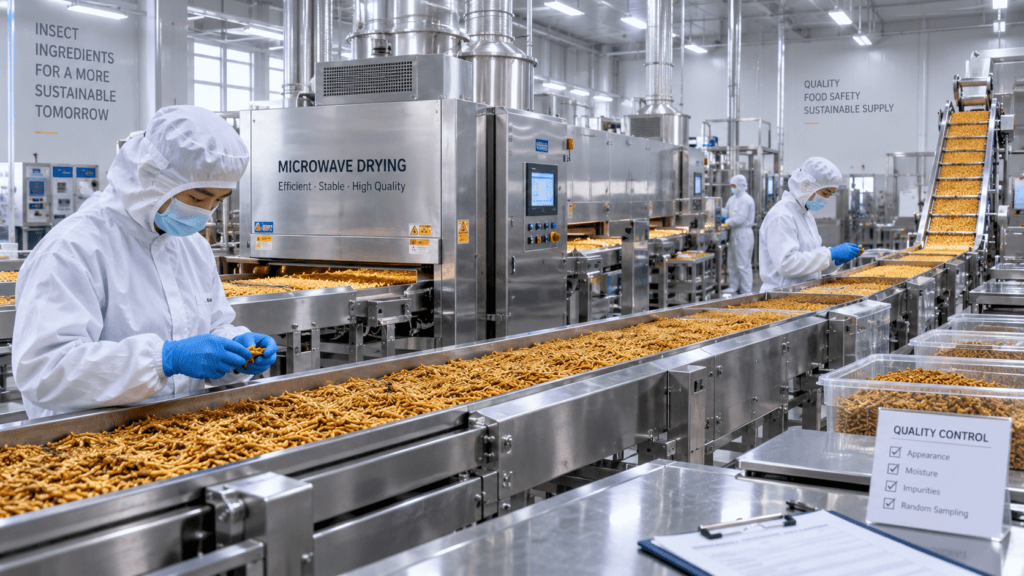
- Industrial Microwave Dehydration: Instead of slow batch-drying ovens, top facilities utilize continuous microwave tunnel dryers. This technology achieves rapid core temperature elevation, instantly destroying pathogenic bacteria while preserving the delicate amino acid profile and preventing lipid oxidation (rancidity) in the finished meal.
- Mechanical Screw-Press Expellers: To achieve consistent defatted protein meals (typically targeting 55% to 62% crude protein), manufacturers rely on heavy-duty mechanical pressing rather than chemical solvent extraction. This ensures the resulting insect oil and protein meal remain clean-label and highly appealing to premium pet food brands.
- Hygienic Facility Segregation: Capital is spent on building distinct physical barriers between “wet” larval receiving zones and “dry” milling and bagging cleanrooms, adhering strictly to international biosecurity standards to prevent microbial cross-contamination.
4. Rigorous Quality Assurance and Export Compliance
A lingering historical misconception among some Western procurement teams was that Asian agricultural processing lacked stringent quality controls. Today, the export-oriented landscape has systematically shattered this assumption. Survival in the global B2B ingredient market requires absolute compliance with destination customs authorities.
Modern Asian processing hubs operate under internationally audited Hazard Analysis Critical Control Point (HACCP), ISO 22000, and Good Manufacturing Practice (GMP) quality management frameworks. Export-grade facilities maintain comprehensive in-house laboratory facilities paired with mandatory third-party validation testing through globally recognized bodies such as SGS or Eurofins.
Before any shipping container is sealed, every commercial production batch undergoes quantitative screening. This includes testing for heavy metals (cadmium, lead, arsenic, and mercury), pesticide residues, and critical microbiological indicators. Standard export protocols mandate the absolute absence of Salmonella across five 25g samples, with Enterobacteriaceae controlled well below European EFSA and American FDA regulatory limits. By consistently meeting these targets, leading asian insect protein manufacturers reliably issue Certificates of Analysis (COA) that sail through international customs clearances.
5. Strategic Sourcing and B2B Procurement Operations
For global feed formulators, aquaculture integrators, and pet food brands, partnering with these mid-tier Asian processors resolves the industry’s most critical commercial hurdle: scalability at the right price point.
While Western gigafactories frequently allocate 100% of their limited output to exclusive, multi-year corporate development agreements, established Asian manufacturers operate flexible, high-volume capacity lines. They are uniquely positioned to fulfill multi-container monthly spot orders and long-term contracts alike. Furthermore, even after factoring in trans-oceanic container freight, marine insurance premiums, and customs import tariffs, the landed cost of Asian insect protein consistently sits 30% to 45% below domestic Western spot prices.
Securing a reliable procurement pipeline requires rigorous vetting. Buyers preparing cross-border supply agreements should utilize our established framework for evaluating an insect ingredient supplier to systematically assess raw material traceability, facility hygiene, and long-term financial stability. Additionally, remaining informed about global supply chain management strategies is crucial for mitigating risks related to ocean freight volatility and seasonal agricultural cycles.
By conducting thorough due diligence and building direct, transparent partnerships with these Asian hidden champions, international animal nutrition brands can secure cost-effective, high-quality insect protein at the massive scale necessary to lead the future of sustainable feed.