Clear Asian export hurdles. Practical guidance on veterinary certificates, customs HS codes, and bilateral quarantine protocols for insect meals. Published: September 2026 | Fact-checked by: IIR Research Team | Regulatory…
Clear Asian export hurdles. Practical guidance on veterinary certificates, customs HS codes, and bilateral quarantine protocols for insect meals.
Published: September 2026 | Fact-checked by: IIR Research Team | Regulatory Analysis: IIR Regulation
As international animal feed millers and pet food formulators seek cost-effective, scalable alternatives to volatile marine and plant ingredients, Asia has emerged as a key global production hub. With favorable climatic conditions, efficient agro-industrial integration, and dedicated bioconversion manufacturing hubs, Asian producers offer significant commercial advantages. However, successfully capitalizing on these supply chains requires mastering the legal landscape governing insect protein export regulations.
Importing animal feed ingredients across international borders involves complex veterinary, sanitary, and customs oversight. Sourcing managers must understand that export compliance begins within the exporting nation’s borders. Navigating formal customs clearances, bilateral sanitary agreements, and analytical laboratory testing guarantees consignments arrive at destination ports smoothly without costly demurrage or customs delays.
1. Export Facility Registration and National Competent Authorities
The foundation of cross-border trade in animal proteins lies in official facility approval granted by the exporting nation’s General Administration of Customs or Ministry of Agriculture. Under international veterinary trade protocols, private manufacturers cannot independently export processed animal proteins without direct state oversight:
Processing plants must be registered on national animal feed export registries. This registration requires passing rigorous on-site inspections monitoring biosecurity, pest-exclusion mechanisms, and Hazard Analysis Critical Control Point (HACCP) manufacturing discipline. Facilities must operate dedicated physical segregation between raw larval biomass receiving areas and downstream dried meal packaging lines to eliminate microbiological recontamination.
Crucially, prospective buyers must confirm that the Asian manufacturing plant appears on the specific bilateral export eligibility lists maintained agreed upon by the origin country and destination customs authorities (such as the European Union TRACES system or the US FDA foreign facility registration system). Sourcing from an unregistered plant will result in immediate border rejection upon arrival.
2. Harmonized System (HS) Tariff Classification and Documentation
Accurate customs classification represents another essential operational pillar within insect protein export regulations. Misclassifying bulk shipments of insect biomass on shipping declarations can trigger administrative fines, duty re-assessments, or prolonged quarantine holds:
- HS Code 2301.20: Frequently utilized for flours, meals, and pellets of fish or crustaceans, and often applied to commercial defatted insect meals intended for animal feed applications.
- HS Code 0511.99: Covers animal products not elsewhere specified or included, often utilized for whole dried insects, pupae, or insect derivatives intended for technical or specialty applications.
- HS Code 1518.00: Typically applied when importing separated, crude, or refined industrial insect oils used in specialized animal nutrition.
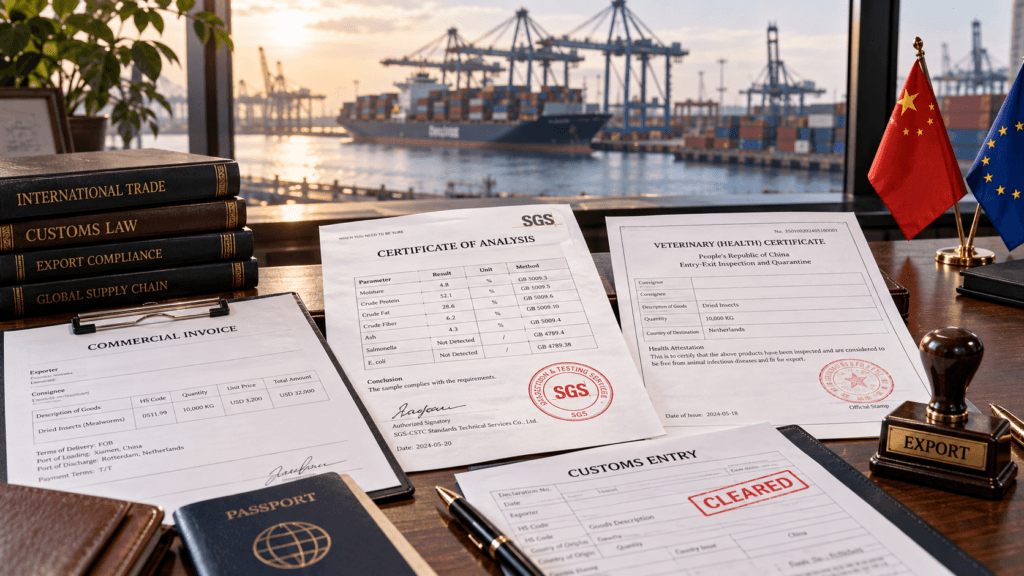
Shipments must always be accompanied by a comprehensive export documentation packet:
- Official Veterinary Health Certificate: Issued by the origin nation’s government quarantine authority, certifying that the insect biomass was raised on approved vegetal substrates, underwent validated thermal treatment, and is free from infectious livestock pathogens.
- Commercial Certificate of Analysis (COA): Demonstrating batch-level compliance with moisture limits (typically under 10%), fat thresholds, and microbiological safety (Salmonella negative, Enterobacteriaceae within allowable tolerances).
- Bill of Lading and Certificate of Origin: Confirming physical freight routes and origin authenticity for preferential tariff eligibility.
3. Microbiological and Chemical Compliance Thresholds
Destination customs clearance depends entirely on verified laboratory testing. Commercial insect meal consignments undergo mandatory random sampling upon discharge. Asian export platforms targeting global markets must routinely verify compliance against two primary hazard vectors:
Pathogen Eradication
Processing lines must employ continuous thermal drying systems—such as industrial microwave sterilization or rotary hot-air dryers—that achieve temperature profiles exceeding 90°C for sufficient duration to denature vegetative bacterial cells. Shipments must consistently demonstrate the total absence of Salmonella across five representative 25-gram samples and maintain Enterobacteriaceae counts below strict target thresholds.
Because insect species bioaccumulate background elements from feed substrates, destination customs agencies enforce stringent maximum residue limits (MRLs). Defatted meals and whole dried insects must pass quantitative screening for cadmium, lead, total arsenic, and mercury. Additionally, export batches must comply with strict limits for synthetic chemical preservatives, banned antibiotics**,** and mycotoxins.
4. Commercial Procurement Audit Protocols
To guarantee seamless customs clearance, international procurement directors should implement a structured compliance workflow prior to issuing purchase orders:
First, conduct a complete pre-shipment documentation audit. Mandate that prospective suppliers furnish full-set sample export declarations and anonymized destination clearance documentation from prior commercial shipments.
Second, align your vetting procedures with structured industry audit criteria. Buyers should review our established framework on How to Evaluate an Insect Ingredient Supplier to audit physical factory capabilities, batch traceability systems, and laboratory certification before finalizing procurement contracts.
Finally, stay updated on international trade documentation benchmarks by monitoring developments in standard customs declaration procedures. By partnering with audited, state-registered Asian manufacturers who master these regulatory requirements, global feed millers can secure scalable, high-quality insect protein with total compliance confidence.