Independent intelligence for the global insect industryISSUE 01 · 2026
How to Read a Certificate of Analysis (COA) for Insect Ingredients
By IIR Editorial DeskSeptember 13, 2026
Master the insect ingredient COA. Learn to evaluate moisture limits, heavy metal risks, and microbiological red flags before your next B2B order.
Published: September 13, 2026 | Fact-checked by: IIR Quality Assurance Team
For feed millers, pet food brands, and aquaculture formulators, a pristine marketing brochure means nothing without a verified Certificate of Analysis (COA). As insect ingredients scale globally, interpreting the COA is the first and most critical line of defense against supply chain disruptions, formulation failures, and regulatory breaches. This guide breaks down a standard insect meal COA line-by-line, highlighting the critical thresholds and immediate red flags every buyer must know.
As we discussed in our guide to evaluating an insect ingredient supplier, procuring insect proteins like Black Soldier Fly Larvae (BSFL) or Yellow Mealworms involves biological complexities not typically seen in traditional soy or fishmeal supply chains. Because insects are voracious bio-converters, their final nutritional profile and safety metrics are hyper-dependent on what they were fed (the substrate) and how they were processed.
Understanding a COA is not just about confirming protein levels; it is a forensic audit of a supplier’s operational hygiene, drying technology, and substrate control.
1. Why the COA is Your First Line of Defense
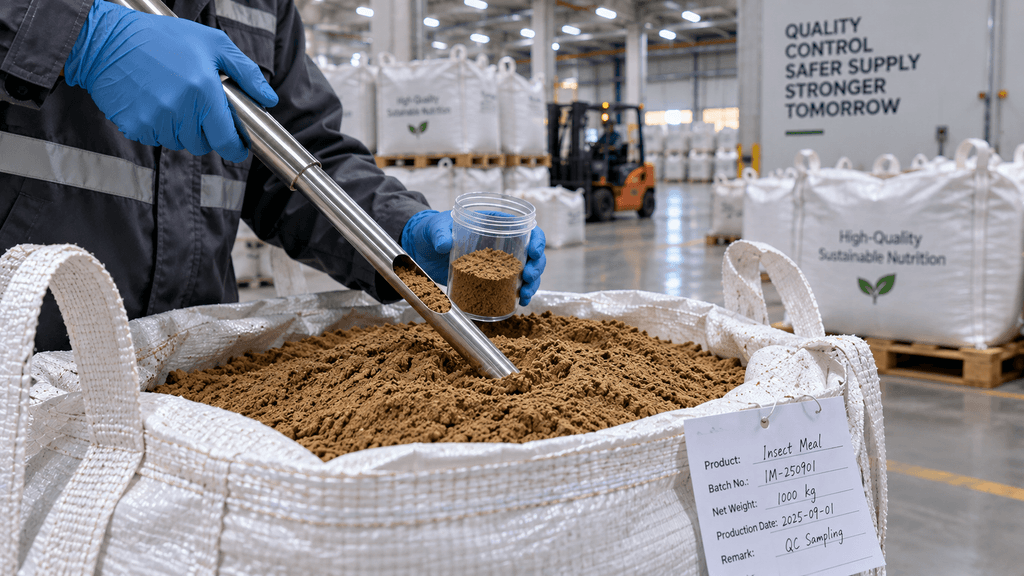
A COA is a certified document issued by a supplier’s internal laboratory or, ideally, an accredited third-party testing facility (like SGS or Eurofins). It verifies that the specific batch of ingredients being shipped meets the agreed-upon technical specifications.
In the insect industry, a COA serves two primary commercial functions. First, it dictates formulation matrices. Even a variation of 2% in moisture or fat can throw off an extruder’s parameters in pet food manufacturing. Second, it acts as a legal shield. If a shipment is held at customs due to heavy metal contamination or excessive residue, the COA and the accompanying purchase contract are your only recourse.
2. Macronutrient Profile: The Baseline Indicators
The top section of any insect COA details the macronutrients. While high protein is the goal, buyers must scrutinize how that figure is achieved.
Moisture Levels and Shelf Life: Moisture is the silent killer of bulk insect shipments. For dried whole insects and defatted insect meal, moisture content directly indicates processing efficiency and shelf-life stability.
The IIR Benchmark: Moisture must be strictly maintained below 10% (ideally between 5% and 8%). Anything above 10% drastically increases the risk of mold proliferation and lipid oxidation (rancidity) during multi-week ocean freight transit. If a COA shows 12% moisture, it is an immediate red flag indicating inadequate drying technology.
Crude Protein and the Chitin Factor: Defatted BSFL or mealworm meal typically ranges from 55% to 65% crude protein. However, buyers must watch out for the “chitin trap.” Standard crude protein analysis (Kjeldahl or Dumas methods) measures total nitrogen and multiplies it by a conversion factor (typically 6.25). Because insect exoskeletons contain chitin (a nitrogen-bound polysaccharide), traditional testing can artificially inflate the true digestible protein value. Advanced suppliers will often provide amino acid profiles or specifically denote true protein values adjusted for non-protein nitrogen (NPN), allowing formulators to make accurate dietary calculations.
Ash Content: Monitoring Mineral Imbalances: Ash represents the total mineral content remaining after the organic matter is burned away. For BSFL, ash content can fluctuate wildly (from 7% to over 15%) depending on the harvest stage and the calcium levels in the substrate. Spikes in ash content can dilute the protein density and disrupt the calcium-to-phosphorus ratio in sensitive aquafeed diets.
3. Microbiological Safety Limits
Insect processing involves high initial microbial loads from the raw substrate and the larvae’s gut. The microbiological section of the COA proves the efficacy of the supplier’s sanitation step (blanching or sterilization).
Salmonella and Enterobacteriaceae represent the strictest regulatory tripwires in the feed industry.
Salmonella: There is zero tolerance. Aligned with strict frameworks set by organizations like the European Food Safety Authority (EFSA), the COA must explicitly state: Absent in 25g or Negative/25g. If Salmonella is detected, the batch is legally unfit for commercial animal feed.
Enterobacteriaceae (or E. coli): These act as indicator organisms for overall hygiene. While total elimination is rare, counts must be significantly suppressed (typically < 100 CFU/g for high-grade feed components). High counts indicate post-processing contamination or insufficient heating during the kill step.
4. Heavy Metals and Mycotoxins: The Substrate Risk
Insects are exceptional bio-accumulators. If a supplier utilizes contaminated organic waste (such as municipal waste with industrial runoff), the larvae will absorb and concentrate heavy metals in their bodies.
Cadmium, Lead, and Arsenic Limits Heavy metal toxicity is the most frequent reason insect shipments fail border inspections. Buyers must verify that the COA tests for the “Big Three”:
Cadmium (Cd): BSFL are particularly prone to accumulating cadmium. Regulatory limits vary, but premium feed grades typically require Cadmium levels to be strictly below 2.0 mg/kg.
Lead (Pb): Requires strict monitoring and is usually capped below 5.0 mg/kg for general feed materials.
Arsenic (As): Total arsenic requires evaluation, with inorganic arsenic being the primary concern.
Mycotoxins (Aflatoxins and DON) Although insects themselves do not produce mycotoxins, their feedstocks (like agricultural grains) can be contaminated with mold. While some research suggests certain larvae can metabolize specific mycotoxins, a rigorous COA must still confirm that Aflatoxin B1 and Deoxynivalenol (DON) remain well below regulatory limits defined by bodies like the Association of American Feed Control Officials (AAFCO).
5. Red Flags: When to Reject a Batch
Procurement managers should establish a strict “No-Go” protocol based on the COA. Reject the batch or demand third-party arbitration if you observe the following:
Missing Third-Party Verification: If a new supplier provides solely provides an “In-House” COA without corresponding SGS/Eurofins lab validation for the initial shipments.
Moisture > 10%: Guarantee of reduced shelf life and potential mold.
Salmonella Detection: Immediate legal and biosecurity hazard.
Omitted Heavy Metal Data: A COA that details protein and fat but conveniently leaves the heavy metal section blank is highly suspicious and implies poor substrate traceability.
Evaluating an insect ingredient COA requires stepping past basic protein metrics. By rigorously assessing moisture controls, chitin adjustments, and bioaccumulation risks, buyers can filter out amateur producers and build a safe, highly functional supply chain.
Remember that verifying the COA is just one crucial step; you must rigorously evaluate an insect ingredient supplier across all operational aspects before signing a procurement contract.
Disclaimer: This article is for informational purposes only and does not constitute business, legal or investment advice. Always consult primary sources and qualified professionals.