ASEF International and Ignatius Ajuru University of Education have signed a Waste4Meal agreement to advance black soldier fly farming, agricultural research, and practical training in Nigeria.
ASEF International and Ignatius Ajuru University of Education have signed a partnership agreement to develop black soldier fly farming, agricultural research, and student training under the Waste4Meal initiative in Nigeria.
By IIR Editorial Desk · October 18, 2026 · Latest Coverage
The Agricultural and Social Entrepreneurship Foundation International (ASEF) and Ignatius Ajuru University of Education in Rivers State, Nigeria, have signed a Memorandum of Understanding to advance black soldier fly farming, agricultural research, and enterprise development through Project Waste4Meal.
The agreement, signed on October 8, 2026, establishes a framework for collaboration involving researchers, students, agricultural entrepreneurs, and project partners. The proposed activities include developing a demonstration farm and an integrated agricultural system connecting organic waste recovery with livestock feed production and practical education.
According to Vanguard’s report on the Waste4Meal partnership, the initiative also involves Safe Nest Cooperative and aims to connect academic learning with practical agricultural operations.
The agreement represents a planned collaboration rather than a completed commercial insect-production project. The partners will need to secure resources, develop approved work plans, and establish the necessary facilities before the initiative can demonstrate operational results.
Waste4Meal Links Insect Farming With Agriculture
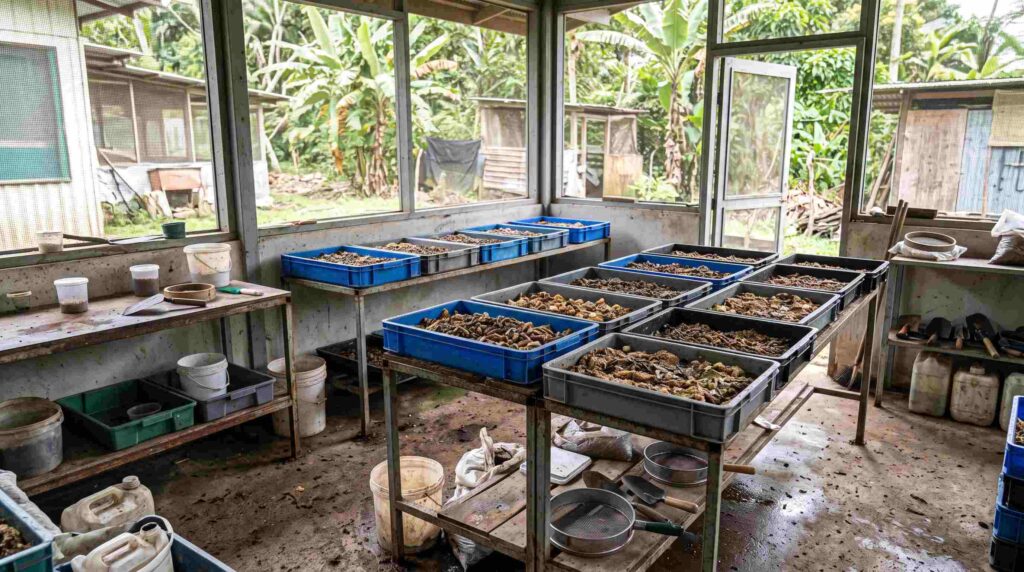
Project Waste4Meal is based on converting suitable organic materials into agricultural resources using black soldier fly larvae.
Under the proposed system, larvae would process suitable organic materials and produce insect biomass for potential use in animal feed, subject to applicable safety and regulatory requirements. Residual material could also support fertilizer production following appropriate treatment and quality assessment.
The broader initiative aims to connect insect farming with poultry, aquaculture, greenhouse cultivation, agricultural processing, and other complementary activities.
This integrated approach is important because insect production depends on more than successful larvae rearing. A commercially viable operation must coordinate feedstock sourcing, biological production, processing, quality control, and downstream sales.
Combining these activities could create opportunities to use local resources more efficiently. However, the benefits will depend on how effectively the proposed system operates and whether its outputs can meet market requirements.
The agreement does not yet establish production capacity, actual feed cost reductions, or commercial profitability.
Research and Student Training Are Part of the Plan
Education and practical training form another major component of the Waste4Meal partnership.
Ignatius Ajuru University is expected to facilitate academic participation and access to approved facilities, while ASEF intends to contribute technical expertise, support project activities, and pursue funding opportunities.
Students may gain experience in insect farming, agricultural production, processing, resource management, and enterprise development through approved demonstration activities and practical training.
The proposed Seed to Success Agripreneur Program is also intended to connect agricultural education with business development, mentorship, and enterprise incubation.
These activities could help address a common barrier to emerging agricultural technologies: the shortage of personnel with both technical knowledge and practical operating experience.
Black soldier fly production requires skills in insect biology, substrate management, environmental control, harvesting, processing, and quality assurance. University-linked demonstration projects may support workforce development, but they require sustained operational resources to deliver useful results.
What the Partnership Means for Nigeria’s Insect Sector
Nigeria’s livestock and aquaculture industries create potential demand for alternative feed ingredients, although commercial adoption depends on product performance, quality, availability, cost, and regulatory acceptance.
Black soldier fly farming is one potential approach to producing locally sourced feed ingredients while recovering value from suitable organic materials.
The Waste4Meal partnership could contribute by connecting university research with demonstration production and agricultural entrepreneurship.
Its wider relevance lies in the proposed connection between education, technical development, and commercial agricultural systems. This may help participants understand not only how larvae are produced but also how production costs, feedstock supply, and customer requirements affect business viability.
Nevertheless, university research and demonstration projects should not be treated as evidence that commercial supply chains have already been established.
IIR Analysis: From Demonstration to Commercial Supply
The Waste4Meal partnership reflects a broader challenge for the insect industry: translating technical knowledge and small-scale demonstrations into reliable commercial operations. University-linked initiatives can help develop local expertise, but education and research alone do not establish a sustainable insect ingredient supply chain.
From IIR’s analysis, the project’s long-term significance will depend on whether it can demonstrate consistent feedstock availability, measurable production costs, repeatable processing methods, and viable demand for its insect-derived products.
The commercial question is particularly important because a functioning demonstration farm and a reliable feed ingredient supplier are not necessarily the same thing. Industrial buyers require predictable product specifications, production volumes, traceability, and quality assurance procedures.
A successful demonstration could therefore be useful in two ways: as a training facility and as a source of operational evidence for future commercial development.
However, the project should be evaluated against measurable results rather than its planned scope. Construction progress, operating continuity, production costs, and downstream customer acceptance will provide a clearer indication of its potential.
The next meaningful milestone will not simply be the opening of a demonstration farm. It will be evidence that the model can operate consistently and produce materials meeting the technical and commercial requirements of downstream buyers.
What to Watch Next
Following the agreement, attention will shift to implementation plans, funding arrangements, facility development, and the start of practical training and research activities.
Important milestones include the establishment of the proposed demonstration farm, publication of production data, identification of suitable feedstocks, and evidence that processed insect products meet relevant market requirements.
Future announcements concerning feed trials, product quality assessments, or partnerships with livestock and aquaculture businesses could also indicate whether the initiative is moving toward commercial application.
For now, the Waste4Meal partnership represents an institutional commitment to developing insect-based agriculture rather than proof of an established production system.
Its longer-term importance will depend on whether the partners can translate that commitment into functioning facilities, measurable outcomes, and sustainable agricultural enterprises.