Independent intelligence for the global insect industryISSUE 01 · 2026
Silkworm Supply Chain: From Rearing to Ingredient Distribution
By IIR Editorial DeskOctober 3, 2026
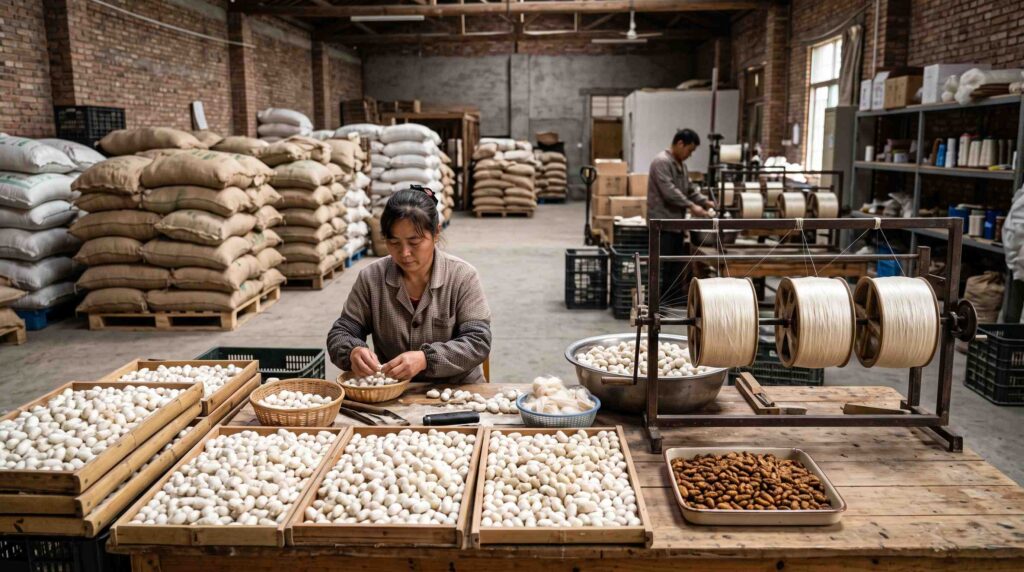
The silkworm supply chain is built around a production system whose primary commercial output is silk, while silkworm pupae create an important secondary stream for food, feed and ingredient markets. This makes the chain different from insect industries where the farm is designed primarily around the production of a standardized protein ingredient.
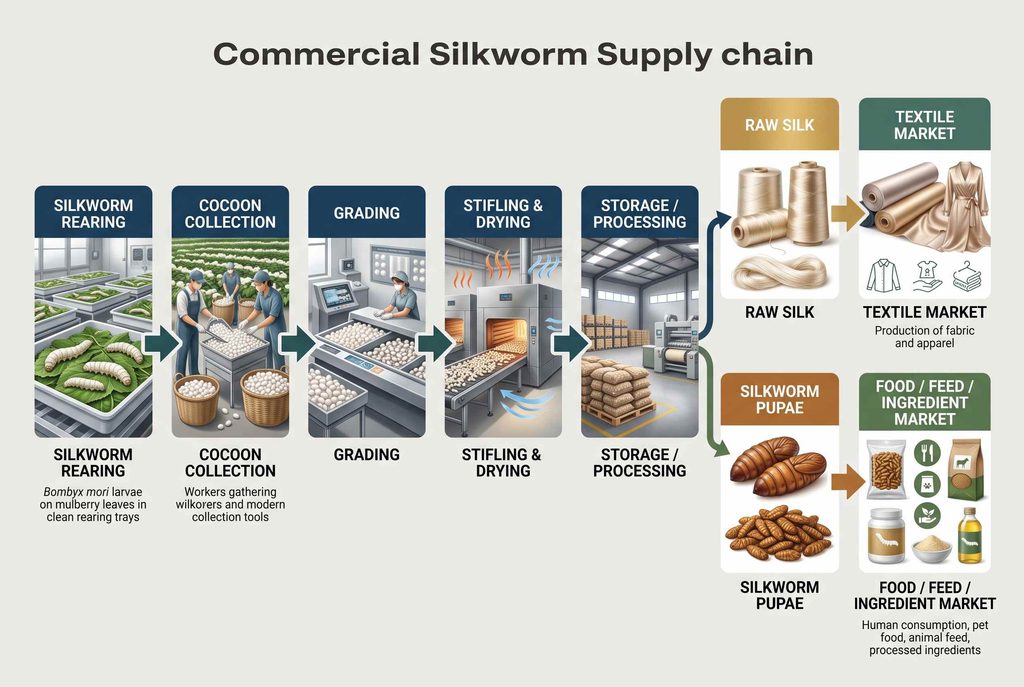
The commercial flow begins with mulberry cultivation and silkworm rearing, but the supply chain does not end when cocoons are harvested. Cocoons must be collected, graded, stabilized and stored or transferred to reeling operations. After silk is recovered, pupae and other residual materials can enter separate processing channels, creating additional supply chains with their own requirements for quality, storage, packaging and distribution.
1. The Supply Chain Begins With a Coordinated Agricultural Base
Commercial silkworm production depends on a reliable supply of suitable mulberry leaves, making agriculture the first link in the chain. Mulberry cultivation needs to remain synchronized with the biological cycle of the silkworm because feed availability directly affects the ability of farms to maintain production through the larval growth period.
Egg suppliers and rearing operations form the next part of the chain. Commercial farms may receive silkworm eggs from specialized breeding and seed-production systems before raising larvae through the cocooning stage. This creates an upstream network involving agricultural inputs, biological material and farm-level production rather than a simple linear factory supply chain.
Geography matters at this stage. Regions with established sericulture infrastructure can connect mulberry production, egg supply, rearing and cocoon markets more efficiently than locations attempting to build the entire system from scratch. This helps explain why silkworm supply remains concentrated in established producing regions.
2. Cocoon Collection Connects Farms With Processing Markets
Once cocoons are formed, the supply chain shifts from biological production toward aggregation and post-harvest handling. Farms need to collect cocoons at the appropriate stage, remove unsuitable material and prepare production lots for grading, storage or sale.
Cocoon markets can involve individual farms, local collection points, cooperatives, traders and reeling facilities. This structure means that the commercial buyer may not always purchase directly from the farm where the silkworms were reared. Multiple production lots can be consolidated before entering a larger processing operation.
Aggregation creates efficiency but also creates a traceability challenge. When cocoons from multiple farms are combined, information about origin, production batch and handling conditions can become more difficult to maintain. More formal B2B supply chains therefore need clear lot identification and consistent handling procedures as material moves between producers and processors.
3. Grading Determines Where Cocoons Move Next
Not every cocoon follows the same downstream route. Physical condition, shape, size, shell characteristics and reelability can influence whether a cocoon is directed toward higher-value silk reeling, lower-grade silk applications or other processing routes.
Grading therefore acts as a supply-chain allocation mechanism. Higher-quality cocoons can be directed toward operations requiring more consistent silk characteristics, while material that is unsuitable for conventional reeling may enter alternative channels.
This separation matters for downstream buyers. A silk processor needs predictable cocoon characteristics, while a pupae processor may have different requirements concerning the condition, drying status and traceability of the remaining biological material. Supply chains become more efficient when product specifications are defined before material is moved between stages.
4. Stifling and Drying Create the First Major Logistics Boundary
Fresh cocoons contain living pupae and cannot simply be stored and transported like a stable dry ingredient. Commercial post-harvest handling therefore needs to stabilize the cocoon and reduce moisture before longer storage or movement to processing facilities.
Stifling and drying create a critical boundary in the silkworm supply chain. Properly dried cocoons can be stored and transported for later reeling, giving processors greater flexibility in managing production schedules and raw-material inventories.
The drying method can also influence downstream quality. Uneven or inadequate drying can increase storage risks and affect later reeling performance, while excessive or poorly controlled treatment can also damage the commercial characteristics of the cocoon. Supply-chain management therefore begins to overlap directly with product quality management at this stage.
5. Storage and Inventory Management Protect Supply Continuity
Cocoon production is biological and can be seasonal or concentrated into particular production cycles, while silk processors may need raw material over a longer operating period. Storage allows these two schedules to be separated.
Proper storage requires control of moisture, ventilation, pests and other conditions that can damage dried cocoons. The objective is not simply to keep inventory on hand, but to preserve enough quality for the material to remain suitable for the intended processing route.
Inventory strategy also affects commercial purchasing. Reeling facilities may purchase cocoons in larger quantities when prices or availability are favorable, while smaller processors may rely on more frequent purchases. The resulting inventory decisions influence working capital, storage requirements and the reliability of downstream supply.
6. Reeling Converts Agricultural Output Into a Tradable Silk Product
After grading, stabilization and storage, suitable cocoons move into reeling operations. The cocoons are prepared and cooked so that the silk filament can be unwound, then multiple filaments are combined into raw silk suitable for subsequent textile processing.
At this point the supply chain changes product form substantially:
Cocoons → Cooked Cocoons → Raw Silk → Yarn and Textile Processing
Reeling efficiency depends on the characteristics of the incoming cocoons as well as process conditions, machinery, water quality and operator skill. This creates a direct connection between upstream farming quality and downstream manufacturing performance.
Raw silk can then move to re-reeling, finishing, yarn preparation, weaving and textile manufacturing. Buyers at these stages generally care about consistency, quality specifications, packaging and delivery reliability rather than the biological origin of the original silkworm crop.
7. Pupae Create a Parallel Ingredient Supply Chain
The silk stream is only one part of the post-cocoon supply chain. After silk processing, silkworm pupae can be recovered and directed into separate commercial channels.
The basic structure becomes:
Cocoon Processing → Silk Recovery + Pupae Recovery
The pupae can then move through several product pathways:
Pupae → Whole/Dried Product
Pupae → Meal
Pupae → Oil + Defatted Fraction
Pupae → Further Ingredient Processing
This secondary chain requires different buyers and specifications from the silk industry. Food and feed customers may require defined moisture, microbiological, nutritional and packaging specifications, while processors purchasing pupae for oil extraction may prioritize different raw-material characteristics.
The development of this secondary chain is commercially important because it allows the sericulture industry to connect with markets beyond textiles.
8. Ingredient Processing Requires Stronger Quality and Traceability Controls
Once pupae enter food, feed or ingredient markets, the supply chain becomes more similar to other B2B ingredient industries. Buyers need to know what the material is, where it came from, how it was processed and whether it meets the specification agreed for the intended application.
Fresh pupae have limited stability because of their high moisture content, making rapid stabilization or appropriate cold-chain handling important when the material is not processed immediately. Dried pupae and processed meals are easier to store and transport, but they still require moisture protection and appropriate packaging.
Traceability becomes especially important when pupae from multiple cocoon-processing facilities are consolidated. A professional ingredient supply chain should be able to connect finished lots with their processing source and, where required, upstream production records.
9. Packaging, Logistics and International Trade Determine Delivered Supply
The physical form of the product strongly affects logistics. Dried cocoons, raw silk, whole dried pupae, pupae meal and oil have different packaging, storage and transport requirements.
For international trade, the supply chain also needs to account for destination-country requirements, customs documentation, product classification and any applicable food, feed, animal-product or novel-food rules. The regulatory requirements depend on the product, intended use and destination, so a single global compliance pathway does not apply to every silkworm-derived product.
International distribution therefore adds another layer between processing and the final buyer:
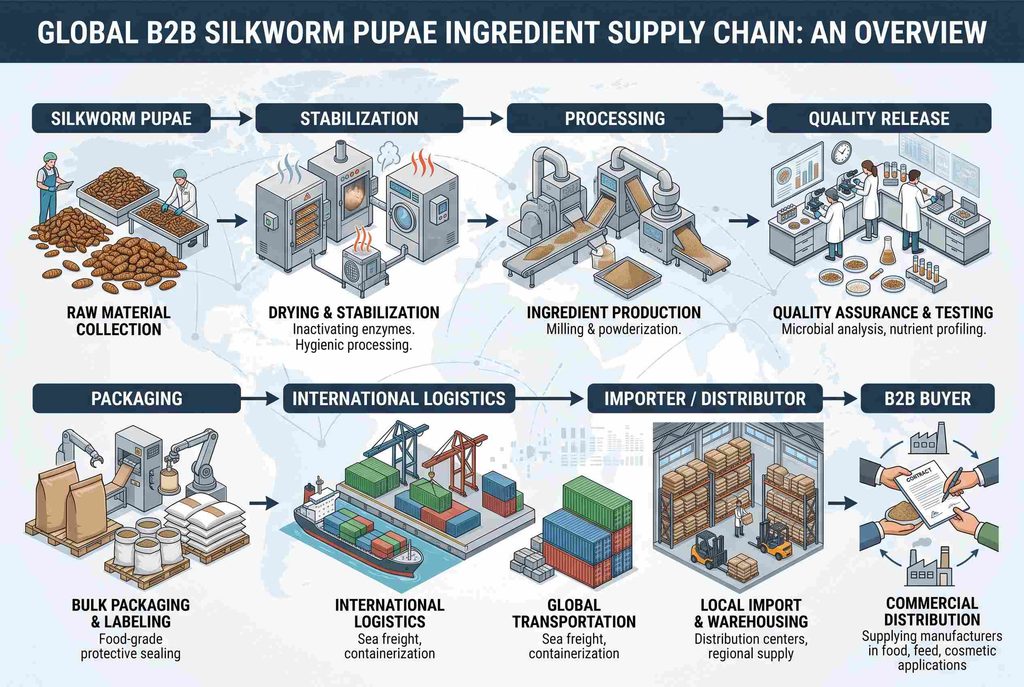
Processing → Quality Release → Packaging → Export Documentation → Freight → Import Clearance → Local Distribution → Buyer
A supply chain can have sufficient biological production capacity and still struggle commercially if these downstream processes are inconsistent.
10. Reliable Supply Depends on Coordination Across the Whole Chain
The most important supply-chain constraint is not necessarily the volume of silkworms being reared. It can be the weakest connection between production, processing and distribution.
A region may have substantial cocoon output but limited reeling capacity. Another region may have strong silk-processing infrastructure but fragmented pupae collection. An ingredient buyer may have demand for dried pupae meal but insufficient access to processors capable of producing consistent specifications.
This makes supply reliability different from biological production capacity. Buyers need predictable volumes, consistent product form, defined quality, stable lead times and traceable batches. These requirements become increasingly important as products move from local markets toward formal international B2B trade.
The strongest supply chains therefore coordinate five connected layers:
Production → Aggregation → Processing → Quality Release → Distribution
Weakness at any one of these stages can reduce the commercial value of the entire system.
IIR Analysis
The silkworm supply chain is best understood as two connected commercial pathways emerging from the same biological production system.
The first is the established textile chain:
Mulberry → Silkworm Rearing → Cocoons → Reeling → Raw Silk → Textile Manufacturing
The second is the developing biomass-utilization chain:
Mulberry → Silkworm Rearing → Cocoons → Silk Processing → Pupae → Food / Feed / Ingredients
This structure gives the silkworm industry a distinctive supply-chain advantage. Pupae do not necessarily need to carry the full economics of silkworm farming because the upstream system is already supported by silk production. The commercial challenge is instead to collect, stabilize, process and distribute the secondary stream efficiently enough to create additional value.
For IIR, the key supply-chain question is therefore not simply whether enough silkworms or cocoons can be produced. It is whether the industry can connect farm-level production with standardized processing, traceable lots, stable storage, reliable logistics and buyers capable of absorbing both silk and pupae-derived products at commercial scale.
This analysis examines how silkworm-derived products move through the commercial chain, from mulberry-based rearing and cocoon collection to silk processing, pupae recovery, storage and international distribution.
By IIR Editorial Desk · October 3, 2026 · Market Intelligence
The silkworm supply chain is built around a production system whose primary commercial output is silk, while silkworm pupae create an important secondary stream for food, feed, and ingredient markets. This makes the chain different from insect industries, where the farm is designed primarily around the production of a standardized protein ingredient.
The commercial flow begins with mulberry cultivation and silkworm rearing, but the supply chain does not end when cocoons are harvested. Cocoons must be collected, graded, stabilized, and stored or transferred to reeling operations. After silk is recovered, pupae and other residual materials can enter separate processing channels, creating additional supply chains with their own requirements for quality, storage, packaging, and distribution.
1. The Supply Chain Begins With a Coordinated Agricultural Base
Commercial silkworm production depends on a reliable supply of suitable mulberry leaves, making agriculture the first link in the chain. Mulberry cultivation needs to remain synchronized with the biological cycle of the silkworm because feed availability directly affects the ability of farms to maintain production through the larval growth period.
Egg suppliers and rearing operations form the next part of the chain. Commercial farms may receive silkworm eggs from specialized breeding and seed-production systems before raising larvae through the cocooning stage. This creates an upstream network involving agricultural inputs, biological material, and farm-level production rather than a simple linear factory supply chain.
Geography matters at this stage. Regions with established sericulture infrastructure can connect mulberry production, egg supply, rearing, and cocoon markets more efficiently than locations attempting to build the entire system from scratch. This helps explain why the silkworm supply remains concentrated in established producing regions.
2. Cocoon Collection Connects Farms With Processing Markets
Once cocoons are formed, the supply chain shifts from biological production toward aggregation and post-harvest handling. Farms need to collect cocoons at the appropriate stage, remove unsuitable material, and prepare production lots for grading, storage, or sale.
Cocoon markets can involve individual farms, local collection points, cooperatives, traders, and reeling facilities. This structure means that the commercial buyer may not always purchase directly from the farm where the silkworms were reared. Multiple production lots can be consolidated before entering a larger processing operation.
Aggregation creates efficiency but also creates a traceability challenge. When cocoons from multiple farms are combined, information about origin, production batch, and handling conditions can become more difficult to maintain. More formal B2B supply chains, therefore, need clear lot identification and consistent handling procedures as material moves between producers and processors.
3. Grading Determines Where Cocoons Move Next
Not every cocoon follows the same downstream route. Physical condition, shape, size, shell characteristics, and reelability can influence whether a cocoon is directed toward higher-value silk reeling, lower-grade silk applications, or other processing routes.
Grading, therefore, acts as a supply-chain allocation mechanism. Higher-quality cocoons can be directed toward operations requiring more consistent silk characteristics, while material that is unsuitable for conventional reeling may enter alternative channels.
This separation matters for downstream buyers. A silk processor needs predictable cocoon characteristics, while a pupae processor may have different requirements concerning the condition, drying status, and traceability of the remaining biological material. Supply chains become more efficient when product specifications are defined before material is moved between stages.
4. Stifling and Drying Create the First Major Logistics Boundary
Fresh cocoons contain living pupae and cannot simply be stored and transported like a stable dry ingredient. Commercial post-harvest handling, therefore, needs to stabilize the cocoon and reduce moisture before longer storage or movement to processing facilities.
Stifling and drying create a critical boundary in the silkworm supply chain. Properly dried cocoons can be stored and transported for later reeling, giving processors greater flexibility in managing production schedules and raw-material inventories.
The drying method can also influence downstream quality. Uneven or inadequate drying can increase storage risks and affect later reeling performance, while excessive or poorly controlled treatment can also damage the commercial characteristics of the cocoon. Supply-chain management, therefore, begins to overlap directly with product quality management at this stage.
5. Storage and Inventory Management Protect Supply Continuity
Cocoon production is biological and can be seasonal or concentrated into particular production cycles, while silk processors may need raw material over a longer operating period. Storage allows these two schedules to be separated.
Proper storage requires control of moisture, ventilation, pests, and other conditions that can damage dried cocoons. The objective is not simply to keep inventory on hand, but to preserve enough quality for the material to remain suitable for the intended processing route.
Inventory strategy also affects commercial purchasing. Reeling facilities may purchase cocoons in larger quantities when prices or availability are favorable, while smaller processors may rely on more frequent purchases. The resulting inventory decisions influence working capital, storage requirements, and the reliability of downstream supply.
6. Reeling Converts Agricultural Output Into a Tradable Silk Product
After grading, stabilization, and storage, suitable cocoons move into reeling operations. The cocoons are prepared and cooked so that the silk filament can be unwound, then multiple filaments are combined into raw silk suitable for subsequent textile processing.
At this point, the supply chain changes product form substantially:
Cocoons → Cooked Cocoons → Raw Silk → Yarn and Textile Processing
Reeling efficiency depends on the characteristics of the incoming cocoons as well as process conditions, machinery, water quality, and operator skill. This creates a direct connection between upstream farming quality and downstream manufacturing performance.
Raw silk can then move to re-reeling, finishing, yarn preparation, weaving, and textile manufacturing. Buyers at these stages generally care about consistency, quality specifications, packaging, and delivery reliability rather than the biological origin of the original silkworm crop.
7. Pupae Create a Parallel Ingredient Supply Chain
The silk stream is only one part of the post-cocoon supply chain. After silk processing, silkworm pupae can be recovered and directed into separate commercial channels.
The pupae can then move through several product pathways:
Pupae → Whole/Dried Product
Pupae → Meal
Pupae → Oil + Defatted Fraction
Pupae → Further Ingredient Processing
This secondary chain requires different buyers and specifications from the silk industry. Food and feed customers may require defined moisture, microbiological, nutritional, and packaging specifications, while processors purchasing pupae for oil extraction may prioritize different raw-material characteristics.
The development of this secondary chain is commercially important because it allows the sericulture industry to connect with markets beyond textiles.
8. Ingredient Processing Requires Stronger Quality and Traceability Controls
Once pupae enter the food, feed, or ingredient markets, the supply chain becomes more similar to that of other B2B ingredient industries. Buyers need to know what the material is, where it came from, how it was processed, and whether it meets the specification agreed for the intended application.
Fresh pupae have limited stability because of their high moisture content, making rapid stabilization or appropriate cold-chain handling important when the material is not processed immediately. Dried pupae and processed meals are easier to store and transport, but they still require moisture protection and appropriate packaging.
Traceability becomes especially important when pupae from multiple cocoon-processing facilities are consolidated. A professional ingredient supply chain should be able to connect finished lots with their processing source and, where required, upstream production records.
9. Packaging, Logistics, and International Trade Determine Delivered Supply
The physical form of the product strongly affects logistics. Dried cocoons, raw silk, whole dried pupae, pupae meal, and oil have different packaging, storage, and transport requirements.
For international trade, the supply chain also needs to account for destination-country requirements, customs documentation, product classification, and any applicable food, feed, animal-product, or novel-food rules. The regulatory requirements depend on the product, intended use, and destination, so a single global compliance pathway does not apply to every silkworm-derived product.
International distribution, therefore, adds another layer between processing and the final buyer:
Processing → Quality Release → Packaging → Export Documentation → Freight → Import Clearance → Local Distribution → Buyer
A supply chain can have sufficient biological production capacity and still struggle commercially if these downstream processes are inconsistent.
10. Reliable Supply Depends on Coordination Across the Whole Chain
The most important supply-chain constraint is not necessarily the volume of silkworms being reared. It can be the weakest link between production, processing, and distribution.
A region may have substantial cocoon output but limited reeling capacity. Another region may have a strong silk-processing infrastructure but a fragmented pupae collection. An ingredient buyer may have a demand for dried pupae meal but insufficient access to processors capable of producing consistent specifications.
This makes supply reliability different from biological production capacity. Buyers need predictable volumes, consistent product form, defined quality, stable lead times, and traceable batches. These requirements become increasingly important as products move from local markets toward formal international B2B trade.
The strongest supply chains, therefore, coordinate five connected layers:
Production → Aggregation → Processing → Quality Release → Distribution
Weakness at any one of these stages can reduce the commercial value of the entire system.
IIR Analysis
The silkworm supply chain is best understood as two interconnected commercial pathways that emerge from the same biological production system.
This structure gives the silkworm industry a distinctive supply-chain advantage. Pupae do not necessarily need to carry the full economics of silkworm farming because the upstream system is already supported by silk production. The commercial challenge is instead to efficiently collect, stabilize, process, and distribute the secondary stream to create additional value.
For IIR, the key supply-chain question is therefore not simply whether enough silkworms or cocoons can be produced. It is whether the industry can connect farm-level production with standardized processing, traceable lots, stable storage, reliable logistics, and buyers capable of absorbing both silk and pupae-derived products at a commercial scale.
Disclaimer: This article is for informational purposes only and does not constitute business, legal or investment advice. Always consult primary sources and qualified professionals.