Independent intelligence for the global insect industryISSUE 01 · 2026
Silkworm Production: How Commercial Farming and Processing Work
By IIR Editorial DeskOctober 2, 2026
This analysis explains how commercial silkworm production moves from mulberry cultivation and egg management through larval rearing, cocoon harvesting and post-cocoon processing. By IIR Editorial Desk · October 2, 2026…
This analysis explains how commercial silkworm production moves from mulberry cultivation and egg management through larval rearing, cocoon harvesting and post-cocoon processing.
By IIR Editorial Desk · October 2, 2026 · Market Intelligence
Commercial silkworm production is fundamentally different from insect-farming systems designed primarily to produce protein ingredients. The dominant domesticated silkworm, Bombyx mori, is reared principally for its cocoon, making silk the primary commercial output and the pupa an important secondary product generated during post-cocoon processing.
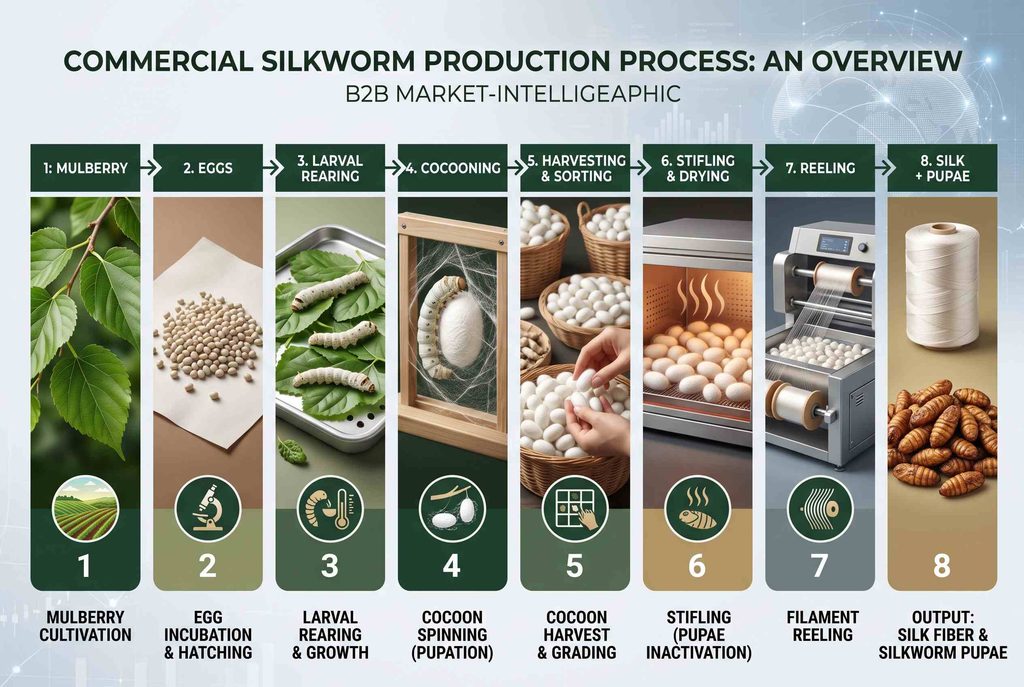
The production system therefore connects agriculture, insect rearing and industrial processing. Mulberry cultivation supplies the feed, specialized egg production provides the biological starting material, larval rearing creates the cocoon crop, and post-cocoon operations convert that crop into silk and recoverable pupae. Performance at each stage can influence the quality and quantity of the outputs available further downstream.
1. Commercial Production Begins With Mulberry and Silkworm Eggs
Mulberry cultivation forms the agricultural foundation of conventional Bombyx mori production because the larvae depend heavily on mulberry leaves. Leaf availability, nutritional quality, and harvesting practices directly affect the rearing system, so commercial sericulture needs to coordinate plant production with the timing and scale of silkworm batches.
The biological production cycle begins with silkworm eggs produced through specialized breeding and seed systems. Healthy eggs are incubated under controlled conditions until hatching, after which young larvae enter the first stages of intensive feeding. Commercial systems may separate young-age rearing from later stages because early larvae require careful management and can be particularly sensitive to environmental and nutritional conditions.
This structure creates an important difference from many other farmed insects. Feed is not simply a purchased formulation delivered from an external supplier; in traditional sericulture, mulberry production is closely integrated with the biological capacity of the farm.
2. Larval Rearing Converts Mulberry Leaves Into Cocoon Biomass
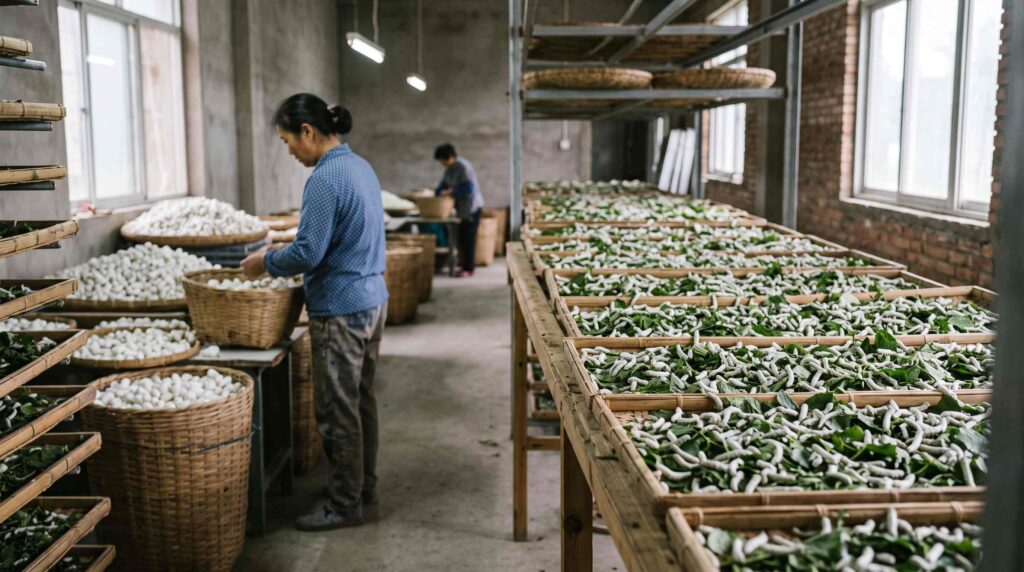
After hatching, silkworm larvae progress through a series of growth stages separated by molts. Feeding intensity increases substantially as the larvae develop, with later stages consuming large quantities of mulberry leaves before cocoon formation begins.
Commercial rearing requires coordination between leaf supply, feeding frequency, stocking conditions, hygiene, and environmental management. Temperature and humidity requirements can change as larvae develop, while poor environmental conditions can affect survival, development, and cocoon characteristics. The objective is not simply to produce the largest possible larvae but to maintain a healthy population capable of producing consistent cocoons.
Hygiene is equally important because biological problems can spread through densely managed rearing populations. Cleaning, batch separation, and appropriate handling help protect the crop during the weeks of intensive feeding. In larger operations, standardized procedures become increasingly important because variation during larval rearing eventually appears as variation in cocoon output.
3. Cocoon Formation Is the Critical Biological Transition
As mature larvae approach the end of their feeding stage, they stop consuming leaves and begin searching for suitable locations to spin. Producers transfer or guide them onto mounting structures that provide space for individual cocoon formation.
The larva secretes silk and gradually constructs the cocoon around itself before entering the pupal stage. This is the point at which the biological farming process creates the primary raw material for the silk industry. Cocoon characteristics such as weight, shell proportion, filament properties, cleanliness, and physical shape can influence subsequent grading and reeling performance.
Cocoon formation also marks the beginning of a second production challenge: timing. If the adult moth is allowed to emerge naturally, it breaks through the cocoon and interrupts the continuous silk filament. Commercial production therefore needs to harvest and process cocoons before emergence compromises their value for reeling.
4. Cocoon Harvesting and Sorting Establish Commercial Quality
Once cocoon formation is complete, cocoons are removed from the mounting system and prepared for post-cocoon handling. Loose external fibers can be removed, and the crop is sorted to separate commercially suitable cocoons from defective material.
Sorting can consider size, shape, staining, shell condition, and other visible characteristics. Consistent cocoons are valuable to reeling operations because irregular or damaged material can interrupt processing and reduce the efficiency of recovering continuous silk filament.
This stage remains labor-intensive in many production systems, although automated imaging and sorting technologies are being developed to classify cocoons more efficiently. Regardless of whether sorting is manual or automated, the objective is the same: create more uniform production lots before drying, storage, and reeling.
5. Stifling and Drying Preserve the Cocoon for Processing
Fresh cocoons contain living pupae that will eventually develop into moths. Commercial silk production needs to prevent emergence while preserving the cocoon shell, leading to a post-harvest operation known as stifling.
Heat-based methods can stop pupal development, while drying reduces moisture and improves the storage stability of the cocoon. The process needs to balance biological stabilization with preservation of silk quality because inappropriate treatment can negatively affect later reeling performance.
Drying also changes the handling characteristics of the cocoon and pupa. Once adequately stabilized, cocoons can be stored and transported before reeling, allowing the biological production schedule to be separated from the operating schedule of the processing facility.
This stage is one of the clearest points where silkworm production transitions from farming into industrial processing.
6. Silk Reeling Separates the Primary Product From the Pupa
Before silk can be reeled, cocoons are prepared so that the continuous filament can be unwound. Processing typically involves exposing cocoons to hot water to soften the sericin surrounding the silk filament and facilitate reeling.
Filaments from multiple cocoons can then be combined during reeling to produce raw silk suitable for subsequent textile operations. Reliability depends not only on processing equipment but also on the quality of the cocoon produced upstream. Rearing conditions, cocoon formation, drying, storage, and sorting can all influence how efficiently silk is recovered.
The pupa remains after the silk shell has been processed. This creates the defining production split of the silkworm industry:
Cocoon → Raw Silk + Silkworm Pupa
Silk remains the primary product, while the pupa becomes a secondary raw material that can enter separate processing and commercial channels.
Recovered pupae are biologically different from a shelf-stable commercial ingredient. Their condition depends partly on how the cocoons were stabilized, stored, and processed before the pupae were separated from the silk stream.
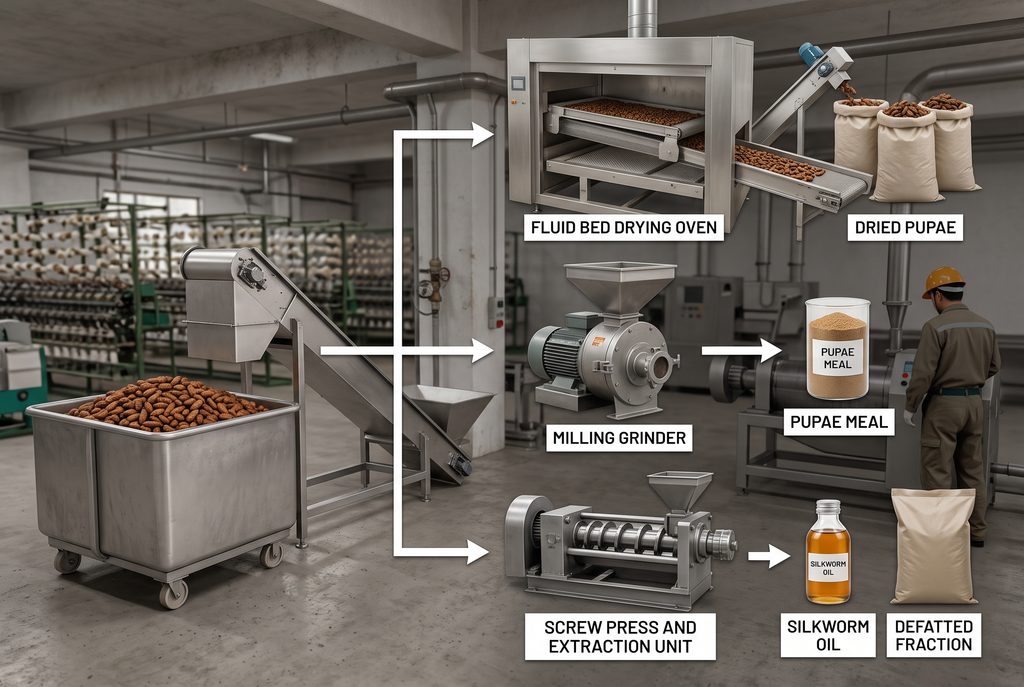
Further processing can include drying, milling, and oil extraction, depending on the intended product. Whole dried pupae require moisture control and appropriate storage, while pupae meal adds size reduction and potentially other preparation steps. Defatting creates two additional streams: extracted oil and a lower-fat solid fraction that can be processed for food, feed, or further ingredient development.
The production route can therefore branch substantially after silk recovery:
Silkworm Pupae → Whole/Dried Pupae
Silkworm Pupae → Pupae Meal
Silkworm Pupae → Oil + Defatted Fraction
More specialized processing can create protein-rich fractions or other ingredients, but these outputs require additional equipment and process control. They should be viewed as downstream manufacturing extensions of sericulture rather than the original purpose of silkworm farming.
8. Production Quality Depends on the Entire Chain
Commercial output cannot be evaluated only at the final processing stage. Mulberry quality affects larval development; environmental management affects survival and cocoon formation; cocoon characteristics influence reeling; and post-cocoon handling affects both silk recovery and the condition of the remaining pupae.
Traceability becomes increasingly important when pupae are intended for food, feed or ingredient markets. Production batches need to remain identifiable as material moves from rearing through cocoon handling and processing, particularly when different farms or production lots are consolidated downstream.
Weak control at one stage can reduce the commercial value created later. Commercial silkworm production is therefore better understood as an integrated biological and processing system rather than a simple insect-rearing operation.
9. Scaling Production Requires Coordination Across Agriculture and Processing
Increasing the number of silkworms does not automatically create a proportional increase in commercially usable output. Larger production requires enough mulberry leaves at the correct time, suitable rearing space, labor or mechanization, mounting capacity, and downstream cocoon-processing infrastructure.
Processing capacity also needs to remain aligned with farm output. A larger cocoon crop creates limited value if drying, sorting, or reeling capacity becomes a bottleneck. Similarly, developing a higher-value pupae business requires collection, stabilization, and processing systems capable of handling the secondary stream without compromising the primary silk operation.
This makes production capacity a system-level concept. The strongest commercial operations coordinate biological throughput with post-cocoon processing rather than maximizing one stage independently.
IIR Analysis
Commercial silkworm production is best understood as an integrated sericulture system rather than a conventional insect-protein farm. Mulberry cultivation supports larval growth, larval management determines cocoon production, and post-cocoon processing determines how efficiently the biological output is separated into silk and pupae.
This structure gives silkworm production an unusual commercial advantage. The upstream farming system is primarily supported by demand for silk, while pupae can create an additional value stream without requiring the entire cost of rearing to be justified by food or feed markets alone. That relationship helps explain why pupae can become commercially relevant even though silkworms were not originally domesticated as an ingredient species.
The main production opportunity is therefore not simply to rear more silkworms. It is to improve coordination across mulberry production, biological performance, cocoon quality, post-cocoon processing and pupae recovery so that more value can be captured from the same sericulture system.
Disclaimer: This article is for informational purposes only and does not constitute business, legal or investment advice. Always consult primary sources and qualified professionals.