Independent intelligence for the global insect industryISSUE 01 · 2026
Silkworm Production Cost: Key Drivers of Commercial Economics
By IIR Editorial DeskOctober 2, 2026
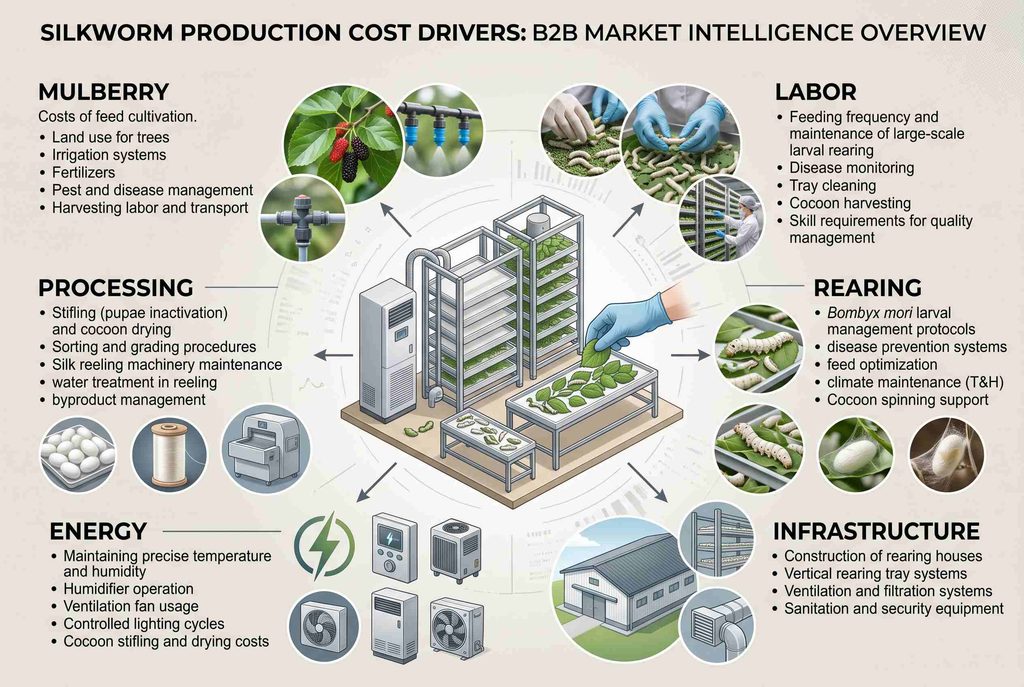
Silkworm production economics depend on mulberry cultivation, labor, biological performance, cocoon yield and post-cocoon processing. This analysis examines the main commercial cost drivers.
This analysis examines the main drivers of commercial silkworm production cost, from mulberry cultivation and labor to cocoon yield, processing efficiency and the value recovered from silk and pupae.
By IIR Editorial Desk · October 2, 2026 · Market Intelligence
Commercial silkworm production cost cannot be reduced to the cost of rearing insects. Sericulture connects mulberry cultivation, egg production, larval rearing, cocoon harvesting, and post-cocoon processing, meaning that costs accumulate across both agricultural and industrial stages before finished silk reaches the market.
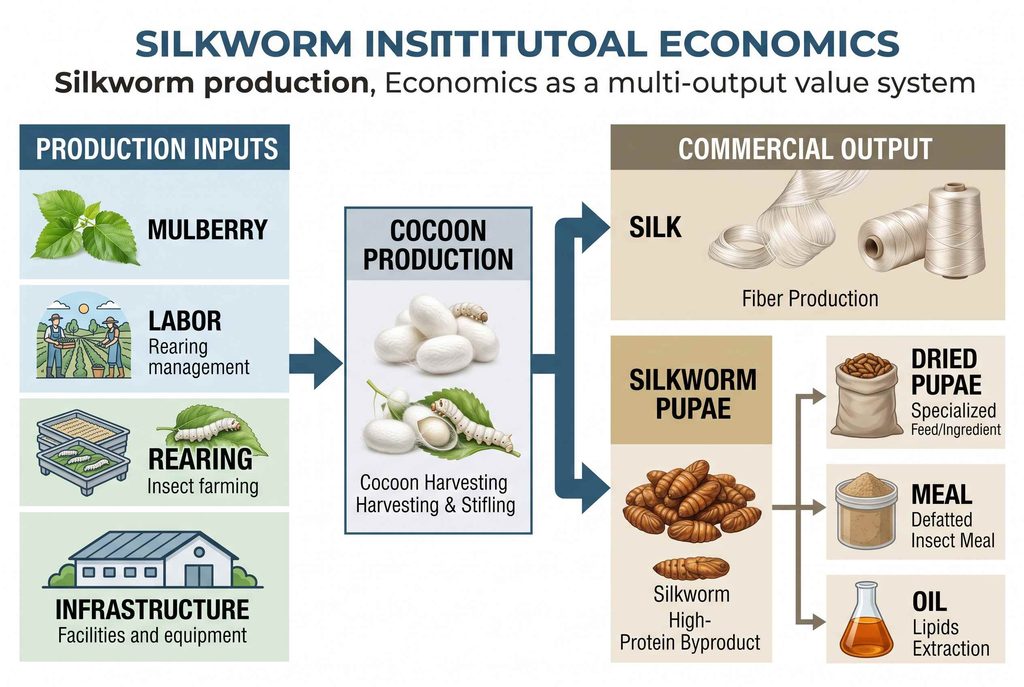
The economics are also unusual because a single biological production cycle creates more than one potentially valuable output. Silk is the primary product, while silkworm pupae can enter food, feed, and further-processing markets. Commercial performance, therefore, depends not only on minimizing production expenses but also on cocoon quality, silk recovery, facility utilization, and the amount of value captured from secondary outputs.
1. Mulberry Production Creates the First Major Cost Base
Conventional Bombyx mori production depends on a reliable supply of mulberry leaves. Land, planting material, fertilizer, irrigation where required, field management, harvesting, and transportation can all contribute to the cost of supplying feed to a commercial rearing operation.
The relevant economic measure is not simply the cost of producing a kilogram of leaves. Leaf quality and availability influence larval growth and cocoon production, so a lower-cost mulberry system can become economically inefficient if it produces inconsistent nutrition or fails to supply enough suitable leaves during periods of peak consumption. Location also changes the calculation because land, water, agricultural inputs, and transportation costs vary significantly between production regions.
This creates an important relationship between agriculture and insect production. A sericulture operation cannot optimize rearing economics independently from the crop system that supplies its feed.
2. Labor Remains a Major Economic Variable
Silkworm farming requires repeated handling across feeding, cleaning, environmental management, mounting, cocoon harvesting and sorting. Mulberry cultivation adds another layer of agricultural work before leaves even reach the rearing facility.
Labor requirements also change throughout the production cycle. Young larvae consume relatively little feed, while later stages require substantially more leaves and more frequent material handling. Cocoon harvesting and sorting can create another concentrated labor requirement at the end of the cycle.
Mechanization can reduce some repetitive work, but the economics depend on scale and utilization. Equipment that supports substantial throughput can reduce labor requirements per unit of output, while expensive machinery used only periodically can add depreciation and maintenance costs without generating equivalent savings. The relevant question is therefore how much saleable cocoon and downstream value each unit of labor supports.
3. Biological Performance Determines How Inputs Become Cocoons
Feed, labor, and infrastructure generate economic value only when larvae survive and produce commercially usable cocoons. Mortality before cocooning represents more than biological loss because resources have already been invested in the insects that fail to reach harvest.
Cocoon yield also depends on the performance of surviving larvae. The number of cocoons produced, their weight, shell characteristics, and suitability for reeling influence how effectively farm inputs are converted into the primary commercial product. Poor biological performance can therefore increase unit cost even when the prices of mulberry leaves, labor, and energy remain unchanged.
The economic objective is not simply maximum larval growth. Producers need consistent biological performance that converts available leaves, labor, and productive space into cocoons with sufficient commercial quality.
4. Cocoon Quality Can Matter as Much as Cocoon Quantity
Two farms producing similar cocoon weights can generate different economic outcomes if their cocoons perform differently during grading and reeling. Defective, stained, malformed or otherwise unsuitable cocoons may receive lower commercial value or produce less usable silk.
This means that production economics need to consider saleable cocoon quality, not only gross cocoon output. Rearing conditions, mounting practices, harvesting timing and post-harvest handling can all influence the proportion of production that reaches higher-value grades.
Quality also connects the farming stage directly with industrial processing. A decision that appears inexpensive during rearing can become costly later if it reduces reliability or raw-silk recovery. Cost control, therefore, needs to consider the value of the final output rather than treating farm expenses in isolation.
5. Stifling, Drying and Reeling Extend the Cost Boundary
Harvested cocoons are not the final commercial output. Stifling, drying, storage, and silk reeling introduce additional equipment, energy, labor, and handling requirements after the biological production stage has finished.
The cost boundary, therefore, matters. Farm-level cocoon production cost is different from the cost of dried cocoons, and both differ from the cost of producing raw silk. Comparisons become misleading when figures calculated at different stages of the value chain are treated as equivalent.
Reeling efficiency is particularly important because the commercial value recovered from a cocoon depends on how effectively the silk filament can be converted into usable raw silk. Equipment performance, cocoon uniformity, processing conditions, and operator skill can all influence the relationship between incoming cocoon volume and final silk output.
6. Yield Determines the Real Unit Economics
Commercial sericulture contains several yield transitions rather than one simple conversion. Mulberry cultivation produces leaves, larvae convert those leaves into biological growth, mature larvae produce cocoons, and post-cocoon processing separates silk from the remaining pupal biomass.
Losses or inefficiencies at each stage accumulate. Poor leaf production can restrict rearing capacity; larval mortality reduces the number of cocoons; defective cocoons reduce saleable output; and inefficient reeling lowers the amount or quality of silk recovered from the harvested crop.
For this reason, silkworm production cost should ultimately be considered against commercially usable output rather than biological production alone. A farm with higher input spending can still achieve stronger unit economics if it produces better cocoon yields and higher-value output from those inputs.
7. Scale Only Reduces Cost When Capacity Is Utilized
Larger sericulture operations can potentially spread infrastructure, management, and equipment costs across greater output. They may also support more standardized rearing procedures, mechanized handling, and better coordination with downstream processing.
Scale, however, creates new requirements. More larvae require more mulberry leaves, larger rearing areas, additional mounting capacity, and sufficient cocoon-processing infrastructure. Expanding one stage without matching capacity elsewhere can create bottlenecks rather than economies of scale.
Facility utilization is therefore more important than installed capacity alone. Rearing rooms, drying systems, and reeling equipment generate stronger economics when they operate at productive throughput. Large facilities operating below capacity can carry higher fixed costs per unit than smaller systems whose resources are consistently utilized.
8. Pupae Recovery Can Change Whole-System Economics
Silk is the primary commercial output of conventional sericulture, but the pupa remaining after cocoon processing can create an additional revenue stream. Pupae can be sold with limited processing or converted into dried products, meal, oil, defatted material, or more specialized ingredients.
This secondary value matters when evaluating the economics of the entire production system. Treating pupae only as waste assigns the full commercial burden to silk, while recovering value from pupae allows revenue to be generated from biomass that already exists as part of cocoon production.
Additional processing is not automatically profitable. Drying, milling, oil extraction, and fractionation introduce new equipment, energy, labor, and quality-control costs. The economic benefit depends on whether the resulting product can generate enough additional value to justify those expenses.
Silkworm economics are therefore better evaluated as a multi-output production system rather than by assigning every upstream cost to a single product.
9. Market Prices Determine Which Production Systems Remain Viable
Production efficiency ultimately needs to be evaluated against the value of the outputs being sold. Cocoon prices, silk quality, raw-silk prices, and the potential value of pupae products all influence how much production cost the system can commercially support.
This relationship can vary substantially by region. Labor costs, mulberry productivity, production structure, silk grade, access to processing infrastructure, and downstream markets differ between major sericulture areas. A cost structure that works in one production region cannot automatically be transferred to another.
For the same reason, a universal global figure for silkworm production cost would provide limited analytical value without clearly defining geography, production scale, and product boundary. A more useful framework is:
This is not an accounting formula. It illustrates why farms with similar input prices can produce different commercial outcomes.
IIR Analysis
The economics of silkworm production cost are defined by the integration of agriculture, insect biology and industrial processing. Mulberry cultivation determines the feed base, labor supports both crop and insect management, biological performance determines cocoon output, and post-cocoon processing determines how much value can ultimately be recovered from that production.
This makes simple cost-per-kilogram comparisons particularly difficult. The result changes depending on whether the measurement stops at fresh cocoons, dried cocoons or raw silk, and whether revenue from silkworm pupae is treated as a by-product credit, a separate commercial output or not captured at all.
The strongest production systems therefore do more than minimize individual expenses. They improve the conversion of mulberry, labor, infrastructure, and processing capacity into saleable cocoons, recoverable silk, and commercially useful pupae. Better utilization of the secondary pupae stream can further strengthen whole-system economics, provided that the additional processing required is supported by real market demand.
For IIR, the most meaningful measure of silkworm production economics is consequently not the lowest apparent farming cost. It is the amount of commercial value generated from the complete sericulture system relative to the agricultural, biological, and processing resources required to operate it.
Disclaimer: This article is for informational purposes only and does not constitute business, legal or investment advice. Always consult primary sources and qualified professionals.