Independent intelligence for the global insect industryISSUE 01 · 2026
Silkworm Market Demand: Feed, Pet Food, and Emerging Applications
By IIR Editorial DeskOctober 3, 2026
Silkworm market demand extends beyond silk production, with growing interest in pupae for animal feed, pet food, human food, protein, oil and other higher-value applications.
This analysis examines where commercial demand for silkworm-derived products is developing, from animal feed and pet food to human food, protein and oil applications, while separating established markets from emerging opportunities.
By IIR Editorial Desk · October 3, 2026 · Market Intelligence
Silkworm market demand is closely connected to the economics of sericulture because the primary commercial output remains silk, while the pupae create a substantial secondary stream. As a result, the market for silkworm-derived products is not simply another insect-protein market: demand is developing around a by-product that already comes from an established agricultural and processing system.
The strongest commercial logic is currently found in animal nutrition, food applications, and the recovery of higher-value components such as protein and oil. Research has expanded considerably across these areas, but the amount of published research should not be confused with the size of realized commercial demand. A significant share of current work evaluates substitution, processing, functionality, and product development rather than large-scale market adoption.
1. Silkworm Market Demand Is Built Around a By-Product Stream
Unlike insect species produced primarily for protein or feed, silkworm pupae are generated as part of silk production. After the cocoon is processed for silk, the pupae can enter food, feed, or ingredient markets rather than being treated solely as low-value residue. This gives silkworm pupae an unusual position in the broader insect industry: the upstream biological production system already exists, while downstream demand determines how much additional value can be captured.
This structure also means that the silkworm market demand is influenced by factors outside the pupae market itself. Silk production volumes, cocoon processing practices, local consumption, collection systems, and the ability to stabilize pupae all affect the amount of material available for commercial use. Demand can grow through better utilization of an existing stream rather than through the construction of an entirely new farming system.
2. Animal Feed Remains One of the Most Studied Commercial Applications
Animal feed is one of the clearest demand pathways for silkworm pupae. Research has examined their use in poultry, pigs, fish, and other livestock systems, generally as a protein-rich ingredient or partial substitute for conventional feed materials. A systematic review of 105 studies found that animal nutrition was one of the dominant areas of research, with silkworm pupae meal frequently evaluated as an alternative or supplement to traditional feed ingredients.
The commercial opportunity depends on more than protein content. Feed buyers need consistent composition, acceptable handling characteristics, microbiological quality, storage stability, and a price that works within the target formulation. Full-fat pupae and defatted meal can serve different formulation objectives, so the downstream product specification can materially change the addressable market. Feedipedia also notes that silkworm pupae meal has been used in poultry, pigs, fish, and ruminant feeding, while drying and grinding are important because fresh spent pupae spoil rapidly.
3. Aquafeed and Poultry Feed Offer Different Demand Profiles
Aquafeed is an important research and application area because fish diets can incorporate alternative protein ingredients when nutritional performance, palatability, and economics are acceptable. Poultry is similarly relevant, with reviews evaluating both full-fat and defatted silkworm pupae as potential feed ingredients. The nutritional characteristics of the material can therefore support several formulation strategies rather than a single standardized feed product.
For commercial buyers, however, technical suitability is only one part of the equation. A feed ingredient must also compete with available protein sources on delivered cost, quality consistency, and regulatory acceptability. This creates a distinction between feed research demand and recurring commercial procurement demand: positive feeding results can demonstrate technical potential without guaranteeing sustained market adoption.
4. Pet Food Creates a Smaller but Higher-Specification Demand Segment
Pet food represents a separate demand pathway because ingredient selection is influenced by formulation positioning, palatability, digestibility, sourcing, and consumer expectations, as well as basic nutrient supply. Research reviewed across silkworm applications has examined pupae and silkworm-derived materials for dogs and other companion animals, including the possibility of replacing conventional animal-derived ingredients in selected formulations.
The pet food opportunity is therefore better viewed as a differentiated ingredient market rather than simply another outlet for feed-grade pupae. Buyers may require more controlled processing, clearer specifications, stronger traceability, and consistent sensory characteristics. Odor, fat content, particle size, and processing method can become commercially important because they influence formulation performance and finished-product acceptance.
5. Human Food Is an Established Use in Some Markets
Silkworm pupae should not be treated exclusively as an animal-feed resource. Human consumption has a long history in several Asian silk-producing regions, and pupae have been used as food in countries including China, Japan, Thailand, and India.
The commercial opportunity is different from that of commodity feed. Human-food markets can include whole pupae, processed ingredients, and protein-based products, but they require appropriate food-safety controls, processing standards, and market-specific regulatory acceptance. Recent research has also examined silkworm pupa protein and peptides for use in foods such as cookies, yogurt, and ice cream, illustrating how the market can move from traditional consumption toward formulated products.
6. Protein and Oil Processing Can Expand the Addressable Market
Processing changes the commercial boundary of silkworm pupae. Instead of selling the material only as whole or ground pupae, processors can separate or concentrate components such as protein and oil, creating products designed for different buyers. This creates a broader ingredient portfolio and allows the same biological resource to serve multiple markets.
Research on silkworm pupa protein and oil has examined extraction, modification, and functionality for food and feed applications. More recent work has also highlighted the potential for higher-value uses while noting unresolved issues around allergenicity, regulation, and processing.
The commercial question is whether the additional processing creates enough value to justify the added capital, energy, quality-control, and logistics requirements. A technically attractive fraction is not automatically a commercially attractive product.
7. Whole Pupae, Meal, and Refined Ingredients Serve Different Buyers
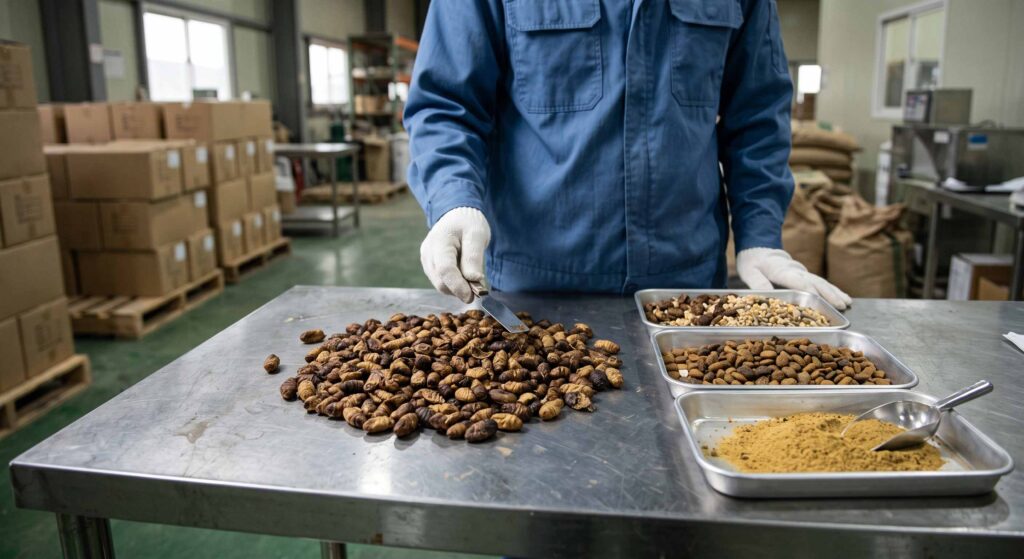
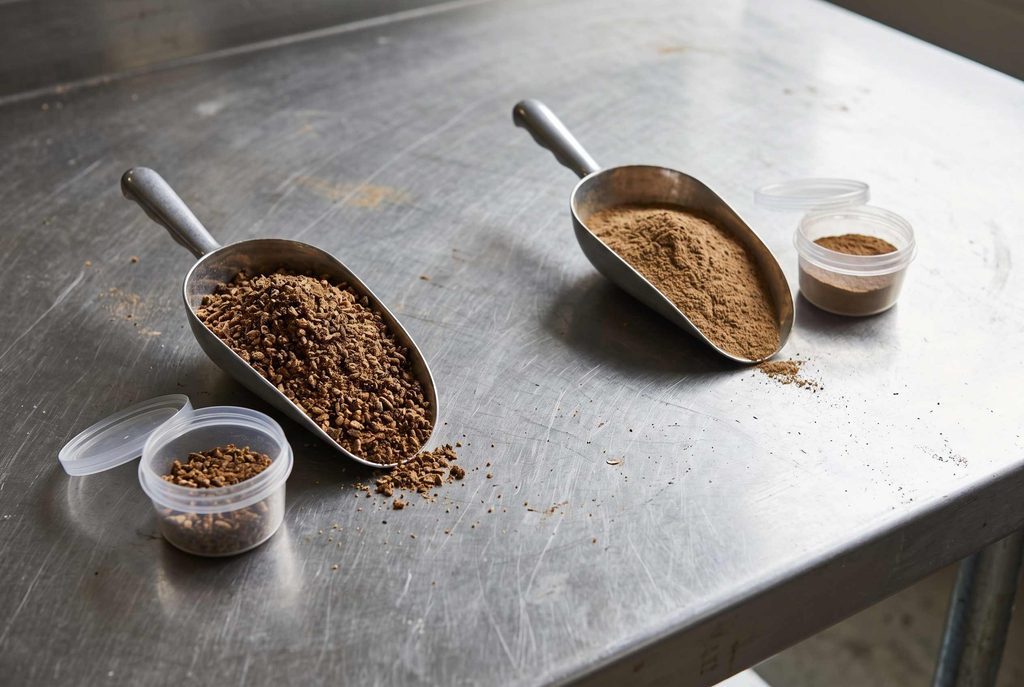
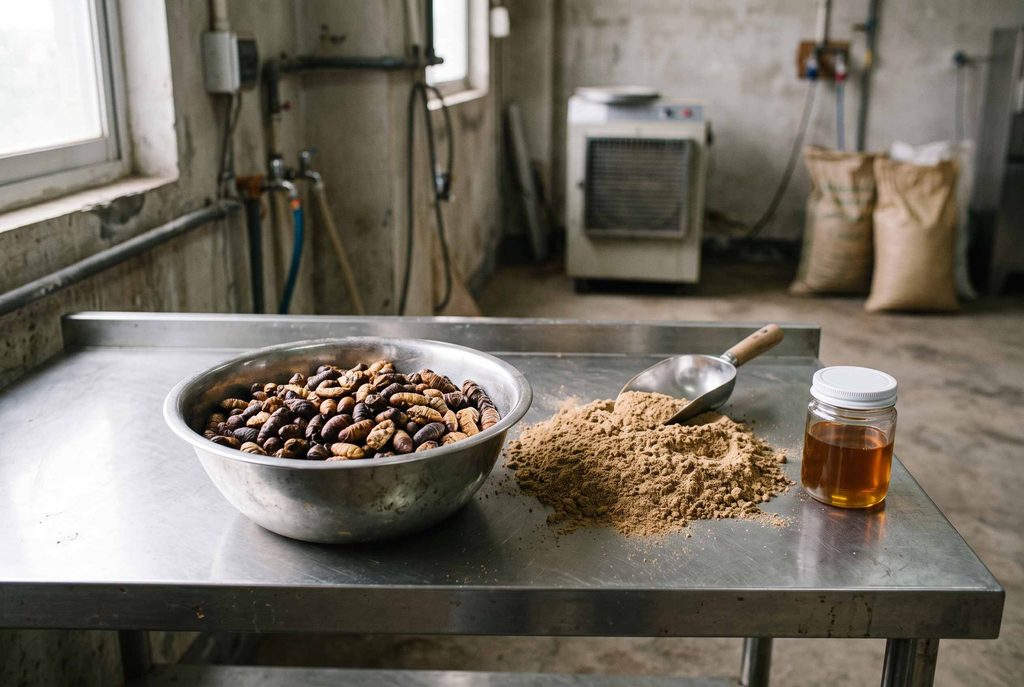
Product form is one of the most important variables in the silkworm market demand. Whole or minimally processed pupae can fit traditional food markets and some animal-feed applications, while ground meal provides easier incorporation into feed formulations. Defatted meal can target buyers seeking higher protein concentration, while extracted oil and purified protein move the product further into specialized ingredient markets.
These products should therefore not be treated as interchangeable. Each has different requirements for moisture, stability, packaging, processing, specifications, and pricing. Feedipedia notes that defatting can reduce perishability and increase the protein concentration of silkworm pupae meal, illustrating how processing can change both product characteristics and potential buyer segments.
8. Emerging Applications Are Growing Faster in Research Than in Established Demand
Silkworm pupae are attracting research interest in functional foods, bioactive compounds, pharmaceuticals, cosmetics, and other higher-value applications. Recent reviews describe proteins, lipids, peptides, and other components with potential functional uses, while also emphasizing the need for further development around extraction, safety, and regulatory requirements.
For market analysis, these applications should remain classified as emerging unless there is evidence of recurring commercial procurement at a meaningful scale. A growing number of academic studies can indicate technological opportunity, but they do not establish market size, buyer adoption, or commercial viability. This distinction is particularly important for silkworm pupae because the research landscape is much broader than the currently standardized commercial product market.
9. Supply Reliability Can Limit Demand Conversion
Potential buyers cannot build a recurring ingredient program around theoretical availability. Silkworm pupae are generated through geographically concentrated sericulture systems, and their availability is linked to cocoon production, processing practices, and local collection networks. Stabilization is also important because fresh pupae have high moisture and can deteriorate rapidly without appropriate processing.
For industrial buyers, the relevant question is therefore not simply how much silkworm biomass exists, but how much material can be collected, stabilized, standardized, and delivered with predictable specifications. This is where the silkworm supply chain becomes directly connected to market demand: stronger aggregation and processing systems can convert a dispersed by-product stream into a more dependable commercial ingredient.
10. Price and Product Consistency Shape Commercial Adoption
Silkworm-derived ingredients compete on more than nutritional value. Buyers compare them with fishmeal, poultry meal, soybean-derived ingredients, other insect meals, and conventional oils or proteins according to delivered cost, formulation performance, and supply reliability.
Consistency can be particularly important when a buyer is considering a long-term formulation. Variations in fat content, moisture, protein concentration, odor, processing method, or storage stability can make a material less attractive even when its average nutritional profile is favorable. As a result, market demand is likely to favor suppliers that can offer standardized product specifications rather than simply the lowest nominal price.
11. Demand Maturity Differs Across Applications and Regions
The silkworm market should be viewed as a collection of application markets with different levels of maturity. Traditional human consumption and established use of pupae in animal nutrition have a longer commercial history, while standardized pet-food ingredients, extracted proteins, functional products, and specialized industrial applications remain more dependent on product development, regulation, and buyer validation.
Geography also matters. Regions with established sericulture can have stronger access to raw material and processing knowledge, while markets outside traditional silk-producing areas may require additional logistics, regulatory work, and consumer or buyer education. The result is a fragmented demand landscape rather than a single global silkworm ingredient market.
12. The Commercial Funnel Runs From Biological Supply to Recurring Demand
A useful way to evaluate the silkworm market demand is to separate the five stages:
The first stage depends on sericulture output. The second depends on collection and stabilization. The third depends on processing and product specifications. The fourth depends on food or feed regulations, market access, and buyer requirements. Only the final stage represents recurring commercial demand.
This framework helps prevent a common analytical error: treating every technically possible application as an existing market. A silkworm-derived protein may be nutritionally promising, but the commercial market becomes meaningful only when buyers can source it consistently, use it legally and economically, and repeat purchases at a scale that supports the supply chain.
IIR Analysis
Silkworm market demand is best understood as a multi-output utilization market built on the existing sericulture economy. Animal feed currently provides one of the strongest research-supported pathways, while pet food and human food create more specialized opportunities. Protein, oil, and other fractions broaden the potential value chain, but their commercial development depends on processing economics, regulatory access, and buyer adoption.
The key distinction for market analysis is between potential demand and realized demand. The literature demonstrates substantial technical interest in silkworm pupae, including animal nutrition, food products, and higher-value fractions, but research activity alone cannot establish the size of a commercial market. For IIR, the more useful indicator is the progression from available pupae to standardized products, qualified buyers, and recurring procurement.
Disclaimer: This article is for informational purposes only and does not constitute business, legal or investment advice. Always consult primary sources and qualified professionals.