Independent intelligence for the global insect industryISSUE 01 · 2026
Silkworm Industry: Market, Production, and Commercial Applications
By IIR Editorial DeskOctober 1, 2026
The silkworm industry extends beyond silk production. This analysis examines sericulture, production systems, silkworm pupae and expanding food, feed and industrial applications.
This analysis examines the silkworm industry from sericulture and silk production to the growing commercial use of silkworm pupae in food, animal feed and higher-value industrial applications.
By IIR Editorial Desk · October 1, 2026 · Market Intelligence
The silkworm industry differs fundamentally from most emerging insect-protein sectors. Silkworms were not originally commercialized as food or feed ingredients; they were domesticated and reared primarily for silk. That established sericulture system created a large biological production chain in which cocoons are the primary product, and pupae become an important secondary resource after silk processing.
This relationship changes how the industry should be evaluated. Silk remains the economic foundation of commercial silkworm production, while food, feed, oil, and other applications increasingly offer ways to capture additional value from biomass generated by the existing silk industry. The commercial opportunity is therefore not simply about scaling insect farming, but about improving the utilization of an established agricultural and textile value chain.
1. Sericulture Forms the Economic Foundation of the Silkworm Industry
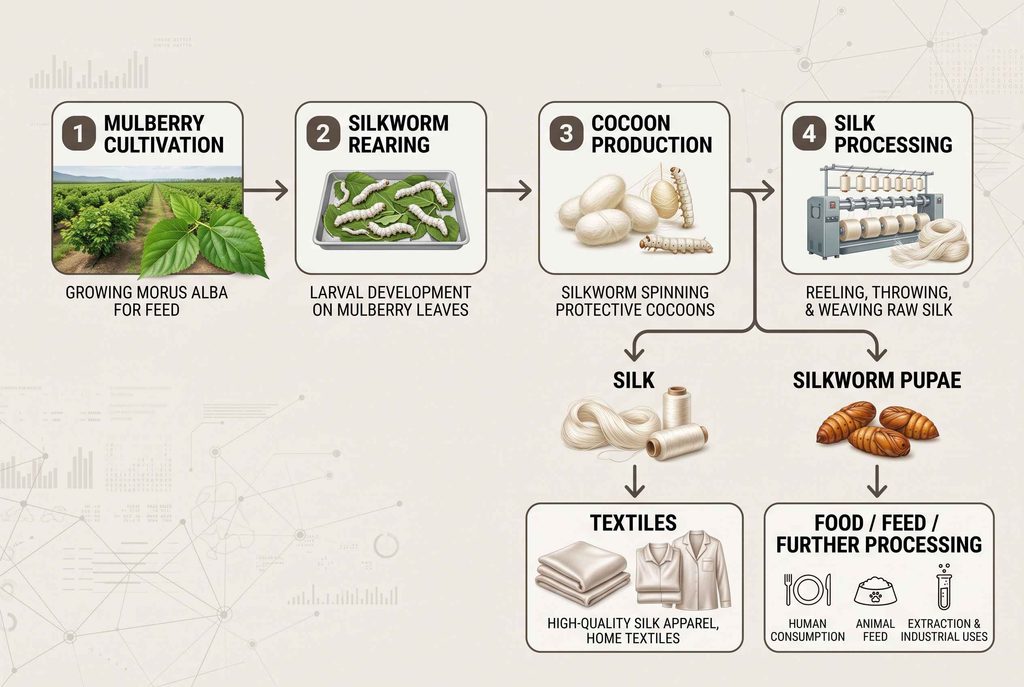
Commercial sericulture combines host-plant cultivation, silkworm egg production, larval rearing, cocoon production, silk reeling, and textile manufacturing. The mulberry silkworm, Bombyx mori, is the dominant domesticated species associated with commercial mulberry silk and depends on mulberry leaves as its primary feed source.
Unlike insect farms designed around a finished protein ingredient, the silkworm production cycle is optimized primarily for cocoon and silk characteristics. Larvae consume mulberry leaves through successive growth stages before spinning cocoons, which are harvested and transferred into reeling or other silk-processing channels. This makes the silkworm industry closely connected with agriculture, rural labor, and textile manufacturing rather than functioning as a stand-alone insect ingredient sector.
India illustrates the continuing industrial scale of sericulture. Official Central Silk Board data show raw silk production of 36,582 metric tons in 2022–23, with mulberry silk representing the largest component. More recent Indian government materials continue to identify the country as the world’s second-largest silk producer after China.
2. Production Remains Concentrated in Asia
Global silk production is geographically concentrated, with China and India forming the industry’s two principal production centers. Other producing countries include Uzbekistan, Vietnam, Thailand, and Brazil, although their output is considerably smaller. The exact global shares vary across datasets and reporting years, so comparisons need to use consistent sources and periods rather than combining figures from different industry estimates.
Asia’s position reflects more than current production capacity. Sericulture depends on established mulberry cultivation, silkworm breeding, cocoon markets, reeling infrastructure, technical knowledge, and labor networks that have developed over long periods. These systems create substantial barriers to the rapid geographic relocation of the industry.
Production concentration also matters to emerging pupae markets. Regions with substantial silk-reeling activity naturally generate larger streams of silkworm pupae, giving them a structural advantage if demand expands for food, feed, or processed pupae ingredients. In this respect, the geography of the future silkworm-ingredient industry is partly inherited from the geography of the existing silk industry.
3. The Production Chain Creates Two Commercial Value Streams
The most important feature of silkworm economics is the relationship between the primary silk product and the pupae remaining after cocoon processing. Once the silkworm completes cocoon formation, the cocoon contains both the silk shell and the developing pupa. Silk processing recovers the fiber while creating a substantial stream of pupal biomass.
Silkworm Pupae → Food / Feed / Meal / Oil / Protein / Other Industrial Uses
Silkworm pupae are therefore different from insects whose entire farming system must be economically supported by sales into feed or food markets. In sericulture, much of the upstream production infrastructure already exists because silk itself supports the primary industry. Better utilization of pupae can add revenue while reducing the amount of biological material treated as low-value residue or waste.
4. Silkworm Pupae Are Becoming a Broader Commercial Raw Material
Silkworm pupae have long been consumed in parts of Asia and used in animal nutrition, but research increasingly treats them as a multi-output raw material rather than a single by-product. A systematic review of 105 studies found applications across animal feed, human food, health-related research, and other industries, with pupae meal and oil receiving particularly substantial research attention.
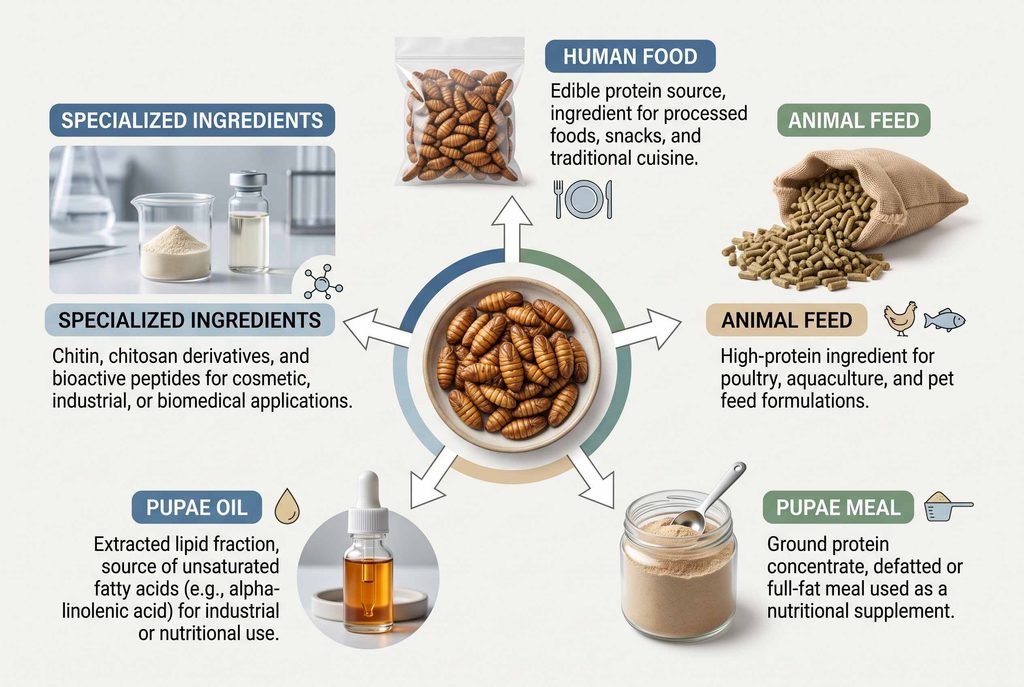
Product form determines the addressable market. Whole or minimally processed pupae can enter established food channels in regions where consumption is culturally familiar. Drying and milling produce a meal suitable for further formulation, while defatting separates oil from a higher-protein solid fraction. More specialized processing can isolate proteins, lipids, or other compounds for higher-value applications.
This creates a broader commercial hierarchy than the traditional model of selling silk and disposing of the remaining biomass. The same production cycle can potentially support textile materials, food products, animal nutrition, and more specialized ingredients, although research interest should not automatically be interpreted as established industrial demand.
5. Food Markets Combine Traditional Consumption With New Product Development
Silkworm pupae already have an established food history in several Asian countries, including China, India, South Korea, Japan, and Thailand. A systematic review of Bombyx mori nutrition identifies pupae as the principal silk-industry by-product used for food and notes their existing consumption across Asia.
Modern food development is extending the discussion beyond recognizable whole pupae. Researchers have investigated silkworm pupae meal, protein, and oil in formulated foods, while nutritional studies have examined protein quality, fatty-acid composition, and other characteristics relevant to product development. Composition is not completely uniform: strain, diet, origin, pretreatment, and drying methods can all affect reported nutritional characteristics.
Commercial expansion will therefore depend on more than nutritional potential. Food safety, sensory characteristics, processing consistency, consumer acceptance, and regulatory status will determine whether traditional consumption develops into broader ingredient demand outside established markets.
6. Animal Feed Is One of the Most Studied Pupae Applications
Animal nutrition represents one of the largest research areas for silkworm pupae. Studies have evaluated pupae meal, defatted meal, and oil in aquaculture, poultry, mammals, and companion animals, often examining whether these materials can partially substitute conventional ingredients such as fishmeal or soybean meal. The 2024 systematic review found animal feed to be the most frequently represented general-use category in the literature it analyzed.
Aquaculture is particularly relevant because silkworm pupae have a history of use as feed material in integrated agricultural systems. Research has since expanded into more controlled formulations for fish and other farmed species. Poultry, livestock, and pet-food applications have also been investigated, but appropriate inclusion levels and performance vary according to animal species, processing method, and diet formulation.
The commercial distinction remains important: positive feeding studies demonstrate technical potential, not automatically large-scale market demand. Feed applications become commercially meaningful only when pupae can be supplied with consistent specifications, adequate safety controls, reliable volumes, and pricing that competes with alternative ingredients.
7. Oil, Protein, and Other Fractions Expand the Value Chain
Silkworm pupae contain lipids and proteins that can be separated into more specialized commercial fractions. Research on pupae oil has received substantial attention, including studies of its unsaturated fatty-acid profile and possible applications in food and other industries. Protein concentrates, hydrolysates, and other fractions have also been investigated for nutritional, pharmaceutical, cosmetic, and material applications.
These applications create the possibility of a cascading value model rather than a single-product market. Pupae can be sold with limited processing, converted into meal, separated into oil and defatted meal, or processed further into specialized ingredients. Each additional step can increase the number of potential markets but also adds capital requirements, process control, quality specifications, and manufacturing cost.
For the industry, the key question is not how many theoretical applications can be identified. It is whether processing can consistently produce fractions that buyers value enough to justify the additional cost.
8. Market Growth Depends on Better By-Product Utilization
The commercial development of silkworm pupae does not require the industry to replace its traditional silk business. A more realistic pathway is to increase the value captured from biomass already generated by sericulture.
This creates an important circular-economy opportunity. When pupae move from low-value residue into food, feed, or industrial processing, producers and processors can potentially generate additional revenue from the same cocoon production system. Better utilization can also reduce disposal problems associated with large volumes of organic material.
The opportunity is strongest where silk production, pupae collection, stabilization, and downstream processing can be connected efficiently. A region may produce substantial quantities of cocoons but still lack a viable ingredient industry if pupae are fragmented across many small processors, deteriorate before stabilization, or cannot meet the specifications required by formal buyers.
9. The Silkworm Industry Is Moving Toward a Multi-Product Model
The traditional industry can be understood primarily as:
Mulberry → Silkworm → Cocoon → Silk
A broader commercial model increasingly looks like:
This does not mean every application has reached the same level of commercialization. Silk remains the established primary market, food consumption is mature in certain regions, animal-feed use has a substantial research base, and more specialized fractions remain at varying stages of technical and commercial development.
The strategic significance lies in diversification. A mature sericulture system can potentially create more value from the same biological production cycle without requiring pupae demand to carry the entire economics of silkworm farming.
IIR Analysis
The silkworm industry should not be analyzed as another emerging insect-protein farming sector. Its economic foundation already exists in sericulture, with Bombyx mori production integrated into a long-established agricultural and textile chain. That gives the sector an unusual advantage: substantial pupal biomass can be generated as part of an industry whose primary commercial product is silk.
The next stage of development is therefore centered on value recovery. Food and animal feed represent the most established or extensively researched pathways, while oil, protein, and other fractions create opportunities for deeper processing. The 2024 systematic review of silkworm-pupae applications reinforces this direction, showing broad research interest across animal nutrition, human food, and industrial uses while also making clear that many applications remain areas of potential rather than proven large-scale markets.
For IIR, the industry’s long-term commercial opportunity is best understood as a transition from a single-primary-product sericulture model toward a multi-output biological value chain. The strongest businesses will not necessarily be those producing the most cocoons, but those capable of connecting silk production with efficient pupae collection, stabilization, processing, and markets that can absorb the resulting food, feed, and higher-value ingredients.
Disclaimer: This article is for informational purposes only and does not constitute business, legal or investment advice. Always consult primary sources and qualified professionals.