Independent intelligence for the global insect industryISSUE 01 · 2026
Insect Frass: Production, Specifications and Commercial Applications
By IIR Editorial DeskOctober 26, 2026
Insect frass is an emerging agricultural input associated with commercial insect farming. This analysis examines its production, composition, processing, quality specifications, fertilizer applications, regulatory considerations and market economics.
Insect frass is attracting interest as a potential agricultural input and secondary revenue stream for insect producers. This analysis examines how commercial frass products are generated, processed, tested, regulated and evaluated across fertilizer and soil-management markets.
By IIR Editorial Desk · October 27, 2026 · Market Intelligence
Insect frass is an insect-farming residual material increasingly evaluated for use in fertilizers, soil amendments, and other agricultural products. It originates from insect rearing systems and may contain insect excrement, residual feeding substrate, shed exoskeletons, and other insect-derived materials. Its precise composition depends on the species, production system, and separation process, making it a variable agricultural input rather than a standardized commodity.
As commercial insect farming expands, frass management is becoming an important operational and economic consideration. Producers must determine whether residual material can be processed into a marketable agricultural product, while fertilizer manufacturers and distributors need reliable information about nutrient composition, safety, regulatory eligibility, and agronomic performance. Understanding these factors is essential before treating insect frass as a dependable commercial fertilizer ingredient.
1. What Is Insect Frass?
Insect frass is commonly used as a broad commercial term for residual material generated during insect rearing. Although insect excrement forms part of this material, collected frass often includes uneaten feed, shed insect skins, and other residues that remain after harvesting the insects.
This distinction matters because frass composition varies with the amount and type of residual substrate. Two products described as insect frass may have substantially different nutrient concentrations, organic matter characteristics, particle sizes, and microbial profiles. The material collected from a black soldier fly larvae facility may therefore differ from frass generated through mealworm or cricket production.
Commercial definitions may also differ from everyday industry terminology. Some regulatory frameworks establish specific definitions and compositional requirements for frass, including limits on particular residual insect materials. A general description used by a supplier does not automatically establish that the product meets the applicable legal definition.
In addition, raw rearing residue should be distinguished from processed, commercially packaged frass. Collection, stabilization, screening, treatment, and quality verification can influence whether the material is suitable for a particular agricultural application.
2. How Commercial Insect Frass Is Produced
Insect frass production is closely connected to insect farming operations. Unlike insect protein meal or oil, frass is generally not the primary biological output of the rearing process. It accumulates as insects consume feed and develop within a controlled production environment.
The actual process depends on the species and rearing system. Black soldier fly larvae are often raised in systems where residual substrate must be separated from harvested larvae. Mealworm production may generate a comparatively dry mixture that requires screening to remove insects and other material. Cricket facilities can produce residual streams with different physical and handling characteristics.
Separation efficiency influences the finished product. Material containing excessive residual feed or unintended insect biomass may have a different composition from a more consistently processed fraction. These differences affect both product classification and commercial quality.
Production records should identify the relevant insect species, rearing inputs, collection practices, and processing history. For buyers, this information provides the basis for evaluating whether the supplier can deliver consistent material across recurring orders.
3. Separation, Stabilization, and Processing Methods
Processing determines whether collected frass can be transformed into a manageable commercial agricultural input. Depending on the production system and destination market, operations may include screening, controlled heat treatment, drying, maturation, granulation, and packaging.
Screening removes unwanted oversized material and helps establish a more consistent particle size. Additional separation may be required to reduce residual insects or other components that do not belong in the specified product grade.
Stabilization is especially important when the collected material contains substantial moisture or biologically active residues. Uncontrolled storage may lead to odor development, microbial changes, nutrient losses, or inconsistent handling properties. Manufacturers therefore need appropriate procedures for managing material between collection and final processing.
Heat treatment may be required under certain regulatory frameworks. However, a general claim that the product has been dried or heated does not establish compliance with a prescribed treatment standard. Where specific time-temperature conditions apply, the supplier must demonstrate that the required process has been followed.
Granulation or pelletizing may improve handling, dust management, and packaging consistency. Nevertheless, these operations introduce additional costs and do not automatically improve the underlying nutrient composition or agronomic performance.
The appropriate processing system depends on raw-material characteristics, regulatory obligations, customer requirements, and the economics of the intended product.
4. Insect Frass Nutrient Content and Composition
Insect frass nutrient content is a major factor in agricultural evaluation. Commercial products may contain nitrogen, phosphorus, potassium, organic matter, and a range of secondary nutrients and trace elements. However, their concentrations can vary considerably.
Insect species and feeding substrates are important sources of variation in nutrient composition. Processing and separation also influence composition, particularly when the proportion of residual feed differs between batches.
Component
Agricultural relevance
Commercial evaluation
Total nitrogen
Potential nutrient contribution
Concentration and availability
Phosphorus
Plant nutrition
Reporting convention and available fraction
Potassium
Plant nutrition and crop requirements
Measured content and nutrient balance
Organic matter
Soil organic input
Measurement method and composition
Carbon-to-nitrogen ratio
Potential nutrient mineralization behavior
Relationship to application conditions
Calcium and magnesium
Secondary nutrient contribution
Actual concentration
pH
Soil and formulation compatibility
Batch result and application context
Electrical conductivity
Soluble salts and potential salinity effects
Crop and application sensitivity
Moisture
Storage and handling
Defined acceptance range
Particle size
Spreading and blending performance
Uniformity and processing requirements
Nutrient values should be compared on a consistent reporting basis. Results expressed on a dry-matter basis may differ substantially from values reported as received, particularly when moisture levels vary.
Total nutrient concentration also differs from plant-available nutrient supply. Nitrogen and other nutrients may become available through biological and chemical processes after application, and the timing of release depends on the material and soil conditions.
Consequently, a favorable laboratory nutrient profile does not independently establish crop performance. Commercial evaluation should combine composition data with relevant agronomic evidence.
5. Key Insect Frass Specifications
Insect frass specifications should define the characteristics required for a particular fertilizer or soil amendment application. Unlike a standardized mineral fertilizer, frass can exhibit substantial biological and compositional variability.
A commercial specification may include nutrient content, moisture, organic matter, pH, electrical conductivity, particle size, physical impurities, and relevant safety parameters. The importance of each characteristic depends on whether the product is intended for direct soil application, fertilizer blending, horticultural substrates, or another permitted use.
For example, a fertilizer manufacturer may prioritize predictable nutrient concentration and blending performance, while a horticultural buyer may require additional information about salinity, maturity, and plant response.
Specifications should also identify whether the product is raw, treated, granulated, or otherwise processed. These categories should not be compared as if they represent equivalent material.
A supplier’s typical nutrient analysis is useful for initial evaluation, but it does not replace batch-specific documentation or contractual acceptance limits. Buyers need clarity about which values are indicative, which are guaranteed, and how compliance will be verified.
6. Quality Control and Safety Requirements
Commercial insect frass quality depends on controls over rearing inputs, collection, processing, storage, and distribution. The material’s agricultural origin does not eliminate the need to assess potential biological, chemical, or physical hazards.
Microbiological risks may be associated with raw substrates, handling practices, and inadequate treatment. Depending on the regulatory framework and intended application, testing may include relevant pathogens or hygiene indicators.
Chemical contaminants also require consideration. Heavy metals, pesticide residues, and other substances may originate from rearing inputs or processing environments. Their significance depends on the specific production system and applicable limits.
Physical quality is another concern. Excessive foreign material, inconsistent particle size, abnormal moisture, or unstable storage behavior may reduce the product’s suitability for commercial handling.
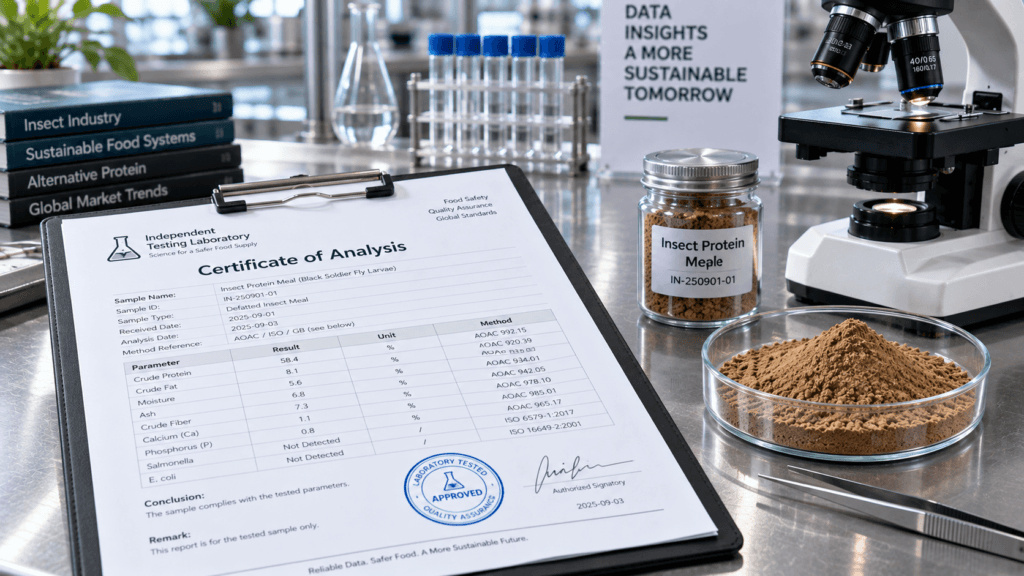
A batch-specific Certificate of Analysis can provide evidence of nutrient composition and relevant safety testing. However, laboratory results should support a broader quality-management system that includes traceability, process controls, and procedures for handling nonconforming material.
Commercial buyers should verify the requirements applicable to the intended destination rather than assume that a product suitable for domestic use can be exported without additional controls.
7. Insect Frass Fertilizer Applications
Insect frass fertilizer products are being evaluated as sources of plant nutrients and organic material. Their potential use includes soil application, incorporation into fertilizer blends, and selected horticultural production systems.
The principal agronomic function is nutrient supply, although the amount and timing of available nutrients can differ from conventional fertilizers. Frass may contain both mineral and organic nutrient fractions, making its behavior dependent on soil conditions, microbial activity, and product composition.
Application rates should be based on crop requirements, soil conditions, measured nutrient content, and relevant agronomic evidence. A fixed application rate cannot be recommended universally across insect species, frass grades, and agricultural environments.
The potential value of frass also depends on its compatibility with existing fertilizer programs. In some cases, it may complement rather than replace conventional nutrient sources.
For commercial users, performance testing under representative conditions is more informative than general claims that frass increases crop yield or improves soil health.
8. Soil Amendments, Horticulture, and Growing Media
Beyond direct nutrient supply, insect frass is being investigated for its potential contribution to soil management and horticultural production.
Organic matter and other components may influence soil biological activity and nutrient cycling. However, these effects vary with frass composition, application rate, soil properties, and crop species.
Horticultural applications require particular attention to electrical conductivity, pH, nutrient availability, and possible phytotoxic effects. Material that performs adequately in one soil or crop system may not be suitable for sensitive seedlings or container-grown plants.
Growing-media manufacturers may also evaluate particle size, moisture stability, odor, and compatibility with other substrate components. These practical characteristics influence manufacturing and customer acceptance.
Research interest in soil biological effects should not be interpreted as proof of consistent performance across all products. Where suppliers make claims about plant growth promotion, pest suppression, or other biological benefits, those claims require suitable evidence and may be subject to additional regulatory requirements.
9. Chitin and Potential Biological Effects
Insect frass may contain chitin-associated material originating from shed exoskeletons and other insect residues. This has attracted research interest because chitin and related compounds can interact with soil microorganisms and plant-associated biological processes.
Nevertheless, the amount and characteristics of chitin-containing material depend on the production system and separation process. Frass should not be assumed to have a consistent chitin concentration across species or suppliers.
Some studies have investigated possible effects on soil microbial activity and plant responses. However, observed results may also be influenced by nutrient availability, organic matter, and other components of the tested material.
For commercial product development, claims about plant defense, disease suppression, or biostimulant activity require evidence specific to the product and application. Nutrient-related effects should be distinguished from biological effects that extend beyond conventional fertilizer action.
A scientifically credible market position therefore depends on measured composition and reproducible performance rather than broad claims about the benefits of insect-derived materials.
10. Production Economics and Commercial Supply
Frass commercialization creates a potential secondary revenue opportunity for insect producers, but the economics depend on processing requirements and access to suitable markets.
Collection, separation, treatment, drying, granulation, testing, packaging, and distribution all contribute to production cost. These activities may be necessary to convert a residual stream into a product that meets commercial and regulatory requirements.
Transport economics are particularly important because fertilizer and soil amendment products can be sensitive to freight costs. Moisture content, bulk density, packaging format, and distance to the customer affect delivered cost.
In addition, the amount of frass generated depends on the insect species, rearing inputs, operating conditions, and how residual material is defined and collected. There is no reliable universal conversion factor that can be applied to every insect production facility.
A producer may generate substantial residual material without having an economically viable commercial outlet. The ability to sell frass depends on consistent quality, suitable processing, regulatory access, and demand within a practical distribution radius.
Commercial assessments should therefore separate the volume of material generated from the volume that can be sold as a compliant agricultural product.
11. Insect Frass Market Demand
Insect frass market demand is linked to agricultural input markets, insect farming capacity, product regulation, and the willingness of growers or fertilizer manufacturers to adopt alternative materials.
Potential customers include organic fertilizer producers, soil amendment manufacturers, horticultural suppliers, agricultural distributors, and growers interested in evaluating new nutrient sources.
However, interest in circular agriculture does not automatically translate into recurring purchases. Commercial customers need evidence of nutrient consistency, safety, agronomic performance, and price competitiveness.
Market development may also differ by region. Areas with established fertilizer distribution networks, suitable regulatory pathways, and nearby insect production facilities may offer different opportunities from markets that require expensive long-distance transport.
The distinction between experimental use and established demand is important. Research trials and pilot sales can demonstrate technical potential, but they do not independently establish the size of a recurring commercial market.
Reliable market intelligence should therefore consider actual customer adoption, product registration, supplier capacity, distribution economics, and verified transactions rather than rely solely on broad sustainability narratives.
12. Packaging, Logistics, and Commercial Procurement
Commercial insect frass may be supplied in bulk, bags, or other formats depending on the product grade and customer requirements. Processed granules and loose residual material can have different handling characteristics, making packaging and freight comparisons product-specific.
Moisture protection is important during storage and transport. Packaging should also limit contamination and prevent unnecessary product loss. For fine or dusty materials, handling controls may be needed to protect workers and maintain a clean distribution environment.
Buyers should request a clear product specification, recent analytical results, information about processing and treatment, and evidence of regulatory eligibility for the intended market.
Commercial quotations should identify net weight, packaging, order quantity, delivery terms, and any testing or registration responsibilities. Comparing products solely on price per metric ton can be misleading when nutrient concentration, moisture, and treatment requirements differ.
A useful procurement comparison considers the delivered cost per unit of relevant plant nutrient, while also accounting for organic matter, agronomic performance, handling requirements, and compliance obligations.
For recurring supply, consistent quality and predictable availability are more valuable than a favorable result from one isolated production batch.
13. Regulation and International Market Access
Regulatory requirements are a central consideration in the commercialization of insect frass. The legal treatment of the material may depend on its definition, origin, processing method, intended agricultural use, and destination market.
In the European Union, specific rules address frass derived from farmed insects, including requirements associated with treatment and placing the material on the market. These rules should be evaluated alongside applicable fertilizer legislation and any other relevant product obligations.
The European regulatory definition is more specific than the broad commercial use of the term. Consequently, material described as insect frass by a producer may require additional verification before it qualifies under the applicable legal framework.
In the United States, fertilizer and soil amendment requirements can involve state-level registration, labeling, and contaminant standards. The exact obligations depend on the product’s classification, claims, and intended market.
Regulatory approval for one product or jurisdiction should not be treated as authorization for every frass material. In particular, claims involving pest control, plant disease suppression, or other biological effects may trigger additional requirements.
Before commercial distribution or export, suppliers and buyers should confirm the applicable product definition, treatment obligations, registration requirements, testing standards, and permitted claims.
14. Commercial Outlook and Industry Development
Insect frass represents an opportunity to improve the commercial utilization of residual materials generated by insect farming. However, its long-term market position will depend on whether producers can deliver consistent agricultural products rather than simply redirecting waste streams.
Improved separation, processing, nutrient characterization, and safety testing may support greater product standardization. Granulation and other conditioning technologies could also improve handling and distribution, although their benefits must be weighed against additional costs.
Agronomic research remains important. Commercial adoption requires a clearer understanding of nutrient availability, application rates, soil interactions, crop responses, and potential risks across different frass sources.
The economics of frass may be strongest where insect production facilities have access to nearby agricultural customers or established fertilizer manufacturers. Long-distance distribution may be more difficult to justify for lower-value or high-moisture products.
As the sector develops, reliable product data and transparent regulatory compliance will be essential for building confidence among professional agricultural buyers.
IIR Analysis
The commercial significance of insect frass lies in its potential to transform an insect-farming residual stream into a usable agricultural input. Nevertheless, this opportunity depends on more than the presence of nitrogen, phosphorus, potassium, or organic matter.
For commercial buyers, the most important considerations are source traceability, nutrient consistency, appropriate treatment, contaminant controls, agronomic performance, and regulatory eligibility. Products that differ in species, rearing substrate, or processing history should not be assumed to deliver equivalent agricultural results.
Frass also presents a distinct economic challenge. Its commercial value must justify collection, processing, testing, packaging, and transportation costs. As a result, the location of agricultural customers and the availability of established distribution channels can be as important as the nutrient profile.
The emerging market should therefore be evaluated through verified product performance and recurring customer demand rather than generalized assumptions about the growth of insect farming.
Ultimately, insect frass may become a valuable component of circular agricultural supply chains, but its long-term success will depend on consistent, compliant, and economically viable fertilizer or soil amendment products.
Disclaimer: This article is for informational purposes only and does not constitute business, legal or investment advice. Always consult primary sources and qualified professionals.