Independent intelligence for the global insect industryISSUE 01 · 2026
Housefly Larvae Industry: Market, Production, and Commercial Applications
By IIR Editorial DeskOctober 4, 2026
The housefly larvae industry combines insect production with organic waste bioconversion, creating opportunities in animal feed, fertilizer and emerging insect-derived products. This analysis examines production systems, commercial applications and the constraints shaping industry development.
This analysis examines the commercial housefly larvae industry, from breeding and substrate-based production to animal feed, organic waste bioconversion and emerging value-added applications, while assessing the constraints that still limit wider industrial adoption.
By IIR Editorial Desk · October 4, 2026 · Market Intelligence
The housefly larvae industry is developing around a species with an unusual commercial profile. The common housefly, Musca domestica, is widely recognized as a pest, but its larvae can also convert organic substrates into protein-rich biomass and residual material with potential agricultural value. Recent research has increasingly examined housefly larvae as a production animal rather than simply a pest species.
The commercial model is therefore broader than insect protein alone. Housefly larvae can potentially generate animal-feed ingredients while simultaneously supporting organic waste conversion, with additional opportunities in fertilizer, chitin, bioactive compounds and other derived products. The central industry challenge is turning these technical capabilities into standardized, safe and economically competitive production systems.
1. Housefly Larvae Are Becoming a Production Species
The commercial concept behind housefly larvae is to convert a biological characteristic into a controlled production system. Unlike wild houseflies, industrial production requires managed breeding, egg collection, larval rearing, harvesting, and stabilization under controlled conditions.
This distinction is fundamental to the industry. A housefly is naturally associated with decomposing organic material and potential pathogen transmission, while a commercially reared larva must be produced under defined conditions with controlled substrates, hygiene, and processing. The economic value comes from separating the species’ useful biological function from the risks associated with uncontrolled populations.
2. Organic Waste Bioconversion Is a Core Industry Driver
One of the strongest arguments for housefly larvae production is their ability to utilize organic residual streams. Research has examined substrates ranging from manure to food-related residues and other underutilized organic materials, with larval growth and composition strongly depending on substrate characteristics. A recent comprehensive review identifies substrate conditions, larval nutrition, waste management, and bioconversion as central issues in industrial housefly production.
This creates a potentially integrated business model: a facility can treat an organic residual stream while generating insect biomass and a processed residual material. The commercial value of this model depends on whether the incoming substrate has a meaningful disposal or utilization value, whether it can be used legally, and whether the resulting larvae and residue meet the requirements of their intended markets.
3. Production Starts With Controlled Breeding and Egg Supply
Commercial housefly production depends on maintaining a reliable breeding population and producing sufficient eggs for larval rearing. This creates a different production challenge from simply supplying larvae to a customer. The upstream breeding system determines how consistently a facility can populate its production substrate.
Temperature, humidity, adult nutrition, mating conditions, egg collection, and generation timing can all influence production continuity. Earlier research identified large-scale egg production and knowledge of housefly biology as important barriers to industrial expansion, while more recent work continues to emphasize the need for a better understanding of nutritional ecology and production parameters.
4. Larval Rearing Converts Substrate Into Commercial Biomass
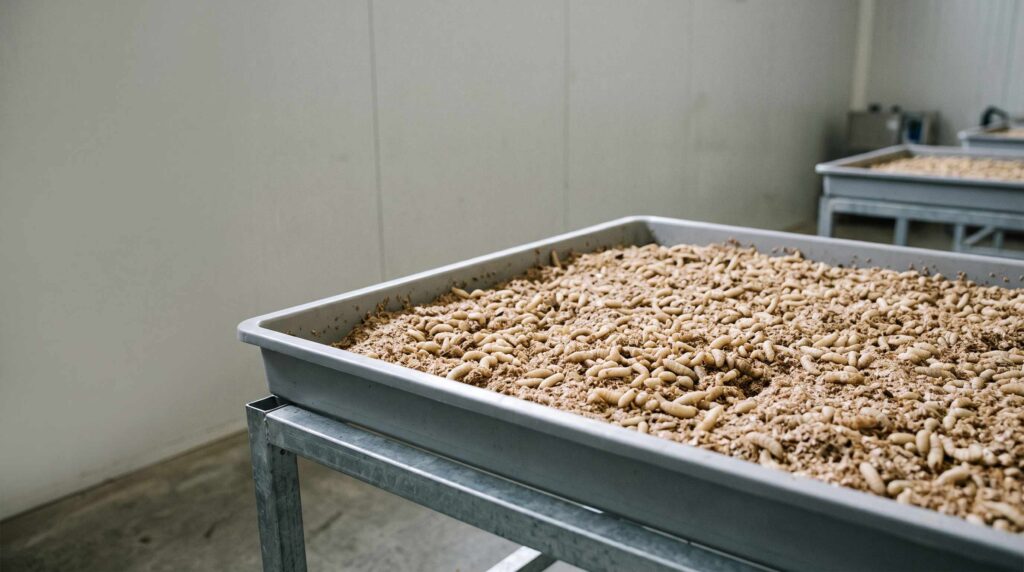
After hatching, larvae are introduced into prepared substrates where they feed and develop. The substrate is therefore more than a feed input: it is also the physical environment in which larvae live, grow, and interact with microorganisms.
Production performance depends on substrate composition, moisture, nutrient availability, temperature, larval density, and the timing of harvest. Changing the substrate can alter not only growth performance but also the nutritional composition of the resulting larvae. This makes feedstock selection a central production and quality-control issue rather than simply a waste-disposal decision.
5. Substrate Choice Creates Both an Economic Opportunity and a Safety Risk
The ability to utilize low-value organic streams can reduce the cost of larval production, but the cheapest available substrate is not automatically the best commercial input. Substrate origin, composition, contaminants and microbiological risks can affect both larval safety and the downstream market that the product can enter.
This is particularly important for housefly larvae because their natural feeding ecology creates a close connection between substrate and larval composition. Industrial production therefore requires a controlled relationship between what enters the rearing system and what ultimately becomes a feed ingredient or other commercial product. Recent research specifically highlights potential contaminants and the need to better understand substrate-to-larva interactions.
6. Animal Feed Is the Main Commercial Application
Animal feed is currently the clearest commercial pathway for housefly larvae. Research has investigated their nutritional value for livestock and other farm animals, with particular attention to their protein, lipid and mineral content. A systematic review of housefly and black soldier fly larvae found substantial research interest in their use as alternative feed materials.
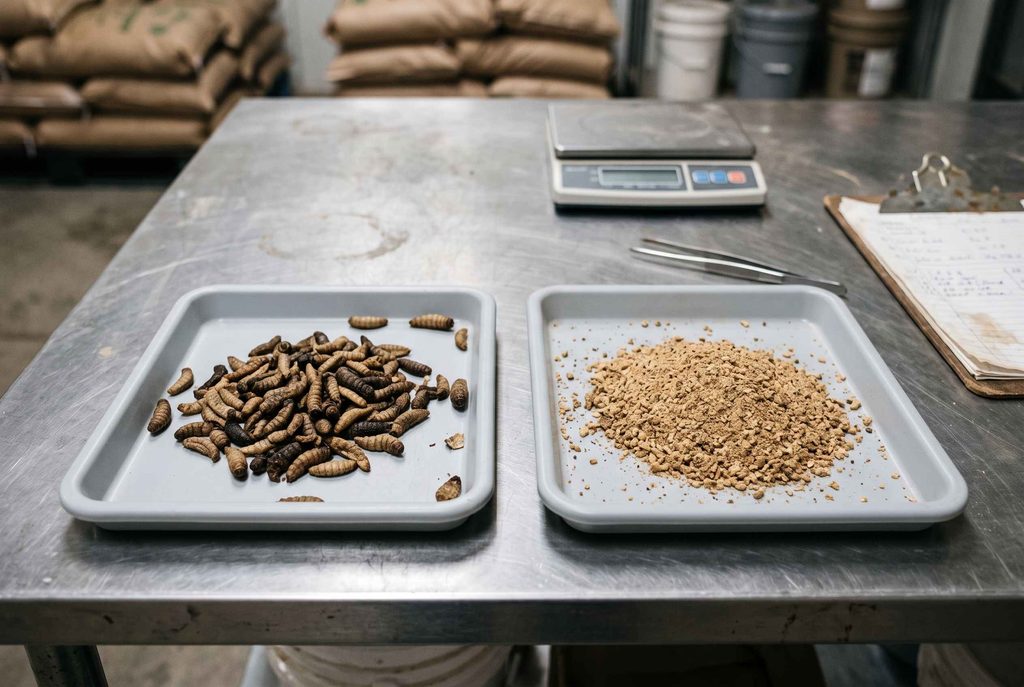
Housefly larvae can potentially be processed into whole dried larvae, meal or other ingredient forms. However, nutritional potential alone does not determine market adoption. Feed manufacturers also need predictable composition, microbiological safety, storage stability, regulatory acceptance and competitive delivered cost. These requirements make standardized processing increasingly important as the industry moves from experimental feeding toward commercial procurement.
7. Aquaculture and Livestock Represent Different Demand Opportunities
Housefly-derived feed ingredients can serve multiple animal production sectors, but the commercial requirements are not identical. Aquaculture buyers may evaluate protein digestibility, amino acid balance, palatability, and formulation economics, while poultry and livestock applications can place different emphasis on nutrient composition, inclusion rates, and production performance.
This means that the housefly larvae industry should not be treated as a single-feed market. Different applications require different product specifications and evidence of performance. The most commercially attractive market may ultimately be the segment in which housefly-derived ingredients provide a clear economic or functional advantage over established feed materials.
8. Pet Food Is a Potential Market Rather Than the Core Industry
Pet food offers another potential outlet for insect-derived ingredients, particularly when alternative animal proteins or novel protein sources are being evaluated. Housefly larvae have nutritional characteristics that make them technically interesting, but the commercial positioning of housefly-derived pet ingredients remains less established than the broader animal-feed pathway.
Pet-food buyers can also impose tighter expectations around ingredient consistency, traceability, processing, odor, and consumer acceptance. For housefly larvae, this means that entering pet food would require more than demonstrating nutritional suitability. Suppliers would need a stable ingredient specification and a clear regulatory and safety position for the target market.
9. Waste Management Gives the Industry a Second Commercial Function
The housefly larvae industry differs from many insect-protein businesses because its value proposition can include both biomass production and waste bioconversion. Larvae can reduce the mass of certain organic substrates while converting part of the available nutrients into insect biomass.
This creates an important economic distinction. A facility that earns value only from selling insect meal must compete directly with other protein ingredients. A facility that also creates value through waste treatment or resource recovery may have a different economic structure. The viability of that model depends on local regulations, substrate availability, treatment economics, and the value of the resulting products.
10. Residual Material Can Create an Additional Value Stream
Larval production leaves behind a residual material containing insect excreta, substrate residues, and other organic matter. Depending on the production system and applicable regulations, this material can potentially be processed into agricultural soil amendments or fertilizer-related products.
The concept has already received regulatory attention in the broader insect sector. EU rules define frass and establish conditions for its treatment and use, reflecting the growing importance of insect production residues as a separate output rather than simply waste.
For housefly producers, this creates the possibility of a multi-output production model: larvae + residual biomass + potentially other insect-derived products. Whether those outputs generate meaningful revenue depends on local regulation and product quality.
11. Housefly Larvae Can Support a Broader Biorefinery Model
Beyond feed, researchers have identified potential applications for housefly-derived chitin, chitosan, bioactive compounds, and other fractions. Recent reviews describe the species as a potential biorefinery resource rather than solely an animal-feed ingredient.
These applications should still be considered emerging from a market perspective. Technical extraction or biological activity does not automatically create a large commercial market. Processing costs, purification requirements, regulatory pathways, and buyer demand can all determine whether a laboratory-scale opportunity becomes an industrial product.
12. Commercial Scale Depends on More Than Larval Growth
Fast larval development is useful, but commercial production requires the entire system to operate reliably. Breeding, egg production, substrate preparation, larval density, harvesting, separation, drying and downstream processing all have to function together.
Scaling also increases the importance of automation and environmental control. Manual systems may work at a small scale, but labor requirements, hygiene, substrate handling, and product consistency become more difficult to manage as throughput increases. The industry, therefore, needs production systems that can maintain biological performance while reducing variation between batches.
13. Biosecurity Is a Defining Constraint for Housefly Production
Houseflies occupy a different risk position from many insects used for feed because the species itself is associated with disease transmission in uncontrolled environments. Commercial production must therefore maintain a strong separation between managed production colonies and surrounding environments.
Containment, hygiene, substrate control, microbial monitoring, and processing conditions become central to the commercial model. Regulatory frameworks also matter because authorities evaluate insect species, substrates, and processing methods together rather than treating insect biomass as an ordinary agricultural commodity.
In the European Union, Musca domestica is among the insect species identified for the production of processed animal protein from farmed insects under specified conditions. The rules also place restrictions on eligible substrates and require controlled processing and handling.
14. Regulation Determines Which Housefly Products Can Reach Buyers
The regulatory position of housefly larvae varies by product, destination and intended use. Feed ingredients are subject to animal-health, feed-safety and processing requirements, while waste-conversion operations can also fall under environmental or waste-management rules.
This makes regulatory access part of the commercial product itself. A larval product may be technically suitable for animal nutrition but still have a limited addressable market if the production substrate, processing method or intended application does not meet the destination market’s requirements.
15. The Housefly Larvae Industry Is Still Developing Its Commercial Model
The industry has strong technical foundations but remains less mature than the leading commercial insect species. Research has demonstrated the potential of housefly larvae for bioconversion and animal nutrition, while production research continues to address breeding, substrate management, safety, and scaling.
The central challenge is commercialization rather than biological feasibility. A viable industry needs reliable egg production, controlled substrates, predictable larval composition, efficient harvesting and processing, regulatory access and buyers willing to purchase the resulting ingredients repeatedly.
16. The Industry Is Moving Toward an Integrated Circular-Economy Model
The strongest long-term case for housefly larvae may not be based on protein alone. The species can potentially connect organic residual streams with feed ingredients, agricultural residues and higher-value insect-derived products.
A mature commercial model could therefore operate as an integrated system:
This structure gives housefly larvae a potentially distinctive position within the insect industry. The opportunity is not simply to replace conventional protein, but to recover value from materials that otherwise have limited economic use.
IIR Analysis
The housefly larvae industry has a strong technical proposition but remains a developing commercial sector. Its most credible near-term market is animal feed, supported by research into nutritional value and production systems. Waste bioconversion adds another potential source of economic value, while fertilizer-related residues and higher-value compounds create additional pathways.
The main difference from more mature insect industries is the balance between opportunity and risk. Housefly larvae can convert low-value organic substrates efficiently, but substrate control, biosecurity, regulatory compliance, egg production and product standardization are all critical to commercial scale. The industry will therefore depend less on proving that housefly larvae can grow and more on demonstrating that they can be produced safely, consistently and economically at industrial scale.
Disclaimer: This article is for informational purposes only and does not constitute business, legal or investment advice. Always consult primary sources and qualified professionals.