Independent intelligence for the global insect industryISSUE 01 · 2026
Grasshopper Production Cost: Key Drivers of Commercial Economics
By IIR Editorial DeskSeptember 30, 2026
Grasshopper production economics depend on feed, labor, environmental control, biological performance, processing and facility utilization. This analysis examines the variables that determine the cost of commercial output.
This analysis examines the main drivers of commercial grasshopper production cost, including feed, labor, climate control, biological performance, processing and facility utilization.
By IIR Editorial Desk · September 30, 2026 · Market Intelligence
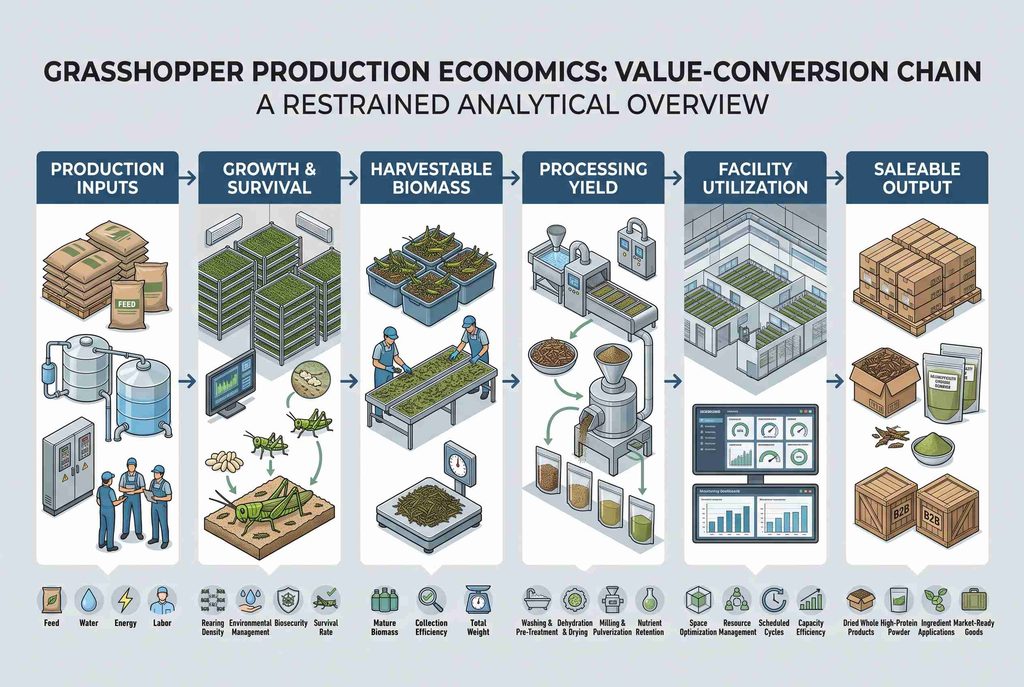
Commercial grasshopper farming is still developing toward more standardized production models, making cost comparisons difficult across species, regions, and operating systems. Grasshopper production cost depends not only on feed prices but also on labor, environmental control, biological performance, processing, product yield, and the utilization of production infrastructure.
Public commercial cost data remain limited, particularly when compared with better-documented insect sectors. A single industry-wide cost per kilogram would therefore create false precision. A more useful approach is to examine how individual cost drivers interact and how efficiently a production system converts biological inputs and infrastructure into saleable output.
1. Feed and Nutrition Shape Input Economics
Feed is one of the most important recurring inputs in commercial grasshopper and locust farming. Depending on the production model, farms may rely on fresh vegetation, cultivated forage, purchased plant materials, or more controlled diets. The real cost extends beyond the purchase price because sourcing, cultivation, transportation, storage, preparation, and daily distribution can all require additional resources.
Nutritional quality also affects the economics of feed. Research into the nutritional requirements of migratory and desert locusts indicates that balanced diets influence growth, survival, and physiological performance. A cheaper feed is not necessarily economically efficient if insects consume more of it, develop slowly, or produce less harvestable biomass.
Feed economics should therefore be measured against productive output rather than input price alone. The more relevant question is how much saleable grasshopper biomass a feeding strategy produces from the combined cost of feed, handling, and the production resources used during the growth cycle.
Local availability adds another variable. Farms with reliable access to suitable plant materials can face a different cost structure from operations that need to cultivate or transport substantial quantities of feed. This makes feed strategy partly a geographic economic decision as well as a nutritional one.
2. Labor and Automation Change Operating Costs
Commercial grasshopper farming involves repeated tasks across breeding, feeding, monitoring, cleaning, harvesting, and material handling. These activities can be manageable manually at small scale, but labor requirements increase as more production units are added.
The relevant economic measure is not simply the hourly wage paid to workers. Producers need to consider how much saleable output each unit of labor supports. A production system that requires frequent manual intervention can become increasingly expensive even when local wage levels are relatively low.
Automation and mechanization can change this relationship. Feed delivery, environmental monitoring, material movement, and some harvesting operations may be partially automated as facilities become larger. These systems can reduce repetitive work and improve consistency, but they also introduce equipment, maintenance, and depreciation costs.
Automation is therefore not automatically cheaper than manual production. Its economic value depends on throughput. Equipment that is used intensively across a productive facility can lower labor requirements per unit of output, while expensive systems operating below capacity can increase unit costs.
3. Climate Control Creates Location-Specific Costs
Grasshoppers and locusts are ectothermic, making environmental conditions directly relevant to production performance. Temperature influences activity, development, and nutrient utilization, while humidity and ventilation contribute to the conditions experienced by insects inside production facilities.
Maintaining those conditions can require energy. A facility in a cooler climate may need substantial heating, while operations in warmer regions can face different requirements for ventilation, cooling, or humidity management. The same biological production model can therefore generate different operating costs in different locations.
Faster growth does not automatically produce better economics. Higher temperatures can accelerate development under some conditions, but producers still need to consider feed efficiency, survival, energy use, and final output. The economically useful objective is not maximum growth rate in isolation but an environmental regime that produces consistent harvestable biomass at a viable total cost.
Geography consequently influences more than access to customers or logistics. Local climate and energy prices can affect the fundamental cost structure of the production facility itself.
Survival, reproduction, and development time strongly influence how efficiently operating expenses are converted into commercial output. Feed, labor, energy, and rearing space invested in insects that die before harvest generate little or no saleable biomass.
Survival rate therefore has a direct economic effect even when input prices remain unchanged. Improving survival allows a larger proportion of the resources entering the production system to reach the point where revenue can be generated.
Reproductive performance affects economics in a different way. Commercial farms need enough eggs and juveniles to keep downstream rearing capacity occupied. Weak or inconsistent reproduction can leave cages, environmental-control systems, and other infrastructure underused even when the facility was designed for higher throughput.
Development time also matters because it determines how long productive space remains occupied before harvest. Shorter, predictable cycles can increase annual throughput, but only if faster development does not compromise survival, feed efficiency, or final product quality. These biological variables need to be evaluated together rather than optimized independently.
5. Density and Biosecurity Affect Facility Productivity
Production density influences how efficiently farms use physical space. Higher stocking density can increase potential output per square meter, but simply placing more insects into an enclosure does not guarantee better economics.
Excessive density can change behavior, increase management difficulty, and potentially affect survival or production consistency. This issue is particularly relevant to locusts because population density has biological and behavioral consequences. The economically meaningful metric is therefore saleable output per unit of productive space, not maximum stocking density.
Biosecurity adds another dimension to facility productivity. Cleaning, separation of production groups, monitoring, and controlled movement of materials all require labor and resources, but they help protect the biomass already being produced.
A biological disruption can affect more than one batch of insects. It can reduce output, interrupt production schedules, and leave infrastructure underused. Biosecurity is therefore both a biological control measure and a form of economic risk management.
6. Harvesting and Stabilization Add Post-Harvest Costs
Harvestable insects are not yet finished commercial products. Grasshoppers need to be collected, separated from production residues, and transferred into post-harvest handling. Whole-insect markets may require additional care because physical integrity and appearance can influence product value.
Fresh biomass then needs appropriate stabilization before longer-term storage or further processing. Thermal treatment, freezing, or other stabilization methods add equipment, energy, labor, and handling costs, with the appropriate process depending on the intended product and applicable safety requirements.
These operations establish an important cost boundary. Fresh or farm-gate biomass does not carry the same cost structure as stabilized material ready for drying or further processing. Cost comparisons need to identify clearly which stage of the production chain is being measured.
7. Drying and Product Yield Change Unit Economics
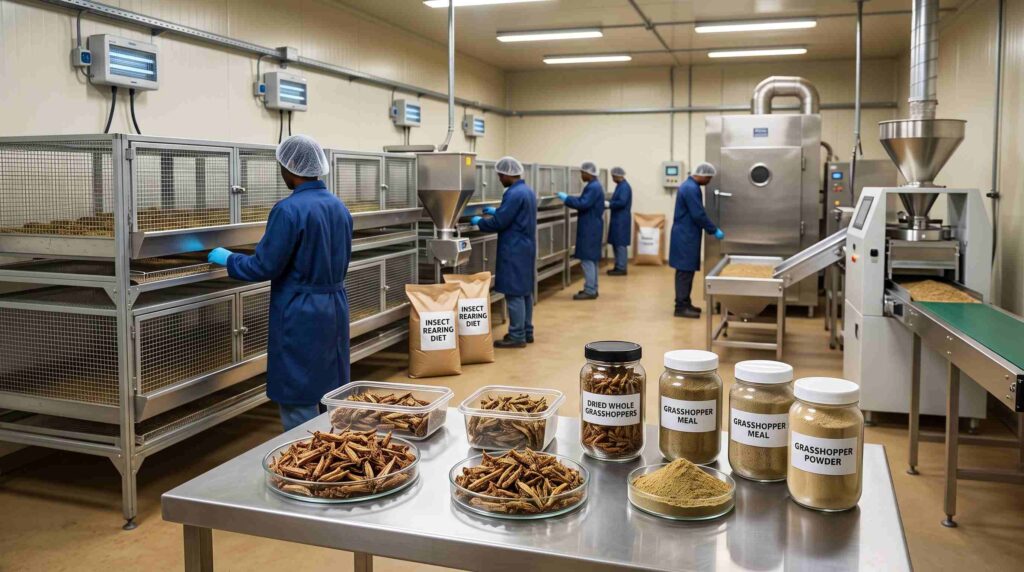
Drying adds equipment, processing time, and energy costs while simultaneously reducing product mass as moisture is removed. Freeze-drying, hot-air drying, and other technologies can have substantially different capital and operating requirements, making the selected processing route an important component of grasshopper production cost.
Yield is equally important. A kilogram of fresh insects does not become a kilogram of dried product, so calculations based on fresh biomass can substantially misrepresent the economics of a dried commercial product. Costs need to be distributed across the amount of saleable material remaining after moisture removal and other processing losses.
Whole-product markets add another yield consideration. If customers expect recognizable, intact grasshoppers, excessive breakage can downgrade part of a batch even when the material remains nutritionally usable. Sorting and careful handling may increase processing cost but can protect the value of the higher-grade output.
Powder production changes the calculation again. Physical integrity becomes less important, while milling introduces additional equipment, energy, and process-control requirements. The economically relevant yield therefore depends on the final product being sold.
8. Further Processing Must Create Additional Value
Different grasshopper products have different cost boundaries. Fresh insects largely reflect farming and harvesting costs, while whole dried products add stabilization, drying, and potentially sorting. Powder adds milling, and more specialized ingredients can require additional refining or formulation.
Each processing stage expands the cost base. Additional equipment, energy, labor, quality control, and material losses need to be supported by the value of the resulting product.
The commercial rationale is to reach new customers or higher-value applications. Further processing is economically viable only when the added value outweighs the additional manufacturing cost.
This makes product strategy an important part of production economics. A producer should not assume that the most extensively processed product automatically provides the highest return; the answer depends on processing efficiency, yield, customer requirements, and achievable selling price.
9. Facility Utilization Determines the Economics of Scale
Buildings, environmental-control systems, processing equipment, and other fixed assets continue to generate costs even when production remains below design capacity. When biological output is inconsistent or equipment is underused, those costs are distributed across fewer kilograms of saleable product.
Bottlenecks can make this problem worse. A facility may have substantial rearing capacity but insufficient drying equipment, while another operation may have processing capacity that exceeds the biomass supplied by its breeding and rearing systems. Effective capacity is determined by the performance of the entire production chain rather than its largest individual component.
Scaling can improve economics when greater throughput spreads fixed costs, supports automation, and enables more efficient purchasing or processing. Larger operations also require more feed, stronger environmental management, tighter biosecurity, and sufficient downstream capacity.
Economies of scale should therefore be demonstrated through actual utilization and saleable output rather than assumed from facility size. Large installed capacity has limited economic value when key parts of the system remain underused.
10. Wild Harvesting and Farming Have Different Economics
Grasshopper economics differ from several other insect sectors because controlled farming can coexist with wild or seasonal harvesting in some markets. The two supply models have fundamentally different cost structures.
Wild harvesting avoids many of the expenses associated with breeding colonies, controlled environments, and continuous rearing. However, supply can be seasonal and unpredictable, while species consistency, traceability, and environmental exposure can be more difficult to control. Pesticide use against agricultural pests creates an additional concern when insects are collected from areas where chemical control has occurred.
Controlled farming requires infrastructure, feed, labor, and environmental management, but provides greater control over species, production timing, and input history. It can also create a more consistent basis for specifications and traceability.
Comparing the two models only at the point of harvest can therefore be misleading. Commercial buyers may place economic value on predictable availability, controlled sourcing, and documentation that is not captured by a simple farm-gate or collection cost.
11. Quality Control and Logistics Extend the Cost Boundary
Finished grasshopper products may require testing, documentation and quality-release procedures before entering formal B2B markets. These activities add laboratory and administrative costs but can be necessary for buyers that require defined specifications, traceability or destination-specific compliance.
Packaging and storage add another layer. Whole dried products may require protection from physical damage, while all dried products need appropriate control against moisture and other conditions that could affect quality during storage.
Freight can materially change delivered economics, particularly for international shipments or relatively small orders. Shipment size, packaging efficiency, transport mode, and distance all influence the difference between production cost and the price required to deliver a product to the customer.
Cost comparisons are meaningful only when their measurement boundary is clear. Farm-gate cost, processed cost, warehouse cost, and delivered cost are not interchangeable figures.
12. Market Position Determines What Cost Is Commercially Viable
Production cost cannot be evaluated independently from the market in which the product is sold. Whole dried grasshoppers supplied to specialty animal or established food markets operate under different pricing conditions from processed ingredients attempting to compete in large-volume feed formulations.
Broader research into commercial insect-farm profitability shows that selling prices can vary substantially according to geography, end market, and quantity. Although published economic models for other farmed insect species cannot be applied directly to grasshoppers, they demonstrate why production economics should be considered alongside the value of the target market.
A technically efficient producer can still be commercially weak if its cost structure does not match the price customers are willing to pay. Conversely, a relatively expensive production model can remain viable when the product serves a market that values differentiation, product form, traceability, or specialized functionality.
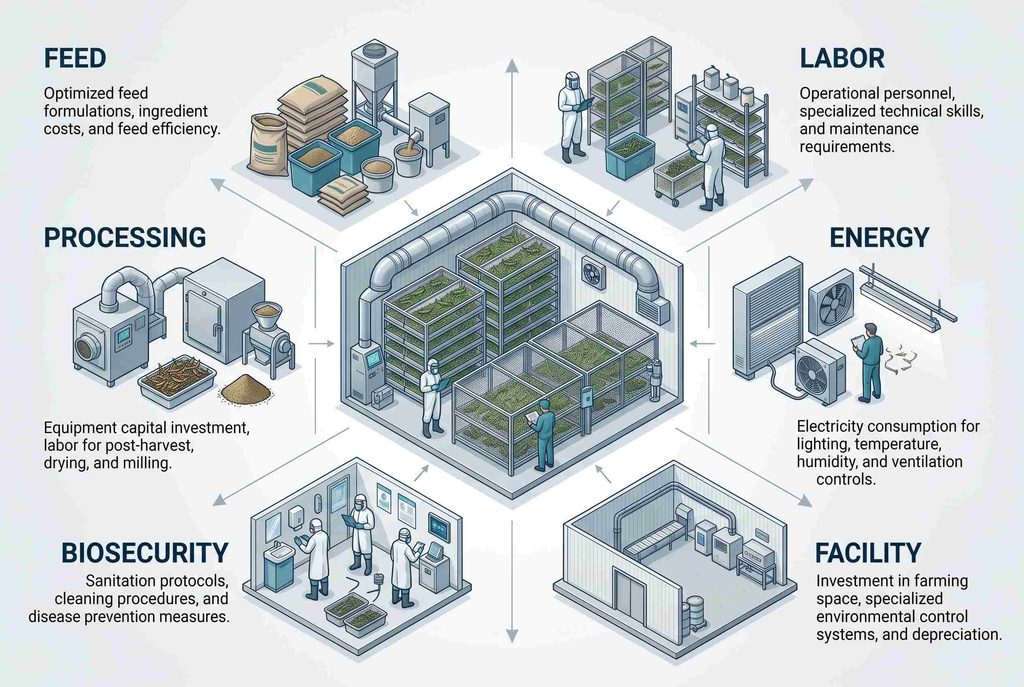
The economics can therefore be understood through a simple analytical framework:
Feed + Labor + Energy + Facility + Biosecurity + Processing + Quality Control
This is not an accounting formula. It illustrates why farms with similar input prices can achieve very different unit economics depending on how effectively they convert resources into products that customers will actually purchase.
IIR Analysis
Reliable public data on grasshopper production cost remain too limited to support a universal cost-per-kilogram benchmark. Applying figures from cricket, mealworm, or black soldier fly farms directly to grasshopper production would create false precision because species biology, feed systems, processing requirements, and production maturity differ.
The more useful economic indicators are therefore operational. Feed needs to generate sufficient biological performance, labor needs to support enough productive capacity, environmental control needs to justify its energy use, and survival and reproduction need to keep infrastructure productively occupied. After harvest, drying and processing must preserve enough saleable yield to support their additional costs.
Grasshopper production also has an unusual competitive dynamic because controlled farming can coexist with wild-harvested supply. Farming introduces infrastructure and operating costs but can offer greater control over species, feed, production timing, traceability, and predictable availability. Those characteristics can carry commercial value even when the direct production cost is higher.
For IIR, improving grasshopper economics should therefore not be defined simply as reducing feed prices or increasing stocking density. The stronger indicator is whether a production system can generate more consistent saleable output from the same combination of biological inputs, labor, energy, and productive infrastructure while maintaining enough market value to support those costs.
Disclaimer: This article is for informational purposes only and does not constitute business, legal or investment advice. Always consult primary sources and qualified professionals.