Independent intelligence for the global insect industryISSUE 01 · 2026
Grasshopper Market Demand: Feed, Pet Food, and Emerging Applications
By IIR Editorial DeskOctober 1, 2026
Grasshopper demand spans established food and specialty animal markets, while pet food, feed ingredients and processed applications offer developing opportunities.
This analysis examines where commercial demand for grasshopper products exists today, where new applications are developing, and how product form, price, regulation and supply reliability shape market adoption.
By IIR Editorial Desk · October 1, 2026 · Market Intelligence
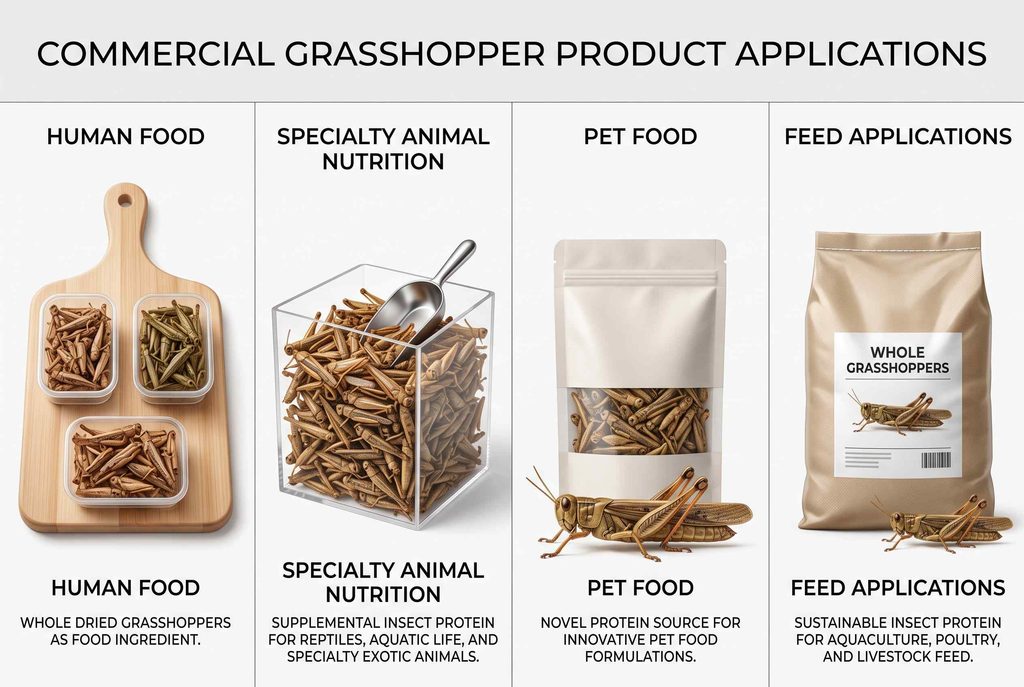
Commercial grasshopper market demand does not come from a single end market. Whole insects, dried products, and processed ingredients can serve very different customers, ranging from established human-food markets and specialty animal nutrition to pet food, feed, and emerging ingredient applications.
The maturity of these markets also varies significantly. Grasshoppers and locusts have a long history of human consumption in multiple regions, while many modern feed and formulated-product applications remain less commercially established. Research demonstrating nutritional suitability should therefore not be treated as evidence of equivalent market demand.
A useful market analysis needs to distinguish between applications that already support recurring transactions and those that still depend on regulatory access, competitive pricing, scalable supply, or broader buyer adoption.
1. Traditional Human Consumption Provides an Established Demand Base
Human consumption is one of the oldest commercial pathways for grasshoppers and locusts. Unlike insect ingredients developed primarily for industrial feed, these insects have long been consumed directly in parts of Africa, Asia, Latin America, and the Middle East. A global review of locust utilization has documented traditional consumption across numerous countries, demonstrating that human food is not simply a speculative future application.
Demand can include fresh, cooked, dried, or otherwise processed insects depending on local food traditions and distribution systems. However, established consumption does not imply a uniform global market. Consumer familiarity, species preferences, preparation methods, food-safety requirements, and purchasing behavior vary substantially between regions.
Traditional human consumption should therefore be treated as an established but geographically differentiated demand segment rather than evidence of universal consumer acceptance.
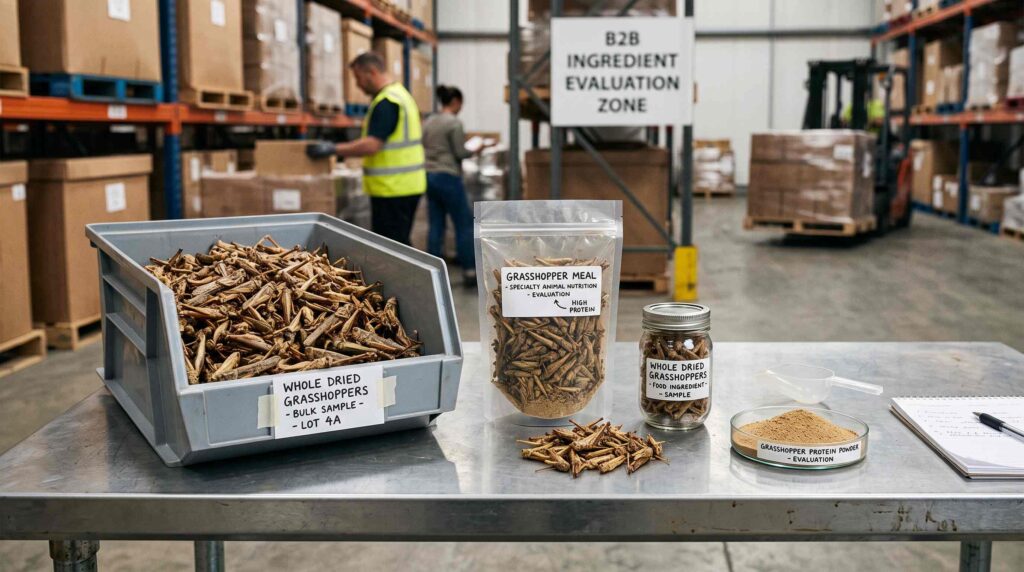
Whole dried grasshoppers occupy a different market position from protein powders or highly processed ingredients. Because the insect remains visually recognizable, characteristics such as size, color, cleanliness, physical integrity, and species can become part of the commercial specification.
Drying improves storage and transportation compared with highly perishable fresh biomass, allowing products to move through longer distribution chains. This creates opportunities for food distributors, specialty retailers, and animal-nutrition suppliers that specifically require whole insects rather than anonymous protein ingredients.
For these markets, processing value comes partly from preserving recognizable product characteristics. Excessive breakage or inconsistent appearance can reduce the value of material intended for whole-product channels even when its basic nutritional composition remains acceptable.
3. Specialty Animal Nutrition Is a Natural Commercial Market
Grasshoppers are part of the natural diet of many insectivorous animals, giving whole dried products a straightforward position in specialty animal nutrition. Bird, reptile and other exotic-animal markets can use recognizable insects as feed or treats, particularly where customers value product form as well as nutritional composition.
These products compete with mealworms, crickets and other commercially available insects, so grasshopper demand depends on more than biological suitability. Availability, product size, physical condition, packaging and price can all influence purchasing decisions.
This segment is commercially different from commodity livestock feed. Volumes may be smaller, while product integrity and presentation can carry greater importance. Whole dried grasshoppers can therefore have a more natural commercial fit in specialized animal markets than in applications where ingredients are evaluated primarily on cost per unit of protein.
4. Pet Food Represents a Developing Demand Channel
The broader pet-food industry has become an important commercial pathway for insect ingredients as manufacturers explore alternative proteins and differentiated formulations. Grasshopper products could participate in this market through whole treats, dried products, or processed ingredients, depending on the product concept and applicable regulatory requirements.
Grasshopper-specific demand, however, should not automatically be equated with the more developed commercial position of species such as black soldier fly larvae or mealworms. Ingredient availability, production scale, regulatory status, formulation requirements, and price all influence whether manufacturers can incorporate grasshopper products into repeatable commercial programs.
Pet food is therefore better classified as a developing commercial opportunity rather than a universally established high-volume grasshopper market. Technical suitability creates an opportunity, but recurring purchasing requires a supply chain capable of supporting commercial formulation and distribution.
5. Poultry Feed Has Technical Potential but Faces Commercial Competition
Grasshoppers and locusts have attracted research interest as potential poultry-feed materials because of their nutritional composition. This creates a technically plausible application, particularly in markets seeking alternative protein sources.
Commercial feed manufacturers, however, operate in highly cost-sensitive environments. Grasshopper ingredients must compete not only with conventional proteins but also with other insect ingredients that may already benefit from more standardized production systems, larger processing capacity, or more developed regulatory pathways.
Consistent supply, appropriate processing, regulatory acceptance, and delivered cost therefore matter alongside nutritional performance. A feeding trial demonstrating that grasshopper material can be incorporated into poultry diets establishes technical potential; repeat purchasing by commercial feed manufacturers represents realized demand.
That distinction is critical when assessing grasshopper market demand.
6. Aquaculture Is Another Potential Feed Application
Aquaculture has become an important application area for the wider insect-protein industry. Insect ingredients can provide protein and other nutrients, and research continues to examine their performance across different aquatic species and feed formulations.
Grasshoppers and locusts form part of this wider technical opportunity, but commercial adoption should be evaluated separately from experimental evidence. Feed manufacturers consider nutritional performance alongside ingredient consistency, processing characteristics, regulation, supply volume, and price.
Competition is also important. Black soldier fly and mealworm producers have invested heavily in developing standardized feed ingredients, giving buyers alternative insect proteins with increasingly structured supply chains.
Grasshopper products, therefore, need a compelling combination of performance, availability, and economics to move beyond niche or experimental applications. Aquaculture should currently be viewed as a developing opportunity rather than assumed to be a mature source of grasshopper demand.
7. Product Form Changes the Addressable Market
The same grasshopper biomass can address very different customers depending on how it is processed. Whole dried insects retain species identity and visual characteristics, while powders and more processed ingredients can enter formulations where a recognizable insect appearance is unnecessary.
Specialized Ingredients → Emerging Functional or Formulated Applications
Processing, therefore, does more than change presentation. It changes the competitive environment. Whole grasshoppers compete primarily with other recognizable insect products, while powders increasingly compete with a much broader range of protein ingredients.
Additional processing can expand the addressable market, but it also adds manufacturing cost. A larger theoretical customer base does not automatically create stronger commercial demand if the resulting ingredient cannot compete on price, functionality, or supply reliability.
8. Human Food Can Expand Beyond Whole-Insect Consumption
Traditional consumption provides an established demand base, but modern human-food applications can extend beyond eating whole grasshoppers. Dried products and powders can potentially enter formulated foods where the insect itself is less visually prominent.
Regulatory developments demonstrate this possibility. In the European Union, frozen, dried, and powder forms of Locusta migratoria are included among authorized Novel Foods under defined specifications and conditions of use. This creates a formal market-access pathway for the specified products and applications.
Authorization, however, should not be interpreted as evidence of broad consumer demand. Manufacturers still need commercially viable products, retailers need reasons to stock them, and consumers need reasons to purchase them.
Regulatory access therefore makes market development possible; it does not guarantee market adoption.
9. Specialized Processing Could Create Higher-Value Applications
Grasshopper and locust biomass contains more than protein. Lipids, chitin, and other components create potential pathways toward more specialized ingredients, while processing technologies could produce materials designed for specific food, feed, or functional applications.
These markets are fundamentally different from selling whole dried insects. Extraction, fractionation, or other advanced processing increases manufacturing complexity and requires buyers who value the resulting functionality enough to support the additional cost.
Scientific research can identify potentially useful properties, but technical potential should not be presented as existing industrial demand. Commercialization requires repeatable specifications, scalable processing, regulatory acceptance where required, and customers willing to purchase the resulting ingredient on a recurring basis.
Specialized processed ingredients should therefore remain in the emerging application category until stronger evidence of sustained commercial adoption develops.
10. Price and Supply Reliability Determine Commercial Adoption
A buyer can recognize the nutritional value of grasshopper products and still choose another ingredient because of price or supply risk. This becomes particularly important as grasshopper products move from specialty markets toward larger food, pet-food, or feed applications.
Manufacturers need predictable purchasing conditions. Seasonal availability, fragmented sourcing, inconsistent species, or variable processing can make an ingredient difficult to incorporate into products manufactured continuously throughout the year.
Controlled farming can improve predictability, but production economics still need to support a commercially viable selling price. Wild harvesting can provide significant biomass under some conditions, yet availability may be irregular, and source control can be more difficult.
Commercial demand becomes stronger when buyers can obtain the required product repeatedly, at predictable quality, in appropriate quantities, and at a viable delivered cost. Without those conditions, theoretical demand may not convert into recurring orders.
11. Regulation Defines the Commercially Addressable Market
Technical suitability is only the first stage of market development. A product also needs to be permitted for its intended application in the destination market.
The distinction is especially important for grasshoppers because species, product form, and intended use can affect market access. Authorization of specified Locusta migratoria products for particular human-food uses should not be generalized to every grasshopper species, every product format, or every feed application.
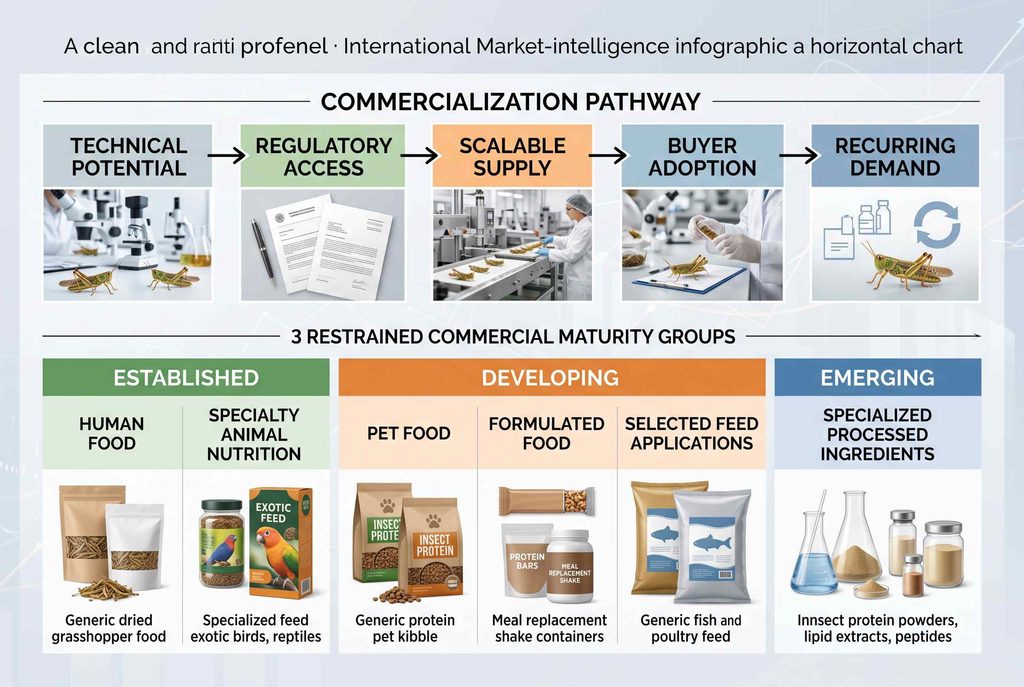
The commercially addressable market is therefore narrower than the full range of technically possible applications. A useful framework is:
Each stage removes part of the theoretical opportunity. A product that performs well technically but lacks regulatory access has no legal commercial market for that application. A product with regulatory access but unreliable supply may still struggle to attract industrial buyers.
Recurring demand emerges only when these conditions begin to align.
12. Market Maturity Differs by Application
Grasshopper demand should not be summarized as a single market-growth story because different applications sit at different stages of commercialization.
Established demand is clearest in traditional human-food markets and specialty animal-nutrition channels where recognizable grasshoppers and locusts already have a defined commercial role.
Developing demand includes pet food, selected formulated foods, and certain feed applications. These markets have plausible technical foundations but remain more dependent on regulation, production scale, supply consistency, pricing, and buyer adoption.
Emerging demand includes specialized processed ingredients and functional applications requiring additional extraction, fractionation, or product development. These opportunities may expand the addressable market over time, but scientific feasibility should not be confused with current purchasing activity.
The categories can change as the industry develops. Applications move toward established demand only when suppliers can repeatedly produce the required product and customers continue to purchase it under commercially viable conditions.
IIR Analysis
The central issue in the grasshopper market demand is no longer whether grasshoppers have nutritional value. Traditional consumption already demonstrates an established food market in multiple regions, while its role in specialty animal nutrition provides another relatively direct commercial pathway.
The challenge becomes greater as the industry moves toward pet food, aquaculture, poultry feed, and other formulated products. In these markets, grasshopper ingredients compete not only on nutritional composition but also on price, regulatory status, processing consistency, and supply reliability. Other insect species with more industrialized production systems can create additional competitive pressure.
Human food represents a separate development path. Regulatory authorization for specified products demonstrates that modern markets can extend beyond traditional whole-insect consumption, but market access remains only one component of commercialization. Consumer acceptance, product development, distribution, and repeat purchasing ultimately determine whether regulatory access becomes meaningful demand.
For IIR, the strongest indicator of future market development is therefore movement through the complete commercialization sequence:
Disclaimer: This article is for informational purposes only and does not constitute business, legal or investment advice. Always consult primary sources and qualified professionals.