Independent intelligence for the global insect industryISSUE 01 · 2026
Grasshopper Industry: Market, Production and Commercial Applications
By IIR Editorial DeskSeptember 29, 2026
The grasshopper industry connects established food traditions with emerging commercial farming, feed applications and processed insect products. This IIR analysis examines production, market demand, applications and the constraints shaping commercial scale.
This analysis examines the commercial grasshopper industry, from species selection and production systems to food, feed and specialty applications, as well as the constraints shaping larger-scale supply.
By IIR Editorial Desk · September 29, 2026 · Market Intelligence
The Grasshopper Industry Has a Different Commercial Structure
The grasshopper industry occupies a distinctive position within the broader insect economy. Grasshoppers and locusts have long histories as food in parts of Africa, Asia, and other regions, while commercial farming and processing are creating additional opportunities in food, specialty animal nutrition, and feed.
Unlike black soldier fly or mealworm production, however, the sector cannot be understood through one dominant industrial model. Commercial supply can originate from controlled farming, smaller-scale production or, in some regions, wild harvesting. Species also vary substantially between markets.
This diversity creates both opportunity and complexity. Grasshoppers can be sold as recognizable whole insects or processed into meals and powders, but production systems, food-safety risks, regulatory status, and buyer requirements can differ according to species and source.
1. Grasshopper and Locust Markets Overlap but Are Not Identical
The terms grasshopper and locust are sometimes used loosely in commercial discussions, but they should not be treated as exact synonyms. Locusts are grasshopper species capable of undergoing behavioral and physiological changes associated with high-density swarming.
This distinction matters commercially because research, regulations, and production methods may refer to specific species. Locusta migratoria, the migratory locust, is particularly important in European regulatory discussions, while other grasshopper and locust species have different regional histories and commercial uses.
A professional industry analysis should therefore identify species whenever the information depends on biology, production performance, safety, or regulatory status rather than assuming that findings for one species apply to the entire category.
2. Commercial Supply Comes From More Than One Production Model
Grasshopper supply has historically included wild collection as well as farming. In regions where edible grasshoppers or locusts are traditionally consumed, seasonal harvesting can connect naturally occurring insect populations with local food markets.
Controlled production creates a different supply model. Farming can provide greater control over feed, production conditions, harvest timing, and traceability, making it more suitable for buyers that require repeatable specifications.
Commercial development is increasingly focused on whether production can move toward more standardized systems. A 2025 review of migratory and desert locust farming highlights the potential of both species for food and feed while also emphasizing the need for better understanding of nutritional requirements to improve production efficiency.
3. Species Selection Shapes the Production System
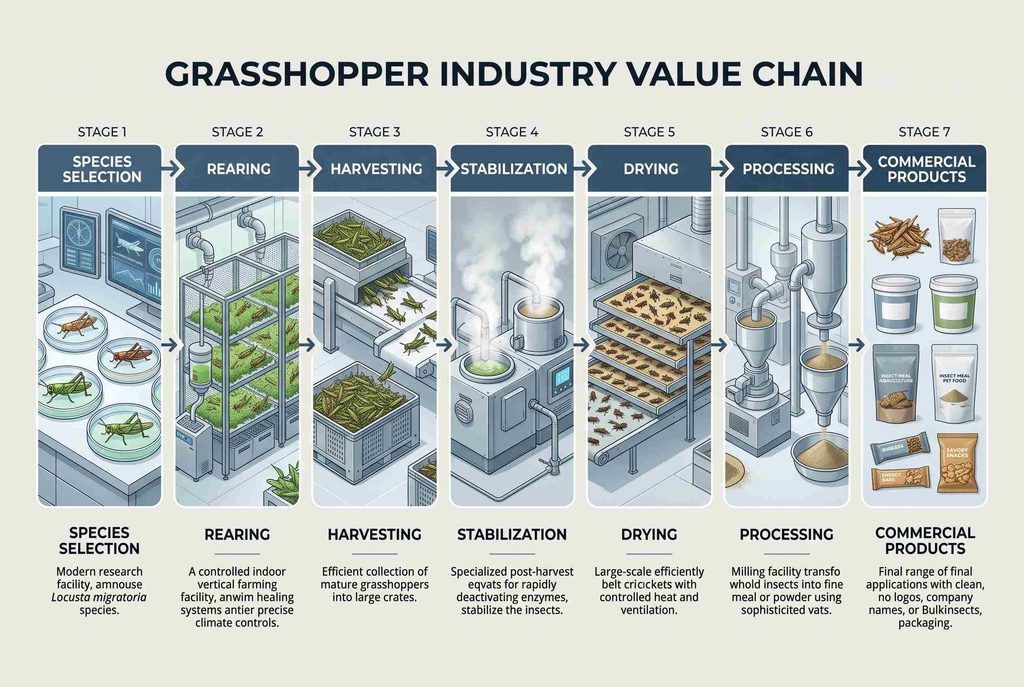
There is no single production model that applies equally to every grasshopper species. Biological characteristics influence diet, development, environmental requirements, stocking strategies, and harvesting.
The migratory locust, Locusta migratoria, has received substantial attention because of its relevance to both food production and regulation. The desert locust, Schistocerca gregaria, has also been investigated as a potential farmed species for food and feed.
Other grasshopper species may be commercially relevant in particular regions. This makes species identification more important in the grasshopper sector than in markets where one production species dominates most commercial supply.
4. Feed Management Is Central to Commercial Production
Grasshoppers and locusts require suitable nutrition to support growth and survival. Feed strategy can influence production performance and, ultimately, the amount of harvestable biomass produced from a farming system.
Research into migratory and desert locust nutrition shows that balanced diets are important for physiological performance. Poorly balanced diets can increase feed consumption while reducing fitness, creating a direct connection between nutrition and production efficiency.
This makes feed management a future scaling issue for the sector. Producers need diets that are biologically suitable, commercially available, and practical to deliver consistently across larger production populations.
5. Environmental Control Influences Production Consistency
Commercial farming requires more than providing insects with feed. Temperature, humidity, ventilation, population density, and housing conditions can all influence biological performance.
At small scale, producers may be able to manage these factors with relatively simple systems. Larger operations need greater environmental consistency because biological variation can translate into irregular harvest timing, mortality, or inconsistent finished products.
Facility design becomes more important as production expands. The economic challenge is to create controlled conditions without adding environmental-management costs that exceed the value of the resulting output.
6. Harvesting Marks the Transition From Farming to Processing
Once grasshoppers reach the intended harvest stage, the production system begins to connect with processing. Insects need to be collected, handled, and prepared for stabilization or other post-harvest treatment.
The intended product affects how harvesting is managed. Whole dried grasshoppers can require careful handling because buyers may evaluate physical appearance, completeness, and cleanliness. Products intended for grinding can tolerate different physical characteristics.
Harvesting is therefore not simply the end of farming. It is the first stage at which the requirements of the final commercial product begin to influence operational decisions.
7. Processing Expands the Range of Commercial Products
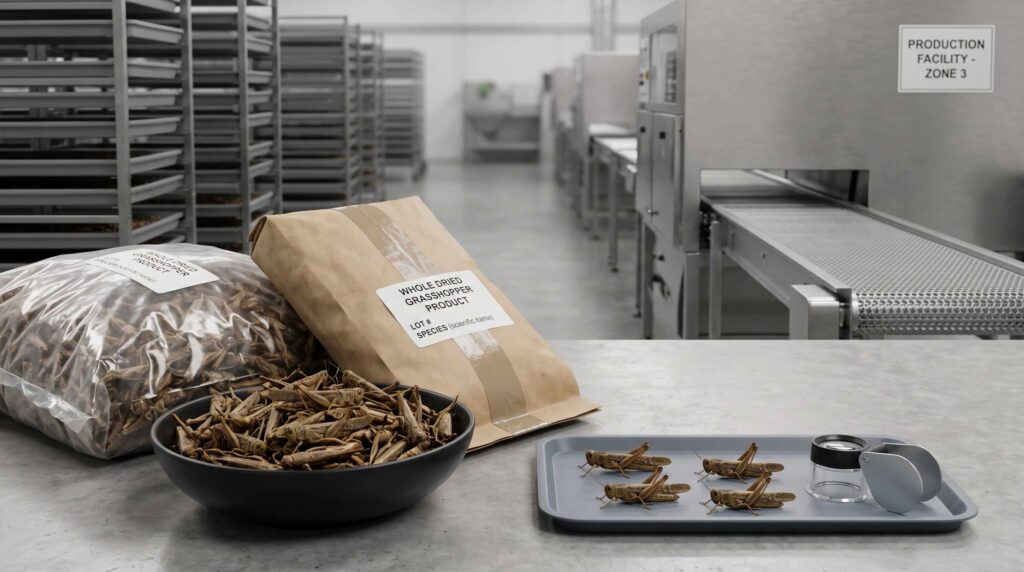
Grasshoppers can reach the market in several forms. Whole dried insects are particularly visible in traditional food and specialty animal markets, while grinding can create powders or meals for further formulation.
Processing can improve storage and distribution, but it also changes the product. Drying conditions can influence moisture, appearance, texture and other characteristics, while milling removes the physical identity of the whole insect and creates a more conventional ingredient format.
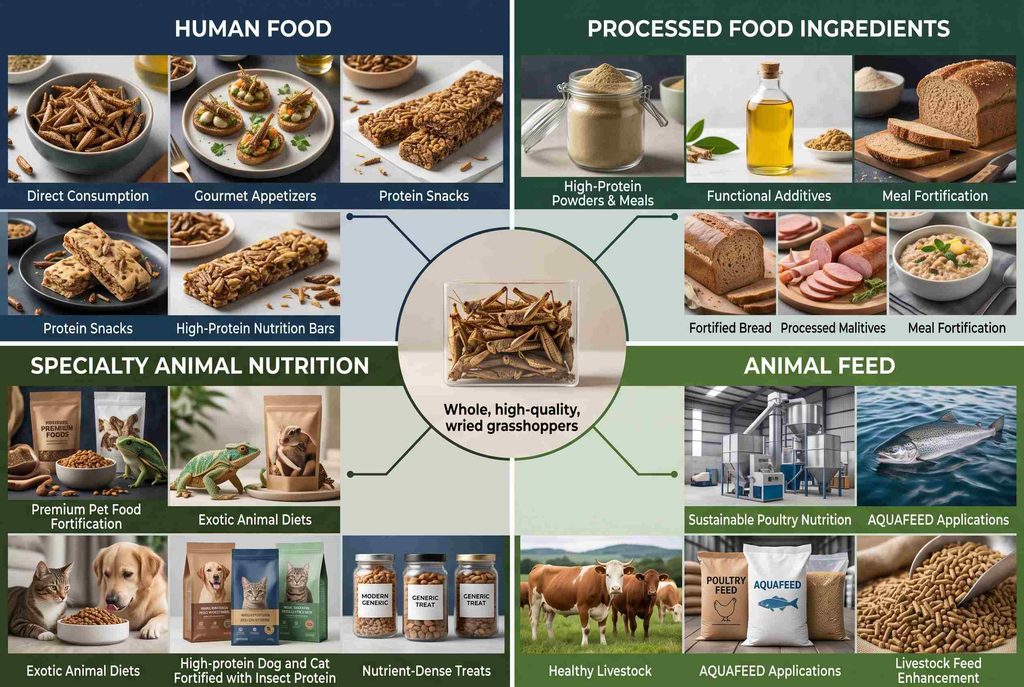
The industry can therefore serve different buyers from the same biological raw material. The commercial value of each route depends on product quality, processing cost, regulatory requirements, and customer demand.
8. Human Food Is an Important Part of the Market
Grasshoppers and locusts have a long history of human consumption. Reviews of edible grasshoppers describe their importance as food and their nutritional contribution, while broader analyses of locust use document traditional consumption across multiple countries.
Commercial food demand can take different forms. Whole insects can remain important where consumers are already familiar with entomophagy, while powders and formulated products can create alternative routes in markets where visible insects face greater acceptance barriers.
This distinction makes the grasshopper food market geographically diverse. Traditional consumption patterns, consumer familiarity, food regulation, and product presentation can all affect commercial demand.
9. European Food Regulation Provides a Species-Specific Example
The European Union illustrates why species identification is commercially important. Frozen, dried and powder forms of Locusta migratoria have been authorized as a Novel Food under specified conditions.
That authorization does not create a general approval for every grasshopper species. It applies to a defined novel food and includes specifications, conditions of use, and labeling requirements.
For producers and buyers, the practical lesson is that “grasshopper products” cannot be treated as one regulatory category. Species, processing form, application, and destination market all need to be evaluated individually.
10. Specialty Animal Nutrition Provides Another Commercial Channel
Grasshoppers and locusts also have an established biological fit with insect-eating animals. Birds, reptiles, and other animals naturally consume orthopteran insects, creating demand for whole products in specialty animal nutrition.
This market differs from industrial feed. Buyers can place greater value on recognizable whole insects, appropriate size, cleanliness and physical integrity rather than treating the product purely as a source of protein.
Whole dried grasshoppers can therefore occupy a product category in which appearance remains commercially important. This can favor processing and packaging systems designed to reduce excessive breakage.
11. Animal Feed Creates a Larger but More Competitive Opportunity
Grasshopper and locust meals have been investigated for poultry, pigs and fish. Feed literature indicates that these insects can replace part of conventional protein sources under some formulations, although performance can decline as inclusion levels increase and results vary by species and diet.
The addressable feed market is much larger than most whole-insect specialty markets, but the commercial threshold is also higher. Feed manufacturers compare ingredients according to nutritional value, consistency, availability, and price.
Research showing that an ingredient can be used in animal diets should therefore not be interpreted as evidence of large established demand. Commercial adoption depends on whether the ingredient performs competitively under real procurement conditions.
12. Wild Harvesting and Farming Create Different Risk Profiles
Wild harvesting can provide access to large insect populations, but it introduces risks that differ from controlled farming. The origin of the insects, environmental exposure, and possible contact with pesticides can be difficult to control.
This issue is particularly important for locusts collected from outbreak areas. Locust-control programs may involve insecticides, making food or feed use dependent on careful assessment of chemical-residue risks. Reviews of harvested locusts also identify microbial contamination and allergens as relevant safety concerns.
Controlled farming can reduce some of this uncertainty by defining feed sources and production conditions. It does not eliminate food-safety requirements, but it creates a more traceable production environment for commercial buyers.
13. Food Safety Becomes More Important as Markets Formalize
Traditional consumption and industrial ingredient procurement operate under different expectations. Commercial buyers increasingly require documentation, specifications, and evidence that products meet relevant safety requirements.
Microbiological control, chemical contaminants, allergens and processing hygiene can all become important depending on the product and market. Insect proteins may also create allergic reactions, including potential cross-reactivity for people with existing crustacean, dust-mite or mollusk allergies; EU insect Novel Food authorizations include specific labeling requirements related to allergenicity.
As the industry develops, food safety becomes part of commercial market access rather than an issue considered only after production.
14. Product Form Determines the Customer Base
The grasshopper industry does not sell one standardized product. Whole insects, dried products, powders and meals can serve different commercial channels.
Whole Grasshoppers → Traditional Food / Specialty Animal Nutrition
Dried Grasshoppers or Locusts → Food / Distribution / Specialty Products
These categories can overlap, but they illustrate why production volume alone does not describe market opportunity. The form in which biomass reaches the market determines which buyers can realistically use it.
15. Production Capacity Remains an Important Scaling Constraint
Grasshopper and locust farming has not reached the same level of industrial standardization as some better-established insect-production systems. Recent literature continues to identify production efficiency and nutritional management as areas requiring further development.
Scaling involves more than increasing insect numbers. Breeding, feed supply, environmental control, harvesting, processing, and quality management all need to operate at compatible throughput.
The difference between theoretical biological production and consistent commercial output is therefore significant. Buyers need supply that can be repeated across batches, not simply evidence that a species can be reared successfully.
16. Market Structure Varies Strongly by Region
Regional market structures can differ because grasshopper consumption is closely connected to local food traditions, species availability, and production systems.
In markets with established entomophagy, recognizable whole insects can have direct food value. In other markets, powders or processed ingredients may provide a more practical route because the insect is incorporated into familiar product formats.
Regulation adds another layer. The existence of EU authorization for Locusta migratoria demonstrates one defined route into a regulated food market, but the commercial opportunity still depends on consumer adoption, distribution, and economics.
17. Market Demand Should Be Separated From Technical Potential
The potential applications of grasshoppers are broader than the market currently demonstrated by recurring commercial purchases.
Food and feed research can demonstrate biological or technical potential. Regulation can determine whether a specific product is legally marketable. Neither automatically creates sufficient demand to support industrial-scale production.
For market analysis, recurring purchases, stable distribution channels, and repeatable supply provide stronger commercial signals than the number of possible applications identified in research.
18. Economics Will Determine How Far the Industry Can Scale
Industrial growth ultimately depends on whether grasshopper products can be produced at costs compatible with their target markets.
Whole insects sold into specialty or traditional food channels can support different economics from meals competing with established feed proteins. Processing intensity, labor, feed, environmental control, and utilization of production capacity can all affect the cost structure.
This creates a strategic choice for producers. They can pursue markets that value the insect as a differentiated product, or attempt to lower production costs sufficiently to access larger ingredient markets. The optimal model can differ by species, geography, and customer base.
What Could Drive the Next Stage of the Grasshopper Industry?
Greater production standardization would make the sector easier for commercial buyers to evaluate. More consistent breeding, nutrition, environmental control, and processing could improve the reliability of supply and specifications.
Clearer separation between farmed products and wild-harvested supply could also strengthen procurement decisions. The two models have different traceability, residue, and scaling considerations and should not be evaluated as if they were interchangeable.
Market development will depend on finding applications that match production economics. Traditional and specialty markets can support whole insects, while broader food and feed applications require scalable processing, regulatory access, and competitive ingredient economics.
IIR Analysis
The grasshopper industry differs from several other insect sectors because it sits between traditional food systems, wild harvesting, and emerging controlled production.
That diversity creates commercial opportunities but makes generalization difficult. A wild-harvested grasshopper sold into a traditional food market, a farmed Locusta migratoria product entering a regulated European food application, and a processed locust meal evaluated for animal feed are all part of the wider sector, but they operate under different production, safety, and market conditions.
Species identification is therefore fundamental. The commercial sector should not treat grasshoppers and locusts as a single standardized commodity, particularly when discussing regulation or industrial production.
For IIR, the next stage of development will depend less on demonstrating that grasshoppers can be consumed or used in feed—the technical and historical evidence already supports multiple applications—and more on whether the sector can build repeatable production, controlled processing, reliable specifications, and commercially viable routes to market.
Disclaimer: This article is for informational purposes only and does not constitute business, legal or investment advice. Always consult primary sources and qualified professionals.