Research coverage reports that fermented spent coffee grounds can replace up to half of the wheat bran in experimental mealworm diets while maintaining high survival and pupation rates. Commercial use will depend on processing costs, feed safety, and regulatory requirements.
Research coverage reports that fermented spent coffee grounds can replace up to 50% of wheat bran in experimental mealworm diets without significantly reducing survival or pupation, highlighting potential opportunities for alternative feed development.
By IIR Editorial Desk · November 7, 2026 · Latest Coverage
Fermented coffee grounds for mealworms may provide a promising alternative to part of the wheat bran commonly used in yellow mealworm (Tenebrio molitor) production. A recently reported feeding study found that larvae raised on diets containing up to 50% fermented spent coffee grounds maintained high survival and pupation rates, while certain higher-inclusion treatments showed faster development and increased pupal weight. The findings suggest that processed coffee residues could be investigated as a supplementary rearing ingredient, although commercial viability remains unproven.
The results were described in a November 6 research report published by Bioengineer.org, which identifies a 2026 study titled Fermented spent coffee grounds as an alternative food source for improved growth and pupal formation of Tenebrio molitor in Food Science and Biotechnology. The reported work examines how fermentation-treated coffee residues influence larval development, feed composition, and selected safety indicators. Its significance lies in determining whether a common food-service by-product can replace part of a conventional insect feed ingredient without compromising biological performance.
How Fermented Coffee Grounds for Mealworms Were Tested
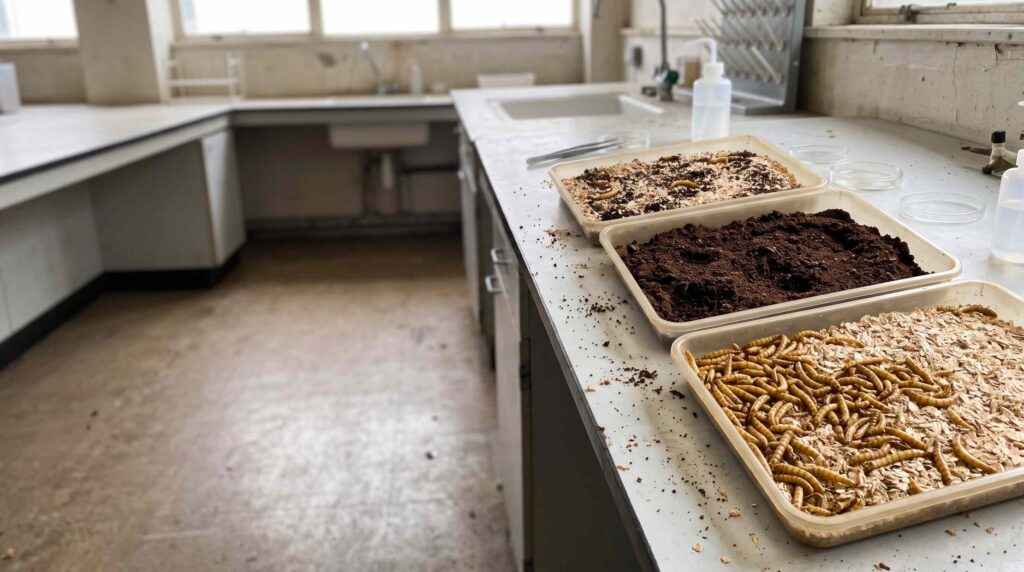
According to the research report, investigators evaluated fermented spent coffee grounds, abbreviated as f-SCG, as a partial substitute for wheat bran in experimental mealworm diets. Third- to fourth-instar larvae were assigned to four feeding treatments containing 0%, 10%, 30%, or 50% f-SCG, with wheat bran making up the remaining proportion. The wheat-bran-only diet served as the control, allowing the researchers to compare larval survival, development, and pupation across increasing replacement levels. The feeding observations included measurements reported through the eighth week, while developmental duration was also summarized for the treatment groups.
This experimental design focused on partial substitution rather than feeding mealworms exclusively on coffee waste. That distinction is important because wheat bran provides nutrients and a familiar rearing substrate, while spent coffee grounds can differ considerably in fiber content, residual bioactive compounds, moisture, and nutritional availability. Fermentation may modify some of these characteristics, potentially making the material more suitable for insect consumption. However, the available secondary report does not provide sufficient methodological detail to independently establish which fermentation organisms, processing conditions, or changes in chemical composition were responsible for the observed biological performance.
Mealworm Survival and Pupation Remained High
The research coverage reports that larval survival exceeded 88.7% across the four feeding treatments, while total pupation rates remained above 91%. No statistically significant difference in survival or total pupation was reported between the f-SCG diets and the wheat-bran-only control. These observations suggest that, under the specific experimental conditions, replacing part of the conventional feed with fermented coffee residues did not produce a substantial decline in these primary measures of rearing success. However, survival and pupation are only two indicators of performance and do not independently establish optimal feed efficiency or commercial harvest yields.
Developmental timing and pupal weight were also reported to change with higher inclusion levels. Larvae receiving diets containing 30%–50% f-SCG completed development in approximately 8.7–8.9 weeks, compared with about 9.3 weeks for the control group. The report further states that the 50% replacement treatment increased pupal weight by 14.9% relative to the wheat-bran control. These findings are potentially relevant to insect producers seeking shorter production cycles or improved developmental consistency, but the 14.9% figure refers specifically to pupal weight rather than total harvestable larval biomass, production revenue, or overall farm output.
Feed Composition and Safety Require Separate Evaluation
The reported nutritional analysis found that the diet containing 50% f-SCG had 18.1% crude protein and 53.7% dietary fiber, together with 131.6 milligrams of calcium per 100 grams. The mixture reportedly contained more crude protein and fiber than the wheat-bran reference material, while its phosphorus, potassium, and magnesium concentrations were lower. These differences indicate that replacing a conventional substrate can alter several nutritional variables simultaneously. A feed mixture with a higher protein percentage does not necessarily provide a better overall nutrient balance, particularly when digestibility, amino acid availability, and other essential nutrients have not been fully evaluated.
The research report also describes low concentrations of selected heavy metals, including lead, cadmium, and arsenic, and states that the tested mycotoxins were not detected. These results are encouraging within the reported experimental scope, but they should not be interpreted as a universal food or feed safety certification for spent coffee grounds. Coffee waste collected from different sources may vary in chemical residues, storage history, microbial condition, and contamination risk. Moreover, satisfactory results for an experimental feed mixture do not automatically establish the safety, regulatory eligibility, or contaminant profile of finished mealworm products intended for commercial food or animal-feed markets.
Why Coffee Waste Pretreatment Matters
Using spent coffee grounds in insect farming is not a new concept, but previous studies have shown that performance can depend heavily on how the material is prepared and combined with other feed ingredients. Research published before 2026 reported unfavorable growth outcomes when mealworms were fed certain coffee-residue substrates, while other experiments found benefits from blending coffee grounds with conventional feed. These mixed findings suggest that the relevant question is not simply whether mealworms can consume coffee waste, but which substrate formulations and pretreatments support reliable development without introducing unacceptable nutritional or biological risks.
Fermentation is one possible approach to improving the suitability of agricultural by-products. Depending on the microbial process and operating conditions, it may alter nutrient availability and selected compounds that affect insect performance. However, fermentation also requires controlled processing, equipment, energy, labor, and appropriate hygiene measures. Different fermentation methods cannot be assumed to produce equivalent results, and findings from one treatment protocol should not be generalized to all coffee residues. This creates an important distinction between laboratory evidence supporting biological feasibility and a standardized feed ingredient that can be reliably manufactured and distributed at commercial scale.
IIR Analysis: Can Coffee Residues Lower Mealworm Production Costs?
The commercial opportunity suggested by this research is the possibility of reducing dependence on conventional wheat bran while creating value from a widely generated food-service residue. Feed costs can influence the economics of mealworm production, particularly when facilities operate at substantial volumes and require consistent supplies of suitable substrates. However, coffee grounds are not automatically a low-cost ingredient simply because they are available as a by-product. Collection, transportation, dewatering, fermentation, stabilization, quality testing, and storage may add costs that reduce or eliminate any savings from purchasing less wheat bran.
For industrial producers, the findings also reinforce the importance of upstream ingredient control. IIR’s earlier guide to mealworm meal quality explains why rearing inputs, traceability, manufacturing controls, and contaminant testing must be evaluated alongside finished-product specifications. If fermented coffee residues are introduced into a production system, suppliers would need to demonstrate consistent feed preparation, suitable input quality, stable larval performance, and compliance with the requirements of the intended market. Biological suitability does not automatically establish that a particular waste-derived material is permitted for commercial insect production.
From IIR’s perspective, the most important next step is to evaluate feed replacement using complete production economics rather than isolated growth indicators. An effective commercial comparison should account for the delivered cost of wheat bran and processed coffee residues, fermentation expenses, larval survival, harvestable biomass, production-cycle duration, and the quality of the resulting insects. The study coverage provides useful preliminary evidence that fermented coffee residues may support mealworm development at meaningful inclusion levels, but it does not establish an optimum industrial formulation or demonstrate a verified reduction in production costs.
What to Watch Next
Further research should test the reported feeding results across larger mealworm populations, multiple production batches, and different sources of spent coffee grounds. Direct comparisons between untreated, fermented, and other pretreated materials could help determine which processing steps contribute most to the observed performance. Studies should also report complete feed conversion metrics, larval biomass yield, nutrient digestibility, and the composition of harvested insects, rather than relying primarily on survival, pupation, and pupal weight.
For commercial application, the priorities will be consistent fermentation protocols, reliable contaminant monitoring, regulatory evaluation, and cost comparisons under practical farming conditions. The results reported in November 2026 provide a potentially useful direction for alternative substrate research, but broader validation is needed before fermented coffee grounds can be considered a dependable replacement ingredient in industrial mealworm production.