Independent intelligence for the global insect industryISSUE 01 · 2026
Earthworm Production: How Commercial Farming and Processing Work
By IIR Editorial DeskOctober 7, 2026
Commercial earthworm production combines controlled vermiculture with substrate management, harvesting, cleaning and processing to produce worm biomass and related outputs.
This analysis explains how commercial earthworm production moves from species selection, breeding and substrate preparation through controlled vermiculture, harvesting, cleaning, drying and downstream processing.
By IIR Editorial Desk · October 7, 2026 · Market Intelligence
Commercial earthworm production is a biological farming system in which suitable earthworm species are maintained and multiplied under controlled conditions to generate worm biomass, vermicompost, or both. The production process can appear relatively simple, but commercial consistency depends on controlling substrate, moisture, temperature, stocking, feeding, harvesting, and post-harvest handling.
The production objective also matters. A vermicomposting operation designed primarily to process organic material may manage its worm population differently from a facility focused on producing biomass for animal nutrition. Commercial systems, therefore, need to define the intended output before selecting production methods, because the balance between worm reproduction, biomass growth, and substrate conversion changes according to the business model.
1. Commercial Production Starts With Species Selection
Not every earthworm species is equally suited to intensive commercial production. Vermiculture generally favors species capable of living in organic-rich surface material, reproducing relatively quickly, and tolerating the conditions found in managed beds or reactors.
Eisenia fetida is among the best-known species used in vermiculture and vermicomposting. Its widespread use reflects characteristics that make it practical for managed organic substrates, but other species may be commercially relevant depending on geography, climate, and production objective.
Species selection should therefore be connected to the intended product. A producer focused on vermicomposting may prioritize reproduction and organic material processing, while biomass-oriented production places additional emphasis on growth, harvestable yield, and the characteristics of the final worm material.
2. Breeding Stock Determines Production Continuity
A commercial system needs enough healthy breeding stock to maintain production without repeatedly rebuilding the population. Mature earthworms reproduce through cocoons, which develop into juvenile worms and eventually replenish the productive population.
Reproduction is influenced by environmental conditions, population density, and substrate quality. Irregular breeding performance can reduce the number of juveniles entering the system and eventually constrain harvestable biomass, even when sufficient production space is available.
This makes breeding capacity an upstream production variable. Expanding beds or purchasing additional processing equipment does not create sustainable capacity unless the biological population can support the intended production cycle.
3. Substrate Preparation Creates the Production Environment
Substrate plays a dual role in earthworm production: it provides nutrition and forms the physical environment in which the worms live. Manure, agricultural residues, and other biodegradable organic materials can be used in vermiculture systems, but suitability depends on their physical, chemical, and biological characteristics.
Fresh organic material is not always ready for direct introduction. Depending on the feedstock, preprocessing or partial stabilization may be necessary to reduce excessive heat, unfavorable chemical conditions, or other factors that could harm the worms. Mixing different materials can also help create a more suitable structure and moisture balance.
For commercial biomass production, substrate selection should consider more than growth rate. Material origin, consistency, potential contaminants, and downstream product requirements become increasingly important when harvested worms are intended for feed or other ingredient markets.
4. Moisture and Temperature Drive Biological Performance
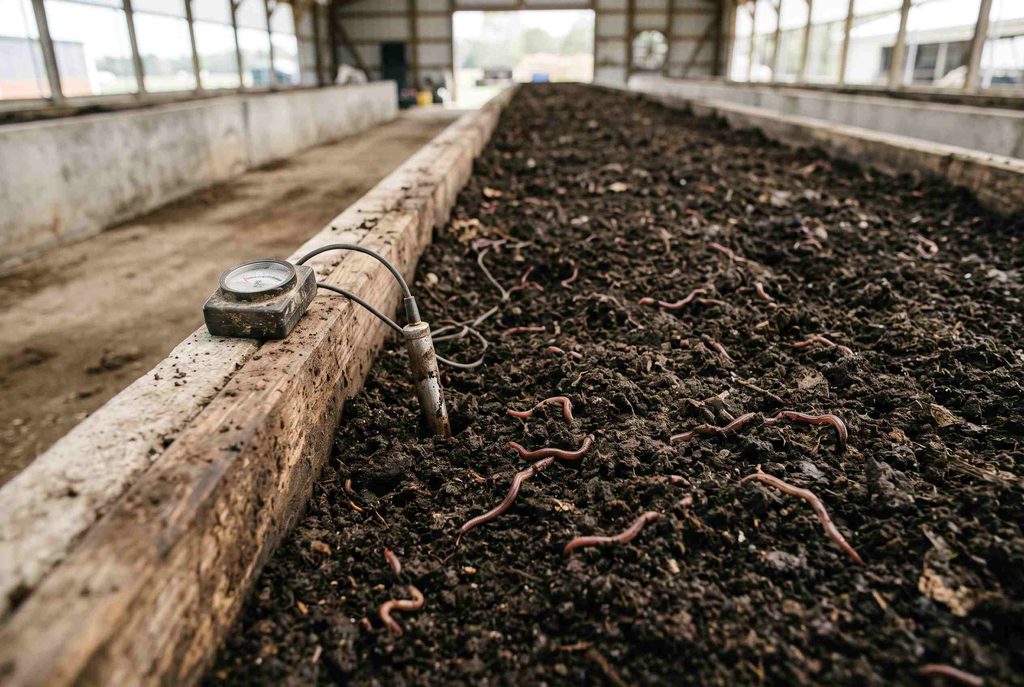
Earthworms require a moist environment because gas exchange occurs through the body surface. A production bed that becomes too dry can suppress feeding, growth, and reproduction, while excessive water can reduce aeration and create unfavorable substrate conditions.
Temperature also influences biological activity. Suitable ranges vary by species, but commercial systems generally perform best when large fluctuations are avoided. Outdoor production may depend heavily on seasonal conditions, while covered or enclosed systems can provide greater environmental control at the cost of additional infrastructure.
Moisture and temperature should therefore be managed together with aeration and substrate structure. The objective is not to maximize one environmental variable but to maintain conditions that support stable biological activity across the production cycle.
5. Stocking and Feeding Determine Biomass Development
Stocking density influences how effectively a production system uses available space and substrate. Very low density can underutilize the production area, while excessive density can increase competition and alter growth or reproductive performance.
The feeding strategy must also match the biological capacity of the system. Adding organic material faster than the worms and associated microbial community can process it may create unstable conditions, while insufficient feeding limits biomass growth. Commercial production, therefore, benefits from scheduled feeding based on observed consumption and bed condition rather than simply maximizing input volume.
For biomass-oriented systems, the relevant production metric is harvestable worm output over time. A bed that processes large quantities of organic material is not necessarily the most productive system for worm biomass if much of the biological value is directed toward substrate transformation rather than harvestable growth.
6. Harvesting Separates Worm Biomass From the Substrate
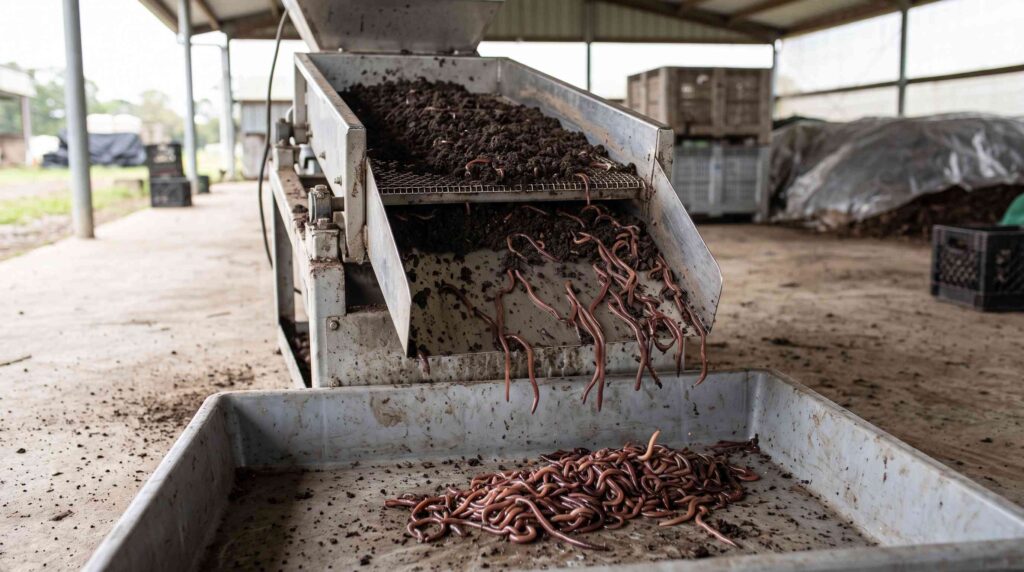
Harvesting creates the transition between vermiculture and downstream processing. Worms must be separated from bedding material, vermicompost, and unprocessed organic residues without excessive loss or contamination.
Commercial separation methods can use screening, mechanical separation, light response, or other behavioral and physical differences between worms and the surrounding material. The appropriate method depends on production scale, substrate texture, and whether the priority is live worms, processing biomass, or vermicompost.
Harvest efficiency affects both sides of the production system. Recovering worms efficiently increases biomass yield, while effective separation also improves the cleanliness of the vermicompost stream. A poorly designed harvest stage can therefore reduce the value of both outputs.
7. Cleaning and Purging Prepare Worms for Processing
Earthworms intended for processing require additional preparation after separation. Soil, substrate, and other adhering material need to be removed so that downstream product quality reflects worm biomass rather than residual production material.
Purging or gut evacuation may also be incorporated into processing systems when the intended product requires reduced gut contents. The exact approach depends on species, product specification, and processing objective, and should not be treated as one universal procedure for all earthworm products.
This stage is particularly important for dried whole earthworms and earthworm meal. Residual soil and inorganic material can affect cleanliness and ash content, making pre-processing control commercially relevant rather than merely cosmetic.
8. Drying Converts Fresh Biomass Into a Stable Product
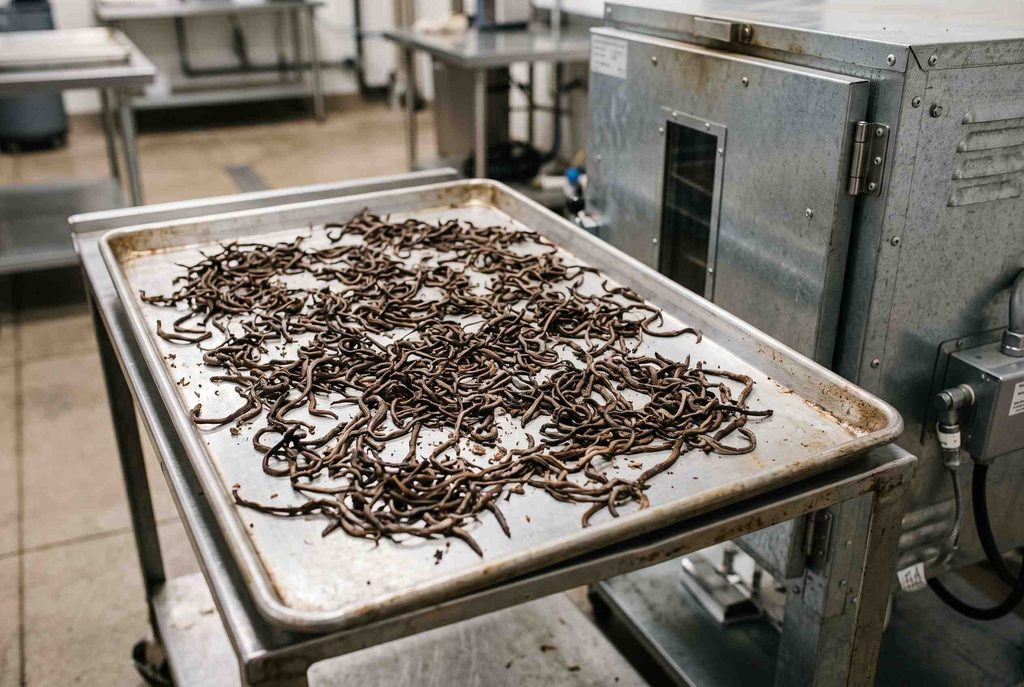
Fresh earthworms contain high levels of moisture and deteriorate rapidly after harvest. Drying reduces water content and allows biomass to move into longer-duration storage, transportation, and ingredient processing.
Several drying approaches can be used, including sun drying and controlled thermal drying, while freeze-drying can be used where the target product justifies substantially more intensive processing. Drying method and conditions can influence appearance, physical integrity, nutrient characteristics, and processing economics.
For commercial operations, the relevant endpoint is not simply “dry.” Producers need a repeatable moisture specification appropriate for storage and the intended market. Uneven drying can create product variability and increase the risk of deterioration during storage.
9. Processing Depends on the Target Commercial Format
The production chain can end in several different forms. Live worms may be sold for breeding, bait, or selected animal-feeding applications, while fresh biomass has a shorter logistics window. Dried whole earthworms provide a more stable, recognizable product, and grinding produces earthworm meal that can be incorporated more easily into formulated feeds.
Each additional processing stage changes equipment and quality requirements. Whole dried products emphasize cleaning, physical condition, and moisture, while meal production adds milling and particle-size control. More advanced fractionation would create an even more complex manufacturing boundary.
The production line should therefore be designed backward from the intended buyer. Processing worms first and searching for a market afterward creates a greater risk of producing a format that does not match commercial specifications.
10. Quality Control Starts Before Harvest
Earthworms interact directly with their production substrate, which means quality control cannot begin only after drying. Substrate origin and composition can influence the harvested biomass, while contaminated production environments can introduce undesirable substances into the final product.
This is particularly important because earthworms can accumulate certain contaminants from their environment. Controlled substrate sourcing and traceability are therefore essential when biomass is intended for animal nutrition rather than only for vermicomposting.
Post-harvest controls can then address parameters such as moisture, ash, nutritional composition, microbiological quality, and contaminants according to the intended application. Commercial production requires these controls to be connected to identifiable batches rather than applied only as occasional finished-product testing.
11. Scaling Requires Control Across the Entire System
Scaling earthworm production requires more than increasing the number or length of vermiculture beds. Substrate sourcing, preprocessing, feeding, environmental management, harvesting, cleaning, and drying all need sufficient capacity to support the biological production system.
Labor can become particularly important because many traditional vermiculture operations rely on manual feeding, bed management, and separation. Mechanization can improve throughput, but equipment must be compatible with living worms and variable organic materials rather than designed as if the process were conventional dry-material manufacturing.
A commercial biomass system can therefore be represented as:
Vermicompost develops alongside this chain as an important co-product rather than simply as waste from worm production. The commercial efficiency of the operation can depend on how effectively both biomass and processed substrate are converted into saleable outputs.
IIR Analysis
The central challenge in commercial earthworm production is converting a naturally flexible vermiculture process into a controlled biomass-production system. Earthworms can thrive on diverse organic resources, but commercial buyers require greater consistency than a basic composting operation normally needs.
Production for feed or ingredient markets, therefore, shifts the operating priorities. Substrate traceability, worm cleanliness, ash control, drying consistency, and batch quality become more important, while harvesting must recover sufficient biomass without undermining the economics of the vermicompost stream.
The strongest commercial model is consequently not defined by maximum worm numbers alone:
Disclaimer: This article is for informational purposes only and does not constitute business, legal or investment advice. Always consult primary sources and qualified professionals.