Independent intelligence for the global insect industryISSUE 01 · 2026
Earthworm Production Cost: Key Drivers of Commercial Economics
By IIR Editorial DeskOctober 7, 2026
Earthworm production economics depend on substrate, labor, biomass yield, harvesting, processing and the value of co-products such as vermicompost.
This analysis examines the main drivers of earthworm production cost, from feedstock and labor to biomass yield, harvesting, cleaning and drying, and explains how vermicompost and other co-products can change commercial economics.
By IIR Editorial Desk · October 7, 2026 · Market Intelligence
Commercial earthworm production cost cannot be represented by one universal cost per kilogram. Vermiculture systems differ substantially in feedstock, climate, labor intensity, production scale and commercial objective. A business focused primarily on vermicompost operates under a different economic model from a facility harvesting earthworm biomass for drying and feed-ingredient production.
This distinction is fundamental. Organic materials can provide relatively inexpensive biological inputs, but producing a standardized earthworm ingredient adds harvesting, separation, cleaning, moisture removal, and quality-control costs that may not exist to the same degree in a conventional vermicomposting business. Commercial economics, therefore, depend on the complete production boundary rather than the apparent cost of growing worms.
1. Feedstock Cost Depends on the Production Model
Earthworms can utilize manure, agricultural residues, and other suitable organic materials, creating an opportunity to build production around relatively low-value feedstocks. In integrated agricultural systems, some materials may already be available on-site, reducing direct purchasing costs.
However, a low purchase price does not mean zero production cost. Feedstock may need collection, transportation, storage, preprocessing, mixing, and moisture adjustment before entering a vermiculture system. Materials that are free at source can become expensive when they must be transported over long distances or handled repeatedly.
The economic value of a feedstock also depends on biological performance. A cheap material that produces poor growth or requires long production cycles can generate a higher biomass cost than a more expensive substrate that supports better productivity. Producers therefore need to evaluate feedstock cost per unit of saleable output, not simply cost per tonne of incoming organic material.
2. Labor Can Become a Major Economic Constraint
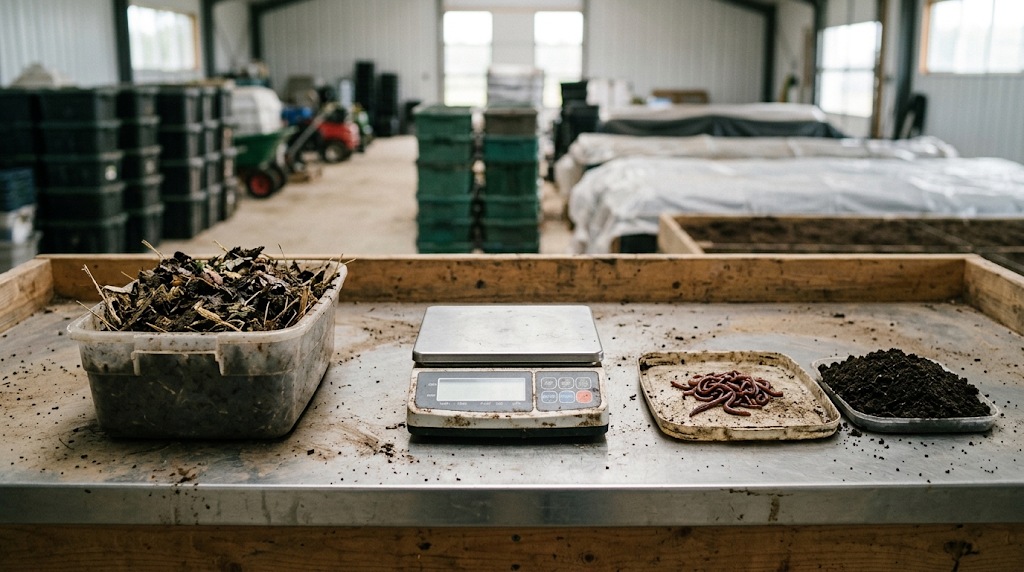
Commercial vermiculture contains numerous operations that can remain labor-intensive: feedstock preparation, bed loading, moisture management, feeding, harvesting, worm separation, and product handling. Labor requirements can increase further when the objective shifts from vermicompost toward clean earthworm biomass.
Extension production budgets illustrate this operational burden. Feeding and harvesting require recurring labor even in relatively simple earthworm-production systems, making workflow design an important part of commercial economics.
The challenge becomes particularly significant when earthworms are intended for animal feed ingredients. Harvesting worms from vermicompost and preparing them for further processing introduces handling that a business selling only vermicompost may avoid. Mechanization can reduce labor requirements, but it also introduces equipment, maintenance, and depreciation costs.
The economics of biomass production depend on how quickly and reliably the system converts feedstock, production area, and labor into harvestable worms. Growth, reproduction, survival, and production-cycle duration all influence the quantity of biomass available over time.
Poor environmental conditions can increase unit cost even when the feedstock is inexpensive. Inadequate moisture, unsuitable temperatures, overcrowding, or inconsistent feeding can reduce growth and reproduction while the facility continues consuming labor and production space.
This makes biological productivity a denominator in the cost equation. Fixed and recurring operating costs are ultimately distributed across the saleable biomass. Increasing biological output without proportionally increasing inputs can reduce unit cost, while mortality or slow growth has the opposite effect.
4. Harvesting and Separation Add a Distinct Cost Layer
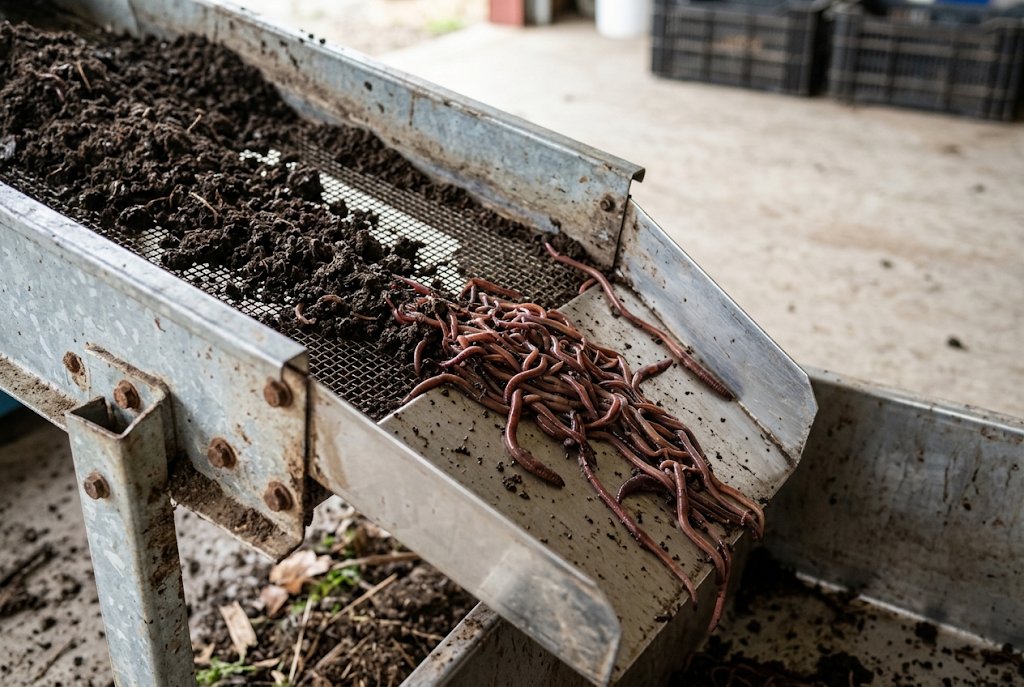
Harvesting is one of the clearest economic differences between vermicomposting and dedicated earthworm biomass production. A vermicompost producer may need to separate some worms to maintain the production colony, but an ingredient producer must recover substantial quantities of biomass efficiently and repeatedly.
Traditional separation can require considerable manual work. Mechanical screening and other harvesting technologies can improve throughput, but equipment must separate flexible living worms from heterogeneous organic material without creating excessive losses.
The economic target is therefore not simply maximum recovery. Producers need to balance harvest recovery, labor input, equipment cost, and product cleanliness. A system that produces abundant worms but requires excessive manual separation can remain commercially unattractive.
5. Cleaning Creates Additional Cost for Feed-Grade Biomass
Harvested earthworms can carry substrate externally and retain material within the digestive tract. When the worms are intended for processing into a commercial ingredient, cleaning requirements can therefore become more demanding than those associated with selling live worms or maintaining a vermiculture population.
Washing requires water, handling, and equipment, while purging or gut evacuation can add time and potentially reduce the amount of final saleable biomass. These steps can also affect the ash and cleanliness characteristics of the processed product.
The required level of preparation depends on substrate and product specification. Biomass raised on controlled materials may present a different processing challenge from worms grown in mineral-rich or variable substrates. Cleaning cost should therefore be evaluated together with upstream substrate design rather than treated only as a post-harvest problem.
6. Drying Changes the Economics of the Finished Product
Fresh earthworms contain substantial moisture, so fresh biomass weight cannot be compared directly with the weight of dried commercial product. Moisture removal creates a significant mass reduction between harvest and saleable dried output.
Drying also introduces equipment and energy costs. Research evaluating earthworm meal production from fruit and vegetable waste identified electricity used in fresh-earthworm processing as an important contributor, with more energy-intensive drying routes carrying a greater burden than conventional feed-oriented drying.
For commercial economics, the appropriate denominator is therefore the kilogram of saleable dried output when dried earthworms or earthworm meal are the target products. A production system can appear inexpensive when measured against fresh biomass, but it becomes substantially more costly after accounting for drying, yield, and energy.
7. Facility Design and Utilization Affect Unit Cost
Earthworm farming can use relatively simple beds, windrows, or more controlled production systems. Infrastructure requirements depend on climate, scale, feedstock, and the degree of environmental protection required.
Simple systems can reduce capital expenditure but may expose production to greater seasonal variation and require more manual handling. More controlled facilities can improve consistency but add structures, equipment, utilities, and depreciation.
Utilization determines whether those investments reduce unit cost. Increasing bed capacity without sufficient breeding stock, feedstock, labor, harvesting capacity, or downstream demand can create idle infrastructure. Commercial scale becomes economically useful only when the production chain remains sufficiently balanced.
8. Vermicompost Changes the Revenue Equation
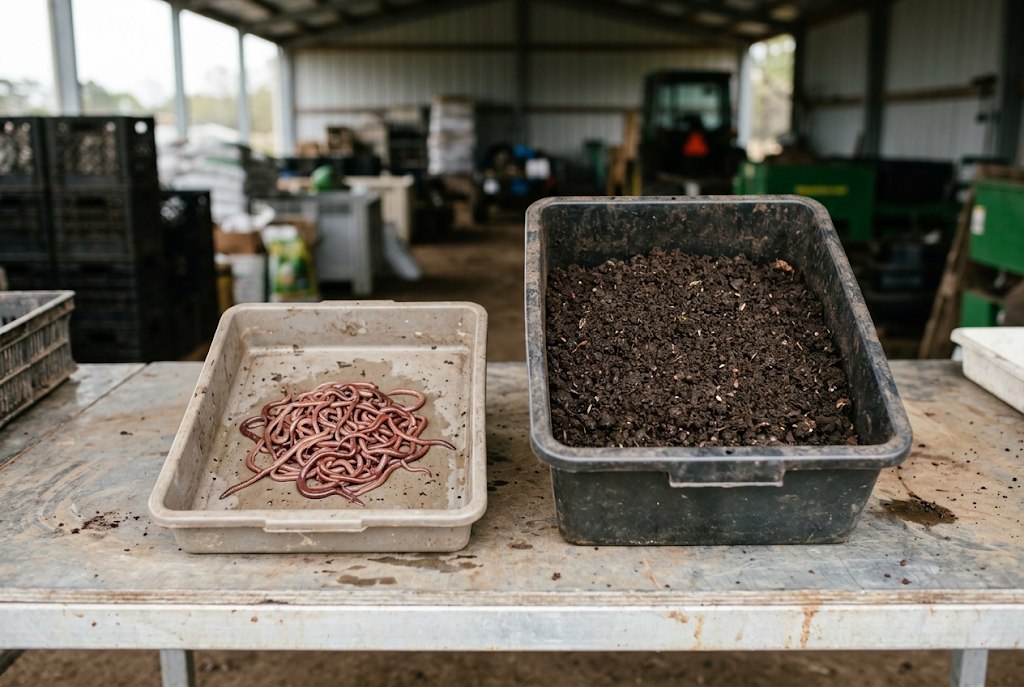
Earthworm biomass production has an important economic characteristic that differentiates it from many single-output protein systems: the remaining processed substrate can itself be a marketable product.
Vermicompost can therefore help distribute the economics of the production system across more than one revenue stream. Pilot-scale economic research has demonstrated that vermicomposting can operate as a viable business under specific local assumptions, although individual profitability figures should not be generalized across countries or production models.
The relative value of those outputs depends on the business. For some producers, vermicompost may be the primary product and worms a secondary revenue stream. For biomass-oriented operations, the relationship can be reversed. Cost allocation, therefore, matters when comparing businesses or calculating the production cost of earthworm meal.
9. Logistics Can Offset Low-Cost Feedstock
Earthworm production is often attractive where organic materials are locally available. Transportation can weaken this advantage because many feedstocks contain substantial moisture and have relatively low value per unit of weight.
Moving wet organic material over long distances can therefore create disproportionate logistics costs. Research on earthworm meal production has identified transportation of fruit and vegetable waste among the important process considerations, reinforcing the value of locating production close to suitable feedstock sources.
The same principle applies downstream. Drying reduces product weight and improves storability, which can make longer-distance distribution more practical, but the producer must first absorb the processing cost required to create that stable product.
10. Commercial Economics Depend on the Product Being Sold
There is no meaningful earthworm production cost without defining the final product. Live breeding worms, bait, fresh feed biomass, dried whole earthworms, earthworm meal, and vermicompost represent different production boundaries and different markets.
A producer selling live worms may avoid drying entirely but face biological inventory and transportation constraints. A dried-earthworm supplier adds cleaning and moisture removal. Earthworm meal introduces grinding and potentially tighter ingredient specifications. A vermicompost-focused facility may earn most of its revenue from the processed substrate rather than worm biomass.
Commercial analysis should therefore connect production cost with saleable product specification and realized revenue, rather than comparing isolated cost-per-kilogram figures from fundamentally different production systems.
IIR Analysis
The economics of earthworm production are best understood as a multi-output biological conversion system, not simply as the cost of feeding worms. Low-value organic materials can create an attractive starting point, but labor-intensive harvesting, separation, cleaning, and drying can absorb much of that apparent feedstock advantage.
A practical cost framework is:
Feedstock + Labor + Water + Facility + Harvesting + Cleaning + Energy + Processing + Quality Control
Salable Earthworm Biomass + Vermicompost + Other Commercial Outputs
This also explains why economics reported for vermicomposting facilities should not automatically be used as production-cost benchmarks for dried earthworms or earthworm meal. The production boundary is different.
For biomass-oriented businesses, one of the most important commercialization challenges is likely to remain reducing labor and post-harvest processing costs while maintaining the value of the vermicompost stream. The strongest economic model may therefore be one that optimizes the combined value of multiple outputs rather than forcing earthworm biomass to carry the entire production cost.
Disclaimer: This article is for informational purposes only and does not constitute business, legal or investment advice. Always consult primary sources and qualified professionals.