Independent intelligence for the global insect industryISSUE 01 · 2026
Cricket Production: How Commercial Farming and Processing Work
By IIR Editorial DeskSeptember 26, 2026
Commercial cricket production connects breeding and controlled rearing with harvesting, stabilisation, drying and downstream processing. This analysis explains how the production chain works and where scale, consistency and biosecurity matter most.
This analysis explains how commercial cricket production moves from breeding and egg production through nymph rearing, harvesting and processing, and where environmental control, biosecurity and processing decisions affect commercial output.
By IIR Editorial Desk · September 26, 2026 · Market Intelligence
How Commercial Cricket Production Works
Commercial cricket production is a controlled biological manufacturing system. Farms need to manage breeding populations, egg production, hatching, nymph development, and harvesting before the resulting biomass can move into stabilisation, drying, or further processing.
House cricket, Acheta domesticus, is particularly relevant to industrial production because its relatively consistent life cycle allows reproduction and harvesting to be organised around recurring schedules. Commercial systems can therefore maintain different age groups simultaneously, creating a continuous production cycle rather than waiting for one population to complete its development before beginning another.
At scale, however, production depends on more than reproduction. Temperature, humidity, stocking density, feed, water, hygiene, disease control, harvesting, and processing all need to operate as an integrated system. A bottleneck at any one stage can reduce the amount of finished product available for commercial sale.
1. Breeding Establishes the Production Cycle
Commercial production begins with breeding populations maintained specifically to generate eggs for future production cohorts. Adult crickets need appropriate environmental conditions, feed, and access to suitable egg-laying material.
The breeding unit performs a different function from the main grow-out system. Its objective is not maximum harvest weight but reliable reproduction. Farms therefore need to manage adult populations so that egg production can support planned downstream rearing capacity.
This creates the first capacity relationship in the production chain. Expanding grow-out space without sufficient breeding output can leave production units underutilised, while excessive egg production provides little advantage if the farm lacks space to rear the resulting nymphs.
2. Egg Management Connects Breeding With Rearing
After oviposition, eggs need conditions that support predictable development and hatching. Egg-management systems vary between farms, but commercial operations need to coordinate incubation with available rearing capacity.
Timing matters because newly hatched crickets are considerably smaller and more vulnerable than later developmental stages. The transition from egg to early nymph therefore requires careful management of environmental conditions, feed access and hydration.
Predictable hatching also helps farms organise production cohorts. When egg output and hatch timing become more consistent, labour, housing and future harvesting schedules become easier to plan.
3. Nymph Rearing Produces Most of the Commercial Biomass
Once hatched, crickets enter the main biomass-production phase. They progress through successive developmental stages while consuming feed and increasing in body mass.
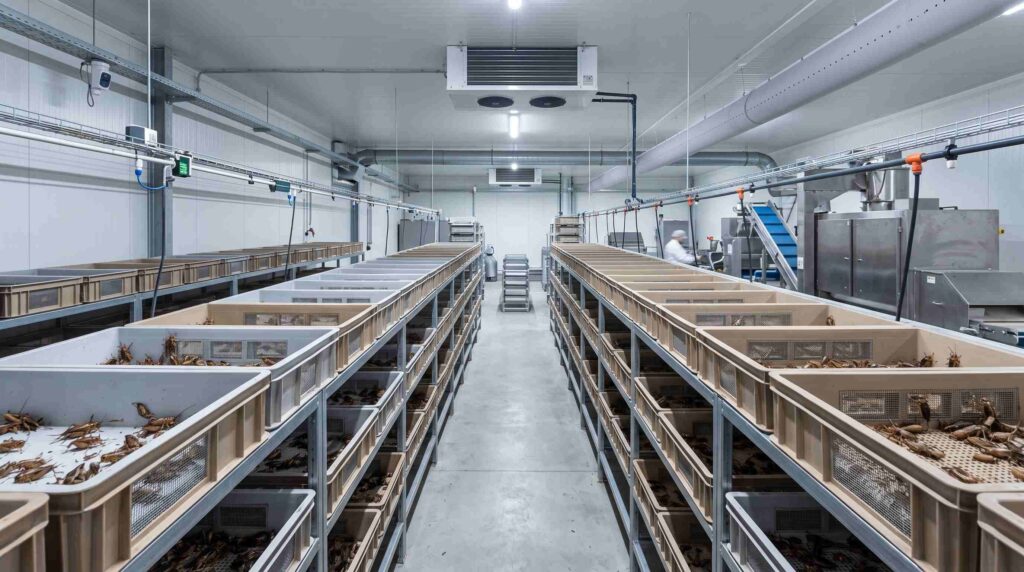
Indoor systems commonly use containers, boxes, or larger enclosed production units that allow feeding, ventilation, and environmental conditions to be managed more consistently. The objective is to maintain conditions that support growth while controlling mortality and avoiding unnecessary stress.
Commercial performance therefore depends on the relationship between the number of insects entering a production cohort and the quantity of usable biomass eventually harvested. High stocking numbers alone do not guarantee high output if survival, growth, or harvest consistency deteriorates.
4. Temperature and Humidity Influence Production Performance
Crickets are ectothermic animals, making environmental conditions directly relevant to biological performance. Temperature can influence development rate, while humidity and ventilation affect both the insects and the production environment.
Commercial facilities therefore need to balance biological requirements with operating costs. Maintaining suitable temperatures throughout large indoor facilities can require substantial environmental-control infrastructure, particularly in climates where external conditions differ significantly from the preferred production range.
Environmental management is also linked to consistency. Large variations between production areas can produce cohorts that develop at different rates, complicating harvesting schedules and reducing predictability.
5. Stocking Density Affects the Production Environment
Increasing the number of crickets within a given production area can improve space utilisation, but density cannot be evaluated independently from ventilation, feed access, hydration, hygiene and heat management.
Higher biological density can change conditions inside rearing units. Competition for resources, waste accumulation and local environmental variation can all become more difficult to manage as populations increase.
For industrial operators, the relevant metric is therefore not simply crickets per container or square metre. The more useful question is how much consistent, harvestable biomass can be produced from a given area without reducing survival, product quality or production stability.
6. Feed Management Influences Biomass Yield
Feed is one of the central inputs in commercial cricket production. The diet needs to support growth and survival while remaining practical to store, distribute, and manage across large numbers of rearing units.
Feed formulation can also influence the characteristics of the resulting biomass. Research on house crickets indicates that diet can affect growth performance and nutritional composition, making feed management relevant to both production efficiency and finished-product consistency.
Commercial feed strategy therefore involves more than identifying the cheapest available material. Producers need to consider biological performance, feed safety, regulatory requirements, supply consistency and how the diet affects the product intended for downstream markets.
7. Water and Hydration Require Controlled Management
Crickets require access to water, but water management can become operationally complicated in dense commercial populations. Open water sources can create drowning and hygiene problems, while excessive moisture can alter conditions within the production environment.
Commercial systems may therefore use controlled hydration methods that provide sufficient moisture without creating unnecessary standing water. The appropriate approach depends on facility design, production density, and feeding system.
Water management also interacts with ventilation and humidity. These variables need to be managed together rather than treated as separate production inputs.
8. Biosecurity Is a Core Part of Cricket Farming
Biosecurity deserves particular attention in cricket farming because infectious disease can disrupt entire production populations. Acheta domesticus densovirus, commonly abbreviated AdDV, is one of the most important examples.
AdDV can cause severe mortality and colony collapse in house crickets. Recent research also indicates that the virus can occur across developmental stages and may be transmitted through multiple routes, reinforcing the importance of controlling its movement within production systems.
For commercial farms, biosecurity can include control over breeding stock, sanitation between production cycles, management of equipment and personnel movement, separation of production groups and procedures for responding to abnormal mortality.
A production facility with substantial physical capacity can therefore still have fragile commercial output if biological health is poorly controlled.
9. Separation and Cleaning Prepare Crickets for Harvest
As production cohorts approach the target harvest stage, farms need to separate insects from residual feed, waste and production materials.
The exact system depends on facility design and intended product. Mechanical separation can reduce labour requirements at larger scale, while smaller farms may rely more heavily on manual handling.
Harvest preparation is particularly important for products intended to remain visually recognisable. Whole-cricket products can expose physical defects or contamination that would be less visible after milling, making cleanliness and product integrity commercially relevant.
10. Harvest Timing Influences Product Consistency
Crickets can be harvested at different developmental stages depending on the production system and intended application. Commercial operations benefit from defining harvest criteria rather than relying only on approximate age.
Developmental stage can affect body composition and physical characteristics. Harvesting populations at a more consistent stage can therefore help reduce variation between batches.
Timing also needs to align with processing capacity. Harvesting large quantities without sufficient downstream stabilisation or drying capacity can create a bottleneck precisely when the biomass is most perishable.
11. Stabilisation Begins Immediately After Harvest
Freshly harvested crickets remain biologically and microbiologically unstable. They therefore need to move quickly into an appropriate post-harvest process.
Commercial food-processing systems commonly use killing or stabilisation steps such as freezing and thermal treatment. Heating can play an important role in reducing microbiological hazards before the insects move into drying or further processing.
The correct process depends on intended use and regulatory requirements. Producers should therefore treat stabilisation as part of product manufacturing rather than as a simple extension of harvesting.
12. Drying Converts Perishable Biomass Into a More Stable Product
Drying is one of the most important processing stages for commercial cricket products. Removing moisture improves stability and makes the material easier to store, transport, and process further.
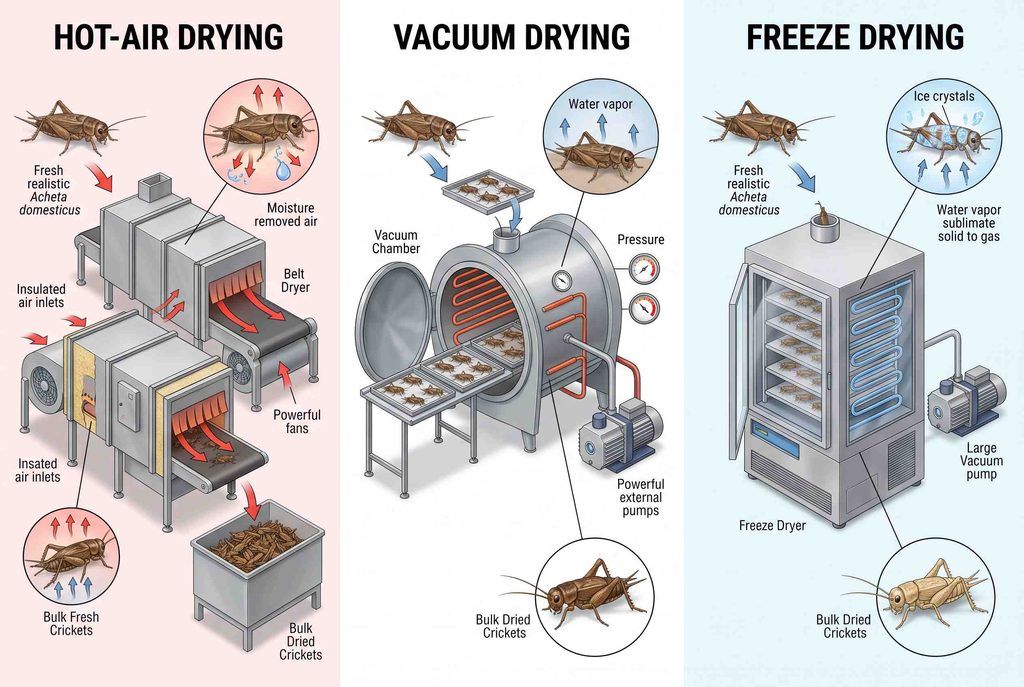
Several technologies can be used, including hot-air, vacuum and freeze drying. These methods should not be treated as interchangeable. Research published in 2026 comparing drying approaches for juvenile A. domesticus found differences in water activity, colour, oxidation, functional properties and aroma even when final moisture contents were similar.
This has a direct commercial implication: achieving a low moisture value does not by itself guarantee identical finished-product characteristics. Processing technology can influence what the downstream customer ultimately receives.
13. Processing Determines the Final Commercial Product
Once stabilised and dried, crickets can enter several different product pathways. Some remain as whole dried insects, while others are milled into powder or subjected to additional processing.
The processing route determines more than physical appearance. It influences the potential customer base, product specifications, equipment requirements and quality-control system.
14. Whole Products and Powders Require Different Process Control
Whole dried crickets retain visible physical characteristics, making colour, integrity, cleanliness and breakage relevant to commercial evaluation. Processing needs to stabilise the product without unnecessarily damaging its appearance.
Cricket powder removes many of those visual considerations but introduces others. Particle characteristics, composition, oxidation, microbiological quality and functional behaviour can become more relevant when the material is intended for incorporation into formulated products.
Recent processing research also shows that drying method can influence the physicochemical and sensory characteristics of cricket powder. Production decisions therefore continue to affect product performance even after the farming stage has ended.
15. Quality Control Runs Through the Entire Production Chain
Quality control should not begin only when finished crickets reach the laboratory. Many characteristics of the final product are influenced earlier by breeding, feed, environmental conditions, harvesting and processing.
Each stage creates variables that can affect the next. Poor feed management cannot necessarily be corrected by drying, while inconsistent drying cannot be solved simply by better packaging.
Finished-product testing remains important, but testing works best as verification of a controlled production process rather than as a substitute for process control.
16. Automation Becomes More Important as Production Scales
Small-scale cricket farming can rely heavily on manual feeding, cleaning, moving containers and harvesting. As facilities expand, repeating these activities across thousands of production units can create substantial labour requirements.
Automation can be introduced into feeding, environmental monitoring, material movement, separation and processing. The commercial objective is not automation for its own sake but more consistent throughput with manageable labour requirements.
The challenge is that biological systems are less uniform than conventional manufacturing lines. Equipment must operate around living insects of different sizes and developmental stages, making reliable automation more complicated than simply mechanising a static product.
17. Production Capacity Depends on the Entire System
The capacity of a cricket farm should not be defined only by the number of rearing containers or the theoretical biomass that could be housed within the facility.
Breeding output, hatching, survival, growth, environmental control, harvesting, and processing all determine how much finished product the system can actually deliver. Disease can further reduce output even when the physical infrastructure remains fully installed.
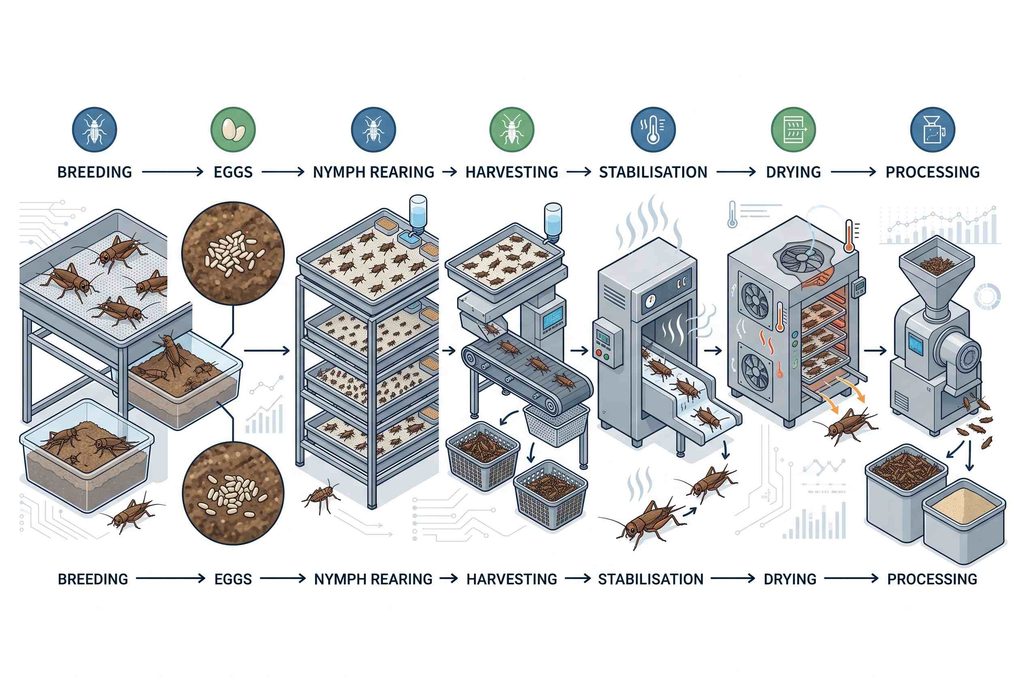
For commercial analysis, the production chain is therefore better represented as:
The final stages matter most to customers because they determine the volume actually available for commercial use.
18. Scaling Cricket Production Requires Process Integration
Industrial scale creates opportunities to spread infrastructure and management costs across greater output, but it also increases the consequences of operational imbalance.
A farm that expands rearing capacity without sufficient egg production, processing throughput or market demand can create underutilised assets. Conversely, inadequate rearing capacity can leave expensive processing equipment operating below its intended throughput.
Disease risk adds another dimension. Larger populations and more interconnected production systems can increase the importance of compartmentalisation, hygiene and monitoring because a biological disruption can affect a substantial proportion of expected output.
Scaling therefore requires coordination between biology, engineering, processing and commercial demand rather than expansion of any one stage in isolation.
IIR Analysis
Commercial cricket production is best understood as an integrated production system rather than a collection of rearing containers. Biological output depends on breeding, environmental management, nutrition and biosecurity, while commercial output depends on harvesting, stabilisation, drying, processing and quality release.
Crickets also have a production characteristic that deserves more attention than in many generic insect-farming discussions: disease resilience. AdDV demonstrates how a biological problem can undermine production even when physical capacity, feed supply and processing infrastructure remain available.
Processing technology is another important differentiator. Recent research demonstrates that different drying methods can produce measurable differences in cricket powder characteristics, meaning that production analysis should not end when biomass leaves the farm.
For IIR, the most useful measure of production maturity is therefore not theoretical rearing capacity. It is the ability to convert breeding output into consistent, quality-released and commercially usable product across repeated production cycles.
Disclaimer: This article is for informational purposes only and does not constitute business, legal or investment advice. Always consult primary sources and qualified professionals.