Independent intelligence for the global insect industryISSUE 01 · 2026
Cricket Market Demand: Feed, Pet Food, and Emerging Applications
By IIR Editorial DeskSeptember 28, 2026
Cricket demand spans specialty animal nutrition, pet food, aquafeed and human food, while powders and processed ingredients create additional commercial opportunities. This analysis examines where demand is established, developing and emerging
This analysis examines where commercial demand for cricket products is developing, from specialty animal nutrition and pet food to aquafeed, human food and emerging higher-value applications.
By IIR Editorial Desk · September 28, 2026 · Market Intelligence
Where Is Commercial Demand for Cricket Products Developing?
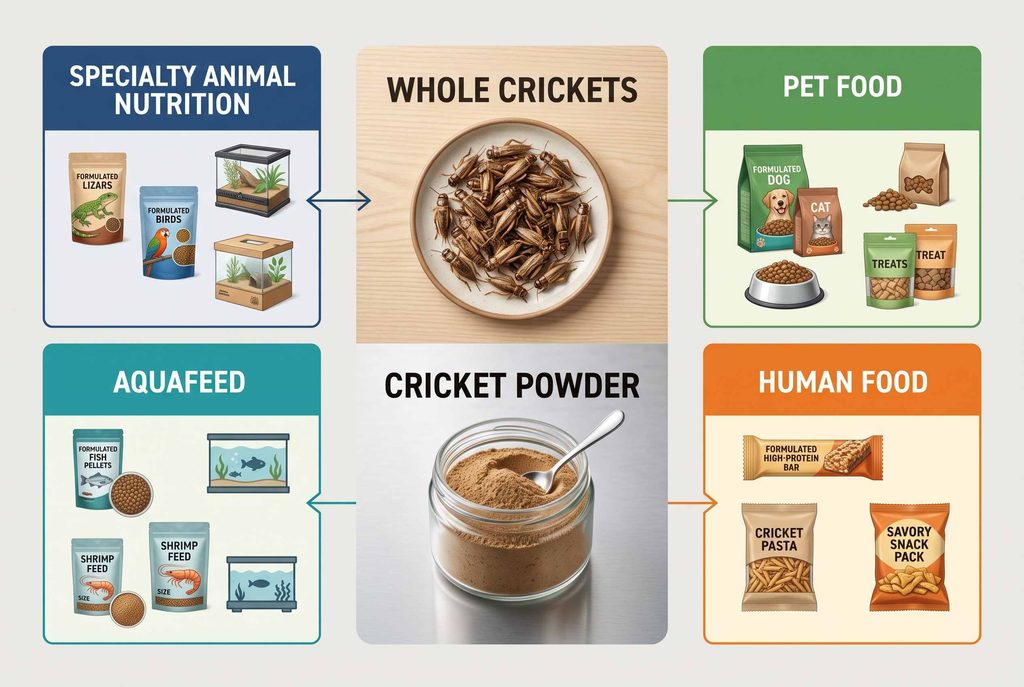
Commercial cricket market demand is spread across several markets rather than concentrated in a single application. Whole crickets can serve specialty animal nutrition and some food markets, while powders and processed ingredients can enter pet food, formulated foods, and other applications.
These markets differ substantially in purchasing behavior. A buyer sourcing whole dried crickets for specialty animal nutrition has different requirements from a food manufacturer evaluating cricket powder as an ingredient. Product form, specification, regulation, price, and supply consistency all influence whether technical interest becomes commercial demand.
This distinction is important when evaluating the sector. A product may be technically suitable for an application without generating significant recurring purchases. IIR therefore separates established demand, developing demand, and emerging applications rather than treating every potential use as an existing commercial market.
1. Specialty Animal Nutrition Provides an Established Demand Base
Whole crickets already fit naturally into several specialty animal-feeding applications. Reptiles, birds, fish and other insect-eating animals can consume whole insects, allowing dried crickets to be sold in a recognizable form without first being converted into a standardized protein ingredient.
This creates a different demand structure from commodity feed markets. Buyers may place greater emphasis on insect size, physical integrity, color, cleanliness, and packaging because the cricket remains visible in the final product.
The market can include specialty-feed companies, pet-product brands, distributors, and retailers. Individual customers may purchase relatively modest volumes, but distributors can aggregate demand across a broader network of smaller buyers.
2. Pet Food Creates a Broader Ingredient Opportunity
Pet food expands the commercial role of crickets beyond whole-insect feeding. Cricket powders and other processed forms can potentially be incorporated into formulated products where the insect is used as an ingredient rather than presented as a complete prey item.
This changes the buyer’s priorities. Manufacturers may focus more heavily on nutritional composition, microbiological quality, consistency, processing performance, and documentation. The commercial relationship becomes closer to ingredient procurement than to the purchase of whole insects.
Pet food can also support differentiated positioning, particularly where brands are exploring alternative proteins or distinctive ingredient stories. That does not mean cricket ingredients automatically achieve broad adoption; formulation requirements, regulation, ingredient price, and reliable supply still determine whether interest becomes repeat purchasing.
3. Aquafeed Represents a Larger Potential Volume Market
Aquaculture creates a potentially much larger ingredient market because feed manufacturers operate at a different scale from many specialty-animal businesses. Cricket meal has been investigated as a protein source in aquaculture formulations, creating a technical basis for further commercial evaluation.
Volume potential alone does not establish a large commercial market. Aquafeed ingredients must compete with established protein sources on nutritional performance, availability, formulation characteristics, and cost. A technically effective cricket ingredient can remain commercially limited if its price is too high for the targeted feed segment.
For cricket producers, aquafeed is better viewed as an addressable ingredient market whose realized demand depends heavily on economics and supply scale.
4. Poultry and Other Livestock Feed Expand the Addressable Market
Cricket-based ingredients have also attracted research interest for poultry and other livestock applications. These markets broaden the potential demand base beyond pet and specialty-animal nutrition.
Large feed markets are highly sensitive to ingredient economics. Buyers need predictable specifications and sufficient supply, but they also compare alternative ingredients according to formulation value and cost. This creates a much higher commercial threshold than simply demonstrating that animals can consume cricket-derived ingredients.
As a result, feed research should not be interpreted automatically as evidence of established industrial demand. Technical feasibility is the beginning of market development, not proof of widespread commercial adoption.
5. Whole Crickets and Cricket Powder Serve Different Buyers
Product form is one of the clearest dividing lines in cricket demand. Whole dried crickets can move into specialty animal nutrition, direct-consumption products, and other markets where the physical insect remains part of the product experience.
Cricket powder serves a different purpose. Milling removes much of the visual identity of the whole insect and allows the material to be incorporated into formulations. That can make it more relevant to manufacturers producing snacks, bakery products, protein foods, or other composite products where ingredient functionality matters.
These forms should not be treated as interchangeable. They involve different processing requirements, buyer expectations, pricing structures, and routes to market.
6. Human Food Creates a Distinct Commercial Demand Path
Human food is one of the features that distinguishes the cricket market from insect sectors focused primarily on animal feed. House crickets have been investigated for their nutritional and functional properties, including their use as whole products and processed food ingredients. Reviews of Acheta domesticus describe potential technological uses linked to protein solubility, water retention, gel formation, and emulsification.
The commercial pathway is also more complex than simply selling a high-protein ingredient. Consumer acceptance, taste, texture, formulation, labeling, food-safety requirements, and regulatory status can all affect demand.
This means the human-food opportunity contains several submarkets. Whole-cricket products, powders incorporated into familiar foods, and more extensively processed ingredients can face very different levels of consumer visibility and acceptance.
7. Formulated Foods Can Reduce the Visibility of the Insect
One commercial challenge for edible insects is that some consumers may be reluctant to purchase products in which the insect remains clearly recognizable. Processing crickets into powder changes that presentation.
Powder can be incorporated into a broader food matrix rather than consumed as a visually intact insect. This expands the range of possible formulations and shifts attention toward nutritional contribution, taste, texture, and ingredient functionality.
European regulation illustrates the breadth of technically permitted food categories. Authorized forms of Acheta domesticus have been specified for uses ranging from cereal and bakery products to snacks, sauces, and meat analogs under defined conditions. Regulatory permission, however, should not be confused with equivalent consumer demand across all of those categories.
8. Partially Defatted Powder Creates Another Product Category
Further processing can create cricket ingredients with characteristics that differ from standard whole-insect powder. Partially defatted cricket powder is one example.
The European Union authorized Acheta domesticus partially defatted powder as a novel food under specified conditions. The authorization identifies numerous possible food categories and defines compositional, microbiological, and labeling requirements.
From a market perspective, this demonstrates how cricket demand can move beyond whole insects toward more defined ingredient formats. Whether those formats achieve significant commercial volumes still depends on manufacturing economics, formulation value, customer adoption, and competitive positioning.
9. Processing Can Create More Specialized Applications
Cricket biomass contains proteins, fats, and other components that can potentially be processed beyond conventional whole-cricket powder. Research into protein functionality has increased interest in more specialized food applications.
These opportunities may include ingredients designed around solubility, emulsification, or other functional characteristics. Such products could shift the commercial conversation away from simply selling “insect protein” toward supplying ingredients with specific technical functions.
Most of these opportunities should still be treated cautiously from a market-demand perspective. Research potential and pilot-scale processing do not establish a mature commercial market.
10. Product Specifications Influence Which Demand Can Be Served
A producer cannot evaluate market demand only by asking whether customers want crickets. The more useful question is what type of cricket product each customer requires.
A specialty-animal buyer may prioritize whole-product appearance and size. A food manufacturer may require powder with a defined composition and microbiological specifications. An industrial ingredient customer can place greater emphasis on processing consistency and functional characteristics.
Demand is therefore filtered through specifications. A producer may have substantial cricket biomass available while still being unable to serve a particular market because the product form or specification does not match buyer requirements.
11. Price Determines How Much Potential Demand Becomes Real Demand
Technical suitability creates an opportunity, but price often determines whether that opportunity becomes a recurring commercial market.
This is particularly important in feed applications. Commodity and large-volume feed buyers already have access to established protein sources, making ingredient substitution highly sensitive to cost and formulation value. Cricket products priced for premium specialty markets may struggle to compete in those applications.
Higher-value markets can tolerate different economics when customers place value on product differentiation, specialized nutrition, functionality, or positioning. Cricket demand should therefore be evaluated market by market rather than against one universal acceptable price.
12. Reliable Supply Is Part of Market Development
Buyers considering a new ingredient need confidence that supply will remain available after product development begins. An ingredient that performs well in trials can still be commercially difficult if volumes fluctuate or specifications change between batches.
This becomes more important when a customer reformulates an existing product around cricket ingredients. Once packaging, labeling, procurement, and manufacturing processes have been established, an inconsistent supply can create costs beyond the ingredient purchase itself.
Reliable production, processing, and quality release are therefore part of demand development. Supply consistency lowers the commercial risk of adopting a less-established ingredient.
13. Regulation Defines the Addressable Market
Regulation determines whether technical demand can become legal commercial demand in a particular market. The relevant rules vary according to species, product form, intended application, and jurisdiction.
In the European Union, frozen, dried, and powder forms of Acheta domesticus have been included in the authorized Novel Food framework, while partially defatted powder is covered by a separate authorization. The rules specify permitted uses, specifications, and labeling conditions, including allergen-related information.
This does not mean that every cricket product can automatically be sold for every application. Market analysis needs to consider the exact product and intended use in the relevant jurisdiction.
14. Geographic Markets Can Develop at Different Speeds
Cricket demand is not uniform across regions. Existing food traditions, regulatory frameworks, consumer familiarity, domestic production and distribution networks can all influence market development.
In some markets, whole insects can fit into established consumption patterns. Elsewhere, commercial development may depend more heavily on processed products that integrate crickets into familiar foods or specialty nutrition categories.
Regional differences also affect pricing and distribution. A product that supports premium positioning in one market may compete under very different conditions in another, making global demand difficult to describe with a single adoption curve.
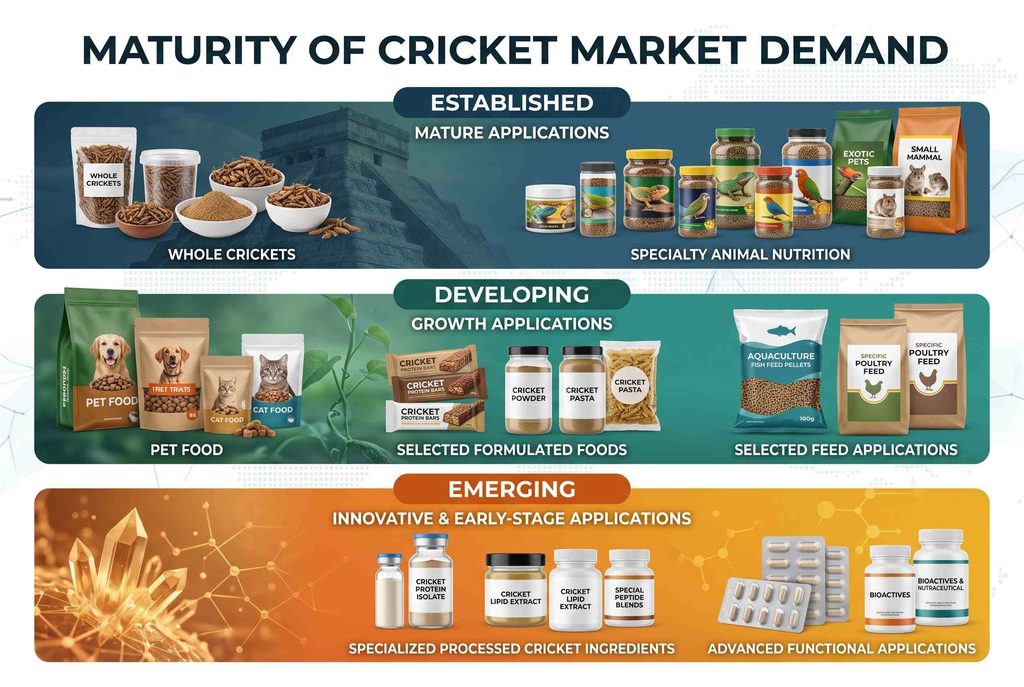
15. Market Demand Should Be Separated by Maturity
A useful way to interpret cricket demand is to separate markets according to their level of commercial maturity rather than placing every possible application into one category.
Established demand includes markets where whole crickets already have a clear commercial role, particularly specialty animal nutrition and related distribution channels.
Developing demand includes applications such as pet food, selected food products, and certain feed uses where technical validation and commercial activity exist, but adoption varies considerably by geography, price, and customer segment.
Emerging demand includes more specialized processed ingredients and applications that depend on further technical development, regulatory access, or stronger commercial economics.
This framework prevents research activity from being mistaken for market size.
16. Technical Potential Is Not the Same as Realized Demand
Cricket ingredients can be technically suitable for a wide range of applications, but the commercially addressable market is narrower.
A failure at any stage reduces the market that producers can actually serve. A technically useful ingredient without regulatory access cannot create legal demand. An authorized product that is too expensive or difficult to source consistently may still generate little repeat purchasing.
For market intelligence, recurring commercial orders provide a stronger demand signal than research interest or potential for theoretical applications.
What Could Drive the Next Stage of Cricket Demand?
Further growth is likely to depend on several variables moving together rather than one breakthrough application. Production economics need to improve enough for cricket ingredients to reach a broader range of customers, while processors need to deliver forms and specifications suited to those markets.
Food applications may benefit from better formulation and ingredient functionality, while feed markets require a stronger relationship between price, nutritional performance, and supply scale. Pet and specialty-animal markets can continue to meet demand when differentiated products deliver higher value.
Regulatory clarity also matters. When buyers understand which species, product forms, and applications are permitted, they can evaluate ingredients with less uncertainty. Commercial adoption then depends on whether suppliers can combine compliance with competitive economics and reliable supply.
IIR Analysis
Commercial cricket market demand is best understood as a portfolio of markets at different stages of development rather than a single rapidly expanding category.
Specialty animal nutrition provides one of the clearest established channels because whole crickets already match the feeding behavior and product format expected in those markets. Pet food and selected formulated products present a different opportunity in which crickets serve as ingredients rather than as recognizable whole insects.
Human food deserves separate attention. The existence of authorized Acheta domesticus forms and defined food applications in the European Union demonstrates genuine regulatory access, while research supports multiple nutritional and technological uses. Neither point, by itself, establishes mass-market consumer demand.
Feed applications offer much larger theoretical volumes but also face stronger economic competition. Their development will depend on whether cricket ingredients can achieve a viable combination of nutritional performance, consistent supply, and price.
For IIR, the most useful demand signal is not the number of applications in which crickets could theoretically be used. It is the number of markets in which regulatory access, buyer requirements, product economics, and reliable supply align strongly enough to generate recurring commercial purchases.
Disclaimer: This article is for informational purposes only and does not constitute business, legal or investment advice. Always consult primary sources and qualified professionals.