Independent intelligence for the global insect industryISSUE 01 · 2026
BSFL Oil Specifications: What Commercial Buyers Should Compare
By IIR Editorial DeskOctober 11, 2026
BSFL oil specifications vary by extraction method, refining level and production batch. This guide explains how commercial buyers compare fatty acid profiles, oxidation indicators, impurities, COAs and supplier quotations.
This buyer’s guide examines how commercial buyers compare BSFL oil specifications, from fatty acid composition and oxidation indicators to impurities, laboratory testing, batch consistency and purchasing terms.
By IIR Editorial Desk · October 11, 2026 · Market Intelligence
BSFL oil specifications are essential for commercial buyers evaluating black soldier fly larvae (Hermetia illucens) oil for aquafeed, poultry feed, pet food, and other permitted applications. Although suppliers may describe their products using similar terms, actual oil characteristics can differ according to larval production, extraction technology, refining level, storage conditions, and quality-control practices.
For procurement teams, comparing BSFL oil requires more than checking lauric acid content or the quoted price per metric ton. Buyers need to understand fatty acid composition, hydrolytic deterioration, oxidation indicators, moisture, impurities, and the reliability of batch-specific documentation. A commercially suitable oil must meet the intended formulation requirements while remaining consistent, safe, and economically competitive across recurring shipments.
Black soldier fly larvae oil is not a single uniform commodity. Its composition can vary with larval diet, harvesting conditions, and processing methods, while downstream treatment influences the physical and chemical condition of the finished oil. Two suppliers may therefore offer products with similar descriptions but materially different analytical results.
The first distinction is between composition and quality. Fatty acid composition describes which fatty acids are present and their relative proportions. Quality indicators such as acid value, peroxide value, and insoluble impurities provide different information about the condition of the oil and its processing history.
Buyers should also distinguish a product specification from a typical analysis and a batch-specific Certificate of Analysis. A specification defines agreed requirements, a typical analysis describes expected characteristics, and a COA should report actual results from an identifiable batch. These documents serve different purposes and should not be treated as interchangeable.
2. Confirm the Oil Grade and Processing History
Commercial BSFL oil may be offered as crude, clarified, filtered, or refined material. Crude oil is recovered through primary extraction and may contain suspended solids, moisture, or other components that require additional treatment. Clarification and filtration remove certain impurities, while refining can involve further operations to modify the oil’s quality characteristics.
These terms do not represent universally standardized BSFL oil grades. A filtered oil from one manufacturer may have different free fatty acid content, peroxide value, or moisture level from a similarly described product supplied by another manufacturer.
Buyers should request a description of the extraction and processing methods, including whether the oil was mechanically pressed, solvent-extracted, or produced through another process. Where relevant, they should also ask about residual processing aids, refining steps, and the conditions used to protect the oil during storage.
The objective is not necessarily to purchase the most extensively refined product. It is to select an oil grade whose composition, purity, and handling characteristics meet the intended application at an appropriate cost.
3. Compare Fatty Acid Profiles and Lauric Acid
Fatty acid composition is a defining characteristic of BSFL oil. Lauric acid (C12:0) is frequently a major component, while myristic acid, palmitic acid, oleic acid, and linoleic acid can also contribute significantly to the overall profile.
However, the relative proportions are not fixed. Larval feeding conditions and extraction methods can influence the measured fatty acid composition. Published studies have reported varying lauric acid percentages, underscoring that buyers should rely on product-specific results rather than assume that all BSFL oil has the same composition.
A commercial fatty acid report should identify the analytical method, individual fatty acids, and reporting basis. Percentages expressed as a proportion of total identified fatty acids are not equivalent to the percentage of each fatty acid by total product weight.
For aquafeed and other formulated diets, the complete profile matters. A high lauric acid percentage does not establish that the oil can replace fish oil or another lipid ingredient without adjustments to essential fatty acid supply.
Fatty acid
Common designation
Why buyers compare it
Lauric acid
C12:0
A major compositional characteristic of many BSFL oils
Myristic acid
C14:0
Contributes to saturated fatty acid composition
Palmitic acid
C16:0
Relevant to energy and physical characteristics
Oleic acid
C18:1
Important monounsaturated fatty acid
Linoleic acid
C18:2
Relevant to essential fatty acid formulation
Alpha-linolenic acid
C18:3
Relevant to omega-3 composition, where present
Buyers should avoid treating a single fatty acid as a complete quality grade. The appropriate composition depends on the target species, formulation, and commercial objective.
4. Understand Acid Value and Free Fatty Acids
Acid value and free fatty acid content are commonly used to evaluate the hydrolytic condition of fats and oils. Free fatty acids can increase when triglycerides undergo hydrolysis during production, processing, or storage.
Acid value is generally reported as milligrams of potassium hydroxide required to neutralize the acids in one gram of oil, expressed as mg KOH/g. Free fatty acid content is often reported as a percentage calculated using a specified reference fatty acid, such as oleic acid or lauric acid.
These measurements are related, but their numerical values should not be compared without understanding the reporting convention. A free fatty acid percentage calculated as oleic acid cannot automatically be treated as equivalent to a percentage calculated as lauric acid.
An elevated acid value may indicate hydrolytic deterioration or insufficient refining, but interpretation depends on the oil grade and intended use. Buyers should compare results against agreed product-specific limits and consider whether the supplier can explain unusual values or changes between batches.
5. Evaluate Peroxide Value and Oxidation Stability
Peroxide value measures primary oxidation products formed during the early stages of lipid oxidation. It is commonly reported in milliequivalents of active oxygen per kilogram of oil, often written as meq O₂/kg.
The result can provide useful information about the oxidative condition of a BSFL oil batch, but it does not describe every stage of deterioration. Peroxides can break down into secondary oxidation products, meaning a low peroxide value alone does not guarantee that an oil has experienced no oxidative damage.
For oils with a history of storage or heat exposure, buyers may consider additional measurements such as anisidine value or other validated secondary oxidation indicators where technically appropriate. Sensory observations, storage history, and the complete testing record can also help interpret results.
BSFL oil may contain a substantial proportion of saturated fatty acids, which influences its oxidation behavior. Nevertheless, oxidation stability still depends on the complete fatty acid profile, processing conditions, antioxidants, packaging, and storage environment.
Commercial buyers should establish acceptable oxidation limits for the actual product and verify whether testing was performed near production, before shipment, or after an extended storage period.
6. Check Moisture, Insoluble Impurities, and Physical Properties
Moisture and volatile matter are important because unwanted water can contribute to processing and storage problems. Even relatively small amounts may affect product stability, particularly when combined with unsuitable handling conditions or residual solids.
Insoluble impurities can include fine particles remaining after extraction or clarification. Their presence may indicate the need for additional filtration or differences in processing efficiency. Buyers should request the relevant analytical method and a defined maximum limit when these characteristics matter to downstream manufacturing.
Color and odor are useful supplementary indicators, but neither should be treated as a universal quality ranking. Crude BSFL oil may naturally appear darker than more extensively processed material. Unexpected discoloration, rancid odor, or visible sediment should nevertheless prompt further investigation.
Melting behavior and viscosity also deserve attention. Depending on composition and temperature, BSFL oil may become cloudy, partially solid, or more difficult to pump. Commercial specifications should address handling conditions where these characteristics could affect unloading, storage or blending.
7. Review Contaminants and Feed Safety Requirements
Commercial oil safety depends partly on the quality of the larvae and the materials used during rearing. The production substrate, harvesting practices, extraction method, and subsequent handling can influence which chemical or physical hazards require attention.
Relevant risks may include certain pesticide residues, persistent organic contaminants, processing-related residues, or other substances identified through a product-specific assessment. Heavy metals may also warrant consideration, although their transfer into the extracted oil fraction should not be assumed to match their concentration in whole larvae or meal.
The testing program should reflect the actual manufacturing process, intended animal species, and destination market. Buyers should request evidence that relevant hazards have been assessed and that applicable limits are met.
Regulatory requirements for insect-derived oils may differ from those for insect meal or processed animal protein. A supplier’s authorization to manufacture or export one product category does not automatically establish eligibility for every other product or application.
8. Understand Testing Methods and Reporting Units
A numerical specification has limited value unless the analytical method and reporting units are clear. Two laboratories may use different methods, sample preparation procedures or reporting conventions, making direct comparison difficult without additional information.
For example, acid value may be reported in mg KOH/g, while free fatty acid content may be expressed as a percentage calculated using a named fatty acid. Peroxide value is commonly expressed in meq O₂/kg, while fatty acid composition may be reported as a percentage of total identified fatty acids.
Commercial buyers can refer to recognized fats-and-oils analytical methods when establishing testing requirements. Methods such as ISO 660 for acid value and ISO 3960 for peroxide value provide established approaches, but their use alone does not create a BSFL oil-specific regulatory specification.
The laboratory report should identify the method used, the units, the sample identity, and the testing date. Where critical purchasing decisions depend on a narrow acceptance range, buyers should also consider laboratory competence, measurement uncertainty, and representative sampling.
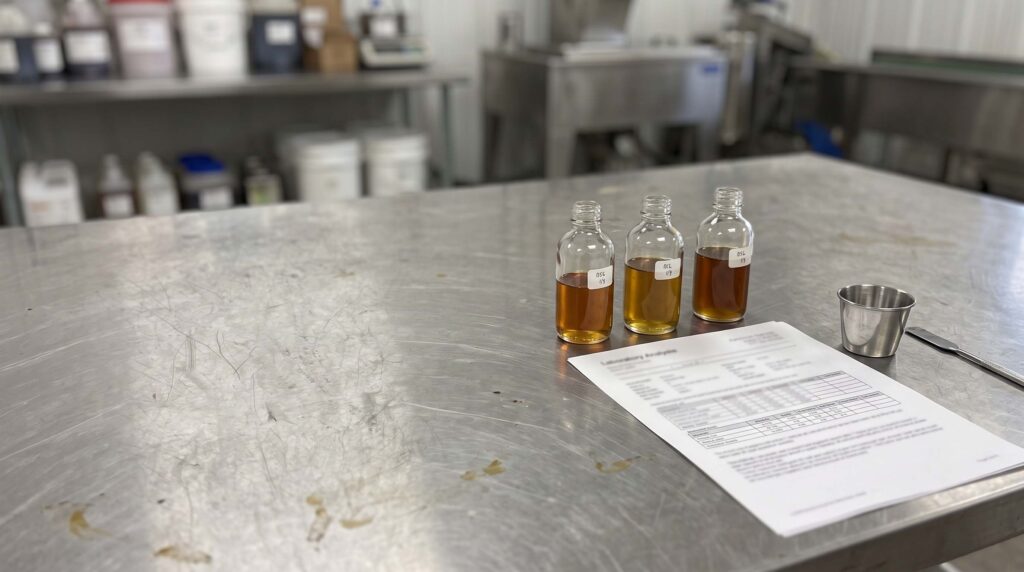
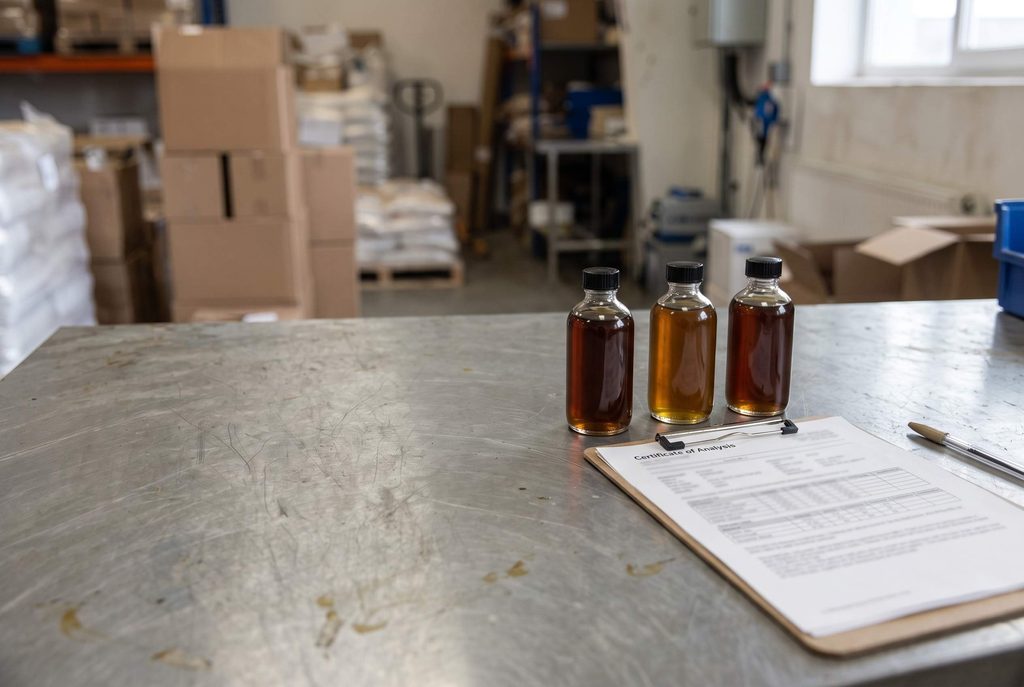
9. Read the BSFL Oil Certificate of Analysis
A Certificate of Analysis is a central document in BSFL oil procurement. It should connect measured results to an identifiable product batch and provide sufficient information for the buyer to evaluate the agreed specifications.
A useful COA typically includes the product name, batch number, testing date, relevant analytical parameters, measured values, units, and testing methods. Depending on the purchasing agreement, it may also include laboratory identification, sample information, and applicable acceptance limits.
Buyers should confirm that the COA corresponds to the material being shipped. A general specification sheet or an older laboratory report from a different batch does not establish the actual quality of the current shipment.
When a parameter is reported as below a detection or quantification limit, the report should identify the relevant threshold where necessary. Buyers should also distinguish a test result from a supplier declaration of conformity, as the two provide different forms of evidence.
For higher-value or recurring purchases, independent testing and retained samples may help resolve disputes or verify consistency. These measures should complement supplier quality systems rather than replace them.
10. Compare Commercial Quotations on an Equivalent Basis
BSFL oil quotations should be evaluated only after the products have been aligned by grade, composition, quality, and delivery requirements. A low-priced crude oil may require additional filtration or refining, while a higher-priced processed oil may offer characteristics that reduce downstream handling.
Fatty acid composition can also affect the ingredient’s value in a feed formulation. Two oils with similar per-metric-ton prices may have different nutritional profiles, especially when the buyer requires a specific balance of saturated and unsaturated fatty acids.
Commercial terms should be reviewed alongside laboratory data. Packaging format, minimum order quantity, shelf life, shipping conditions, Incoterms, payment terms, and destination can all affect the delivered cost.
The most useful comparison is therefore not simply price per metric ton. Buyers should evaluate the delivered cost of an oil that meets the required specifications and can be used reliably in the intended manufacturing process.
11. Evaluate Batch Consistency and Supplier Reliability
An acceptable laboratory sample does not demonstrate that a supplier can maintain consistent BSFL oil specifications over time. Commercial qualification should include evidence from multiple production batches, particularly for parameters that may vary with larval diet, processing, or storage.
Buyers can request recent COAs to review fatty acid profiles, acid value, peroxide value, moisture, and other agreed characteristics. Some variation is expected in biologically derived ingredients, but the results should remain within defined purchasing limits.
Supplier evaluation should also address traceability, processing controls, storage procedures, corrective actions, and the handling of nonconforming batches. The ability to investigate deviations is particularly important when an ingredient is used in tightly controlled feed formulations.
For international procurement, repeatability can be as important as the result from the initial sample. A supplier capable of providing stable specifications, reliable documentation, and predictable delivery is generally easier to integrate into recurring commercial purchasing.
12. Commercial Buyer Checklist
Before approving a BSFL oil supplier, buyers should verify the product’s identity, composition, quality, safety, and commercial suitability.
Procurement parameter
What to compare
Product identity
Hermetia illucens origin and oil product description
Oil grade
Crude, clarified, filtered or refined
Extraction method
Mechanical, solvent-based or other processing route
Fatty acid profile
Individual fatty acids and reporting basis
Lauric acid
Batch-specific C12:0 result
Acid value
Measured value, method and mg KOH/g unit
Free fatty acids
Percentage and reference fatty acid
Peroxide value
Result, method and meq O₂/kg unit
Secondary oxidation
Additional indicators were required
Moisture and volatile matter
Measured value and acceptance limit
Insoluble impurities
Residual solids and filtration quality
Color and odor
Product-grade consistency and deterioration signs
Melting and viscosity
Suitability for storage, pumping and blending
Contaminants
Risk-based testing and applicable limits
COA
Actual batch results and laboratory details
Shelf life
Supporting evidence and storage conditions
Regulatory eligibility
Destination market and intended use
Commercial terms
Quantity, packaging, Incoterms and delivered cost
Supplier consistency
Multiple batches and quality-system evidence
A purchasing decision should consider the combined results rather than a single attractive specification. High lauric acid content, low acid value or a favorable price may each be useful, but none independently establishes that the oil is the best choice.
IIR Analysis
The central challenge in comparing BSFL oil specifications is distinguishing the oil’s nutritional identity from its actual quality and commercial suitability. Fatty acid composition determines part of its formulation value, while acid value, oxidation indicators, moisture, and impurities provide information about the condition of the delivered ingredient.
For commercial buyers, a reliable comparison requires three levels of assessment: product-grade identification, standardized analytical evaluation, and repeatable supplier performance. These levels address different procurement risks and should be evaluated together.
As BSFL oil develops as a commercial lipid ingredient, buyers will need clearer product definitions, more consistent reporting, and stronger batch-level documentation. The most competitive suppliers will not necessarily be those offering the highest lauric acid percentage or lowest initial price, but those able to provide the required composition, verified quality, and dependable commercial supply.
Disclaimer: This article is for informational purposes only and does not constitute business, legal or investment advice. Always consult primary sources and qualified professionals.