Independent intelligence for the global insect industryISSUE 01 · 2026
BSFL Meal Specifications: What Commercial Buyers Should Compare
By IIR Editorial DeskOctober 9, 2026
BSFL meal specifications vary by processing method, product grade and supplier. This buyer's guide explains how to compare nutritional values, COAs, safety testing and commercial quotations before placing an order.
This buyer’s guide explains how to compare BSFL meal specifications across suppliers, including protein testing, fat levels, mineral composition, contaminants, batch documentation and the commercial factors that determine purchasing value.
By IIR Editorial Desk · October 9, 2026 · Buyer Guides
BSFL meal specifications are essential for commercial buyers evaluating black soldier fly larvae meal for aquafeed, poultry feed, pet food, and other permitted animal-nutrition applications. Two products described as BSFL meal can differ significantly in crude protein, fat, moisture, ash, amino acid composition, and processing history, even when suppliers use similar marketing descriptions.
For procurement teams, the objective is not simply to identify the highest protein percentage or lowest price per metric ton. A reliable comparison requires equivalent analytical methods, clear product definitions, batch-specific quality data, and confirmation that the ingredient meets the intended market’s requirements. Understanding these differences helps buyers reduce purchasing risk and evaluate the actual value of competing offers.
1. Why BSFL Meal Specifications Need Careful Comparison
Black soldier fly larvae meal is not a single uniform ingredient. Its composition depends on larval production conditions, harvesting stage, drying, oil extraction, and subsequent processing. These variables can produce meaningful differences between suppliers and between product grades from the same manufacturer.
Commercial buyers may receive quotations for a full-fat meal, a partially defatted meal, or a defatted meal under similar product names. Comparing these offers solely by crude protein content can be misleading because fat content, minerals, amino acid availability, and processing costs also influence the formulation’s value.
A specification sheet should therefore describe the actual product being offered, while a Certificate of Analysis should report results for an identifiable production batch. Buyers should distinguish typical values, contractual limits, and actual test results rather than treating them as interchangeable evidence.
2. Confirm the Product Grade Before Reviewing the Numbers
The first purchasing question is whether the supplier offers full-fat, partially defatted or defatted BSFL meal. Full-fat meal retains much of the original larval lipid fraction, while defatted grades undergo additional oil removal. These products may serve different nutritional and commercial objectives.
Oil extraction generally increases the relative concentration of nonfat components, including protein, when compared on a consistent moisture basis. However, the final composition depends on the extraction process, original biomass, and manufacturing losses. A higher reported protein percentage does not automatically mean that the product has superior nutritional value.
Buyers should request the scientific species name, product form, processing description, and residual fat specification. If a supplier describes a product as defatted, the actual crude fat result and agreed specification range are more informative than the label alone.
3. Compare Crude Protein on the Same Analytical Basis
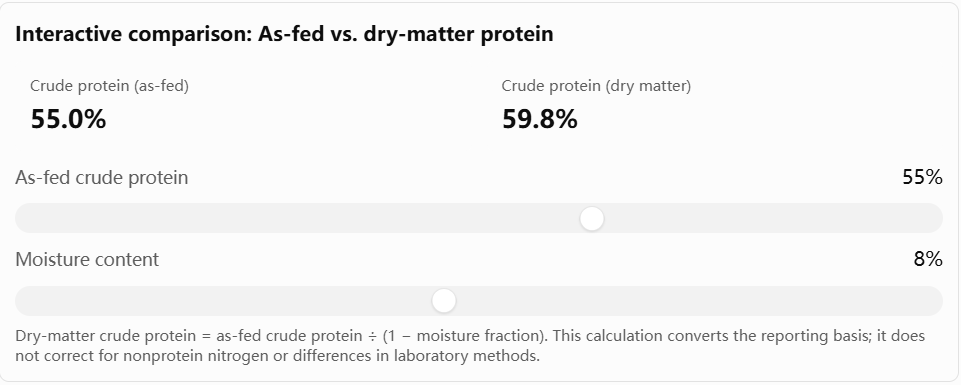
Crude protein is one of the most frequently compared BSFL meal specifications, but the reported percentage requires careful interpretation. Protein values may be presented on an as-fed basis or a dry-matter basis, and these figures cannot be compared directly without accounting for moisture.
For example, a meal containing 55% crude protein and 8% moisture on an as-fed basis has a calculated dry-matter crude protein concentration of approximately 59.8%. Another supplier reporting 60% on a dry-matter basis may therefore be offering a product with a very similar protein concentration.
Crude protein is also commonly estimated from total nitrogen using a conversion factor. Insect-derived materials contain nonprotein nitrogen, including nitrogen associated with chitin, so different analytical approaches or conversion factors can affect reported values. Buyers should request the test method and calculation basis, particularly when comparing suppliers claiming unusually high protein concentrations.
4. Evaluate Fat Content and Defatting Level
Crude fat is particularly important because BSFL meal can vary substantially according to the degree of oil extraction. Full-fat meal contributes both protein and energy, while defatted meal generally provides a different protein-to-fat balance.
The preferred grade depends on the formulation. A feed manufacturer seeking additional energy may evaluate full-fat meal differently from a buyer prioritizing a concentrated protein ingredient. The fatty acid profile, storage stability, and processing characteristics may also affect purchasing decisions.
Commercial comparisons should include both crude protein and crude fat, together with the reporting basis and relevant analytical methods. Buyers should avoid comparing the price of full-fat and defatted products as though they deliver identical nutritional functions.
5. Check Moisture, Ash, and Mineral Composition
Moisture affects product stability, shipping weight, and the concentration of other nutrients on an as-fed basis. A lower moisture result can be advantageous for storage and transportation, but the appropriate limit depends on the product, packaging, processing controls, and validated shelf life.
Ash represents total mineral residue after combustion and is another important parameter for BSFL meal. Black soldier fly larvae can contain substantial mineral fractions, particularly calcium, making ash content relevant to feed formulation. A high ash result is not automatically evidence of contamination, but it may affect the ingredient’s nutritional value and suitability.
Calcium and phosphorus should be reviewed individually when mineral balance matters. Two meals with similar protein content can require different formulation adjustments if their mineral profiles differ. Buyers should request actual analytical results rather than assuming that all BSFL meal grades have comparable mineral composition.
6. Review Amino Acids and Nutritional Performance
Crude protein indicates nitrogen-based concentration, but it does not fully describe the nutritional value of BSFL meal. Essential amino acid composition and digestibility are important when evaluating the ingredient for fish, poultry, or other animals.
Feed formulators may need values for lysine, methionine, threonine, and other relevant amino acids, depending on the target species. The amino acid profile should be interpreted alongside the ingredient’s processing history and the nutritional requirements of the complete diet.
Published feeding studies can provide useful context, but digestibility and performance results from one BSFL meal should not automatically be assigned to another product. Differences in fat extraction, heat treatment, and composition may influence nutritional outcomes. For substantial commercial purchases, buyers may need product-specific analytical data or additional validation.
7. Examine Microbiological and Contaminant Testing
Safety testing is a central part of commercial BSFL meal procurement. The relevant testing program depends on the intended animal species, destination market, production substrate, manufacturing process, and applicable feed regulations.
Microbiological evaluation may include Salmonella and other indicators or organisms specified by the buyer or regulatory framework. Chemical testing may cover relevant heavy metals, pesticide residues, or other contaminants identified through the supplier’s risk assessment. Not every possible test is required for every product, and acceptable limits should be determined from the applicable requirements rather than copied from unrelated ingredients.
Buyers should also examine whether the supplier uses controlled rearing substrates and validated processing methods. A satisfactory test result from one shipment is useful, but it does not replace ongoing process controls, supplier qualification or batch traceability.
8. Understand Chitin, Fiber, and Particle Size
Chitin is a structural component of insect exoskeletons and can affect the interpretation of insect-meal composition. Analytical methods used for crude fiber or related fractions may not capture chitin in the same way, making direct comparisons between supplier reports potentially difficult.
Buyers should clarify which method was used when fiber or chitin values are commercially important. These parameters can be relevant to nutritional evaluation, but they should not be interpreted in isolation from digestibility and the overall feed formulation.
Particle size is another practical specification. Milling and screening determine how BSFL meal behaves during handling, mixing, and feed manufacturing. Different production processes may require different particle-size distributions, so buyers should confirm the actual requirement rather than assuming that finer material is always preferable.
9. Read the Certificate of Analysis Correctly
A Certificate of Analysis provides measured information about a product batch, but buyers need to distinguish it from a general product specification sheet. The specification defines expected or contractual requirements, while the COA should report actual results for an identifiable sample or batch.
A useful COA normally identifies the product, batch or lot, sampling or testing date, reported parameters, units, and relevant analytical methods. Buyers should also determine whether testing was performed internally or by an independent laboratory, and whether the laboratory’s accreditation covers the methods used.
Results must be interpreted according to their reporting basis. A value stated as a maximum specification is not the same as a measured result, and a typical nutritional value is not evidence that the current shipment meets that value. For critical parameters, buyers should confirm the agreed acceptance criteria before shipment.
10. Compare Supplier Quotations on an Equivalent Basis
Commercial BSFL meal quotations should be compared only after the product grades and quality requirements have been aligned. Price differences may reflect fat content, protein concentration, processing technology, production scale, testing requirements, packaging, and delivery terms.
A quotation for one metric ton of full-fat meal is not directly equivalent to a quotation for one metric ton of defatted meal. Buyers may need to compare the delivered cost of usable protein, energy, or digestible amino acids, depending on the ingredient’s role in the formulation.
Incoterms, shipment quantity, packaging, payment terms, and destination can further change the effective purchasing cost. A low ex-factory price may become less competitive after logistics, import charges, quality testing, or additional handling are included. Commercial evaluation should therefore consider the complete delivered ingredient rather than the quoted unit price alone.
11. Verify Batch Consistency and Supplier Capability
A supplier may provide an acceptable evaluation sample without demonstrating the ability to reproduce the same specifications across recurring shipments. Commercial qualification should therefore consider production capacity, process controls, and historical batch consistency.
Buyers can request recent COAs from multiple production batches, together with information about manufacturing processes, quality management, and traceability. Where practical, retained samples and independent testing can help resolve discrepancies between supplier claims and delivered material.
The objective is to establish whether the supplier can consistently deliver the agreed product, not simply whether one batch achieved an attractive analytical result. For manufacturers relying on repeatable feed formulations, predictable specifications can be more valuable than an isolated high-protein result.
12. Commercial Buyer Checklist
Before approving a BSFL meal supplier, commercial buyers should confirm that the product is correctly identified, that analytical values are comparable, and that the proposed supply meets the intended application’s requirements.
Procurement item
What to verify
Species and product identity
Hermetia illucens, product form and processing history
Product grade
Full-fat, partially defatted or defatted
Crude protein
Result, reporting basis, method, and conversion factor
Crude fat
Measured content and agreed specification
Moisture
Actual result and maximum acceptance limit
Ash and minerals
Ash, calcium, phosphorus and relevant mineral values
Amino acids
Product-specific profile where formulation requires it
Chitin or fiber
Test method and interpretation
Microbiological quality
Relevant organisms, limits and test results
Chemical contaminants
Applicable limits and risk-based testing
Particle size
Suitability for the intended manufacturing process
COA and traceability
Batch identification, sampling and laboratory information
Regulatory eligibility
Intended animal, product grade and destination market
Commercial terms
Quantity, packaging, Incoterms and delivered cost
Supply consistency
Multiple batches, repeat capacity and quality controls
No single specification should determine the purchasing decision. A commercially suitable BSFL meal must satisfy the combined nutritional, safety, processing, regulatory, and supply requirements of the buyer.
IIR Analysis
The most common mistake in comparing BSFL meal specifications is treating crude protein percentage as a complete measure of product quality. Protein concentration is important, but it does not describe fat content, amino acid availability, mineral balance, safety, or manufacturing suitability.
A meaningful supplier comparison requires three levels of evaluation: first, confirm that the products belong to comparable grades; second, normalize analytical values and review batch-specific evidence; third, assess whether the ingredient can be delivered consistently under the required commercial and regulatory conditions.
For buyers, the strongest procurement decision is not necessarily the product with the highest advertised protein content or lowest quoted price. It is the product that meets the intended formulation requirements, provides verifiable quality data, and offers dependable value across repeated shipments.
Disclaimer: This article is for informational purposes only and does not constitute business, legal or investment advice. Always consult primary sources and qualified professionals.