A new Wageningen risk assessment finds low modeled BSE transmission risk from certain insect-rearing scenarios, while highlighting the continuing importance of feed safety controls and EU substrate restrictions.
A new risk assessment from Wageningen University & Research estimates very low BSE transmission risk under modeled insect-rearing scenarios, while highlighting the importance of feed safety controls and existing EU substrate restrictions.
By IIR Editorial Desk · October 25, 2026 · Latest Coverage
BSE risk in insect farming has been assessed in a new quantitative study by researchers at Wageningen University & Research in the Netherlands. The model estimates very low probabilities of BSE transmission back to cattle through specific yellow mealworm and black soldier fly rearing pathways under defined assumptions and existing European Union safeguards. The findings provide new evidence for feed safety discussions but do not change current EU substrate restrictions.
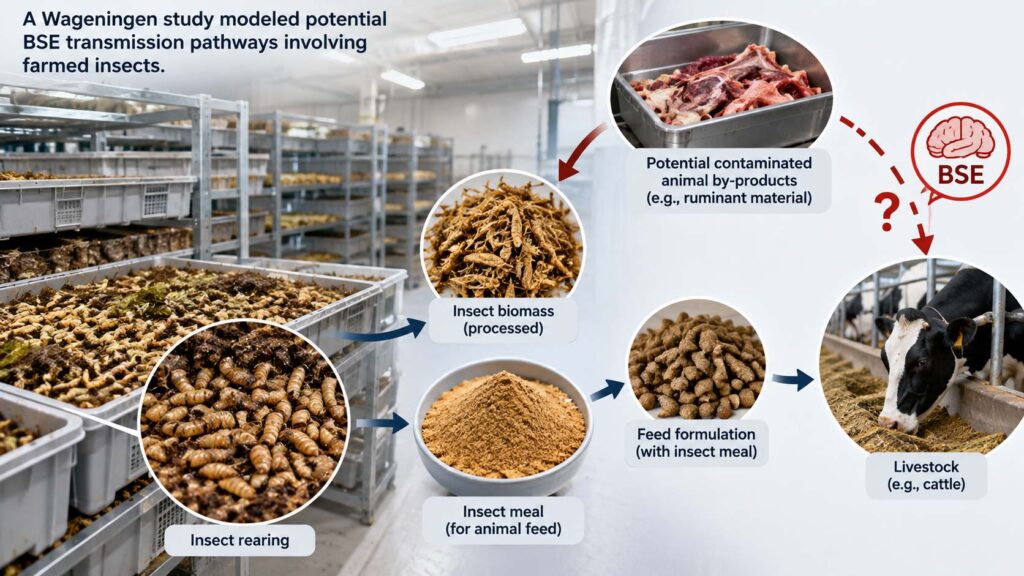
The study, published on October 23, 2026, in Frontiers in Microbiology, examined whether infectious prions associated with BSE could eventually return to cattle if yellow mealworms or black soldier fly larvae were raised on residual materials containing animal proteins. The researchers used a conservative mathematical model rather than observing new infections in an experimental cattle population.
According to the original BSE risk assessment, the estimated probabilities were low across the combinations evaluated. However, the findings do not change existing European regulations restricting the use of certain animal-derived materials and waste streams in insect farming.
How Researchers Evaluated BSE Transmission Risk
The researchers developed a quantitative risk model covering two commercially relevant insect species: yellow mealworm (Tenebrio molitor) and black soldier fly (Hermetia illucens).
The model examined three categories of residual materials: former food from supermarkets, household kitchen scraps, and category 2 meat meal from rendering operations. These materials were selected to investigate potential transmission pathways involving animal proteins, not to establish that they are legally permitted insect feedstocks.
The assessment began with a specific hypothetical event: a single BSE-infected cow escaping detection at slaughter and introducing infectious material into a residual stream. Researchers then modeled how infectivity could potentially move through insect production and related agricultural systems before reaching cattle again.
Three main exposure routes were considered: cross-contamination of cattle feed with feed containing insect ingredients, consumption of forage grown on land treated with potentially contaminated frass or manure, and an indirect route involving fishmeal used in calf milk replacer.
Because experimental data on the persistence and transfer of prions through insects remain limited, the researchers applied conservative assumptions. These included scenarios in which infectious material was not inactivated during insect rearing.
What the BSE Risk Model Found
The estimated exposure to BSE infectivity remained low across the insect species and residual material combinations examined.
The highest median exposure in the baseline model was 5.2 × 10⁻⁶ cattle oral ID50 units, associated with yellow mealworms raised on household kitchen scraps. This corresponded to a modeled probability of approximately 3.6 × 10⁻⁶ for at least one new BSE infection under the specified scenario.
Importantly, this figure is not the probability that a commercial insect product is contaminated, nor is it the annual risk of BSE infection across the European cattle population. It is a conditional model estimate based on a particular starting event and defined exposure pathways.
The research also showed that the relative importance of exposure routes varied by substrate and insect species. In most combinations, cross-contamination of ruminant feed represented the largest modeled contribution to potential exposure.
The findings support the researchers’ conclusion that insect rearing on the residual streams evaluated would be unlikely to trigger a new BSE epidemic under the assumed control conditions. Nevertheless, the outcome depends on important assumptions, including that insects do not biologically amplify infectious prions.
The study therefore provides a quantitative assessment of possible transmission pathways rather than experimental proof that every feedstock or insect-production process is safe.
Why Existing EU Feed Restrictions Still Matter
The research has particular relevance to Europe’s regulated insect-feed sector, where the materials permitted for insect rearing remain subject to animal-feed and animal-by-product rules.
European regulations prohibit various high-risk or unsuitable materials from being used as substrates for farmed insects, including catering waste, manure, and certain animal-derived proteins. These restrictions reflect a broader framework designed to prevent the transmission of animal diseases through feed production.
The new study contributes scientific evidence to this regulatory discussion, but it does not authorize insect producers to use currently prohibited substrates.
This distinction is particularly important for companies developing more circular production systems. The technical ability of larvae to consume a material does not establish that the material can legally enter the insect-feed supply chain.
For commercial producers, regulatory eligibility must therefore remain a separate consideration alongside nutritional suitability, production efficiency, cost, and material availability.
IIR Analysis: What Low BSE Risk Means for the Insect Industry
The broader significance of this research is not simply that the modeled risk was low. It is that quantitative risk assessment can help regulators and industry participants evaluate specific feedstock pathways instead of treating all residual materials as having identical risk profiles.
Feedstock availability remains a major constraint in commercial insect production. Suitable agricultural and food-processing materials must be sourced consistently, transported efficiently, and managed under appropriate quality and safety controls. These requirements affect the wider black soldier fly supply chain, particularly as producers seek to increase capacity.
From an industry perspective, BSE risk in insect farming is only one part of a broader feedstock safety assessment. Producers must also consider microbial contamination, chemical residues, traceability, substrate consistency, and the quality of finished insect ingredients. Regulatory decisions should account for these factors rather than relying on a single disease-risk assessment.
Other considerations include microbial contamination, chemical residues, traceability, inconsistent substrate composition, and the quality of finished insect ingredients. Regulatory decisions must account for these factors rather than relying on a single disease-risk assessment.
The study also highlights the commercial importance of preventing cross-contamination between feed intended for different animal species. Even when the probability of transmission is low, failures in feed segregation, transport, labeling, or handling can undermine the safety assumptions used in risk models.
For insect ingredient producers and downstream buyers, this points toward a wider principle: compliance and traceability are operational requirements, not merely administrative obligations.
IIR’s assessment is that the study strengthens the scientific discussion around alternative insect-rearing substrates, but it should not be interpreted as evidence that significant regulatory changes are imminent.
What to Watch Next
Further research will be needed to clarify how infectious prions behave during insect rearing, particularly whether and to what extent they remain associated with larvae or residual material. Better experimental evidence could help reduce uncertainty in future transmission models.
Industry stakeholders should also monitor whether European food and feed authorities initiate additional risk assessments or regulatory consultations involving alternative insect substrates.
For now, the findings represent a relevant development in the scientific assessment of insect production safety, rather than a change in the legal status of restricted feed materials.
As the insect industry continues to develop circular production models, the interaction between scientific evidence, practical feedstock management, and regulatory safeguards will remain central to commercial growth.