Independent intelligence for the global insect industryISSUE 01 · 2026
Black Soldier Fly Production Cost: Key Drivers of Commercial Economics
By IIR Editorial DeskSeptember 21, 2026
Commercial black soldier fly production connects breeding, feedstock management and larval rearing with harvesting, processing and quality control. This analysis explains how the production chain works and where scale, consistency and processing decisions matter most.
This analysis examines the main cost drivers in commercial black soldier fly production, including feedstock, labor, energy, processing, facility utilization and biological performance.
By IIR Editorial Desk · September 21, 2026 · Market Intelligence
Why Black Soldier Fly Production Cost Is Difficult to Compare
Commercial black soldier fly production cost cannot be reduced to a single industry-wide number.
The economics of a BSF facility depend on where it operates, the substrate it uses, its production scale, labor requirements, energy consumption, biological performance, processing route, and the products it ultimately sells. A 2025 review similarly identified location, substrate type, production scale, and intended product application as important variables influencing economic performance.
This makes comparisons between facilities difficult. A decentralized farm using locally available organic residues may have a very different cost structure from a highly automated European facility producing defatted protein meal and insect oil.
Even the unit being compared matters.
Cost per tonne of fresh larvae, dried larvae, full-fat meal and defatted protein meal cannot be treated as equivalent because each requires different levels of processing and loses different amounts of water or material during production.
For commercial analysis, the more useful question is therefore not:
What does BSF cost to produce?
It is:
Which parts of the production system determine cost per unit of saleable output?
Feedstock Cost Is More Than the Purchase Price
Feedstock is one of the most important economic variables in BSF farming.
At first glance, using food residues or agricultural side streams can appear inexpensive. Some materials may have low acquisition costs, and in certain waste-management models, producers may even receive value for accepting organic material.
But the delivered cost of feedstock can include collection, transport, sorting, storage, grinding, mixing, contamination control, and other preparation steps.
Feedstock quality also indirectly affects production economics.
A cheap substrate that yields slower growth, lower survival, or less harvestable biomass may ultimately result in a higher cost per kilogram of larvae than a more expensive but nutritionally consistent substrate.
This means that commercial producers must evaluate cost per unit of useful biomass produced, rather than cost per tonne of substrate.
Labor Can Become a Major Operating Cost
BSF production combines biological husbandry with material handling.
Workers or automated systems may be required for breeding, egg handling, feedstock preparation, tray management, harvesting, cleaning, processing, quality control, packaging, and facility maintenance.
The importance of labor varies substantially by production model.
Earlier life-cycle cost research on insect-feed systems in West Africa found labor and rearing-substrate procurement to be major determinants of production economics.
Highly automated facilities may reduce some repetitive labor requirements, but automation introduces its own capital expenditures, maintenance, and technical support costs.
The relevant economic question is therefore not simply whether a facility uses more or fewer employees.
It is whether labor and automation together generate sufficient throughput and consistency at an acceptable cost per unit of output.
Energy Becomes More Important During Processing
Energy use occurs throughout commercial BSF production.
Climate control, ventilation, lighting, pumps, conveyors, and other equipment can contribute to electricity demand during rearing. Processing can add another significant energy requirement.
Drying is particularly important.
Fresh larvae contain substantial moisture, while many commercial products require much lower moisture levels for storage, transport and further processing. Removing that water requires energy.
Further processing into meal and oil may involve grinding, pressing, separation and other mechanical operations.
As a result, a facility selling minimally processed larvae and one producing standardized protein ingredients can have substantially different cost structures even if their biological production performance is similar.
Energy source and efficiency therefore influence both production economics and environmental performance. Life-cycle research has found energy use to be an important contributor to the impacts of some BSF production systems.
Biological Performance Changes Unit Economics
BSF production is a biological process, so industrial economics cannot be separated from larval performance.
Growth rate, survival, development time, biomass yield, and feed conversion all influence how much saleable output can be generated from a given amount of feedstock, space, labor, and energy.
Small differences can become economically significant at commercial scale.
If larvae require more time to reach the desired harvest stage, the same rearing infrastructure may complete fewer production cycles. If biomass yield declines, fixed facility and labor costs must be distributed across less product.
This is why biological consistency can matter as much as headline production capacity.
A facility with excellent theoretical capacity but unstable biological performance may have higher unit costs than a smaller operation with more predictable throughput.
Processing Depth Changes the Cost Structure
Commercial BSF biomass can be sold in several forms.
Whole dried larvae require stabilization and drying but preserve the insect largely in its original form.
Producing full-fat meal adds milling.
Producing defatted or partially defatted protein meal and insect oil requires additional separation and processing.
Each additional stage can create commercial value, but it can also add equipment, labor, energy, maintenance, and quality-control requirements.
The relevant comparison, therefore, is not simply the cost of farming larvae.
Producers must evaluate the economics of converting larvae into a saleable product that meets customer specifications.
For this reason, production cost and processing strategy should be evaluated together rather than treated as separate issues.
Scale Can Lower Costs — but Only if Capacity Is Used
Industrial scale can create economic advantages.
Larger facilities may spread fixed costs across greater production volumes, justify automation, negotiate feedstock and logistics more efficiently, and operate specialized processing equipment at higher throughput.
But scale does not guarantee low production cost.
A large facility operating well below its design capacity still incurs depreciation, financing, maintenance, staffing, and infrastructure costs.
If a plant is designed to produce substantially more than it currently sells, fixed costs are distributed across fewer tonnes of commercial product.
Capacity utilization therefore becomes one of the most important variables in commercial economics.
This is also why announced factory size should not be interpreted as evidence of low unit production cost.
Logistics Can Change Feedstock Economics
BSF production is often discussed as a local circular-economy model, but physical logistics still matter.
Many organic feedstocks contain substantial water and can be relatively bulky compared with their economic value. Transporting them over long distances can therefore reduce the cost advantage of inexpensive substrate.
Facilities also need to consider the logistics of finished products.
Drying reduces water content and can improve storage and transportation efficiency, but this advantage comes after energy has already been used in processing.
The geographic relationship between feedstock source → production facility → customer can therefore materially influence the economics of the business.
A low-cost feedstock located far from the plant may no longer be low-cost once collection and transport are included.
Product Mix Determines How Costs Are Recovered
Production economics are determined not only by costs but also by what the facility can sell.
A BSF production system may generate revenue from protein meal, whole larvae, insect oil and frass, depending on its processing configuration and target markets.
Different products have different specifications, processing requirements and potential customer segments.
This means the economics of a facility cannot be understood simply by dividing total operating cost by total larval biomass.
The allocation of biomass to different commercial products—and the value generated by those products—can influence how effectively the facility recovers its production costs.
Frass can also provide an additional revenue stream that can be legally marketed and sold commercially.
However, potential co-product revenue should not automatically be treated as guaranteed income. Market access, product quality, regulation, and customer demand still determine whether an output has commercial value.
CAPEX and OPEX Need to Be Considered Together
BSF economics are often discussed in terms of operating expenses, but industrial production also requires capital.
Buildings, breeding systems, rearing equipment, environmental controls, automation, dryers, processing lines, laboratories, storage, and utilities can require significant upfront investment.
Those assets subsequently affect the economics of production through depreciation, financing, maintenance, and utilization.
A highly automated facility may have higher capital requirements but lower labor intensity.
A simpler facility may require less upfront investment but depend more heavily on manual operations.
Neither model is automatically cheaper.
The economically stronger configuration depends on local labor costs, energy prices, production scale, financing conditions, and operational performance.
A Practical Cost Framework for BSF Production
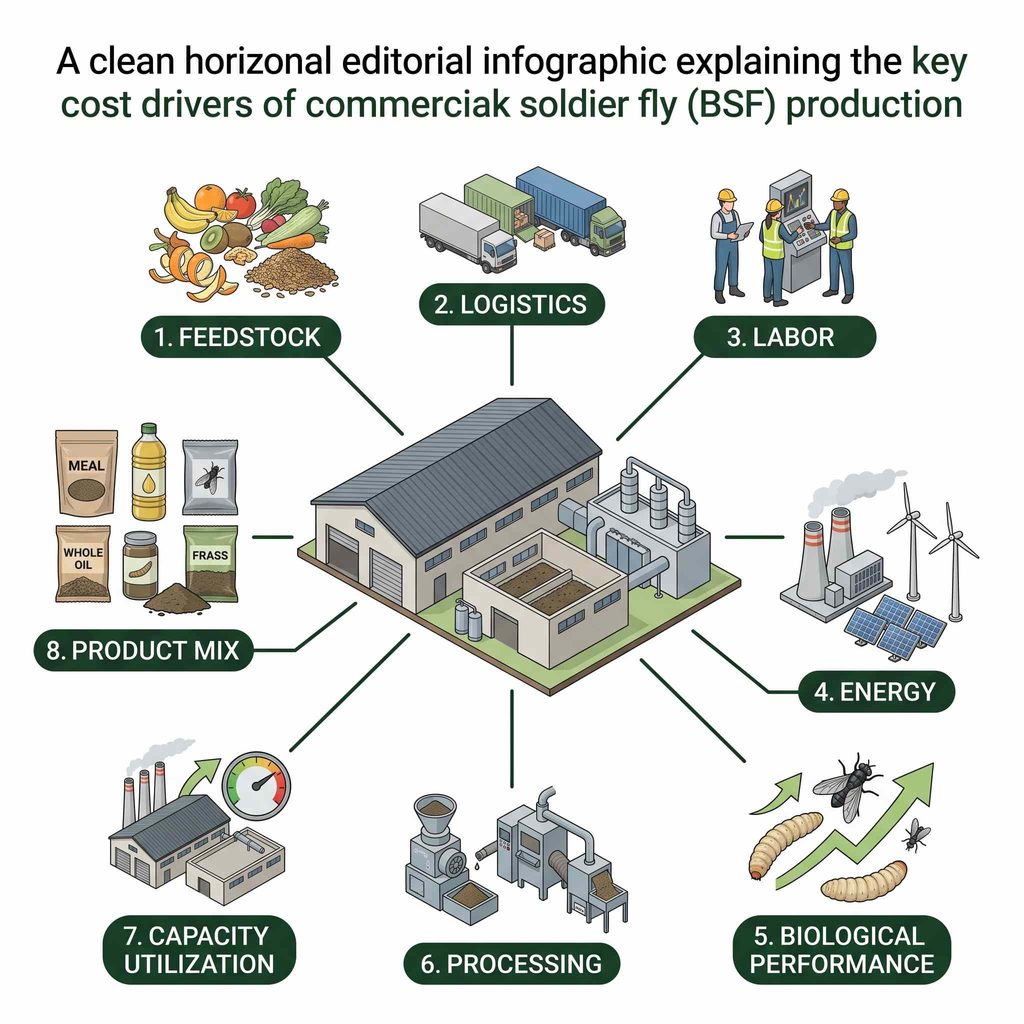
Rather than relying on a single benchmark production-cost figure, IIR considers commercial BSF economics through a set of interacting cost drivers:
Cheaper feedstock may reduce input expenditure but increase preparation requirements. Automation may reduce labor but increase capital intensity. More processing can create higher-value ingredients but also increase energy and equipment costs.
Commercial economics, therefore, depends on optimizing the entire production system rather than minimizing any single input.
IIR Analysis
The economics of black soldier fly production ultimately depend on the relationship between inputs, biological conversion, industrial utilization, and market value.
Feedstock price alone does not determine competitiveness. Neither does facility size, automation level, or announced production capacity.
A commercially efficient operation must convert available feedstock into consistent biomass, process that biomass efficiently, keep expensive infrastructure sufficiently utilized, and sell products into markets that can support the resulting cost structure.
This also explains why BSF production economics vary so widely between locations and business models.
For industry analysis, the most useful metric is therefore not simply the cost of substrate or the size of the factory.
It is the cost of producing a consistent unit of saleable commercial output.
Disclaimer: This article is for informational purposes only and does not constitute business, legal or investment advice. Always consult primary sources and qualified professionals.