A 50-day feeding trial found that defatted black soldier fly larvae meal could replace the 5% fishmeal component in juvenile Nile tilapia diets without significant differences in growth, survival, or feed efficiency.
A 50-day feeding trial found that black soldier fly larvae meal could replace the 5% fishmeal component in practical juvenile Nile tilapia diets without significant differences in growth, survival, or feed efficiency.
By IIR Editorial Desk · October 28, 2026 · Latest Coverage
Black soldier fly meal has successfully replaced the fishmeal component of a low-fishmeal Nile tilapia diet in a newly published feeding trial, with researchers reporting comparable growth, survival, blood parameters, and feed conversion across the two dietary treatments. The findings add evidence for insect-derived ingredients in practical aquaculture formulations, although the experiment covered only a limited inclusion level and a relatively short production period.
Published on October 26, 2026, in Aquaculture Science and Management, the study evaluated 100 juvenile Nile tilapia (Oreochromis niloticus) during a 50-day feeding experiment at Ege University in Izmir, Turkey. The researchers compared a control diet containing 5% fishmeal with an experimental diet in which that entire 5% component was replaced with commercially sourced, defatted black soldier fly larvae meal.
According to the original tilapia feeding study, the two diets were designed with comparable protein and lipid contents. The experiment was intended to test whether black soldier fly larvae meal could remove the remaining fishmeal fraction from a predominantly plant-based formulation without compromising measured biological or economic performance.
How Black Soldier Fly Meal Was Tested in Tilapia Diets
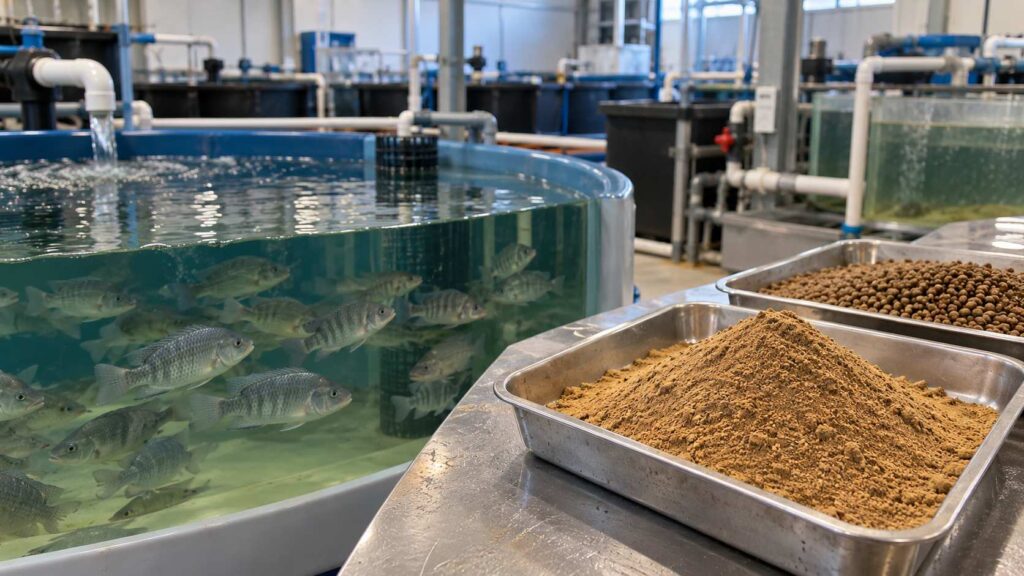
The fish were distributed across six recirculating tanks, with three replicate tanks assigned to each dietary treatment. Average initial body weight was approximately 15.22 grams, and researchers monitored fish growth, feed utilization, survival, and selected blood parameters during the experiment.
Both diets contained approximately 40% crude protein and 6% crude lipid on a dry-matter basis. Ingredients included plant protein sources, other feed materials, oils, and vitamin-mineral supplements. Fishmeal or black soldier fly larvae meal represented just 5% of the complete formulation.
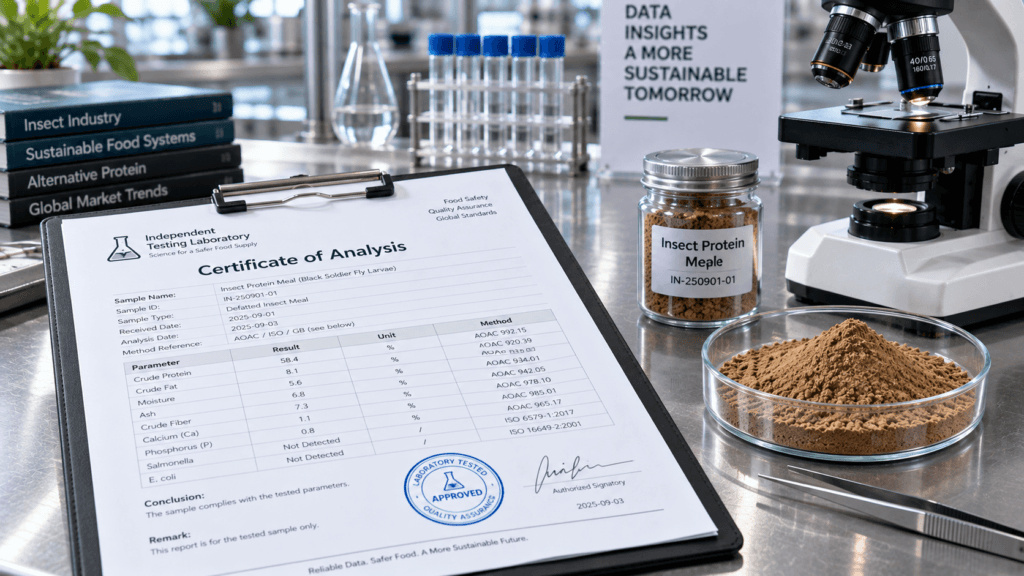
The insect ingredient was a defatted meal obtained from a commercial supplier. Its reported composition included 55.08% crude protein and 7.52% crude lipid, making it different from whole dried larvae or full-fat insect meal.
The distinction between replacement rate and dietary inclusion rate is essential. Researchers achieved 100% replacement of the original fishmeal ingredient because the entire 5% fishmeal portion was removed. The finished experimental diet contained 5% insect meal, not 100% insect meal.
This study therefore does not demonstrate that black soldier fly meal can replace any quantity of fishmeal in every aquaculture formulation. It specifically tests a low-inclusion substitution in juvenile Nile tilapia.
Growth, Survival, and Feed Costs Remained Comparable
At the end of the experiment, fish receiving the fishmeal diet had a mean final body weight of 43.04 grams, compared with 45.92 grams for fish receiving the black soldier fly meal diet.
Feed conversion ratios were almost identical, at 1.018 for the fishmeal treatment and 1.020 for the insect-meal treatment. Survival was 97.81% and 98.88%, respectively.
The differences in these measured outcomes were not statistically significant. Researchers also found no significant treatment-related variation in the blood parameters examined, including red and white blood cell measures and several related hematological indices.
The economic comparison showed similarly narrow differences. The control feed cost approximately $0.81 per kilogram, while the insect-meal formulation cost $0.82 per kilogram. The modeled feed cost per kilogram of fish produced was $0.824 and $0.836, respectively.
These results indicate that the specific substitution was feasible under the trial conditions. They do not prove that insect meal is consistently cheaper than fishmeal in commercial markets, where ingredient prices, supply volumes, processing methods, and freight costs can vary significantly.
The study also did not examine a complete commercial grow-out cycle or provide detailed long-term health outcomes.
Fishmeal remains an important but potentially costly ingredient in aquaculture, encouraging feed manufacturers to evaluate alternatives that maintain nutritional performance and supply reliability.
For omnivorous species such as Nile tilapia, modern feed formulations can contain relatively low levels of fishmeal, with other protein ingredients providing much of the diet’s nutritional content. Removing a small residual fishmeal component may therefore be a practical formulation objective.
The new research contributes to that question by examining a direct replacement at equal inclusion levels rather than comparing diets dominated by marine ingredients.
However, commercial adoption depends on more than average growth performance. Feed producers must also evaluate ingredient consistency, amino acid balance, digestibility, processing quality, contaminant control, and the ability of suppliers to deliver specification-compliant batches.
The biological and commercial results may also differ with insect species, larval substrate, fat content, fish age, and feeding conditions. The findings should therefore be interpreted as evidence for a particular black soldier fly ingredient and tilapia formulation.
IIR Analysis: Commercial Limits of Fishmeal Replacement
The most useful finding for the insect industry is not the headline claim of complete fishmeal replacement. It is the demonstration that a small remaining fishmeal fraction can potentially be eliminated from a practical tilapia formulation without significant short-term performance losses.
That distinction matters commercially. Replacing 5% of a complete feed formulation may be easier to implement than introducing insect meal as a major protein source, particularly when manufacturers already rely heavily on plant-based ingredients.
The reported cost difference was only $0.01 per kilogram of finished feed. At large manufacturing volumes, even small differences can influence procurement decisions, but the calculation cannot be separated from ingredient availability, product consistency, and regional market prices.
From IIR’s assessment, the key question is whether black soldier fly meal suppliers can deliver a consistently specified ingredient at a commercially acceptable cost. Those requirements connect aquafeed formulation with the wider black soldier fly supply chain, including rearing, processing, quality control, and distribution.
The experiment used one defatted commercial ingredient and one inclusion level. That limits conclusions about full-fat insect meal, alternative processing methods, different production batches, and higher substitution levels.
It also illustrates why scientific findings should not be converted directly into marketing claims. Comparable short-term performance in one trial supports further evaluation, but it does not establish universal nutritional equivalence or long-term cost savings.
For feed manufacturers, a logical next step would be to compare multiple commercial insect-meal batches under practical farm conditions, including variations in ingredient pricing and product quality.
What to Watch Next
Further trials should investigate whether comparable performance continues through longer grow-out periods and under different aquaculture conditions.
Research into intestinal health, immune responses, fillet composition, sensory quality, and fish performance under disease or environmental stress would strengthen the evidence for broader adoption.
Additional economic comparisons should also account for current local ingredient prices, transport, processing methods, and the stability of insect-meal supply.
For the insect protein industry, the findings provide another example of how black soldier fly meal may enter commercial aquafeed formulations at carefully defined inclusion levels.
The longer-term opportunity will depend on moving from successful controlled trials toward repeatable, economical supply arrangements that meet the operational requirements of feed manufacturers.