A study in Frontiers in Microbiology finds that fiber-rich wheat bran and starch-rich cassava support different gut bacterial communities in black soldier fly larvae, highlighting feedstock-related changes that require further commercial validation.
A study comparing wheat bran and cassava diets finds that feed composition influences bacterial diversity and distribution within black soldier fly larvae, offering new evidence for understanding substrate–microbiome interactions in insect production.
By IIR Editorial Desk · November 11, 2026 · Latest Coverage
The black soldier fly gut microbiome responds differently to fiber-rich and starch-rich diets, according to research published in Frontiers in Microbiology. Scientists comparing larvae raised on wheat bran and cassava found distinct patterns in bacterial diversity, dominant microbial groups, and the distribution of microorganisms across the digestive tract. The results suggest that feedstock characteristics play an important role in shaping the microbial communities associated with organic material processing, although the study does not directly demonstrate improvements in industrial insect production.
The research published in Frontiers in Microbiology on October 29, 2026, was conducted by researchers affiliated with the Chinese Academy of Tropical Agricultural Sciences and Universiti Malaya. Using bacterial 16S rRNA gene sequencing, the team investigated how different dietary substrates influence the composition, development, and spatial organization of gut microorganisms in black soldier fly larvae (Hermetia illucens). The study provides additional microbiological evidence for an industry in which feedstock selection is closely connected to production consistency and organic waste bioconversion.
How the Black Soldier Fly Gut Microbiome Was Studied
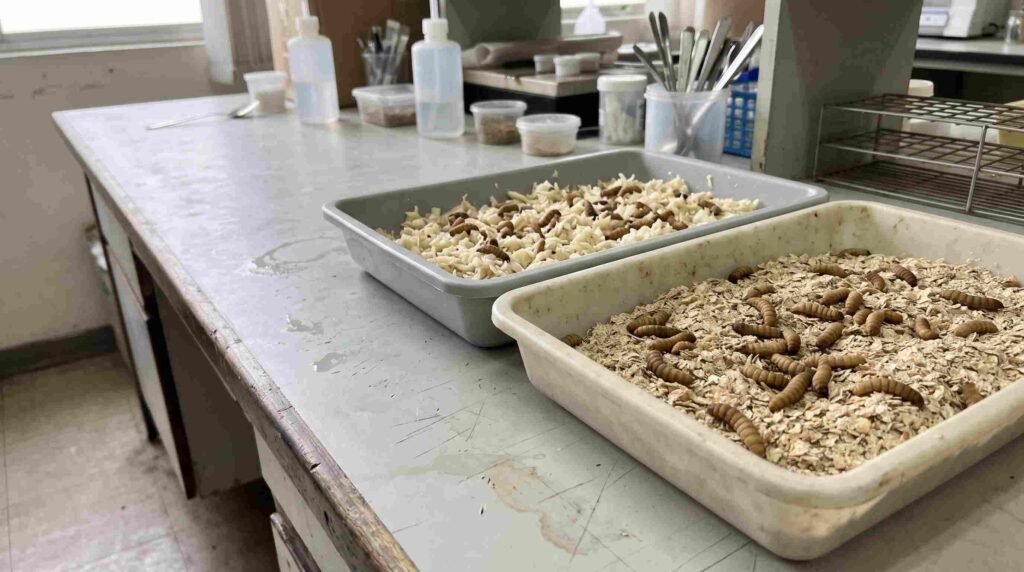
Researchers compared two rearing substrates with contrasting carbohydrate characteristics: wheat bran, which contains substantial structural fiber, and cassava, which is rich in starch. Following an initial three-day incubation period on wheat bran, larvae were assigned to the two dietary treatments and maintained under controlled laboratory conditions. The rearing environment was held at approximately 27°C and 70% relative humidity, with three independent biological replicates per dietary treatment. The experiment continued for 21 days, allowing the researchers to compare bacterial communities at different stages of larval development.
To examine these microbial communities, the researchers collected larval gut samples throughout the rearing period and applied 16S rRNA gene sequencing to identify bacterial groups and estimate their relative abundance. They also analyzed the foregut, midgut, and hindgut separately at the final sampling point. This approach provided information about both developmental changes and the organization of microorganisms along the digestive tract. However, the study generated microbiome data rather than direct measurements of commercial production performance, such as total harvested biomass, feed conversion efficiency, or industrial waste reduction rates.
Wheat Bran and Cassava Produced Different Bacterial Communities
The wheat bran diet supported a more diverse gut bacterial community than the cassava treatment, with significantly higher measures of microbial richness and diversity. Firmicutes accounted for approximately 52.34% of the bacterial community in the wheat bran group, while Proteobacteria represented approximately 79.27% in larvae raised on cassava. These percentages describe the relative abundance of bacterial groups identified through sequencing, not differences in growth rate, nutritional value, or the quantity of waste converted into insect biomass.
The researchers also observed contrasting changes over time. In the wheat bran group, early larval stages were more strongly associated with Proteobacteria, while Firmicutes became more prominent during later development. The cassava group maintained a greater dominance of Proteobacteria throughout the sampling period and showed less change in overall community composition. A principal coordinate analysis separated the dietary groups along an axis explaining 32.5% of the observed microbiome variation. This statistical result indicates differences in bacterial community structure; it does not mean that feed formulation improved biological performance by 32.5%.
Gut Regions Showed Different Microbial Patterns
Beyond the differences between diets, the researchers examined how bacteria were distributed across distinct regions of the larval gut. Wheat bran-fed larvae showed stronger regional differences, with bacterial groups associated with complex carbohydrate degradation distributed differently between the anterior and posterior digestive tract. Bacillaceae were more prominent in the foregut and midgut, while Lachnospiraceae were particularly important in the hindgut. The researchers interpreted this pattern as being consistent with a more differentiated microbial community involved in processing fiber-rich material.
In larvae raised on cassava, bacterial composition was more similar across the digestive tract, with members of Enterobacteriaceae prominent in multiple gut regions. This pattern is consistent with a microbial community associated with a more readily digestible starch-based substrate. However, the sequencing results primarily describe the presence and relative abundance of bacterial taxa. They do not directly measure the metabolic activity of those organisms, establish the exact contribution of individual species to digestion, or prove that a particular bacterial distribution produces higher insect yields.
What the Results Mean for Feedstock Selection
Feedstock selection is an important operational decision in black soldier fly production because agricultural by-products and food-processing residues differ in moisture, fiber, starch, protein, and other nutritional characteristics. These differences can influence larval feeding behavior and the conditions experienced by gut microorganisms. The study suggests that substrate composition should also be considered when examining the microbial communities associated with larval digestion. Nevertheless, a more diverse microbiome should not automatically be interpreted as a more efficient or desirable production system.
The findings also raise questions about microbial risk management. Some bacterial genera identified in the study include species that can act as opportunistic pathogens under certain conditions, but the presence of a genus in sequencing data does not establish that a harmful strain is present or that the finished insect ingredient is unsafe. The researchers did not conduct a comprehensive product safety assessment or demonstrate pathogen transmission to animals consuming insect-derived feed. Commercial producers therefore still need appropriate substrate controls, processing procedures, microbiological testing, and finished-product specifications when evaluating the suitability of different rearing materials.
Research Limitations and Industrial Validation
The researchers acknowledged several important limitations. The analysis used 16S rRNA sequencing, which is effective for describing bacterial community composition but provides limited evidence of the functions performed by individual microorganisms. Confirming whether particular bacterial groups contribute to improved digestion, nutrient utilization, or lipid accumulation would require additional functional analyses, including metagenomic, metatranscriptomic, or metabolic studies. The experiment also compared two nutritionally different substrates, so the observed changes should be interpreted within that specific dietary comparison rather than attributed exclusively to one isolated carbohydrate variable.
The study was conducted under controlled laboratory conditions with a limited number of biological replicates. Large industrial facilities operate with more variable feedstock inputs, different environmental conditions, and additional challenges involving substrate storage, microbial contamination, harvesting, and processing. As a result, the reported bacterial patterns cannot yet be translated into a recommended commercial feeding formula. Further work will be needed to determine whether the microbial differences remain consistent under industrial conditions and whether they are associated with measurable production or quality advantages.
IIR Analysis: What Gut Microbiome Research Means for Industrial Farming
The study reinforces a broader commercial principle: insect feedstock is not simply an inexpensive material consumed by larvae, but a variable biological input that can influence the production environment. For large-scale producers, differences in substrate composition may affect more than nutrient supply, creating changes in microbial communities that deserve further investigation. Understanding those interactions could eventually help producers evaluate feedstock combinations, biological stability, and processing consistency. However, the current findings do not demonstrate that selecting wheat bran instead of cassava would increase profitability or improve overall factory performance.
This has implications for the black soldier fly supply chain, where raw material availability, substrate quality, biological production, harvesting, and ingredient processing must function as a coordinated system. A substrate that supports a diverse bacterial community may still be commercially unattractive if it is expensive, difficult to transport, nutritionally unbalanced, or unavailable in consistent quantities. Conversely, an affordable starch-rich feedstock cannot be dismissed simply because it supports a less diverse microbiome. The meaningful commercial question is whether a legally permitted and standardized substrate supports reliable production at an acceptable total cost.
From IIR’s perspective, the next opportunity lies in connecting microbiome observations with measurable production outcomes. Future studies should compare microbial community data against larval survival, harvested biomass, substrate reduction, feed conversion, nutrient composition, and microbiological quality under controlled conditions. Such research could help establish whether particular bacterial signatures are useful indicators of production performance or whether they mainly reflect differences in the supplied feed. Until those relationships are demonstrated, gut microbiome research should be treated as an informative scientific tool rather than a validated industrial optimization method.
What to Watch Next
Future research should investigate whether the bacterial communities identified in wheat bran- and cassava-fed larvae perform distinct metabolic functions and whether those functions influence organic waste conversion. Studies involving additional agricultural residues, standardized nutrient comparisons, and functional microbial analysis would help separate the effects of carbohydrate structure from other differences between feedstocks. Testing across different larval populations and production environments would also strengthen the evidence for practical applications.
For the insect industry, the most important development will be research that translates microbial observations into reproducible operational results. If future studies establish reliable relationships between specific feedstock characteristics, microbial function, and commercial performance, microbiome analysis could become more useful in substrate evaluation and production quality management. The current study provides a basis for that work, but its findings remain focused on bacterial community structure rather than demonstrated gains in industrial efficiency.