South Korea's insect industry recorded ₩59.1 billion in sales in 2025, up 11.8% year over year. Black soldier fly sales surged 65.3%, while edible insect sales declined 15.1%, according to newly released government figures.
South Korea’s insect industry recorded ₩59.1 billion in sales in 2025, supported by rapid growth in black soldier fly production for animal feed. The latest government survey also reveals declining edible insect sales and a smaller number of registered businesses.
By IIR Editorial Desk · November 10, 2026 · Latest Coverage
The South Korea insect industry generated ₩59.1 billion (59.1 billion South Korean won) in sales during 2025, an increase of 11.8% from the previous year, according to new government figures released on November 9, 2026. Black soldier fly sales rose sharply as interest in alternative animal feed ingredients expanded, while the edible insect segment experienced a notable decline. The results highlight an increasingly differentiated market in which industrial feed applications and human food products are following different commercial trajectories.
According to the November 9 release from South Korea’s Ministry of Agriculture, Food and Rural Affairs, the latest Insect Industry Survey covered 2,760 registered farms and businesses involved in insect production, processing, and distribution. Total industry sales increased from ₩52.8 billion in 2024 to ₩59.1 billion in 2025, extending the growth recorded over the previous five years. However, the number of registered operators declined, suggesting that industry expansion is not occurring evenly across participating businesses.
South Korea Insect Industry Grows 42.8% Over Five Years
The government’s figures show that annual insect industry sales increased from ₩41.4 billion in 2020 to ₩59.1 billion in 2025, representing cumulative growth of 42.8%. During that period, sales reached ₩44.6 billion in 2021, ₩44.9 billion in 2022, ₩47.3 billion in 2023, and ₩52.8 billion in 2024. The latest results therefore continue a multi-year expansion in reported sales, although the figures do not establish how much of the increase came from higher production volumes, changes in prices, or a shift toward higher-value products.
The 2025 market was divided into four broad application categories. Edible insects remained the largest segment at ₩20.1 billion, representing 34.0% of total sales. Feed-use insects followed at ₩16.8 billion, or 28.4%, while other insect applications contributed ₩16.6 billion, or 28.1%. Pet and educational insect products accounted for the remaining ₩5.6 billion, equivalent to 9.5% of the market. These figures demonstrate that South Korea’s insect sector extends beyond protein ingredients for human consumption and includes multiple agricultural, commercial, and specialty applications.
Black Soldier Fly Sales Surge 65.3%
Black soldier fly (Hermetia illucens) was the strongest growth segment identified in the government survey. Sales increased by 65.3% to ₩16.8 billion in 2025, compared with approximately ₩10.2 billion the previous year. The number of registered black soldier fly farms also rose from 241 to 285, representing an increase of 18.3%. This combination of higher sales and more participating farms contrasts with the overall decline in registered businesses across the insect industry, indicating that the species gained commercial attention during the reporting period.
The agriculture ministry linked the expansion partly to rising international fishmeal prices and growing interest in alternative animal protein ingredients. In its announcement, the ministry cited an increase in fishmeal prices from US$1,598 to US$1,825 per metric ton, or approximately 14.2%, as a factor supporting the competitiveness of black soldier fly products. However, higher conventional protein prices alone do not establish the profitability of insect-based alternatives. Actual competitiveness also depends on insect rearing costs, processing requirements, feed formulation, ingredient specifications, and the ability to deliver reliable commercial volumes.
Edible Insect Sales Decline Despite Overall Growth
While demand for feed-use black soldier flies increased, South Korea’s edible insect segment moved in the opposite direction. Sales of insects intended for human consumption declined from ₩23.7 billion in 2024 to ₩20.1 billion in 2025, a decrease of 15.1%. Edible insects nevertheless remained the largest application category by reported sales. The contrast is significant because it demonstrates that broader insect industry growth does not necessarily translate into stronger demand for insect-based consumer foods, nutritional products, or other human consumption applications.
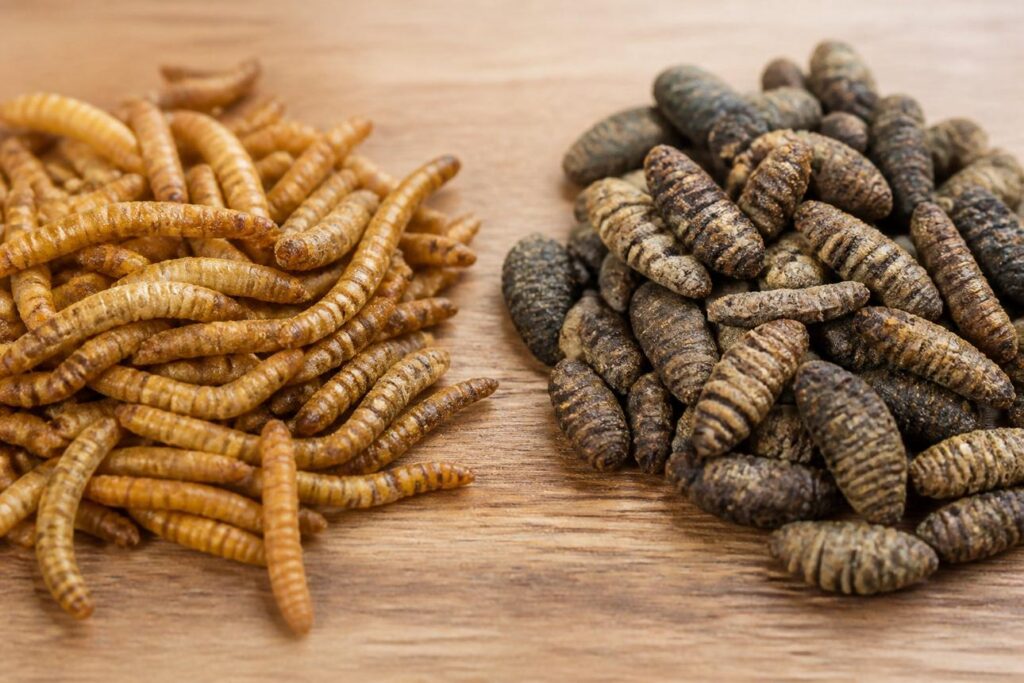
The survey also reported sales by individual insect groups, including approximately ₩10.8 billion for white-spotted flower chafers, ₩5.8 billion for yellow mealworms, and ₩3.5 billion for crickets. These figures provide additional context for the diversity of South Korea’s insect market, although they are organized by insect type rather than final application. Consequently, species-level sales figures should not be added to application-level categories as if they represented separate markets. The available summary does not provide sufficient product-level detail to determine which consumer segments, price changes, or distribution challenges contributed most to the decline in edible insect sales.
Fewer Registered Businesses, Higher Average Sales
The government reported 2,760 registered insect-related operators in 2025, compared with 2,949 in 2024, a decline of 6.4%. Despite the smaller number of registered businesses, average reported sales per operator increased from approximately ₩18 million to ₩21 million, representing growth of 16.7%. These figures indicate that total industry sales expanded faster than the registered business population, although they do not establish whether individual operators became more profitable. Average sales are a revenue measure and do not account for production costs, debt, capital investment, or differences in business size.
The combination of rising sales and fewer registered operators may reflect changes in industry participation, business specialization, or the distribution of commercial activity. However, the survey summary does not provide enough information to conclude that widespread consolidation, improved economies of scale, or sustained productivity gains have occurred. A more complete assessment would require data on closures, new business registrations, production capacity, operating expenses, and the distribution of revenue among small farms and larger processors. The registered business count should therefore be treated as an industry participation indicator rather than a direct measure of financial health.
Government Supports Functional Food and Production Capacity
South Korea is also seeking to strengthen the higher-value edible insect market through functional ingredients and expanded production infrastructure. The agriculture ministry reported that yellow mealworm larvae, marketed locally as gosoae, received recognition in September 2026 as a functional health food ingredient associated with maintaining muscle strength. This development may provide opportunities for more specialized insect-derived nutritional products, although the regulatory recognition applies to a defined ingredient and its permitted use conditions rather than automatically extending to every mealworm product.
Production infrastructure remains another government priority. The Chuncheon Insect Industry Hub Complex was completed in September 2026, with a stated maximum annual production capacity of up to 1,000 metric tons. The facility is intended to improve production infrastructure and support a more reliable supply of insect-derived ingredients. However, its designed capacity should not be confused with confirmed annual output or completed commercial sales. The ministry also plans to continue supporting facility modernization, green biotechnology commercialization, and policy financing, reflecting an effort to develop the industry beyond fragmented small-scale production.
IIR Analysis: Feed Demand and Consumer Markets Are Diverging
The most important finding in South Korea’s latest insect industry survey is the divergence between feed-oriented production and edible insect demand. The strong increase in black soldier fly sales suggests that producers are responding to identifiable commercial applications in animal nutrition, particularly where conventional protein ingredients face cost pressure. In contrast, the decline in edible insect sales shows that market acceptance and recurring consumer demand cannot be assumed simply because insects offer nutritional or functional advantages. These two markets serve different buyers, operate through different distribution channels, and face distinct requirements for pricing, quality, regulation, and product development.
This distinction is consistent with the broader commercial trends examined in IIR’s analysis of the black soldier fly industry, where growth depends on the relationship between biological production, ingredient processing, and actual downstream demand. For feed manufacturers, nutritional consistency, reliable large-volume supply, and competitive delivered costs are critical. For consumer food companies, product acceptance, brand positioning, regulatory compliance, retail distribution, and repeat purchasing become equally important. South Korea’s data provides a useful regional example of why the insect industry should not be evaluated as a single, uniform alternative-protein market.
From IIR’s perspective, the decline in registered businesses deserves as much attention as the increase in sales. Rising average revenue may indicate a shift toward more commercially active operators, but without information on margins and business-level performance, it does not demonstrate that the industry has become financially stronger. The next stage of analysis should examine whether black soldier fly growth is supported by long-term feed purchasing agreements, stable production costs, and higher utilization of existing capacity. For edible insects, the key question is whether functional ingredient development can translate into measurable consumer demand and sustainable product economics rather than isolated regulatory or manufacturing milestones.
What to Watch Next
The next annual survey will be important for determining whether black soldier fly sales growth can be sustained and whether the decline in edible insects represents a temporary adjustment or a longer-term market challenge. Future data on production volumes, product pricing, farm-level operating costs, and the distribution of sales across different business sizes would help clarify the sources of industry growth. In particular, distinguishing higher physical output from price-driven revenue growth will become increasingly valuable for producers, buyers, and investors evaluating South Korea’s insect supply chain.
Government-supported developments, including the Chuncheon production hub and the commercialization of approved functional insect ingredients, will also warrant closer observation. The strongest indicators of progress will be actual facility output, commercially viable products, recurring customer demand, and the ability of registered operators to generate sustainable returns. South Korea’s latest figures confirm growing insect industry sales, but they also show that market development remains uneven across species and applications.