A new study of black soldier flies maintained for more than 64 generations finds that close inbreeding affects feed-use efficiency and adult survival, while several reproductive measures remain relatively stable.
A new study of a long-domesticated black soldier fly population finds that close inbreeding can affect feed-use efficiency and adult survival without causing major declines in several growth and reproductive measures, highlighting the importance of genetic management in insect farming.
By IIR Editorial Desk · November 6, 2026 · Latest Coverage
Black soldier fly inbreeding may affect production efficiency and adult survival even when visible growth and reproductive performance remain relatively stable, according to a new study published in BMC Ecology and Evolution. Researchers examined a laboratory population of Hermetia illucens maintained for more than 64 generations and found that a single generation of full-sibling mating produced measurable changes in resource utilization, body weight, and adult survival patterns without causing an overall collapse in developmental or reproductive performance.
The findings add to growing interest in genetic management as commercial insect producers develop long-term breeding colonies. Industrial facilities must maintain reliable larval growth and adult reproduction across repeated production cycles, making inherited traits relevant to operational stability. In the peer-reviewed study published in BMC Ecology and Evolution on November 3, 2026, researchers Patrick Klüber and Rocio Rodriguez-Servin investigated whether additional inbreeding in an established laboratory strain would reveal production-related disadvantages that might otherwise remain difficult to detect.
How the Black Soldier Fly Inbreeding Study Worked
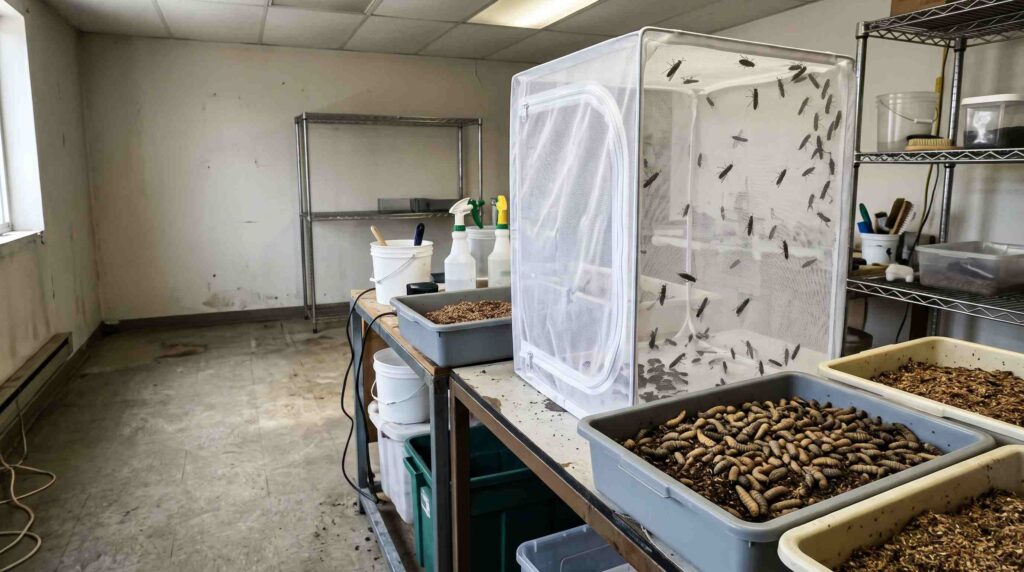
The researchers used a black soldier fly population maintained at the Fraunhofer Institute for Molecular Biology and Applied Ecology in Giessen, Germany. The original colony had been established in 2018 and subsequently kept genetically isolated for 64 generations, with approximately 4,000 adult flies maintained in each generation. This provided a long-domesticated population for evaluating whether an additional generation of close inbreeding would alter measurable biological traits. The researchers established full-sibling mating pairs and compared offspring from an inbred family with individuals collected from the existing laboratory colony under standardized rearing conditions.
The experimental inbred group originated from a single full-sibling mating pair that produced sufficient viable offspring for testing. Researchers distributed 500 larvae from that family across five containers and compared their development with control larvae raised under equivalent feeding and environmental conditions. Measurements covered larval growth, substrate reduction, feed conversion, body size, developmental timing, egg production, and adult survival. The experimental design allowed detailed observation across the life cycle, although its reliance on one inbred family limits how confidently the results can be generalized to genetically different breeding populations.
Feed Conversion Efficiency Revealed Hidden Differences
The researchers found that the two groups followed broadly similar larval growth curves, with no major developmental disruption resulting from the close mating treatment. Differences in developmental duration were generally small, typically remaining within approximately 1.2 days. However, some production-related measurements revealed more substantial changes. The inbred group showed approximately 37.2% higher substrate reduction than the control group, while the control larvae demonstrated 29.4% higher efficiency of conversion of ingested feed, or ECI. This suggests that the inbred larvae processed more substrate without converting the additional consumed material into proportionally greater biomass.
Final larval weights were also lower in the inbred group. Control larvae reached an average final weight of 217.7 milligrams, approximately 6.9% heavier than their inbred counterparts, while control adults were about 6.6% heavier overall. The inbred group also had a higher conventional feed conversion ratio, but that particular difference did not reach the study’s statistical significance threshold. These findings demonstrate why substrate reduction, feed consumption, and biomass production should be evaluated separately. Higher substrate reduction can be desirable in a waste treatment system, but it does not necessarily indicate efficient conversion into commercially valuable insect biomass.
Adult Survival Changed More Than Reproduction
Reproductive performance was relatively resilient under the experimental conditions. The researchers found no statistically significant differences between the groups in several primary measures, including the preoviposition period, timing of peak egg laying, and overall fecundity. Although some egg-laying patterns differed descriptively, those observations did not establish a broad decline in reproductive capacity. This is important because an industrial breeding colony depends on maintaining sufficient egg production to support predictable larval supply, but the stability of the measured reproductive indicators does not prove that long-term breeding performance would remain unaffected over successive generations.
Adult survival presented a more complex result. The control group had an average lifespan of 14.9 days compared with 13.8 days for the inbred group, although that difference was not statistically significant under the study’s mean-duration comparison. A separate survival-curve analysis did detect significant group differences, including shorter survival among inbred males and an earlier median lethal time among inbred females. The findings therefore indicate survival-related costs without supporting the claim that every measure of female longevity or overall reproductive fitness declined significantly. The distinction matters when translating laboratory observations into potential colony-management decisions.
Why the Findings Do Not Apply to Every Commercial Colony
The authors emphasized that their experiment evaluated one long-maintained laboratory population under controlled environmental conditions. The original colony’s genetic composition and baseline heterozygosity were not directly measured, so the exact genetic difference between the comparison groups remains uncertain. Because the inbred group originated from one family, family-specific characteristics also cannot be completely separated from the mating treatment. These limitations make the findings most useful as evidence of possible biological responses rather than as a universal prediction of performance in commercial black soldier fly facilities.
Industrial breeding populations may differ considerably in genetic diversity, population size, selective breeding history, and environmental conditions. A facility selecting flies for rapid larval development or high biomass yield may experience different pressures from a laboratory colony maintained under relatively stable conditions. The study also examined an acute inbreeding event rather than the effects of repeated close mating across many additional generations. Further research is therefore needed before specific genetic replacement schedules or production recommendations can be derived from the results.
IIR Analysis: Genetic Management and Industrial Rearing
The commercial significance of the research lies in the possibility that a colony can appear productive while less visible efficiency measures begin to change. A black soldier fly producer may observe normal egg laying and broadly stable growth, yet still experience differences in substrate utilization or harvested biomass. For large-scale facilities, relatively small biological changes can become economically important when applied across repeated production cycles. However, the current study does not calculate the financial consequences of its findings, and it would be premature to assign a specific production cost increase to inbreeding.
Genetic management should therefore be considered alongside the established operational requirements of the black soldier fly supply chain, including reliable feedstock availability, controlled rearing conditions, harvesting, quality management, and ingredient distribution. Producers may benefit from monitoring breeding population size, reproductive performance, larval weight, development time, and resource conversion trends over successive generations. These measurements can help reveal changes that require investigation, although none of them independently establishes that inbreeding is the cause of declining performance.
From IIR’s perspective, the study supports a more integrated approach to industrial insect breeding. Genetic diversity, biological productivity, and long-term operational stability should not be treated as separate issues. Future management strategies may eventually combine performance records with molecular tools capable of tracking population structure and changes in genetic variation. The immediate conclusion, however, is more limited: a long-domesticated black soldier fly strain showed resilience in several traits after a single close-mating event, while still displaying measurable physiological and survival-related disadvantages.
What to Watch Next
Future studies should compare multiple black soldier fly strains and examine repeated generations of inbreeding under both laboratory and commercial production conditions. Molecular analysis could help determine whether differences in genetic diversity correspond to changes in feed conversion, stress tolerance, survival, or reproductive performance. Evaluating these relationships across different environmental conditions would also clarify whether commercial rearing pressures amplify or reduce the effects observed in controlled experiments.
For insect producers, the most relevant developments will be studies that connect breeding management with sustained biomass yields, egg production reliability, and actual operating economics. The new research provides evidence that short-term resilience does not necessarily mean the absence of biological costs. Its long-term commercial value will depend on whether the findings can be validated across industrial breeding populations and translated into practical genetic management methods.