Finnish insect protein producer Volare has secured €7.1 million in new funding following the completion of its first industrial-scale facility, with plans to expand production capacity through a second factory.
Finnish insect protein producer Volare has secured €7.1 million in new funding after completing its first industrial-scale facility in Pori, with plans to expand production capacity through a second factory.
By IIR Editorial Desk · October 27, 2026 · Company Watch
Volare insect protein production is entering a new industrial phase following the completion of the Finnish company’s first full-scale facility and a €7.1 million funding round. The investment will support production ramp-up at Volare 01 in Pori, Finland, while helping the company prepare for a second industrial-scale factory.
The new funding, reported on October 26, 2026, was raised through Springvest with participation from new and existing investors, including Maki.vc. Volare’s completed facility has a designed annual capacity of up to 5,000 metric tons of insect protein and 2,000 metric tons of insect oil, using black soldier fly larvae to convert suitable food-industry side streams into commercial ingredients.
According to AgFunderNews’ October 26 report, the factory was completed on schedule and within its €15 million capital expenditure budget. Volare has also secured offtake agreements with customers, including aquafeed producer Skretting, providing a commercial foundation for its planned production expansion.
Volare Insect Protein Facility Targets 5,000 Tons Annually
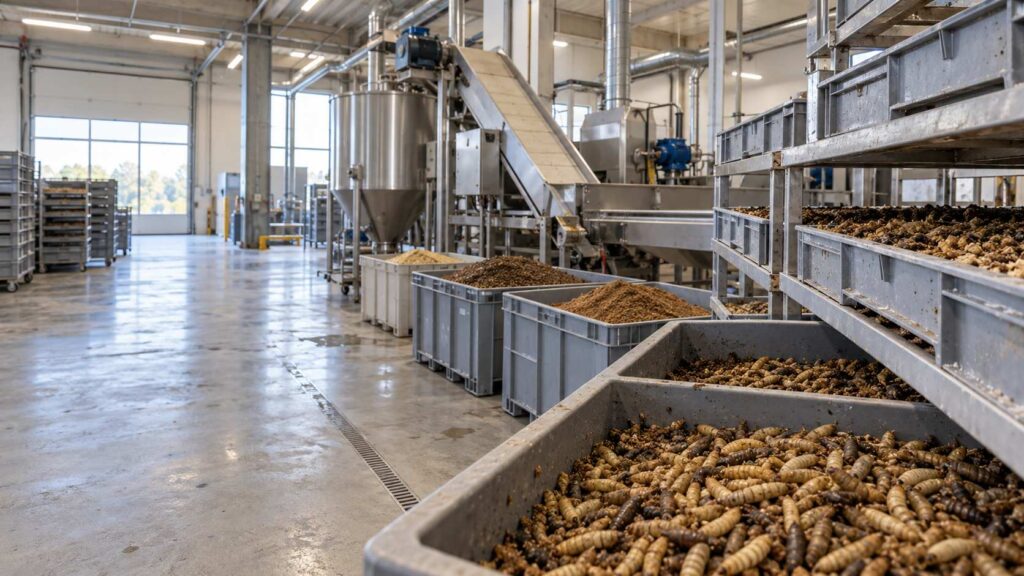
Volare 01 is located in a former newspaper printing facility in Pori, Finland. The approximately 10,000-square-meter site has been adapted for industrial insect production and ingredient processing.
The facility uses black soldier fly larvae (Hermetia illucens) to convert locally sourced food-industry side streams into insect biomass, which is subsequently processed into protein and oil products. Its production model combines biological conversion with automated handling and industrial processing.
Volare officially celebrated the opening of the facility on June 25, 2026, when commercial-scale production was still being prepared. The October announcements provide further information about project completion, financing, customer commitments, and plans to increase output.
This timeline matters because the facility’s opening ceremony, construction completion, and achievement of full production capacity are separate milestones.
The company reports that Volare 01 is designed to operate with four employees per shift and represents an approximately 1,000-fold scale-up from its demonstration operation.
However, the announced annual capacity should be understood as a design target. Publicly available information does not yet establish that the facility has achieved sustained annual production of 5,000 metric tons of protein or 2,000 metric tons of oil.
Customer Agreements Support Industrial Expansion
Volare’s industrial expansion is supported by existing commercial relationships across aquaculture, pet food, and other ingredient markets.
The company has sold insect protein from demonstration-scale production since 2022, giving it experience with commercial customers before completing its first industrial facility.
Reported applications include pet food products and aquaculture feed, while existing offtake agreements include Skretting and an unnamed global chemical company.
These agreements are commercially relevant because insect ingredient producers must develop reliable downstream demand while increasing their production capacity.
For feed manufacturers and other industrial buyers, consistent product specifications, reliable delivery schedules, regulatory compliance, and competitive pricing are essential to long-term procurement decisions.
Securing customer commitments before full-scale production may help reduce market uncertainty during a factory’s ramp-up period. Nevertheless, offtake agreements do not necessarily establish that all contracted quantities have already been delivered.
The actual commercial performance of Volare 01 will depend on how quickly the facility reaches stable production and how effectively its output meets customer requirements.
€7.1 Million Funding Supports Second Factory Plans
The latest €7.1 million funding round represents another step in Volare’s expansion strategy.
The investment was raised through Springvest, with support from existing and new investors, including Maki.vc. The funding is intended to support the ramp-up of Volare 01 and preparations for additional production capacity.
The company is evaluating locations for a second industrial-scale facility, including opportunities in Europe and other regions.
In an interview with AgFunderNews, CEO Jarna Hyvönen indicated that the second factory could target approximately five times the protein production capacity of Volare 01, potentially reaching 20,000–30,000 metric tons annually.
That figure remains a proposed expansion target rather than confirmed operating capacity. The company has not announced a final location, construction timetable, or completed investment commitment for the second facility.
An important site-selection consideration will be reliable access to suitable food-industry side streams. The availability, regulatory eligibility, consistency, and transport requirements of these materials can influence the economics of industrial black soldier fly production.
IIR Analysis: Can Volare Improve Insect Protein Economics?
Volare’s latest development is significant because industrial insect protein production faces a challenge that extends beyond demonstrating technical feasibility: converting large-scale production capacity into commercially competitive and reliably delivered ingredients.
The company’s strategy emphasizes automation, efficient processing, controlled capital expenditure, and the use of local food-industry side streams. These elements address cost pressures that have complicated the expansion of insect protein production in Europe.
However, the €15 million capital expenditure budget cannot be interpreted as the facility’s unit production cost. A meaningful assessment requires information about capacity utilization, feedstock costs, energy consumption, labor, maintenance, depreciation, biological yields, and revenue from both protein and oil.
The relationship between production and demand is equally important. Industrial customers generally need consistent quality and dependable supply rather than theoretical factory capacity alone.
This makes Volare’s customer agreements particularly relevant. They provide evidence of commercial interest, but the next stage will test whether production volumes, ingredient specifications, and delivery performance can be maintained as operations increase.
The project also illustrates the importance of the wider black soldier fly supply chain. Locally available feedstocks must be converted into reliable industrial products, then tested, stored, and delivered to customers operating under different technical and regulatory requirements.
From IIR’s assessment, Volare’s competitive position will depend less on the announced size of its facility than on the combination of production efficiency, contracted demand, ingredient quality, and actual operating costs.
The company’s reported engineering and energy-efficiency advantages are worth monitoring, but independent operating data will be needed to determine whether these advantages translate into sustainable cost competitiveness at full scale.
A second facility could offer opportunities to replicate the production model. Yet replication will require more than copying equipment: each location must provide suitable feedstocks, energy infrastructure, qualified operations, and access to commercial markets.
What to Watch Next
The immediate milestone is the operational ramp-up of Volare 01.
Future disclosures on production volumes, facility utilization, processing costs, and customer deliveries would provide stronger evidence of commercial performance than design capacity alone.
The second factory will also be important to monitor. Its location, financing structure, planned capacity, and feedstock supply arrangements will help indicate whether Volare can reproduce its production model under different operating conditions.
Commercial agreements may offer another indicator of progress, particularly if the company announces additional long-term customers or expands ingredient sales into new geographic markets.
For Europe’s insect protein industry, the Volare development provides a relevant case study in industrial expansion supported by new financing and customer commitments.
Whether the model becomes a broader manufacturing success will depend on its ability to turn planned capacity into consistent, specification-compliant production at commercially competitive costs.