Independent intelligence for the global insect industryISSUE 01 · 2026
Cricket Meal Quality: Key Parameters, Testing and Buyer Red Flags
By IIR Editorial DeskOctober 25, 2026
Cricket meal quality depends on controlled rearing, processing hygiene, contaminant management and reliable batch testing. This guide explains key quality parameters, microbiological risks, oxidation, COA verification and warning signs commercial buyers should investigate.
A high protein percentage does not establish cricket meal quality. Commercial buyers also need to evaluate rearing inputs, processing controls, microbial hazards, chemical contaminants, storage stability and the reliability of batch-specific testing records.
By IIR Editorial Desk · October 25, 2026 · Buyer Guides
Cricket meal quality is a critical consideration for commercial buyers evaluating insect-derived protein ingredients for aquafeed, poultry feed, pet food, and other legally permitted applications. Although crude protein content is often the first specification presented by suppliers, it does not independently establish ingredient safety, nutritional consistency, or manufacturing reliability. The quality of cricket meal also depends on rearing inputs, processing conditions, microbiological controls, chemical contaminants, lipid stability, and the accuracy of batch documentation.
For feed manufacturers, ingredient importers, and procurement teams, quality assessment should extend beyond reviewing a favorable sample or a single Certificate of Analysis. Buyers need evidence that the supplier can control relevant hazards, produce consistent material, and identify the origin and testing history of each shipment. This guide examines the principal quality risks, explains how to interpret laboratory evidence, and identifies supplier warning signs that should be investigated before commercial approval.
1. What Defines Commercial Cricket Meal Quality?
Commercial cricket meal quality involves three connected requirements: ingredient safety, nutritional integrity, and batch consistency. Ingredient safety concerns the control of relevant biological, chemical, and physical hazards. Nutritional integrity describes whether the meal retains the characteristics required by the intended formulation, while batch consistency reflects the manufacturer’s ability to deliver repeatable results.
These requirements should be evaluated together. A cricket meal may meet its crude protein specification but contain excessive moisture, show evidence of lipid oxidation, or lack adequate microbiological documentation. Conversely, a product may pass selected safety tests while showing unexplained changes in amino acid composition or residual fat content.
A reliable cricket meal quality control program should therefore cover upstream material qualification, validated or otherwise appropriate processing controls, finished-product testing, storage conditions, and traceability. The scope of testing should reflect the ingredient’s actual risks and destination-market requirements rather than a generic list of laboratory parameters.
Commercial buyers should also distinguish a typical product specification from an actual batch result. A supplier’s average nutritional profile may be useful during initial evaluation, but shipment acceptance requires evidence that the identified lot meets the agreed purchasing criteria.
2. Rearing Inputs and Raw-Material Traceability
Cricket meal quality begins before harvesting. The cricket species, rearing inputs, environmental conditions, and handling practices can influence both the nutritional characteristics and safety profile of the biomass entering processing.
Commercial production may involve species such as Acheta domesticus or Gryllodes sigillatus. However, species identity should be verified because the legal status, composition, and production characteristics of different crickets are not necessarily interchangeable.
Rearing substrates deserve particular attention. A material suitable for insect growth is not automatically authorized or appropriate for commercial feed ingredient production. Suppliers should maintain procedures for qualifying feed inputs, evaluating relevant hazards, and documenting the origin of materials used during rearing.
Environmental controls also matter. Poorly managed humidity, accumulated residues, or inadequate handling practices can create conditions that increase contamination risks. Nevertheless, buyers should evaluate these issues through documented production controls rather than assume that every cricket farming system presents identical hazards.
A traceability system should connect harvested cricket biomass with the finished meal lot. This allows manufacturers to investigate abnormal test results, identify affected material, and implement corrective actions when necessary.
3. Processing Controls and Thermal Treatment
Processing is a major determinant of cricket meal quality. After harvesting, crickets generally undergo separation, stabilization, drying, milling, and packaging. Depending on the manufacturing system, additional treatment steps may be used to manage relevant hazards.
Thermal processing can contribute to microbial reduction, but its effectiveness depends on the actual time, temperature, product characteristics, and equipment conditions. Consequently, buyers should not assume that a product is microbiologically safe simply because it has been dried.
Drying and microbial inactivation are related but distinct objectives. Moisture reduction can improve storage stability, while an effective microbial reduction process must be demonstrated under the relevant operating conditions. A supplier claiming that a treatment controls a specific hazard should be able to explain how that control has been established.
Excessive or poorly controlled heating can also affect nutritional characteristics. For example, processing conditions may influence protein functionality and the availability of certain amino acids. Therefore, manufacturers need to balance safety objectives with the preservation of suitable ingredient characteristics.
Milling, screening, and post-processing handling introduce additional considerations. Equipment hygiene, foreign-material prevention, and protection against recontamination are important even when earlier treatment steps have been effective.
Buyers should request a practical explanation of the supplier’s processing controls, including how deviations are identified and managed. Detailed proprietary operating parameters may not always be disclosed, but credible evidence of an effective control system remains important.
4. Protein Integrity and Nutritional Consistency
Protein concentration is an important commercial specification, but it is not a complete indicator of cricket meal quality. The reported value depends on species, fat content, moisture, analytical methods, and the nitrogen-to-protein conversion factor used.
Crude protein is commonly estimated from nitrogen measurements. However, insect-derived materials contain nitrogen associated with compounds other than conventional protein, including chitin-related material. As a result, crude protein percentages require careful interpretation.
Buyers should examine whether the laboratory uses consistent methods and reporting conventions across batches. A change in the conversion factor or moisture basis can create apparent differences in protein content without a corresponding change in the underlying material.
Amino acid composition provides additional information. For formulation-sensitive applications, buyers may need to assess essential amino acids and, where available, relevant digestibility evidence. A high crude protein result does not independently demonstrate that all amino acids are nutritionally available to the target animal.
Unexpected variation in protein, fat, ash, or amino acid composition may indicate changes in biomass, processing, or product grade. Such differences should be investigated before assuming that the supplier has delivered equivalent material.
5. Moisture, Water Activity, and Storage Stability
Moisture is an important quality parameter because it influences storage behavior, handling characteristics, and the potential for deterioration. However, moisture content and water activity are not the same measurement.
Moisture content describes the amount of water present in a product. Water activity, by contrast, reflects the availability of water for relevant physical, chemical, and microbiological processes. Two products with similar moisture percentages may therefore have different storage characteristics.
Commercial buyers should establish suitable moisture requirements for the intended grade and packaging system. Where microbial stability or shelf-life performance is especially important, water activity may provide useful additional evidence.
Packaging and storage conditions should also be evaluated. Exposure to excessive humidity, unsuitable temperatures, or damaged packaging may affect product condition after manufacturing. Furthermore, extended transportation can introduce risks that are not fully represented by testing performed immediately after production.
Visible caking, unusual odor, or changes in powder flow may justify investigation. Nevertheless, sensory observations cannot replace laboratory testing, and an acceptable appearance does not establish microbiological safety.
Suppliers should provide appropriate storage instructions and support shelf-life claims with relevant evidence rather than relying solely on a generic expiration date.
6. Microbiological Testing and Manufacturing Hygiene
Cricket meal microbial testing is an important part of commercial quality assurance because insect rearing and processing involve biological raw materials and multiple handling stages.
Relevant microbiological hazards and indicators should be identified through the production process, intended use, and applicable regulatory requirements. Depending on the product and market, testing may include Salmonella, Enterobacteriaceae, total viable counts, or other specified organisms.
However, different tests serve different purposes. Indicator organisms may provide information about manufacturing hygiene, while testing for particular pathogens addresses more specific safety concerns. Buyers should not treat a favorable indicator result as proof that every relevant pathogen is absent.
Sampling is another important limitation. A negative result demonstrates that the organism was not detected in the tested sample under the method’s conditions; it does not establish absolute absence throughout a large production lot.
Effective manufacturing hygiene therefore requires preventive controls as well as finished-product testing. Cleaning procedures, equipment design, personnel practices, separation of processing areas, and post-treatment handling may all influence contamination risks.
A credible supplier should be able to explain its approach to relevant microbiological hazards, including the controls applied before testing and the procedures followed when results fail acceptance criteria.
7. Heavy Metals, Pesticides, and Chemical Contaminants
Cricket meal contaminants should be evaluated according to the production environment, rearing inputs, processing methods, and destination-market requirements.
Potential chemical concerns may include relevant heavy metals, pesticide residues, veterinary or other chemical residues where applicable, and contaminants introduced through unsuitable inputs or processing materials. However, the likelihood and significance of each hazard depend on the actual production system.
For example, the presence of a substance in the rearing environment does not automatically establish its concentration in the finished ingredient. Conversely, a supplier cannot assume that contaminants are absent simply because the crickets appear healthy or the finished powder looks clean.
A risk-based testing program should identify which substances require monitoring, which analytical methods are suitable, and which legal or contractual limits apply. Reports should specify the analytes tested, measured results, reporting units, and relevant detection or quantification limits.
Buyers should also distinguish nutritional mineral analysis from contaminant testing. Essential minerals and potentially harmful elements serve different evaluation purposes, even when both are measured through elemental analysis.
Statements such as “heavy-metal-free” or “pesticide-free” should be treated cautiously unless the supplier defines the substances tested and the analytical basis of the claim.
8. Fat Oxidation, Ash, and Physical Deterioration
Cricket meal can contain a meaningful lipid fraction, particularly when sold as a full-fat product. Consequently, lipid oxidation may affect storage stability and sensory characteristics.
Oxidative deterioration depends on fatty acid composition, processing conditions, oxygen exposure, temperature, packaging, and storage duration. Buyers should evaluate the relevance of oxidation testing according to the product grade and intended shelf life.
Peroxide value or other lipid oxidation indicators may be useful in selected circumstances. However, the methods and interpretation should be appropriate to the meal matrix. Results obtained from extracted oil should not automatically be treated as interchangeable with direct measurements of the finished meal.
Ash content is another useful indicator of composition and batch consistency. An unexpectedly high ash result may justify investigation of mineral content, raw-material differences, or contamination, but ash percentage alone cannot establish the cause.
Physical quality also matters. Unusual particles, inconsistent milling, foreign material, or unexpected changes in color and odor may signal processing or handling problems. Nevertheless, visual inspection should be used as a screening tool rather than a substitute for suitable analytical verification.
For recurring purchasing, trends in residual fat, ash, moisture, and physical characteristics can help identify changes that deserve additional investigation.
9. How to Verify a Cricket Meal Certificate of Analysis
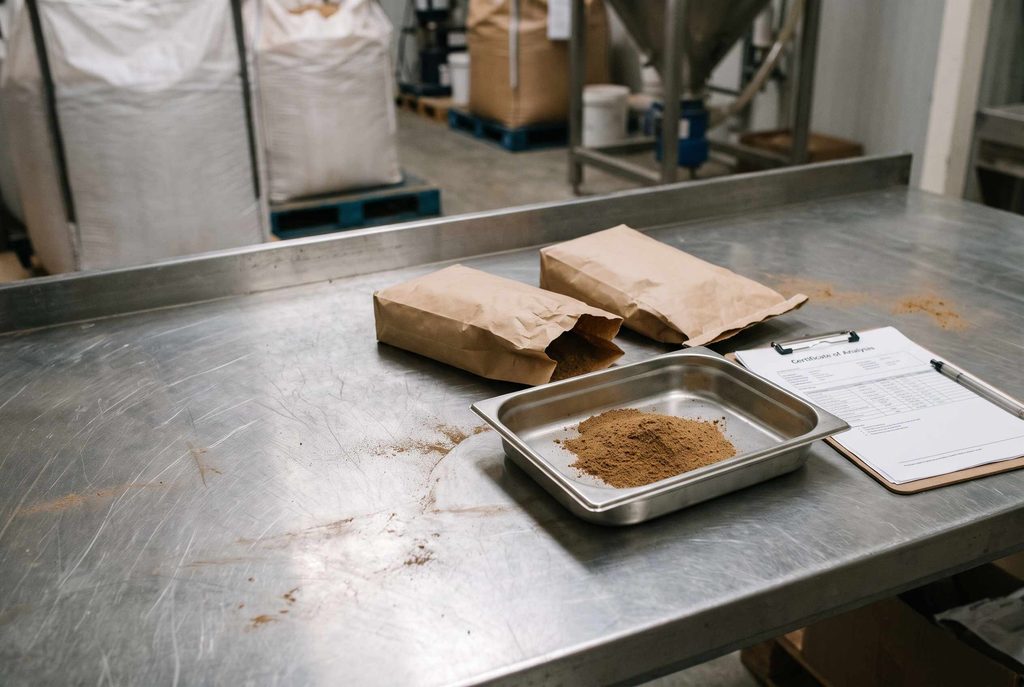
A cricket meal COA should provide evidence associated with an identifiable production batch. It should not be confused with a generic product specification or a laboratory report from unrelated material.
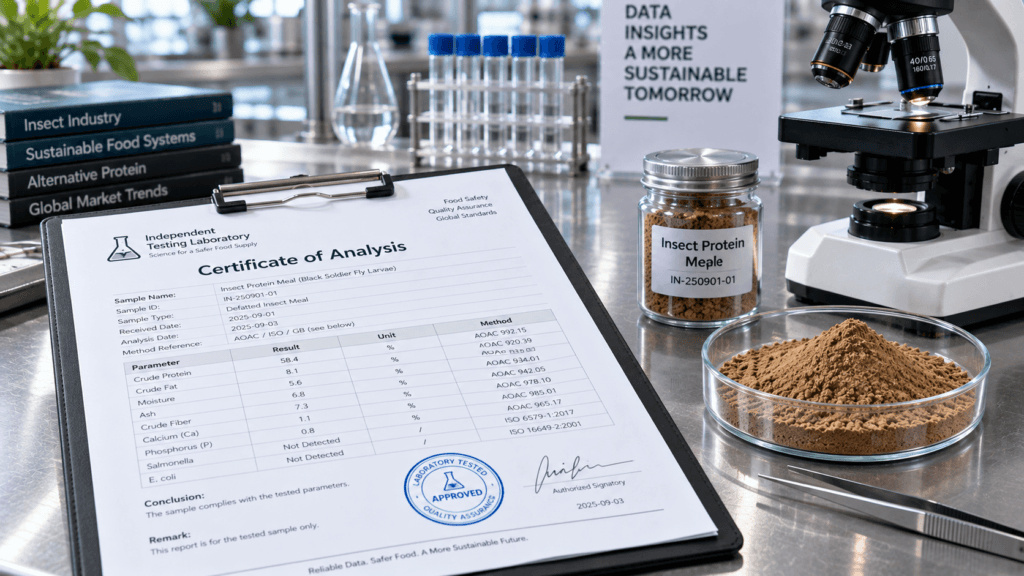
A useful Certificate of Analysis should include product identity, batch or lot number, relevant testing dates, measured parameters, reporting units, analytical methods, and actual results. Depending on the purchasing agreement, it may also identify the laboratory, sampling information, and acceptance criteria.
COA element
What commercial buyers should verify
Product identity
Correct cricket species and meal grade
Batch or lot number
Clear connection to the shipment
Production and testing dates
Relevance to the supplied material
Crude protein
Result, method, conversion factor, and reporting basis
Fat, moisture, and ash
Actual results against agreed limits
Microbiological testing
Relevant organisms, methods, and units
Chemical contaminants
Tested substances and reporting limits
Particle size
Compliance where required for processing
Laboratory information
Testing responsibility and traceability
Acceptance criteria
Clear basis for shipment release
Buyers should pay particular attention to documentation consistency. A report without a lot number may describe a product’s typical characteristics, but it offers limited assurance about a specific shipment. Similarly, a COA containing only “Pass” without sufficient analytical information may not satisfy the buyer’s verification requirements.
Repeatedly identical results across multiple unrelated batches may justify clarification, although identical values alone are not proof of inaccurate reporting. Rounding, reporting limits, and the supplier’s testing procedures should be considered before drawing conclusions.
Where necessary, independent testing can provide additional assurance during supplier qualification or a quality dispute. Nevertheless, a COA should support a broader quality-management system rather than function as its only evidence.
10. Batch Consistency and Supplier Quality Systems
Commercial buyers should evaluate cricket meal suppliers across multiple production lots rather than rely exclusively on one favorable sample.
Batch variation may arise from cricket species, rearing inputs, harvest stage, processing conditions, fat removal, and storage. Some variation is expected in biological ingredients, but unexplained changes outside agreed limits can affect formulation consistency and purchasing reliability.
Suppliers should maintain procedures for identifying lots, reviewing test results, managing nonconforming material, and implementing corrective actions. Where a deviation occurs, the manufacturer should be able to investigate the likely cause and determine whether other batches may be affected.
Historical testing data can help buyers identify changes in protein, fat, moisture, ash, microbiological indicators, and other relevant parameters. However, the usefulness of trend analysis depends on consistent analytical methods and clearly defined product grades.
Supplier qualification should also consider complaint handling, record retention, recall procedures, and the ability to provide traceable documentation. These operational capabilities are particularly important for recurring industrial orders and international supply chains.
11. Buyer Red Flags That Require Investigation
Quality warning signs should be assessed according to their severity and supporting evidence. Some require clarification, while others may justify holding or rejecting a shipment.
Buyer red flag
Potential concern
Recommended action
Musty or unexpected odor
Storage deterioration or contamination
Hold and investigate
Visible mold or abnormal clumping
Possible moisture-related deterioration
Segregate affected material and assess safety
Excessive moisture
Storage and stability concerns
Compare with agreed limits
Failed pathogen testing
Potential food or feed safety issue
Do not release; follow applicable procedures
Missing microbiological documentation
Incomplete verification
Request relevant batch evidence
Unexplained protein variation
Product or analytical inconsistency
Check method, basis, and production records
Unexpectedly high ash
Composition or contamination concern
Investigate mineral and processing data
Unexplained changes in fat content
Grade or process variation
Confirm product identity and processing
Foreign material
Physical contamination
Hold and investigate affected lots
COA without a batch number
Weak traceability
Request lot-specific documentation
Old report presented as current COA
Actual shipment may not be represented
Request current batch results
Missing substrate controls
Unclear upstream hazard management
Review rearing input qualification
Unsupported shelf-life claim
Inadequate stability evidence
Request supporting information
Repeated unexplained document revisions
Documentation reliability concerns
Escalate supplier review
A red flag is not automatically evidence of deliberate misconduct. However, buyers should not release material that fails applicable safety requirements or binding acceptance criteria without an appropriate documented resolution.
12. A Practical Cricket Meal Quality Approval Workflow
A structured approval process helps commercial buyers evaluate suppliers consistently and reduces dependence on marketing claims or isolated laboratory results.
Step 1 — Confirm product identity. Verify the cricket species, full-fat or defatted grade, processing method, and intended application.
Step 2 — Establish acceptance criteria. Define the required nutritional parameters, microbiological limits, contaminant controls, moisture requirements, and physical characteristics.
Step 3 — Review upstream and manufacturing controls. Assess rearing input qualification, processing hygiene, thermal treatment, traceability, and storage procedures.
Step 4 — Verify laboratory methods. Confirm that testing methods, reporting units, conversion factors, and sampling procedures are suitable for the purchasing decision.
Step 5 — Review batch-specific documentation. Match the COA and other relevant records to the actual material being supplied.
Step 6 — Evaluate representative samples. Conduct appropriate physical inspection and arrange independent testing when justified by risk or purchasing requirements.
Step 7 — Make a documented release decision. Approve, hold, or reject the lot according to applicable requirements and agreed acceptance criteria.
Step 8 — Monitor ongoing supplier performance. Review subsequent batches, investigate deviations, and verify corrective actions before expanding purchasing commitments.
This approach allows buyers to establish consistent quality expectations while recognizing that testing programs must be adapted to the specific ingredient and market.
IIR Analysis
The central challenge in evaluating cricket meal quality is distinguishing favorable nutritional specifications from evidence of effective hazard control and manufacturing consistency. A high crude protein percentage may support commercial interest, but it cannot independently establish microbial safety, contaminant compliance, storage stability, or reliable batch traceability.
For industrial buyers, the most useful quality framework combines upstream input controls, appropriate processing, risk-based testing, COA verification, and ongoing supplier monitoring. Each element addresses a different source of uncertainty, and none should be treated as a complete substitute for the others.
The distinction between initial product approval and recurring supply performance is particularly important. One satisfactory sample does not demonstrate that subsequent production lots will meet the same requirements. Therefore, historical testing, documented corrective actions, and consistent manufacturing procedures should form part of long-term procurement decisions.
As commercial cricket ingredient production develops, suppliers capable of providing transparent documentation and repeatable quality may be better positioned to serve industrial buyers. Ultimately, dependable procurement requires safe, traceable, application-appropriate cricket meal that consistently meets agreed technical and regulatory requirements.
Disclaimer: This article is for informational purposes only and does not constitute business, legal or investment advice. Always consult primary sources and qualified professionals.